A useful raised bed size is not just a footprint such as 4 by 8 feet. Width should come from how many sides you can reach, length should fit the site and work route, and wall height should be separated from the total rootable depth available to plants. Beds on usable soil can let roots continue below the frame, while beds on pavement or another hard surface need enough contained growing depth for the crops you plan to grow. Calculate the soil volume and check path access before you commit to the final dimensions.
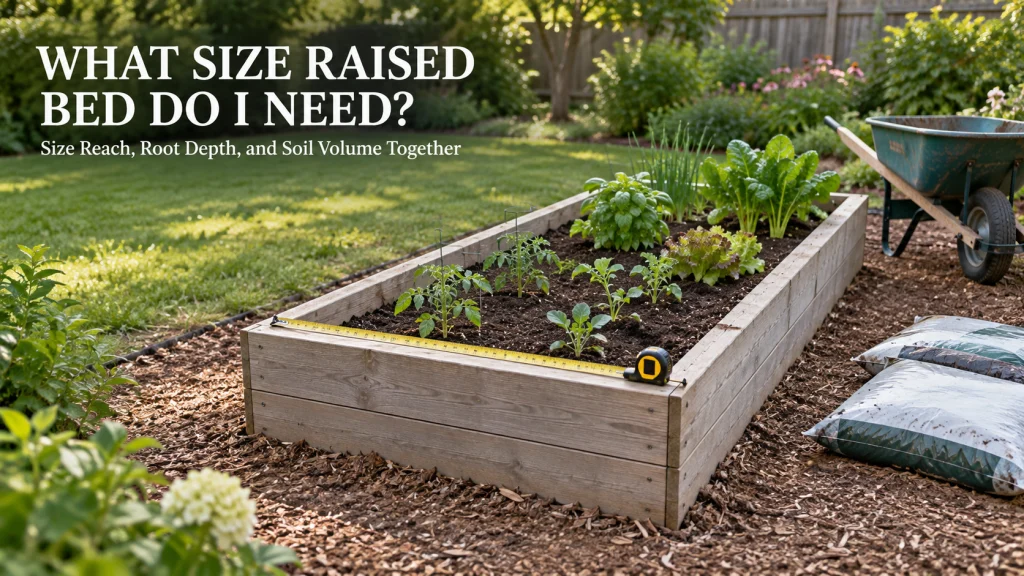
Start with where the bed can actually sit
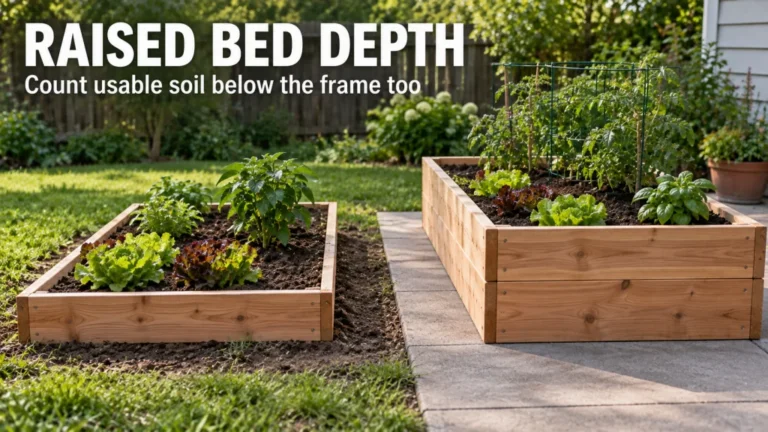
Two beds can both be sold as 4 by 8 feet and still be very different answers to “what size raised bed do I need?” Put one low open-bottom bed where both long sides are reachable, then put a taller bed of the same footprint against a fence on a hard surface. The first may offer comfortable center access and additional rootable soil below the frame, while the second may be harder to reach across and may depend entirely on the soil contained inside it. The 4 by 8 label describes the rectangle, but it does not describe how the bed will work.
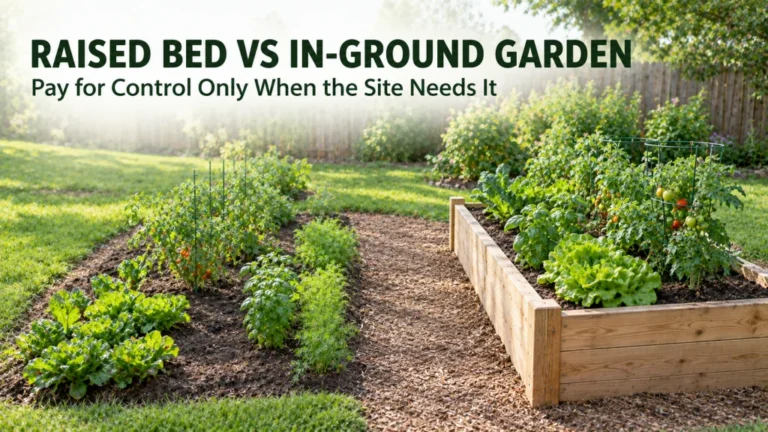
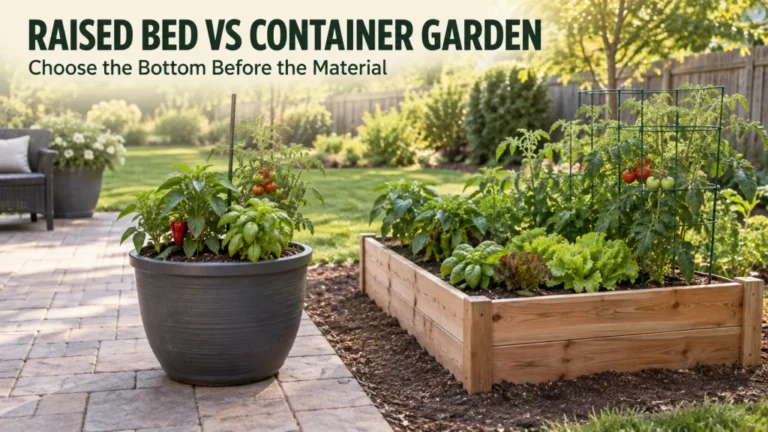
Start with where the bed can actually sit, then separate the sizing decision into three jobs: width controls reach, length controls fit and movement, and height affects working position plus the amount of growing mix you must supply. Check sunlight, drainage, water access, the surface under the bed, and the space needed to work around it before choosing dimensions. The broader raised bed gardening setup guide is useful when placement and general setup are still undecided, while raised beds and container growing guidance helps when you are still deciding which growing system fits the space. Set those constraints first, then let each measurement solve a specific problem.
| Dimension | Question to answer first | What changes the decision |
|---|---|---|
| Width | How many sides can I comfortably reach from? | Fence or wall placement, personal reach, bed height, mobility |
| Length | How long can the bed be without disrupting movement? | Site shape, turning space, hose route, tool access, crop workflow |
| Height | How much contained depth and working height do I actually need? | Underlying soil, crop rooting needs, bending preference, fill volume |
Use that worksheet before comparing frames because each dimension should answer a different practical question. It prevents a familiar mistake: choosing a footprint first, then discovering that the center is unreachable or the fill bill is much larger than expected. If one dimension fails the site test, revise that dimension before changing the others. A slightly smaller footprint that works from every side is usually more useful than extra growing area you cannot comfortably maintain.

This 4-inch mechanical measuring wheel reads in feet and inches and measures up to 9,999 feet. The telescoping handle extends up to 40 inches, and a one-key reset simplifies repeated site measurements. It is useful for checking the overall footprint, path length, and available garden area before a raised-bed layout is fixed.
Check On AmazonIf you click this link and buy, we earn a commission at no additional cost to you.
Choose width from one-sided or two-sided access
Width is the dimension most directly limited by your body and the way the bed is placed. Iowa State University Extension recommends about 1.5 to 2 feet for a bed reached from only one side, such as one placed against a fence or building, and about 3 to 4 feet when both long sides are accessible. Those numbers are useful starting points, not a command to build the widest bed in the range. A shorter gardener, a tall wall, dense mature plants, or limited mobility can all make a narrower bed more practical.
Before buying or building, mark the proposed edges on the ground and test the reach from the position you will actually use. Reach toward the center without stepping into the future growing area, leaning on the frame, or twisting into an uncomfortable position. If the farthest planting spot feels marginal when the bed is empty, it will usually feel worse when foliage fills the space. For a deeper look at this single variable, use the guide to choosing a raised bed width you can actually reach.
| Access pattern | Where you stand | Farthest point you must reach | Useful starting range |
|---|---|---|---|
| One long side accessible | Only along the open edge | The full bed width, all the way to the blocked edge | About 1.5 to 2 feet |
| Both long sides accessible | Along either long edge | Only to the centerline from either side | About 3 to 4 feet |
A 4-foot width works well only when the access pattern and your reach support it. If one side will be blocked, the same nominal width can turn an otherwise useful bed into a maintenance problem. Test the widest proposed bed before treating a common dimension as your target. The goal is full access to the planting surface, not matching a familiar number.

This 25-foot tape measure uses fraction markings and a self-locking retractable blade. Model CMHT37225 gives enough reach for common residential raised-bed widths while remaining practical for spot checks. Use it to mark proposed bed edges and confirm that center reach and surrounding clearance match the planned width.
Check On AmazonIf you click this link and buy, we earn a commission at no additional cost to you.
Choose length from the site and your walk-around workflow
Length is more flexible than width because it does not usually determine whether you can reach the center. Iowa State notes that bed length can be set by space, personal preference, and convenience, which is a better way to think about it than treating 8 feet as a default. A long bed can create plenty of growing area, but it can also force you to walk around the entire frame every time you need to reach the other side. In a narrow yard, two shorter beds with a pass-through may work better than one uninterrupted run.
Walk the proposed route before you settle on the number. Carry the watering can, hose, harvest basket, or other tools you expect to use and notice where you need to turn, cross, kneel, or set something down. Also check whether a long frame would block a gate, downspout, utility access point, or a natural route across the yard. The best length is the one that adds useful planting area without making ordinary maintenance take a detour every time.

This 250-foot roll uses #18 braided nylon in fluorescent orange for high visibility outdoors. The braided line resists unraveling after cutting and works as a layout string for gardening or construction. Stretch it along a proposed bed run to see how length affects gates, crossings, hose routes, and walk-around access.
Check On AmazonIf you click this link and buy, we earn a commission at no additional cost to you.
Choose wall height from rootable depth and working preference
Wall height and rootable depth are related, but they are not always the same measurement. University of Maryland Extension explains that when a raised bed sits over usable ground, roots can grow through the bed soil and into the soil below. That means a relatively low open-bottom frame can still provide more root space than its wall height suggests, assuming the underlying soil is suitable and not blocked by a hard layer. A taller wall can still be worthwhile when reducing bending or creating a more comfortable working position is part of the goal.
The trade-off is that every extra inch of contained height increases the amount of material needed to fill the bed. Instead of assuming taller is automatically better, separate two questions: how much rooting space the crop needs, and how high you want the working surface to be. If your main concern is crop rooting, the detailed guide to raised bed depth and usable root zone handles that variable more closely. If comfort is driving the choice, mock up the proposed wall height with a chair, box, or temporary board and test how it feels to weed and harvest from that level.

This foldable garden kneeler flips between a padded kneeling surface and a raised seat and includes two tool pouches. The frame is rated for up to 330 pounds, and the seat height is 17.32 inches. It can help you compare how different working heights feel before choosing a taller raised-bed wall for comfort.
Check On AmazonIf you click this link and buy, we earn a commission at no additional cost to you.
Treat hard-surface beds as a deeper closed-root-zone case
A raised bed on concrete, pavement, or another hard surface is a different sizing problem from an open-bottom bed over healthy soil. The plants cannot extend their roots into the ground below, so the contained mix becomes the entire practical root zone. University of Maryland Extension gives crop-specific guidance for this situation, including at least 8 inches for leafy greens, beans, and cucumbers, and 12 to 24 inches for peppers, tomatoes, and squash. That is a good example of why the same wall height can be adequate in one location and restrictive in another.
Hard surfaces also change water behavior and heat exposure, so depth is not the only detail to check. Maryland notes that these beds can dry faster because roots cannot draw moisture from soil below, and surrounding hardscape can add reflected heat. Make sure the design can drain freely and that the fill depth matches the crops rather than a generic kit height. If the site is paved, size the bed as a contained growing system first and a rectangle second.
Key point: A 10-inch wall over good open soil and a 10-inch wall over concrete do not provide the same effective root environment. The surface under the bed changes what the height actually means.

This 12.7-gallon resin raised planter is designed for outdoor herb and garden use and includes a self-watering gauge and drainage plug. Its contained planter format is appropriate for patios or other hard surfaces where roots cannot extend into native soil. The drainage feature makes it a useful reference point when thinking about a closed root zone on pavement.
Check On AmazonIf you click this link and buy, we earn a commission at no additional cost to you.
Calculate total fill volume before locking the size
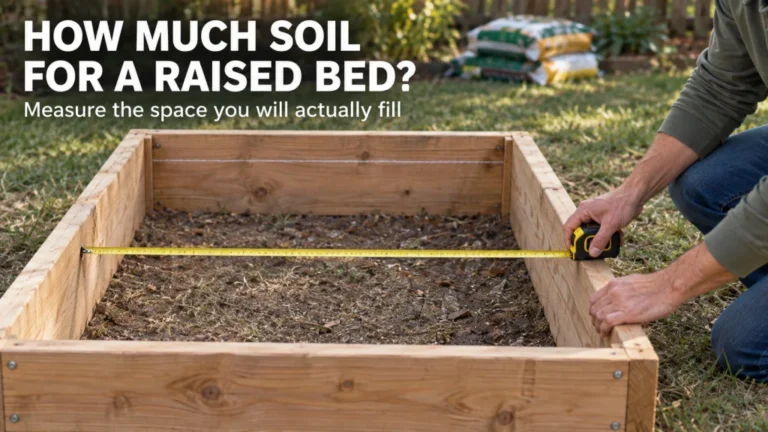
Soil volume is where a small change in raised garden bed dimensions can become a large change in cost and workload. The basic calculation is length multiplied by width multiplied by fill depth, with all three measurements expressed in feet. A bed with 4-foot by 8-foot inside dimensions filled 1 foot deep holds 32 cubic feet, which is about 1.19 cubic yards. Double the fill depth and you double the volume, even though the footprint has not changed at all.
For purchase planning, I would calculate from the inside dimensions of the frame because that is the space the growing mix actually occupies. Then compare the result with the volume sold by your local bulk supplier or printed on the bag you intend to use, rather than assuming a fixed bag count. This is also the point where a taller bed may stop looking like a free comfort upgrade, because extra height means more material to move, fill, and maintain. Do the math before ordering the frame, not after it is sitting empty in the yard.
| Example inside size | Fill depth | Calculated volume |
|---|---|---|
| 4 ft x 8 ft | 6 in | 16 cu ft |
| 4 ft x 8 ft | 12 in | 32 cu ft |
| 4 ft x 8 ft | 18 in | 48 cu ft |
The pattern matters more than the example because volume rises with every dimension you add. Once width, length, or depth changes, recalculate instead of carrying over a soil estimate from another bed. Also check the actual fill line if you plan to leave room for mulch rather than filling to the top edge. A quick volume check can change the size decision before you commit to moving more material than the garden needs.

This folding wood rule extends to 6 feet 6 inches and includes both US and metric measurements. Its rigid folding sections are useful for checking inside length, width, and fill depth without relying on nominal frame dimensions. Those measurements can be converted to feet before multiplying length by width by depth for a soil-volume estimate.
Check On AmazonIf you click this link and buy, we earn a commission at no additional cost to you.
Check path and tool access around multiple beds
Several beds can fit on paper and still fail as a working layout if the paths are treated as leftover space. Iowa State suggests about 3 feet between adjacent beds when room is needed for equipment such as a wheelbarrow or cart, while University of Delaware gives a wider example where more navigation space is useful. Those figures should prompt a tool-access check, not replace one. Measure the width of the cart, wheelbarrow, kneeling position, or mobility aid you will actually use, then add the turning and hand clearance needed to operate it comfortably.
Also think about what happens when plants are mature rather than when the beds are empty. Tomato cages, sprawling squash, row covers, hoses, and a bucket set beside the frame can all consume path space that looked generous during layout. If two large beds leave only a cramped corridor, smaller beds with better access may produce a more manageable garden even with slightly less planting area. The goal is not to maximize framed square footage; it is to keep every bed reachable for watering, weeding, harvesting, and adding soil or compost.

This 4-cubic-foot poly dump cart has a powder-coated steel frame, four 10-inch pneumatic tires, and a 600-pound maximum load capacity. Its quick-release dump bed is designed for yard and garden hauling. Measuring the cart width and turning room against planned paths helps confirm whether the layout leaves enough access for moving soil and compost.
Check On AmazonIf you click this link and buy, we earn a commission at no additional cost to you.
Use exact product dimensions only after your requirements are fixed
A label such as 4 by 8 tells you very little about whether a particular frame fits your site. Wall thickness, corner hardware, exterior dimensions, interior planting dimensions, bracing, and the stated height can all change the space the bed occupies or the soil volume it holds. Once you know your maximum width, preferred length, required root zone, and path clearance, compare those requirements with the exact manufacturer drawing or specification for the frame you are considering. Do not rely on a product photo or the word “standard” to settle a measurement that affects fit.
This is where general sizing and exact product data should stay separate. Use the general rules in this article to decide what the bed needs to do, then compare those requirements with model-level measurements rather than generic footprint advice. If a kit is slightly too wide for your reach or leaves too little path clearance, a familiar nominal size does not make it a good fit. Requirements first, exact dimensions second, purchase last.
Need exact 4 by 8 measurements? Use the current 4 by 8 raised bed dimension data after you have fixed your required width, height, path clearance, and usable planting space. That page is for checking current model dimensions, not for deciding what size your garden needs in the first place.
Key point: Nominal size is a label. Site fit depends on the exact outside footprint, usable inside space, wall height, access around the frame, and the volume you plan to fill.

This Land Guard galvanized steel raised bed is the 8 x 4 x 2-foot variant with a bottomless design. The 24-inch wall height creates a deeper contained fill than a 1-foot model, and reinforced crossbars help the frame hold its shape. Use the exact model dimensions only after your reach, path clearance, and fill-volume requirements are already fixed.
Check On AmazonIf you click this link and buy, we earn a commission at no additional cost to you.
Final thoughts: size the working system, not the nominal rectangle
The right raised bed size is the combination you can reach, move around, fill, and maintain without fighting the layout. Start with access to the site, set width from your real reach, set length from the route around the bed, and set height from the root zone plus your preferred working position. Then calculate fill volume and check the surrounding paths before committing to the frame. That sequence is more reliable than beginning with a standard 4 by 8 label and trying to force the yard to accommodate it.
If two beds have the same footprint but one sits on open soil and the other sits on pavement, they are not the same growing system. If two beds have the same height but one is accessible from both sides and the other is against a fence, they are not the same maintenance problem either. Size is useful only when it describes how the bed works in the actual garden. Choose the dimensions that solve those conditions, then verify the exact frame or build measurements before buying materials.

This 50-pack uses fluorescent orange flags sized 4 x 5 x 15 inches for lawn, irrigation, landscaping, and survey marking. The bright markers make proposed corners and path boundaries visible before any frame is installed. Use them to walk the full layout and confirm access, turning space, and bed placement before buying materials.
Check On AmazonIf you click this link and buy, we earn a commission at no additional cost to you.
FAQs
🌱 What size raised garden bed should a beginner start with?
Start with a bed narrow enough to reach every planting spot without stepping into it and short enough that walking around it is easy. A two-sided bed often falls in the 3 to 4 foot width range, but your reach and site access should decide the final number.
📏 Is 4 feet too wide for a raised bed?
Four feet can work when both long sides are accessible and you can comfortably reach the center from each side. Against a wall or fence, a narrower bed around 1.5 to 2 feet is usually more practical.
🪴 How deep should a raised bed be on concrete?
Depth should match the crops because roots cannot continue into soil below the bed. University of Maryland Extension lists at least 8 inches for leafy greens, beans, and cucumbers, and 12 to 24 inches for peppers, tomatoes, and squash on hard surfaces.
🛒 How much space should I leave between raised beds?
Leave enough room for the person and equipment that will actually use the path. About 3 feet is a useful starting point for a wheelbarrow or cart, but wider access may be needed for turning, mature plants, or mobility equipment.
🧮 How do I calculate soil for a raised bed?
Multiply inside length by inside width by fill depth, with all measurements in feet, to get cubic feet. Divide cubic feet by 27 if you need cubic yards, then compare that amount with the package or bulk volume you plan to buy.
🚪 Is one long raised bed better than two shorter beds?
Not automatically. Two shorter beds can create a useful crossing point and easier tool access, while one long bed may provide more continuous planting space if it does not block movement.
References and sources
- Iowa State University Extension raised bed guidance: Supports width by access pattern, flexible length, path planning, height trade-offs, and soil-volume calculation.
- University of Maryland Extension raised bed guidance: Supports the distinction between beds over usable soil and beds on hard surfaces, including crop-dependent contained depth.
- University of Delaware Cooperative Extension raised bed guidance: Supports access, common residential dimensions, underlying-site considerations, and path planning.