Good garden watering starts with the soil and root zone, not with a fixed calendar or a piece of equipment. The useful questions are whether water is actually needed, how much moisture the root zone needs, and which delivery method can apply it without creating runoff, overspray, or unnecessary work. Soil type, recent rain, plant stage, weather, and the layout of the garden can all change the answer. Once those conditions are clear, hand watering, sprinklers, soaker hoses, drip irrigation, timers, and stored rainwater become tools for a defined job rather than competing shortcuts.
The watering decision starts before the faucet is turned on
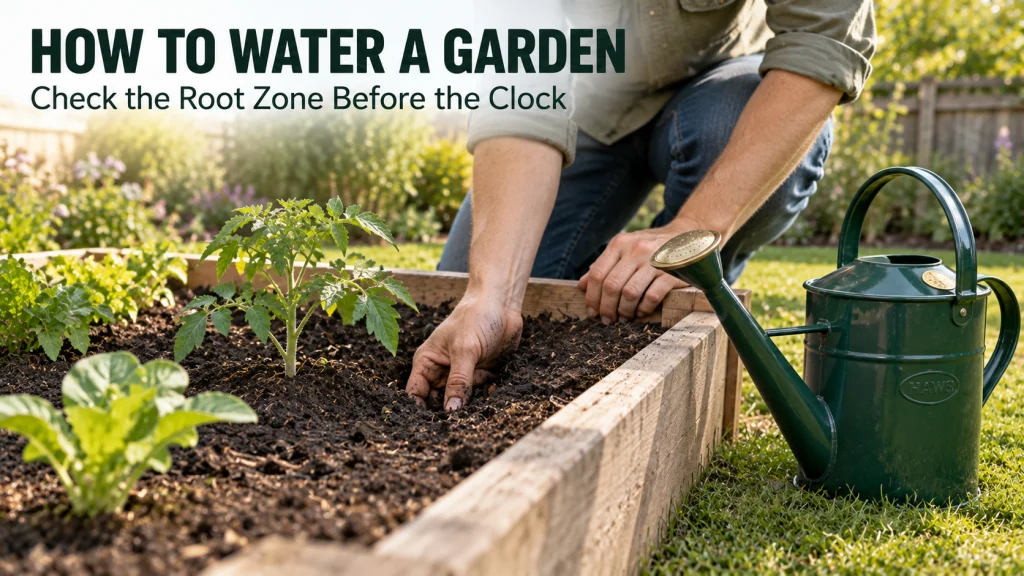
Learning how to water a garden is less about memorizing a schedule and more about matching water to the soil that roots can actually reach. Two gardens can receive the same total amount of water and still respond differently if one gets a slow soaking into the root zone while the other gets frequent surface wetting that dries quickly. A sandy bed, a heavy soil, a newly planted row, and an established border do not lose and hold moisture in the same way. That is why the first useful check is the garden itself, not the setting on a timer.
The simplest system that reliably reaches the root zone is usually the place to start. In a small bed, that may be a hose or watering can used with enough patience to wet the soil deeply. In a larger or repeatedly thirsty area, a sprinkler, soaker hose, or drip line may reduce labor, but only if its coverage matches the planting and its runtime matches the soil. If you are still planning the site itself, a broader garden-starting framework can help settle light, space, access, and layout before irrigation equipment becomes part of the decision.

This battery-free meter is made for indoor and outdoor soil-moisture checks. Its single-probe format provides a direct reading from the soil without requiring batteries. It helps check moisture below the surface before watering begins.
Check On AmazonIf you click this link and buy, we earn a commission at no additional cost to you.
Separate whether the garden needs water from how the water will be delivered
Need and delivery are two different decisions. A dry root zone may need water whether that water arrives from a watering can, a hose, a sprinkler, or a drip line, while a moist root zone may need none of them. Equipment cannot tell you that the soil is dry unless the system includes a reliable moisture-based control and it is set up correctly. Even then, the physical condition of the planting area still matters because roots, soil texture, slope, mulch, and recent rain affect what the sensor reading means.
Choose the delivery method only after you know the target area and the job it has to do. Precision matters most around containers, transplants, isolated plants, and mixed beds where neighboring plants may not need the same treatment. Broad coverage can make sense where the target itself is broad and reasonably uniform, while low-volume lines make more sense when repeated root-zone delivery is the main problem. The comparison below is a starting point, not a universal ranking, because the best fit changes with the garden.
| Watering method | Useful when | Main trade-off to check |
|---|---|---|
| Hand watering | The area is small, irregular, or needs plant-by-plant attention | Coverage depends on the person watering, so shallow or missed spots are easy to create |
| Sprinkler | A broad planting area can be covered evenly from above | Wind, overspray, foliage wetting, and runoff can reduce useful delivery |
| Soaker hose | A bed needs slow delivery along a planted run without overhead spray | Output can vary along the hose and with pressure, slope, and run length |
| Drip irrigation | Repeated root-zone watering needs to be targeted and repeatable | Layout, filtration, emitter placement, maintenance, and changing plant size all matter |
| Timer | A known watering routine needs consistent start and stop control | Automation can repeat a bad runtime just as consistently as a good one |
| Main condition | Start with | Check before changing methods |
|---|---|---|
| Small or irregular area | Hand watering | Root-zone coverage is complete |
| Broad, uniform area | Sprinkler | Coverage is even without major overspray |
| Continuous planted row or bed | Soaker hose | Wetting stays reasonably even along the run |
| Individual plants or zones | Drip irrigation | Emitter placement and pressure fit the layout |
| Method works but timing is easy to miss | Add a timer | Runtime and skip conditions are already known |
Move through this decision path from the simplest method to added complexity only when scale, coverage, consistency, or workload creates a real need. If the current method reaches the root zone reliably, there is no reason to upgrade it.
The practical takeaway is to match the geometry of the water to the geometry of the roots and planting area. If the method routinely waters pavement, empty soil, or foliage while the root zone stays unevenly moist, the problem is not solved just because water came out. Start with the smallest reliable method, then add complexity only when labor, scale, or consistency creates a real reason to do so. That keeps garden irrigation focused on plant need instead of equipment features.

This 5/8-inch by 50-foot garden hose is designed to stay lightweight and flexible in outdoor use. Its leak-free connections support hand watering or connection to other hose-end devices. It works as a basic water-delivery tool after the garden moisture check has already established that watering is needed.
Check On AmazonIf you click this link and buy, we earn a commission at no additional cost to you.
Use soil moisture and recent rain before following a calendar
A calendar can remind you to check the garden, but it should not decide that the garden is dry. Soil moisture, weather, soil type, and plant condition matter because those variables determine how quickly the root zone loses usable water. A brief shower may wet the surface without recharging deeper soil, while a soaking rain may make supplemental irrigation unnecessary. Push past the appearance of the surface and check the soil where active roots are actually using water.
The depth of that check depends on what you are growing and how established it is, so a single finger test cannot represent every plant in every bed. For ordinary garden beds, checking below the dry surface is more useful than judging by color alone, and digging a small inspection hole after watering can show how far moisture actually traveled. Clay-rich soil may accept water slowly and stay wet longer, while sandy soil can drain faster and need more frequent checks. If your main question is the interval between checks and waterings, the dedicated guide to how often to water a garden goes deeper into frequency without turning it into a rigid schedule.

This acrylic rain gauge measures up to 5 inches of rainfall and uses a magnifying design for easier reading. It provides a simple record of recent rain before supplemental watering is added. The gauge complements a soil-moisture check by showing how much rain reached the measurement site.
Check On AmazonIf you click this link and buy, we earn a commission at no additional cost to you.
Separate weekly water amount from watering frequency
Amount and frequency are easy to blur together, but they answer different questions. A broad garden benchmark of around an inch of combined rainfall and irrigation can be useful as a starting reference for many established garden situations, yet that does not mean every garden should receive the same amount in the same number of sessions. Weather, soil texture, root depth, plant stage, and drainage can all move the real requirement. The better use of a benchmark is to estimate the scale of the water need, then verify how deeply that water actually wets your soil.
Frequent light watering can leave most of the moisture near the surface, where it disappears quickly and may encourage shallow rooting. A slower, deeper application is generally more useful when the soil can absorb it without ponding or running away from the bed. Heavy soil or a slope may need watering broken into shorter cycles with soak time between them so the same total amount can enter the soil instead of leaving the target area. That is why a weekly total does not automatically tell you how many times to water or how long to run a particular device.
| Condition | Amount implication | Frequency implication |
|---|---|---|
| Fast-draining soil | A large single application may move too deep | Check moisture more often |
| Slow-infiltrating soil | Apply the total more slowly or in split cycles | Intervals may be longer after deep wetting |
| New seedlings or transplants | Wet the smaller active root zone | Check that smaller zone more often |
| Hot, dry, or windy weather | Water loss can increase | Shorten the interval between checks |
| Recent soaking rain | Supplemental water may be unnecessary | Delay watering until the root zone needs it |
Keep amount and frequency as separate decisions. Adjust the variable that changed, then verify the result in the soil instead of turning either column into a fixed schedule.

This hose-end meter measures gallon usage from an outdoor garden hose. It provides a direct way to record how much water passes through the hose during a watering session. That makes it useful for separating delivery amount from watering frequency.
Check On AmazonIf you click this link and buy, we earn a commission at no additional cost to you.
Choose hand watering when precision and small scale beat automation
Hand watering is not primitive just because automated options exist. It works well when the garden is small, access is easy, and plants need different amounts or need to be observed closely while you water. A hose with controlled flow or a watering can can place water at the base of individual plants without soaking a whole bed that does not need it. The trade-off is that people tend to move faster than water can infiltrate, so a pass that feels thorough may only wet the top layer.
Use hand watering deliberately rather than waving a spray over the bed until the surface looks dark. Apply water slowly enough that it enters the soil, then check a few representative spots to see whether moisture reached the intended root zone. For a larger area, hose handling, reach, kinking, and the route from the faucet can become more important than the watering attachment itself, which is where a focused garden hose guide becomes useful. If hand watering still reaches every target without becoming a recurring chore, there is no requirement to replace it with a more complicated system.

This 2-gallon watering can is designed for indoor and outdoor plants. Its capacity makes it a manual delivery option for small watering jobs. It fits sections where plant-by-plant placement matters more than broad automated coverage.
Check On AmazonIf you click this link and buy, we earn a commission at no additional cost to you.
Use a sprinkler only when its coverage pattern matches the target area
A sprinkler is useful when the target is broad enough that overhead coverage is actually an advantage. The important question is not whether the sprinkler throws water far, but whether it distributes water reasonably evenly across the planted area without spending much of the pattern on pavement, fences, bare ground, or neighboring spaces. Wind can distort the pattern, and fast application on compacted soil, slopes, or slow-draining areas can create runoff before the root zone is adequately wet. A sprinkler therefore needs calibration in the place where it will be used, not just a rated coverage shape on a package.
Straight-sided containers placed across the pattern can reveal whether one part of the bed receives much more water than another. Once you know where the dry and wet zones are, repositioning the sprinkler or splitting the watering into separate placements may be more effective than simply extending runtime. Morning use can also reduce the period that foliage remains wet compared with watering that leaves leaves damp for a long stretch. For help matching spray shape and placement to a garden area, use the more specific garden sprinkler guide.

This weighted oscillating sprinkler uses 16 precision nozzles and an adjustable range for broad overhead watering. Its turbo-drive design and quick-connect bundle support repeatable setup in a lawn or garden area. The adjustable pattern helps match the sprinkler footprint to the planted target instead of watering beyond it.
Check On AmazonIf you click this link and buy, we earn a commission at no additional cost to you.
Use soaker hose or drip when root-zone delivery solves recurring labor or overspray
Soaker hose and drip irrigation both move the watering job closer to the soil surface, but they do not behave the same way. A soaker hose releases water along a porous run, which can be simple for beds and rows, while drip irrigation uses tubing and emitters to place water at selected points or intervals. Both can reduce overhead spray and repeated hose handling when the layout suits them. Neither should be treated as automatically uniform, because pressure, line length, elevation, emitter condition, placement, and soil movement all affect the wetting pattern.
Before committing to either method, run the system and inspect the soil in several places rather than assuming a dark strip on the surface means the whole root zone is covered. A soaker hose is often the simpler choice when an even planted strip can be served by one porous line, and the soaker hose guide covers that fit in more detail. Drip becomes more attractive when emitters need to be placed or adjusted around individual plants or separate planting zones, which is covered in the drip irrigation guide. In both cases, the system earns its complexity only if it reduces labor or overspray while still keeping the right soil volume moist.
- Check whether the line can reach the full planted area without extreme run length or awkward routing.
- Inspect several points along the line for uneven wetting rather than checking only near the faucet.
- Keep emitters or hose placement close enough to the active root zone to make the water useful.
- Recheck the layout as plants grow, beds change, or the system is moved between growing areas.
- Watch for leaks, clogging, damage, or pressure changes before responding by simply increasing runtime.
That checklist matters because low-volume watering can hide failures more easily than an obvious overhead spray. A dry emitter or weak section may be missed until one plant shows stress, while another area remains adequately supplied. Treat the first few watering cycles as calibration, then continue checking often enough to catch changes in output or plant demand. The goal is not to make the system invisible, but to make its results predictable.

This kit combines 35 feet of emitter tubing with 25 feet of distribution tubing for low-volume garden watering. It includes a 25 psi regulator, filter washer, fittings, and stakes for a small raised-bed layout. Rain Bird specifies the kit for garden beds up to 4 feet by 8 feet.
Check On AmazonIf you click this link and buy, we earn a commission at no additional cost to you.
Add a timer only after runtime and zones make sense
A timer solves a remembering problem, not a moisture-measurement problem by itself. If a sprinkler needs repositioning, a drip zone has uneven output, or the soil cannot absorb water at the programmed rate, automation only repeats those weaknesses without supervision. First determine which area is being watered, how long the method takes to wet the intended root zone, and what conditions should cause the schedule to be skipped or adjusted. Only then does automatic shutoff or scheduling remove useful labor rather than remove observation.
A simple timer can be enough when one hose-connected zone already has a proven runtime and the main risk is forgetting to turn it off. More complex scheduling makes sense only when separate zones, changing water needs, or repeated absences create a real benefit that justifies setup and maintenance. Before buying or programming one, use the garden hose timer guide to compare the job you need automated with the controls you actually need. If you still have to guess at runtime, fix that first and leave automation for later.
Before adding automation, make sure you can answer a few basic questions without relying on the timer itself. You should know what area the zone serves, whether the delivery is even, how the soil responds to the application rate, and what recent rain should change. You should also know how you will notice a leak, blocked emitter, damaged hose, or sprinkler that has shifted out of position. If those checks are still unclear, a manual routine gives you better feedback while you calibrate the system.
- Add a timer when the watering zone is already defined and the delivery pattern is reasonably even.
- Add a timer when you have checked how long the method takes to wet the intended soil volume.
- Wait on automation if rainfall, runoff, pressure, or uneven coverage still forces frequent manual correction.
- Wait on automation if the main problem is a damaged hose, poor emitter placement, or a sprinkler pattern that misses the target.
A timer should automate a watering plan you understand rather than create the plan for you. That distinction is useful because convenience can hide a poorly calibrated system for longer than manual watering would. Recheck the soil after automated cycles until you know the programmed runtime is producing the intended result. Then continue adjusting the schedule as rainfall, weather, and plant demand change.

This single-outlet hose timer uses battery-powered digital controls with an LCD screen. It includes a built-in rain-delay function and water-resistant construction for hose-end watering. The timer is most useful after the watering zone and runtime have already been calibrated.
Check On AmazonIf you click this link and buy, we earn a commission at no additional cost to you.
Treat rainwater as a source with storage, quality, and legal constraints
Collected rainwater changes where irrigation water comes from, but it does not change the basic need to match water to the root zone. Storage capacity has to relate to roof collection area, rainfall pattern, garden demand, and the length of dry periods, so a small barrel may be useful without being capable of carrying a whole garden through extended dry weather. The collection system also creates maintenance work around screens, overflow, debris, containers, and delivery from storage to the planting area. That makes rainwater a source decision first and a watering-method decision second.
Local rules and water-quality considerations also matter, especially when water is collected from roofs and then used around edible crops. Check the rules that apply where you live and consider the roofing surface, stored-water condition, and intended use rather than assuming all captured water is interchangeable with treated water. A dedicated rainwater harvesting guide for gardens can help you work through storage and use without turning this general watering framework into a tank-design article. If storage is limited, using collected water for a smaller high-priority area may be more realistic than trying to make it the only source for the entire garden.

This 50-gallon rain barrel is made with 100 percent recycled plastic and uses a flat-back form for home rainwater collection. Its container size provides a defined storage volume for captured roof runoff. It adds storage capacity while local rules, water quality, overflow, and garden demand remain separate planning checks.
Check On AmazonIf you click this link and buy, we earn a commission at no additional cost to you.
Know when the next question is plant-specific, lawn-specific, or symptom-led
General watering rules stop being enough when the question becomes specific to a plant, a lawn, or a symptom. A newly planted shrub, a fruiting vegetable, a container, and an established perennial can have very different root volumes and moisture sensitivity even when they share the same yard. Lawn watering also has its own coverage, rooting, and maintenance context that should not be copied directly into a mixed garden bed. When the decision depends on species, growth stage, or a particular growing space, move to guidance that owns that specific condition instead of stretching a general rule too far.
Plant symptoms need the same restraint because wilting, yellowing, leaf scorch, and slow growth can have more than one cause. Do not assume a stressed-looking plant needs more water until you check soil moisture and the broader site conditions, since saturated soil can also create root problems and symptoms that look like water shortage. If soil itself is staying wet, draining poorly, or behaving differently across the site, the problem may be a soil or drainage issue rather than a delivery-method problem. The right next step is to identify which condition is actually changing the decision, then use the more specific plant, lawn, soil, or troubleshooting guidance for that question.
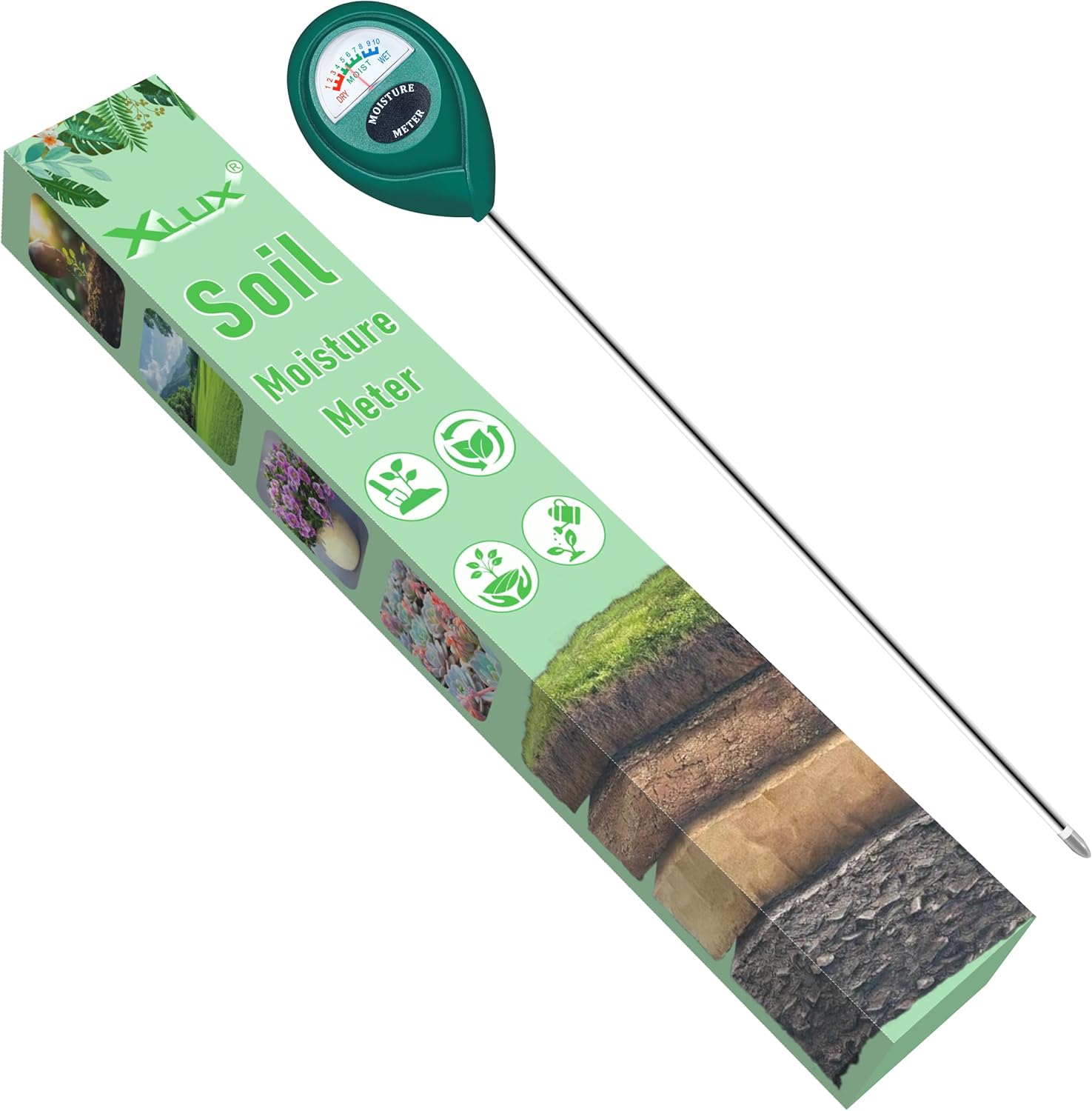
This battery-free moisture meter uses a long probe for soil checks around indoor and outdoor plants. It provides a direct soil reading without requiring batteries. The longer probe helps check moisture below the surface before treating a plant symptom as a watering problem.
Check On AmazonIf you click this link and buy, we earn a commission at no additional cost to you.
Final Thoughts: Let the garden conditions choose the watering method
A reliable watering routine starts with observation: check soil moisture, account for recent rain, decide what part of the root zone needs water, and then choose the simplest method that can reach it. Hand watering may be enough for a small garden, while a sprinkler, soaker hose, or drip system can earn its place when scale, coverage, or recurring labor makes it useful. Automation should come after the method and runtime are understood, not before. That order keeps the system tied to plant need instead of convenience alone.
Keep checking the result after the system is in place. Soil, weather, plant size, and seasonal demand change, and a setup that worked well under one set of conditions may need adjustment under another. Watering a garden well is not about finding one permanent schedule. It is about making the delivery method respond to the garden you actually have.

This 25-foot flat weeper soaker hose releases water along a planted run close to the soil surface. Its flexible flat format is made for garden beds, vegetable gardens, flower beds, lawns, and orchards. It offers a simple root-zone delivery option when garden conditions favor a porous hose over broad overhead watering.
Check On AmazonIf you click this link and buy, we earn a commission at no additional cost to you.
FAQs
💧 How often should I water my garden?
Check the soil and recent rain instead of starting with a fixed interval. Frequency changes with soil texture, weather, plant stage, root depth, and whether the garden is in the ground, a raised bed, or a container.
🌱 Is it better to water deeply or a little every day?
For many established garden plants, a slower application that wets more of the root zone is more useful than frequent surface sprinkling. Seedlings, new transplants, containers, and very fast-draining soils can need more frequent checks, so depth and frequency still have to match the situation.
☀️ What is the best time of day to water a garden?
Morning is generally a practical choice because temperatures are often lower and any wet foliage has time to dry. If you use drip or another method that keeps foliage dry, soil moisture and avoiding unnecessary evaporation remain more important than chasing a perfect clock time.
🪴 How can I tell whether water is reaching the root zone?
Check below the surface after watering by digging a small inspection hole in a representative spot. Repeat the check in more than one location if you use sprinklers, soaker hose, or drip because coverage can be uneven.
⏱️ Should I put my garden watering on a timer?
Use a timer after you know the correct zone, delivery pattern, and approximate runtime for your soil and planting. A timer is useful for consistent start and stop control, but it should still be adjusted for rainfall, changing plant demand, and system problems.
🌧️ Does rain always mean I can skip watering?
No. A short or intense rain may wet the surface while leaving deeper soil relatively dry, so check soil moisture before deciding. A soaking rain that reaches the active root zone can replace supplemental watering for that period.
References and Sources
- Iowa State University Extension watering tips: Supports checking soil moisture, watering the root zone, deep application, and matching watering to weather and soil conditions.
- Penn State Extension watering guidance: Supports adjusting watering for soil, weather, plant stage, and location rather than relying on daily watering myths.
- EPA WaterSense watering tips: Supports avoiding runoff, adjusting irrigation for conditions, and checking local rules before relying on rainwater collection.