A useful set of essential garden tools starts with the jobs your yard actually creates, not with a fixed shopping checklist. Cutting, digging, weeding, raking, hauling, storage, and powered equipment each earn space only when a repeatable task makes them useful. The right kit can be surprisingly small if one tool already handles several jobs well and the garden does not create the workload that justifies specialized gear. By the end, you should be able to keep, add, or skip whole tool families based on work, fit, access, storage, and maintenance rather than on how complete a tool collection looks.
Start with the jobs the garden actually creates
Imagine emptying the shed onto the lawn and looking at every shovel, pruner, rake, cart, and powered tool in one place. The fastest way to rebuild a useful set of essential garden tools is to put each item back only when a recurring job can justify the space it occupies. A small patio garden may create transplanting, light pruning, container cleanup, and hand weeding without ever creating a reason for a full digging kit or a powered cultivator. A larger planted yard may create heavier cutting, bed renovation, leaf cleanup, and hauling, but even then the work should come first and the shopping list second.
This job first approach also prevents the common mistake of treating every familiar tool as a basic requirement. Gardening tools overlap more than store displays suggest, so one comfortable trowel may cover several small planting jobs while a spade may already handle the straight sided cuts that would make another digging tool redundant. Frequency matters as much as capability because a tool used twice a year should clear a higher storage and maintenance bar than one used every week. Before adding anything, name the job, how often it happens, what you already use, and what problem the new tool would actually remove.
| Recurring task | Tool family to consider | What earns the tool a place | Reason to skip |
|---|---|---|---|
| Cutting stems and small branches | Pruning tools | The garden regularly creates cuts your current hand tool can make cleanly and comfortably | There is little woody growth or the cuts are outside safe homeowner reach |
| Opening soil, edging, or lifting plants | Digging tools | Bed work repeatedly requires cutting, scooping, loosening, or lifting | Most growing happens in containers or light beds handled by a small hand tool |
| Removing weeds | Manual weeding tools | A repeated weed type or growth stage makes one removal motion efficient | Hand pulling already works at the scale and frequency you face |
| Moving leaves, soil, or debris | Rakes | The material and surface repeatedly call for sweeping, leveling, or moving debris | Cleanup is too small or too infrequent to justify storage |
| Moving heavy or bulky loads | Wheelbarrow or cart | Loads are frequent and the route has enough width, traction, and turning room | Loads are light, short, or easier to move in a bucket or tub |
The matrix is not a list of things to buy. It is a filter for matching a recurring task to a tool family, then checking whether the current method is already good enough. If the skip column describes your garden better than the ownership column, the no purchase answer is doing exactly what it should. That leaves more room and budget for the few tools that genuinely reduce effort or improve control.

The Bucketeer organizer is designed to fit most 5-gallon buckets for a portable tool setup. Three interior loops accommodate hammers, drills, pry bars, and other long-handled tools. Model 10030 keeps a small working set together in one bucket-mounted organizer.
Check On AmazonIf you click this link and buy, we earn a commission at no additional cost to you.
Build the cutting kit from stem size and reach
Cutting tools make more sense when you sort the work by what is being cut and where the cut is located. Soft growth, ordinary live stems, thicker woody branches, and material above comfortable reach do not create the same job, so a single cutter should not be forced into every situation. Bypass style hand pruners are commonly used for live plant material because the blades pass one another rather than pressing the stem against a flat surface, while larger cuts may call for a lopper or pruning saw. The important decision is not to own every size, but to stop when the cuts in your garden are already handled cleanly and without excessive strain.
Reach is also a boundary, not a reason to keep buying longer cutting tools. If ordinary pruning requires unstable footing, awkward overhead control, or work beyond safe homeowner scale, the problem has moved past a basic tool choice. For routine residential pruning, start with the smallest cutting family that matches the stem size and lets you work from a stable position. The pruning tool guide for common garden cuts goes deeper into choosing among hand pruners, loppers, and saws without turning every woody stem into a reason for a larger tool.
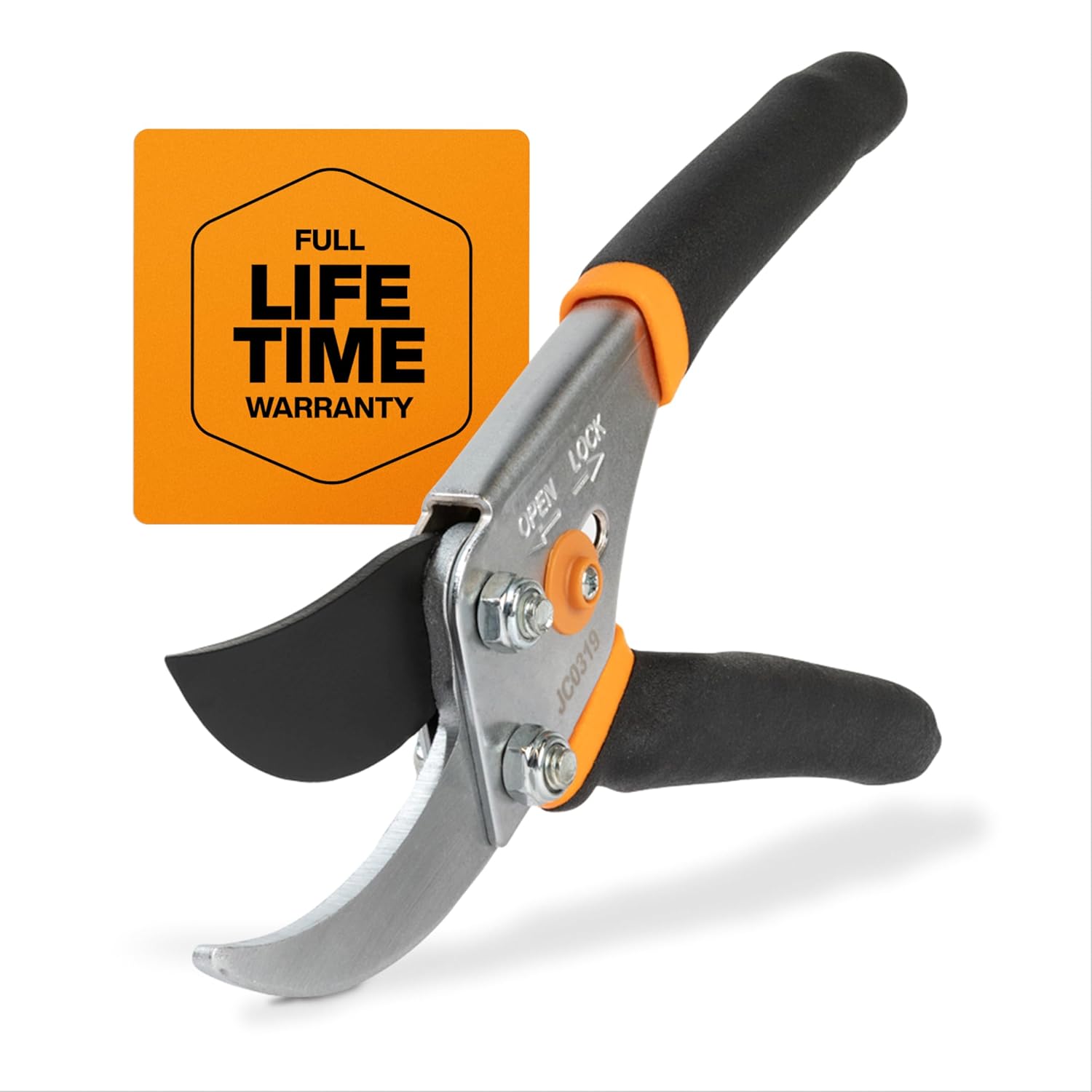
These bypass pruning shears are rated for live stems and small branches up to 5/8 inch in diameter. Precision-ground steel blades use a low-friction coating, while a sap groove helps reduce sticking. The non-slip handle and easy-open safety lock support controlled garden pruning and compact storage.
Check On AmazonIf you click this link and buy, we earn a commission at no additional cost to you.
Separate digging, slicing, and lifting tools by head geometry
Many garden tools look similar until you ask the soil what the tool is supposed to do. A curved shovel head is useful for scooping and moving loose material, while a flatter spade is better suited to slicing, edging, and making straighter cuts. Forks add another motion by loosening or lifting material with tines instead of moving a solid slice of soil. That distinction matters because buying several nearly identical long handled tools rarely helps if all of your real jobs are small planting holes and occasional bed cleanup.
Soil condition and working space change the answer as well. Dense ground, established beds, narrow borders, raised growing areas, and containers can create very different leverage and access needs even when the task is casually called digging. Choose the head shape and handle length around the repeated motion you need to make, then check whether the tool fits your body and the space where it will be used. The garden digging tools guide separates shovels, spades, forks, and smaller hand tools by the jobs their shapes are actually designed to do.

This hori hori uses a 7-inch stainless steel blade with both a sharp edge and a serrated edge. The full-tang wood handle is paired with an included sheath for storage and transport. Its blade is designed for digging, transplanting, cutting roots, dividing plants, and measuring planting depth.
Check On AmazonIf you click this link and buy, we earn a commission at no additional cost to you.
Choose manual weeding tools from weed stage and root form
Weeding tools become easier to choose when the weed itself defines the motion. Tiny seedlings near the soil surface can often be sliced or disturbed with very little force, while established weeds with persistent crowns or deeper roots may need lifting or targeted extraction. That means a broad hoe, a narrow hand weeder, and simple hand pulling are not competing versions of the same solution. They fit different weed stages, root forms, planting density, and working positions.
Frequency matters here more than owning a wide selection of clever shapes. If you weed early and often, a simple tool that moves quickly through small growth may prevent the need for heavier removal later. If the problem is occasional and easy to pull by hand after rain or irrigation, a specialized weeder may spend most of its life in storage. The manual weeding tools guide helps match removal style to weed size, rooting pattern, and the amount of room available around wanted plants.

This stand-up weeder combines a bamboo long handle with a four-claw steel head. The claw design is made to pull weeds such as dandelions, crabgrass, and taproots from the soil. Its long-handle format allows weed removal from a standing position instead of repeated bending or kneeling.
Check On AmazonIf you click this link and buy, we earn a commission at no additional cost to you.
Use flexible and rigid rakes for different surfaces
A rake is a good example of why a garden tools list can be misleading. Flexible tines are useful for gathering lightweight leaves and debris because they can move around uneven surfaces and obstacles without behaving like a digging head. A rigid garden or bow rake is built for firmer contact with soil and heavier material, so it is more useful for leveling, breaking small clods, or moving material across a bed. Those two jobs may both be called raking, but the surface and material create very different demands.
Before buying both, look at the cleanup your property actually produces. A yard with deciduous trees and open ground may make a flexible leaf rake a frequent tool, while a compact vegetable plot may get more value from a rigid rake used during bed preparation. Some gardens create so little raking work that a hand rake, broom, or other existing cleanup method is enough. The guide to types of garden rakes explains how tine stiffness, head shape, and working surface change which rake makes sense.

This bow rake uses a dual-sided head with 17 steel tines and a 63-inch stainless steel handle. One side is designed to loosen compacted soil and remove thatch, while the opposite side levels mulch, gravel, and garden beds. The heat-treated manganese steel head is built for soil loosening, yard leveling, lawn care, and thatch removal.
Check On AmazonIf you click this link and buy, we earn a commission at no additional cost to you.
Add a wheelbarrow or cart only when the hauling route justifies it
Capacity is only useful when the loaded carrier can travel from the pickup point to the dump point. A large wheelbarrow or cart can look efficient until a narrow gate, steep turn, soft path, step, or tight storage corner becomes the real constraint. Start by tracing the route you use for mulch, compost, soil, plants, debris, or tools, then think about load size and unloading at the destination. In many small gardens, a bucket or flexible tub can be easier because it fits the route and creates less storage burden.
The choice between a wheelbarrow and a cart also depends on balance, turning space, ground condition, and how you prefer to unload. One design may feel nimble in a narrow garden while another may feel steadier with a broader load, but neither is automatically better without the route and user in the picture. If hauling is rare, borrowing or using smaller containers may be the more practical decision. The wheelbarrow and garden cart guide focuses on matching capacity to access, handling, dumping, and the type of material you actually move.

This garden dump cart has a 4-cubic-foot tub and a rated 600-pound load capacity. The 10-inch no-flat tires avoid air and puncture maintenance, and the cart uses a quick-release dumping mechanism. Its polypropylene tub and wagon format are designed for moving landscaping and gardening loads.
Check On AmazonIf you click this link and buy, we earn a commission at no additional cost to you.
Treat maintenance tools and storage as part of ownership
A tool does not stop taking up resources after purchase. Metal edges may need cleaning and sharpening, moving joints may need routine attention, wooden parts can deteriorate when neglected, and wet or dirty storage can shorten the useful life of many tools. That makes maintenance workload part of the buying decision, especially when two tools perform similar jobs but one adds more care than you are willing to provide. A smaller kit is often easier to keep clean, dry, organized, and ready to use.
Storage should be judged by access as well as square footage. A tool buried behind seasonal equipment can be technically owned and practically unavailable, which encourages duplicate purchases and skipped maintenance. Keep frequently used tools where they can be reached without moving half the shed, and give sharp or powered equipment a stable place that protects both the tool and the people moving around it. The garden tool maintenance guide covers routine cleaning, edge care, handle checks, and storage choices in more detail.
| Inventory question | What to record | Decision it supports |
|---|---|---|
| What recurring job does this tool perform? | Name the exact cut, dig, weed, rake, haul, or maintenance task | Keep tools tied to real work |
| How often is that job created? | Frequent, seasonal, rare, or no longer relevant | Separate core tools from occasional tools |
| What else can already do the job? | List overlapping tools or simpler methods | Find duplicates and no purchase options |
| What does ownership add? | Storage, cleaning, sharpening, fuel, battery, cord, or other upkeep | Compare convenience with ongoing burden |
| What should happen next? | Keep, maintain, relocate, replace, borrow, or remove | Turn inventory into an action |
This worksheet is most useful when you apply it to the tools already on hand before shopping for more. A neglected duplicate may signal that the job is already covered, while a heavily used tool in poor condition may justify maintenance or replacement before any new category is added. The point is not to reduce the shed to an arbitrary number. It is to make every stored item explain what recurring work it earns its space by doing.

This handheld sharpener uses a tungsten carbide edge for garden blade touch-ups. It is designed for tools including pruning shears, loppers, hedge clippers, axes, machetes, folding saws, and knives. The compact body and slip-resistant handle provide a portable maintenance option for keeping cutting tools ready between uses.
Check On AmazonIf you click this link and buy, we earn a commission at no additional cost to you.
Buy powered hedge equipment only when manual workload no longer fits
A powered hedge trimmer can save time on repeated shaping of long, accessible hedges, but that does not make it a basic gardening tool for every yard. If you have a few shrubs that need selective pruning, ordinary hand tools may provide better control with less storage, setup, and maintenance. The powered option begins to make more sense when the repeated length of hedge, frequency of trimming, and physical workload clearly exceed what manual cutting reasonably handles. It should solve an established workload problem, not create a reason to shear plants that were better pruned selectively.
Once power equipment enters the decision, the exact machine and its current manual matter because controls, power source, maintenance needs, and operating limits vary. Treat cord management, battery care, storage, noise, blade handling, and the ability to keep stable footing as part of ownership rather than as details to consider later. If the work is outside comfortable homeowner reach or involves unsafe access, a larger or longer machine does not remove that boundary. The homeowner hedge trimmer guide takes the next step when the workload truly justifies powered trimming.

The BEHT100 uses a 3.0-amp motor and a 16-inch dual-action hardened-steel blade. It is rated to trim branches up to 5/8 inch thick, while the compact corded design includes cord retention. A built-in T-handle and full-length trigger provide grip and control for routine accessible hedge work.
Check On AmazonIf you click this link and buy, we earn a commission at no additional cost to you.
Buy a tiller or cultivator only after proving hand tools are not enough
Powered soil equipment has a strong visual appeal because it looks faster than a shovel or fork, but speed only matters if the job should be done at that scale. Established beds, compact growing spaces, and gardens with only occasional soil loosening may never create enough repeated work to justify a machine. Hand tools can also be easier to control around roots, irrigation, bed edges, and narrow paths. Before considering powered tillage, define the area, soil condition, frequency, access, and the exact work that hand tools fail to complete efficiently.
A tiller or cultivator also brings storage, cleaning, transport, and model specific maintenance into the equation. That burden can be reasonable for a large recurring preparation job and wasteful for a small bed that is already manageable with simpler equipment. Do not use powered cultivation as a default answer to every soil problem because compaction, drainage, fertility, and soil structure are different questions that may need different responses. The garden tiller and cultivator guide is the better next stop once the workload, soil task, and access conditions show that hand tools are no longer enough.

The TJ604E uses a 13.5-amp corded motor with six angled steel tines. It is designed to cultivate up to 16 inches wide and 8 inches deep, with three-position wheel adjustment for control. The handle folds for storage and transport when a recurring soil-preparation workload justifies powered equipment.
Check On AmazonIf you click this link and buy, we earn a commission at no additional cost to you.
Keep task owned equipment in its own garden system
Not every object used outdoors belongs in a general tool kit. A garden hose is part of the watering system because hose diameter, length, connections, pressure, flow, and irrigation method are water delivery decisions. A lawn aerator belongs with lawn care because the need for aeration comes from turf and soil conditions rather than from a desire to own more equipment. Seed trays belong with propagation, and compost tumblers belong with the composting and soil system that determines whether that method fits the household.
This boundary keeps the tool collection from becoming a catchall for every garden purchase. It also sends the reader to the place where the important conditions can be judged properly instead of reducing a task specific item to a generic feature comparison. When the subject is the tool itself, this equipment section should help you compare fit, workload, maintenance, and storage. When the subject is watering, lawn renovation, propagation, composting, or another garden task, let that task define whether the equipment is needed in the first place.
- Remove a tool from the shopping list if no recurring job clearly needs it.
- Skip a specialized tool when an existing tool already performs the same job comfortably and safely.
- Reject a larger tool when access, storage, or handling makes the added capacity unusable.
- Delay powered equipment until repeated workload, not curiosity, justifies setup and maintenance.
- Move task specific equipment back to the garden system that owns the decision, such as watering, lawn care, propagation, or composting.
Use this checklist after you have identified the real jobs and before comparing prices or features. It is deliberately biased toward removing unnecessary purchases because redundancy is easier to prevent than to organize later. A compact kit is not a minimalist trophy if it fails to do the work, but a crowded shed is not proof of readiness either. The useful middle is a set of tools that repeatedly earns its place in the garden you actually have.

This Flexzilla hose measures 5/8 inch by 50 feet and uses a premium hybrid polymer construction. Its flexible design is made to resist kinking under pressure, coil easily, and lay flat with zero memory. The hose also uses crush-resistant anodized aluminum fittings and an O-ring connection for routine watering setups.
Check On AmazonIf you click this link and buy, we earn a commission at no additional cost to you.
Final thoughts: keep only the tool families that have repeatable jobs in the garden
The best tool kit is not the one that looks complete on a wall. It is the one that matches the cutting, digging, weeding, raking, hauling, and maintenance work your garden creates without forcing you to store and care for equipment you rarely touch. Start with the job, check the scale and access, then see whether something you already own can handle it well. Buy only when a real gap remains.
That same filter should follow you as the garden changes. New beds, mature shrubs, heavier seasonal cleanup, or a longer hauling route can create a legitimate need that did not exist before, while redesigned spaces can make old tools redundant. Recheck fit, condition, maintenance, and storage before assuming the next purchase must be bigger or more specialized. A useful kit grows from repeatable work, not from an obligation to complete someone else’s checklist.

This freestanding tool tower is designed to organize up to 40 long-handled tools such as rakes, brooms, and shovels. Its wheeled format allows the rack to be repositioned in a garage or shed. The black Rubbermaid rack provides a dedicated storage point for long-handled yard tools.
Check On AmazonIf you click this link and buy, we earn a commission at no additional cost to you.
Frequently asked questions
Most questions about basic gardening tools come down to the same decision: what work does the garden actually create, and what is the simplest tool that handles it well? Garden size matters, but workload, plant type, soil condition, access, storage, and how often a task repeats can matter just as much. A small garden can justify a specialized tool when one job happens constantly, while a large yard can still skip equipment that has no clear role. Use the answers below as filters, not as a universal shopping list.
It is also normal for a useful kit to change over time. Plants get larger, beds are added or removed, storage improves, and some tasks disappear when the garden is redesigned. Reevaluate the job before replacing a tool or adding a new family, especially when a purchase also brings sharpening, cleaning, battery care, fuel, or more storage. The goal is reliable work with the least unnecessary equipment, not a particular tool count.
🛠️ What are the most essential garden tools for a beginner?
Start with the jobs already present, usually some combination of light digging, hand weeding, pruning, cleanup, and carrying. A trowel, suitable hand pruner, and one or two larger tools may cover a surprising amount of work, but the exact set should follow your plants, soil, space, and maintenance routine.
🌱 Do I need both a shovel and a spade?
Not always. A shovel is generally better suited to scooping and moving loose material, while a flatter spade is useful for straighter cuts, edging, and slicing into soil, so own both only when those separate jobs recur often enough to justify them.
🍂 Do I need more than one type of rake?
Only if your property creates both lightweight debris cleanup and firmer soil leveling work. Flexible and rigid rakes behave differently, but a garden with only one of those jobs may be better served by owning just the matching type.
🌿 When is a powered hedge trimmer worth considering?
Consider one when long, accessible hedges create enough repeated trimming that hand tools no longer fit the workload. Before buying, include power source, storage, maintenance, stable working position, and the exact model’s manual in the decision.
🪴 Is a garden tiller necessary for starting beds?
No. Many beds can be created or maintained with hand tools, and whether powered cultivation helps depends on area, soil condition, access, existing roots or irrigation, and how often the work will repeat.
🧤 How can I avoid buying duplicate gardening tools?
Write down the exact recurring job before you shop, then list every tool you already own that can perform it. If the new tool does not remove a clear problem involving effort, control, access, safety, or repeated workload, it is probably duplication rather than a useful addition.
References and sources
The distinctions in this guide rely on practical tool use rather than on brand or retailer claims. University based gardening guidance is especially useful here because it connects tool shape, cutting style, rake stiffness, handle fit, and common homeowner tasks to the work those tools are designed to perform. Those details support the job first framework without turning the article into a catalog. They also reinforce why comfort and fit belong in the decision alongside the tool’s nominal function.
Only the sources that directly support those distinctions are included below. Product specific specifications are intentionally absent because this article does not recommend particular models, and any later model comparison should be checked against current manufacturer documentation. Powered equipment decisions also remain at the homeowner selection level rather than drifting into repair instruction. That keeps the evidence proportional to the claims made here.
- UC Marin Master Gardeners essential tools: supports common hand tool families, their basic uses, and distinctions among pruners, shovels, spades, rakes, and hauling tools.
- Penn State Extension on using the right tool: supports matching handle fit, tool head shape, rake stiffness, digging geometry, and cutting style to the work and the gardener.