A hedge trimmer should match the hedge, the access around it, and the amount of trimming you actually do. A short low hedge may be easier to control with hand shears, while a long boundary hedge or a tall face can justify powered equipment for very different reasons. Blade length, reach, power source, and cutting capacity only become useful specifications after you measure the work in front of you. The goal is to choose a tool that makes the routine manageable without buying more machine than the garden needs.
Start with the hedge, not the motor
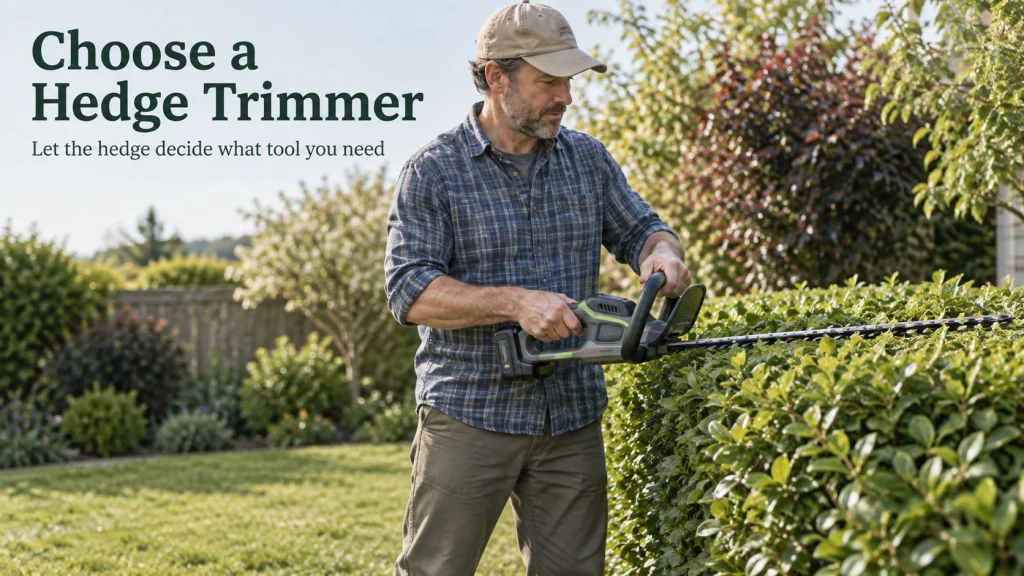
A hedge trimmer solves three very different problems depending on the hedge in front of it. A short low hedge asks for control around corners and nearby plants, a long boundary hedge asks how much repeated cutting you can do comfortably, and a tall hedge face asks whether the cutting line can be reached safely from the ground. Those situations can look similar in a product aisle because all three tools may have moving blades. In the garden, however, the useful choice starts with hedge length, height, depth, access, and how often the work repeats.
I would not begin by choosing battery voltage, engine size, or the longest available blade. First walk the route you will actually trim and note where you can stand, whether fences or beds block your stance, how far the hedge extends, and whether the top can be reached without stretching. A powered trimmer that feels manageable on a small front hedge may become tiring along a long property line, while a longer machine can be clumsy around a compact foundation planting. If your tool collection is still basic, the broader essential garden tools guide can help keep this purchase in proportion to the rest of the work you actually do.
| What to measure | Why it changes the choice | What to write down |
|---|---|---|
| Hedge length | Long repeated passes can make session time and fatigue more important. | Approximate total run you trim in one session. |
| Hedge height | Height determines whether normal reach is enough or an extended configuration is worth considering. | Highest routine cutting line from ground level. |
| Hedge depth | A deep top can tempt you to overreach even when the front face is easy to reach. | Distance from the front edge to the far side of the top. |
| Working access | Walls, slopes, beds, and narrow paths can matter more than raw cutting power. | Where you can place both feet and move the tool freely. |
This simple worksheet prevents a common buying mistake: solving an equipment problem that the hedge does not actually have. It also separates a reach problem from a workload problem before those two issues get mixed together in a product comparison. Keep the measurements beside you when you compare tools so a tempting specification has to answer a real constraint. Once the geometry is written down, the next question is whether any motorized tool is justified at all.

This open-reel fiberglass tape measures 100 feet long and 1/2 inch wide. The blade is double coated and the reel has shock-absorbing rubber bumpers. A marking stake is included for laying out longer garden measurements.
Check On AmazonIf you click this link and buy, we earn a commission at no additional cost to you.
Decide whether the workload needs power
A powered hedge trimmer earns its place when repeated cutting volume, session length, or access makes manual work unnecessarily slow or tiring. It is not automatically the better choice for every clipped shrub. Hand shears can still be a sensible answer for a short hedge, a few small shaped plants, or occasional touchups where precision matters more than speed. Keeping that manual option on the table also avoids adding charging, fuel, cord management, storage, blade care, and another motorized tool to maintain.
The threshold is less about one exact hedge length and more about how the job feels as a repeated routine. If you are making many broad passes over a long face, stopping often because your hands fatigue, or spending a large part of a yard session on the same hedge, power may reduce the burden. If the work is brief, infrequent, and easy to reach, the added setup may not buy much. A retailer may call the machine a hedge cutter or emphasize motor specifications, but neither label tells you whether your workload actually needs it.
- Stay with manual shears when the hedge is small, the cuts are selective, and the session is short.
- Consider power when the same broad trimming motion repeats across a long hedge or several similar hedges.
- Do not use a hedge trimmer as a substitute for removing individual woody branches that exceed the tool’s documented cutting limit.
- Stop the comparison if the job requires unsafe reaching, unstable footing, or cutting work outside ordinary homeowner maintenance.
The useful dividing line is therefore workload, not enthusiasm for a new tool. If manual shears already finish the job comfortably, adding a motor may only trade one kind of effort for setup and maintenance. If the same broad cuts repeat for a long session, power has a clearer job to do. Once powered trimming makes sense, the route around the hedge becomes the next filter because it determines which power source creates the least friction.

These manual hedge shears use 10-inch serrated hardened-steel blades. The telescoping handles extend for extra reach and lock at the selected length. The Power-Lever mechanism increases leverage compared with single-pivot shears.
Check On AmazonIf you click this link and buy, we earn a commission at no additional cost to you.
Choose power source from route and session length
Power source should fit the path you have to walk and the amount of uninterrupted trimming you expect to do. A corded machine can make sense where outlets and a clear cord route stay close to a modest hedge, but the cord itself becomes part of the job around gates, corners, dense planting, and long property lines. Battery power removes that tether, although usable session length depends on the exact tool, battery, load, and operating conditions. Gas equipment removes charging from the cutting session but adds fuel handling, noise, exhaust, starting routines, and more engine-related maintenance.
I would compare these options by tracing the trimming route before comparing marketing claims. Ask where the outlet is, whether a cord would cross the cutting zone, whether you already maintain a compatible battery system, how much of the hedge you plan to finish at once, and what storage or upkeep you are willing to accept. Do not convert a battery voltage or fuel engine size into a promised runtime or cutting result without evidence for the exact machine. Manufacturer buying guides can frame the categories, but actual runtime and workload performance should come from the exact documentation or a test that used the same setup.
| Route condition | Power source to investigate | Tradeoff to verify |
|---|---|---|
| Short hedge near a convenient outlet | Corded or battery | Cord path, tool weight, storage, and total setup. |
| Long hedge with corners or obstacles | Battery or gas | Session length, carried weight, battery plan, fuel burden, and noise. |
| Several separated hedge areas | Battery or gas | Travel between areas, restart or recharge needs, and what you already maintain. |
This is a routing tool, not a universal ranking. The same homeowner may reasonably choose different power sources for two properties with different outlet access, hedge length, or storage constraints. Keep the route sketch beside the specifications so convenience claims stay tied to your actual yard. After power source, the blade should be sized from the hedge surface you need to control rather than from the biggest number on the box.

This 50-foot outdoor extension cord uses 16 AWG SJTW cable and a three-prong NEMA 5-15P to 5-15R connection. It is rated 13 amps at 125 volts and is ETL/cETL listed. The cord includes strain-relief ends and a storage strap.
Check On AmazonIf you click this link and buy, we earn a commission at no additional cost to you.
Measure hedge geometry before blade length
Blade length changes how much hedge surface the tool can cover in a pass, but longer is not automatically easier. A longer cutting bar can be useful on broad, straight faces because it reaches across more foliage before you reset the tool. On a small hedge with corners, nearby ornamentals, or detailed shaping, that extra length can make the front of the machine harder to place precisely. The useful question is how much straight hedge surface you can actually sweep without fighting the space around it.
Hedge depth matters as much as face length because it affects how you approach the top. If the top is wider than your comfortable reach, buying a slightly longer blade may appear to solve the problem while still encouraging you to lean or stretch. Measure from the stance you can safely maintain on level ground, then decide whether a normal tool still gives enough controlled coverage. For a focused comparison of this specification, use the hedge trimmer blade length guide rather than treating blade length as a proxy for overall machine quality.
A useful size choice should reduce unnecessary passes without making the tool harder to turn, stop, and reposition. Pay attention to the ends of the hedge as well as the broad middle because that is where extra blade length can become awkward. A blade that saves a few sweeps but makes every corner clumsy is not automatically an upgrade. That balance becomes especially important when you compare single-sided and double-sided blade layouts.

This cordless hedge trimmer uses a 22-inch blade and the kit includes a 20V MAX battery and charger. The listed cutting capacity is up to 3/4 inch. A wraparound front handle and soft-grip full-length trigger support control during vertical and horizontal trimming.
Check On AmazonIf you click this link and buy, we earn a commission at no additional cost to you.
Treat blade layout as a handling decision
Single-sided and double-sided cutting layouts change how a trimmer moves through the job. Manufacturer guidance commonly positions single-sided designs toward long, straight sections where a longer cutting bar and directional sweeping can be useful. Double-sided designs allow cutting in either sweep direction, which can suit shaping and hedge faces where you change direction often. Neither layout is automatically more appropriate for a homeowner because the right fit depends on hedge shape, working space, and how you naturally move around the plant.
Look beyond the blade label and check the complete machine. Rear handle orientation, overall balance, blade guard design, tool weight, and the room needed to turn at the end of a pass all affect control. A long boundary hedge with a simple flat face may reward a very different layout from a compact hedge wrapped around a walkway. The single-sided hedge trimmer guide goes deeper into that choice without turning one layout into a universal winner.
Once the blade layout fits the movement pattern, reach should be evaluated separately. Do not use blade configuration to compensate for a hedge that is simply too high or too deep for a comfortable stance. Those are access problems, and access changes the leverage and handling of the whole machine. A pole configuration is not simply a normal hedge trimmer with more capability added for free.
This 20V cordless hedge trimmer uses a 22-inch cutting reach and dual-action blades. The D-grip front handle is designed to be held from multiple angles. The kit includes a 2.0Ah 20V PowerShare battery and charger.
Check On AmazonIf you click this link and buy, we earn a commission at no additional cost to you.
Use pole reach only when ground-based access requires it
A pole hedge trimmer is most useful when the routine cutting line is above comfortable normal reach or when hedge depth makes the top difficult to reach from a stable stance. The extension can let you keep your feet on the ground while bringing the cutter to the work. That benefit comes with a different handling problem because more of the machine’s mass is carried farther from your body. The right question is not whether extra reach sounds useful, but whether your hedge geometry repeatedly requires it.
Before choosing an extended tool, mark the highest and farthest points you routinely need to trim from a safe standing position. Then compare that need with the working reach, overall length, articulated head positions, transport size, and operating instructions for the exact model. Do not assume a telescoping or articulating design is lighter, easier to control, or suitable at every angle. The long reach hedge trimmer guide can help narrow this choice when height is the actual constraint.
| Hedge condition | What to consider first | What not to assume |
|---|---|---|
| Low hedge with clear access | Normal reach and precise handling | Extra pole length adds useful value. |
| Tall face reachable only by stretching | Ground-based extended reach | A longer standard blade solves vertical access. |
| Wide top with limited access to the far side | Working angle, head articulation, and stable stance | Any pole tool can be controlled comfortably at the required angle. |
Reach solves an access constraint, but it does not increase the safe cutting capacity of the blade. A tool that can physically reach a branch is not necessarily designed to cut that branch. Keep reach, cutting capacity, and operator control as separate checks when you compare extended machines. Branch thickness and maintenance limits still need to match the manufacturer’s stated limits.

This 40V pole hedge trimmer has a 20-inch dual-action steel blade and a 5/8-inch listed cutting capacity. Its head adjusts through three positions for angled trimming with the extended-reach handle. The kit includes one 2.0Ah battery and charger.
Check On AmazonIf you click this link and buy, we earn a commission at no additional cost to you.
Verify cutting capacity and maintenance in the exact manual
Tooth spacing, blade geometry, and advertised cutting capacity are exact product specifications, not numbers to generalize across an entire tool class. Before buying, find the manual or official specification page for the exact model and confirm what the manufacturer says the cutting attachment is designed to handle. Do not treat a wider tooth gap as permission to force the machine through every branch that can physically enter the gap. If the hedge contains occasional woody stems beyond the documented capacity, those stems belong to a different cutting decision rather than a harder push on the hedge trimmer.
Maintenance should be checked the same way. Manufacturer support material commonly calls for inspecting the blade and guard, keeping fasteners secure, cleaning plant residue, and disconnecting the power source before maintenance, but the exact procedure and service interval vary by model and power system. Battery machines, corded machines, and gas machines also create different storage and service burdens. If a manual sends a repair or adjustment to qualified service, that boundary matters more than a generic do-it-yourself tutorial.
I would read the maintenance section before purchase rather than after the first sticky blade or damaged guard. It tells you whether routine blade care, lubrication, battery storage, fuel system upkeep, or dealer service fits the ownership burden you want. That check can also reveal whether a machine that looks convenient to buy creates a maintenance routine you do not want to own. For the detailed routine, use the hedge trimmer maintenance guide, then follow the exact manual whenever its instructions are more specific.

This STIHL resin solvent is intended for hedge trimmer blades and cutting attachments. The listing states that it dissolves resin and rust. It contains graphite.
Check On AmazonIf you click this link and buy, we earn a commission at no additional cost to you.
Final thoughts: let hedge geometry and workload decide whether power is justified
The most useful hedge trimmer is the one that matches the hedge you actually maintain, not the machine with the longest blade or the largest power number. Start with hedge length, height, depth, route, and session burden, then decide whether manual shears are still enough. If power is justified, narrow the choice through power source, blade length, blade layout, reach, and finally the exact cutting and maintenance limits in the manual. That sequence keeps the purchase tied to control, access, and routine ownership rather than to specifications that may not solve your real garden problem.
Before buying, write down the few constraints that actually changed your decision and compare them with the manufacturer’s specifications. If a simpler tool already handles the workload comfortably, keeping it is a valid outcome. If a powered machine clearly solves session length or access, choose the configuration that addresses that constraint without adding unnecessary size or upkeep. The hedge should be the reason for the specification, not the other way around.

This compact corded trimmer uses a 16-inch dual-action hardened-steel blade and a 3.0-amp motor. The listed cutting capacity is up to 5/8 inch. A cord-retention system, T-handle, and full-length trigger are built into the tool.
Check On AmazonIf you click this link and buy, we earn a commission at no additional cost to you.
Explore related hedge trimmer decisions
Once you know which constraint is driving the purchase, use the matching topic below to narrow that part of the decision. Start with the issue that actually changed your choice, such as manual versus powered work, cord routing, blade length, reach, or cutting limits. There is no need to work through every comparison if several of those questions are already settled by your hedge and property. Each topic focuses on a specific tradeoff instead of repeating the whole selection process.
| Topic | What you’ll find |
|---|---|
| Hedge trimmer vs hedge shears | How workload, precision, and maintenance burden change the manual versus powered choice. |
| Corded or cordless hedge trimmer | How outlet access, cord routing, battery ownership, and session length shape the electric choice. |
| Gas or cordless hedge trimmer | How workload, fuel burden, charging, noise, and maintenance affect the decision. |
| Hedge trimmer blade length | How hedge width, straight run length, control, and maneuvering space affect blade size. |
| Single-sided hedge trimmer | Where directional cutting and blade layout fit long straight hedge work. |
| Long reach hedge trimmer | When added reach solves a real access problem and when it only adds handling burden. |
| Hedge trimmer tooth spacing | How to read tooth spacing and cutting capacity without treating them as interchangeable claims. |
| How to maintain a hedge trimmer | Routine owner checks, cleaning, blade care, storage, and the point where the manual or service provider takes over. |
Use the topic that matches the constraint you found in your own hedge measurements. Keep the original measurements nearby so the narrower comparison does not drift back toward bigger specifications for their own sake. When a choice depends on cutting capacity, maintenance, or a safety procedure, confirm it in the manual for the model you are considering rather than transferring a claim from another machine. Treat that model-specific guidance as the operating limit.

This 28-inch bypass lopper is designed for branches up to 1.5 inches in diameter. Its low-friction blade coating is intended to reduce gumming and improve rust resistance. It uses a bypass blade with non-slip grip handles.
Check On AmazonIf you click this link and buy, we earn a commission at no additional cost to you.
FAQs
✂️ Do I need a powered hedge trimmer for a small hedge?
Not necessarily. If the hedge is short, easy to reach, and only needs occasional shaping, hand shears may be simpler to control and maintain. Power becomes more useful when repeated broad cutting makes the manual session unnecessarily slow or tiring.
📏 Is a longer hedge trimmer blade always better?
No. A longer blade can cover more straight hedge surface, but it can also be harder to maneuver around compact shrubs, corners, nearby plants, and narrow paths. Match blade length to the hedge face and the room you have to move the tool.
🔋 Should I choose a corded or battery hedge trimmer?
Choose from the trimming route and session burden. A nearby outlet and clear cord path can make corded power practical, while corners, long runs, or separated hedge areas can make battery freedom more useful. Verify battery runtime for the exact tool and battery instead of assuming it from voltage alone.
🌿 How thick a branch can a hedge trimmer cut?
Use the cutting limit published for the model you are considering. Tooth spacing by itself is not a safe substitute for the manufacturer’s stated capacity, and oversized woody stems should be handled with a tool suited to that separate task.
🪜 Do I need a pole hedge trimmer for a tall hedge?
Consider one when the routine cutting line cannot be reached from a stable ground position with a standard tool. Check working reach, total length, head angles, weight, and operating instructions for that tool before assuming extra reach will be comfortable to control.
🧤 What should I check before maintaining a hedge trimmer?
Start with the manufacturer’s manual and disconnect the applicable power source before routine maintenance. Inspect the cutting attachment and guards for damage, and follow the instructions for cleaning, lubrication, storage, and any service task that should not be done at home.
References and sources
- Husqvarna hedge trimmer buying guidance: Supports distinctions among single-sided, double-sided, pole, battery, and gas configurations.
- STIHL hedge trimmer buying guide: Supports choosing from task, reach, and power source rather than from one specification alone.
- Husqvarna blade and guard safety check: Supports blade and guard inspection plus disconnecting the power source before checks.
- ECHO hedge trimmer maintenance guidance: Supports model-specific inspection, cleaning, blade care, and maintenance boundaries.