Garden digging tools make more sense when you start with the motion you need in the soil, not the name printed on the shelf tag. A straighter cutting edge suits slicing and edging, a curved bowl helps scoop and move loose material, sturdy tines loosen ground, and compact hand tools handle small planting work. The useful question is whether a tool adds a new motion, scale, or level of control to the kit you already have. That approach keeps a home-garden tool set smaller while making each tool easier to match to the job.
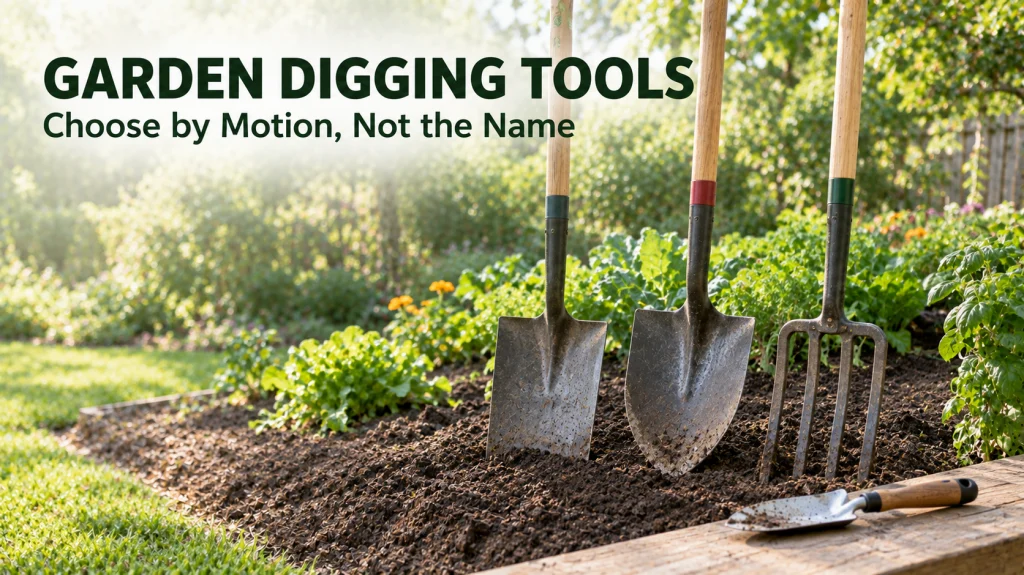
Start with the motion: slice, scoop, loosen, or transplant
Put the same patch of soil in front of four gardeners and the right tool changes with the motion each person needs. One gardener may need a clean vertical slice along a bed edge, another may need to scoop loose soil into a cart, another may need to loosen ground around roots, and another may only need a small hole for a transplant. Those jobs can happen within a few feet of each other, but they do not ask the tool head to behave the same way. Choosing by motion first prevents a shelf label from becoming the decision.
The first distinction is between entering the soil and moving material after it has been disturbed. A narrow or straight-edged head can concentrate force along a cutting line, while a more curved blade can hold more loose material during a scoop. Tines work differently again because they enter the ground at several narrow points instead of presenting one continuous blade. At hand scale, a trowel or garden knife gives more control around seedlings, containers, and established crowns than a full-length digging tool.
| Motion you need | Head feature to notice | Tool family to consider | What to avoid assuming |
|---|---|---|---|
| Slice or edge | Straighter blade and defined cutting edge | Spade | That every pointed shovel will make the same clean cut |
| Dig and scoop | Curved blade that can hold loose material | Shovel | That a flatter blade will carry material as efficiently |
| Loosen or lift through soil | Sturdy tines intended to enter ground | Garden fork | That any fork with long tines is a digging fork |
| Transplant or make a small hole | Compact blade with close hand control | Trowel or garden knife | That a larger tool is automatically faster in tight spaces |
This motion-first approach also gives you a simple way to limit redundancy. If two tools in the shed perform the same motion at the same scale, one may not be adding much unless its handle, width, or access fits a different constraint. For a broader look at how digging tools fit beside cutting, carrying, cultivating, and cleanup tools, the essential garden tools guide puts the whole home-garden kit in context. Here, the decision stays focused on what the head does once it meets soil.

This three-piece set includes a trowel, transplanter, and cultivator for hand-scale digging, planting, and loosening. Cast-aluminum heads resist rust, while SoftGrip handles provide controlled hand contact. The three different head shapes make it a practical match for comparing how motion changes with tool geometry.
Check On AmazonIf you click this link and buy, we earn a commission at no additional cost to you.
Read shovel and spade geometry before the label
Shovel and spade are often used as loose retail categories, so the blade deserves more attention than the product name. Penn State describes shovel heads as more curved in vertical and horizontal cross-section, which creates a bowl that is useful for moving material, while spades are generally straighter and better suited to digging and edging. Pointed tips are common on shovels and flatter ends are common on spades, but those patterns have exceptions. The shape in front of you is therefore more reliable than assuming every item called a shovel or spade follows one standard pattern.
Think about what happens after the blade enters the ground. If you need to cut a straight boundary, lift a section of sod, or make a more defined wall to a hole, a flatter spade profile usually matches that motion better. If you are opening a hole in ordinary garden soil and then moving the loosened soil aside, a digging shovel with some curvature can combine penetration with scooping. The closer the job moves toward carrying loose compost, mulch, or soil rather than cutting ground, the more useful a pronounced scoop becomes.
| Geometry check | What it tends to favor | Home-garden implication |
|---|---|---|
| Flatter blade | Slicing and defined edges | Useful where the cut line matters as much as removing soil |
| Curved bowl | Scooping and carrying loose material | Useful when soil or amendment must be lifted and moved repeatedly |
| Pointed tip | Concentrating the initial entry point | Useful for general digging where a broad flat edge is harder to start |
| Flat or straight edge | Making a straighter cut | Useful for edging and defined digging work |
Handle length, grip, weight, and the connection between head and handle still matter because they affect posture, control, and the amount of tool you are willing to carry around the yard. They do not erase the head geometry, though. Start with the required soil motion, then choose a size and handle that fit your reach, storage, and working space. That order is more dependable than buying a familiar name and asking the blade to do a different job later.

This 43-inch flat spade pairs a 1050MN steel head with a fiberglass handle and polypropylene grip. Its sawtooth blade and widened foot platforms are designed for cutting into firm soil and applying controlled digging force. The square-point profile suits edging, trenching, transplanting, turf cutting, and moving compost.
Check On AmazonIf you click this link and buy, we earn a commission at no additional cost to you.
Use forks when tines solve the ground problem
A garden fork earns its place when several strong tines can enter soil with less continuous blade area than a spade or shovel. UC Marin Master Gardeners describes garden forks as having strong tines that can push into the ground for loosening and turning soil. Penn State also separates digging forks with straighter, flatter tines from pitchforks with rounder, more curved tines intended to move loose material. That distinction matters because two tools can both be called forks while asking their tines to do very different work.
For a home gardener, the practical question is whether the tines need to penetrate ground or carry material that is already loose. Digging around a clump, loosening a bed, or lifting through soil points toward a sturdy garden fork. Moving straw, light debris, or other loose material points toward a fork designed more for lifting than for ground penetration. If the main job is making a straight cut, the fork is not a substitute for a blade just because both tools can enter the soil.
- Choose a digging fork when sturdy tines need to enter and loosen soil.
- Choose a blade when the job depends on a continuous cut or a defined edge.
- Choose a material-moving fork only when the tine shape matches what you are lifting.
- Skip an extra fork when it duplicates the same tine shape, scale, and job you already cover.
Soil condition can change how much effort any hand tool requires, and a tool should not be treated as a cure for drainage, compaction, or soil-structure problems that need their own diagnosis. This section is about matching head design to an ordinary homeowner task, not prescribing a soil-improvement strategy. When the issue is the soil itself rather than the choice of tool, the next decision belongs with soil assessment and management. Keeping that boundary clear prevents a tool purchase from standing in for a garden condition that needs a different response.

This four-tine spading fork uses a heavy-gauge steel head with a fiberglass handle and cushioned D-grip. The fork is suited to turning compost, loosening soil, dividing perennials, and general garden digging. Its manageable format provides good control in garden beds while the forged tines are built for routine soil work.
Check On AmazonIf you click this link and buy, we earn a commission at no additional cost to you.
Keep trowels and garden knives at hand-tool scale
A trowel takes the digging decision down to hand scale. UC Marin describes it as a small, slightly scooped tool used for digging, planting, potting, and weeding, which explains why it feels natural around containers and individual transplants. Its value is not that it replaces a full-size shovel, but that it lets you work close to a plant without swinging a long handle or opening a much larger hole than necessary. The scoop shape also gives it an obvious advantage when a small amount of loose soil needs to be lifted from a planting hole.
A garden knife shifts the hand-scale job toward cutting, probing, and narrow digging. Many garden knives use a pointed blade, and some include a serrated edge, so their useful motion differs from the broader scoop of a trowel. That can make a knife more convenient for a narrow opening, a fibrous root encountered during ordinary hand work, or a weed that needs a controlled cut. It does not automatically make the knife the better transplanting tool if the job is simply scooping soil from a small hole.
Hand size, grip comfort, and the amount of leverage you can apply safely matter more at this scale because the wrist and forearm are doing much of the work. A stiff root, buried stone, or dense ground can quickly turn a small tool into a poor pry bar, especially if the blade or tang was not designed for that load. When a job clearly needs more leverage or a full-depth cut, move up to a full-size tool rather than forcing a hand tool beyond its scale. A compact tool is useful because it is controlled, not because it is supposed to do every digging job.

This hand trowel uses a cast-aluminum head for digging, planting, and moving small amounts of soil. Its ergonomic handle keeps the tool easy to control at close range, and the head is designed to resist rust. The compact format matches work around beds, pots, and individual planting holes where a full-length tool would be oversized.
Check On AmazonIf you click this link and buy, we earn a commission at no additional cost to you.
Use specialized planters only when repetition justifies them
A specialized planter should solve a repeated motion well enough to justify another tool in storage. A bulb planter is a good example because its narrow purpose is easy to understand: remove a plug or open a repeatable planting hole at a small scale. If you are making many similar holes in workable soil, that repeated motion can be more convenient than reshaping each hole with a trowel. If you are planting only a few bulbs or the soil is full of roots and stones, an existing hand tool may already cover the job without adding another single-purpose item.
The same test applies to any specialized digging tool. Ask whether it changes the motion, increases useful reach, handles a recurring scale of work, or reduces the need to switch tools during a task you perform often. Then count the ownership burden: storage space, cleaning, sharpening if applicable, and the chance that the tool will sit unused because a general-purpose tool is already within reach. A specialized design earns its place through repeated fit, not through having a clever name.
| Your recurring job | Minimum motion needed | Start with | Add another tool only if |
|---|---|---|---|
| General bed digging and soil movement | Enter, loosen, then scoop | One full-size digging tool that matches the dominant motion | You regularly need a second, clearly different motion |
| Small transplants and containers | Controlled small hole and scoop | Trowel | Cutting and narrow probing are frequent enough to justify a garden knife |
| Repeated bulb planting | Repeatable small planting holes | Existing trowel or hand tool | Repetition makes a bulb planter materially more convenient |
| Bed-wide loosening | Loosen a wider area without scooping every section | Garden fork for smaller areas | The bed size and repeated workload justify a wider manual tool |
This worksheet is deliberately conservative because a small home garden rarely benefits from owning every variation sold under the digging-tool label. Start with the job that repeats most often, then add a tool only when the missing motion is obvious in actual work. If the same tool keeps being awkward for a second task, that is useful evidence that the kit has a gap. If it works adequately, the simpler kit is already doing its job.

This bulb planter is designed for repeated planting holes and includes an automatic soil-release mechanism for refilling them. A depth marker helps keep successive holes more consistent for bulbs such as tulips, daffodils, and dahlias. Its narrow purpose makes it a strong fit for testing whether repetition justifies a specialized tool.
Check On AmazonIf you click this link and buy, we earn a commission at no additional cost to you.
Use powered tillage only when hand digging no longer fits the job
There is a point where the decision stops being about which hand head geometry works best and starts being about scale, workload, and powered equipment. A large area that requires repeated broad soil disturbance is a different problem from opening planting holes, edging a bed, or loosening a small patch with a fork. Before moving to powered tillage, check whether the job truly repeats at a scale that hand tools cannot reasonably cover for you. A larger machine also brings storage, maintenance, transport, safety, and operating requirements that a shovel or fork does not.
A broadfork can sit between a standard digging fork and powered equipment when the goal is wider manual loosening rather than scooping soil. It is still a specialized hand tool, so it makes sense only when the bed width, repeated task, and available storage justify the extra footprint. For a small garden where only isolated planting areas need attention, a standard fork or spade may remain the more flexible choice. The fact that a tool covers more ground per pass does not automatically make it the better fit for every yard.
Powered equipment also moves this article beyond simple hand-tool selection because exact models have different controls, guards, operating instructions, and maintenance requirements. Those details should be checked against the current manual rather than generalized from the word tiller or cultivator. If the hand-tool decision has become a machine-selection decision, stop comparing blade shapes and reassess the job at that level. That keeps the homeowner decision tied to the actual scale of work instead of treating more power as the default upgrade.

This manual broadfork uses steel tines and fiberglass handles to loosen a wider strip of soil without a powered tiller. The listed weight is 11.8 pounds, and the tool is operated entirely by hand. It fits the middle ground between a standard digging fork and motorized cultivation.
Check On AmazonIf you click this link and buy, we earn a commission at no additional cost to you.
Final thoughts: choose digging tools by the motion their heads perform in soil
A useful digging kit does not need one of every shovel, spade, fork, trowel, knife, and planter. It needs enough distinct head shapes to cover the motions that actually repeat in your garden. Start with whether you need to slice, scoop, loosen, lift, or work at hand scale, then look at blade curvature, edge shape, tine geometry, handle fit, and storage. That sequence makes retailer naming less important and keeps the choice tied to the soil work in front of you.
When two tools solve the same job at the same scale, keep the one that fits your reach and working space better instead of collecting duplicates. When a new task repeatedly exposes a missing motion, that is when a specialized tool starts to make sense. If the work expands beyond ordinary hand digging, reassess the scale before jumping to powered equipment. The right next tool is the one that adds a real capability, not just another name to the shed.

This freestanding tool tower is designed to hold up to 40 long-handled tools, including shovels, rakes, and brooms. Four casters allow the rack to move around a garage or shed, and two casters lock for stability. It supports the section’s emphasis on organizing a compact tool kit rather than adding redundant tools.
Check On AmazonIf you click this link and buy, we earn a commission at no additional cost to you.
Explore related digging tool guides
The broad categories become more useful once you compare the tool families one decision at a time. A spade and a shovel can overlap in general digging while still favoring different motions, and the same is true of forks and hand tools. The guides below isolate those overlaps so you can compare the geometry without turning one article into a catalog of every tool type. Start with the pair or task that is causing uncertainty in your own garden.
| Topic | What you’ll find |
|---|---|
| Spade vs shovel | How straighter cutting geometry and more curved scooping geometry change the job each tool handles well. |
| Round point shovel | When a pointed digging blade fits ordinary hole making and soil movement. |
| Garden fork | How sturdy digging tines fit loosening, lifting, and soil work at full-tool scale. |
| Garden fork and pitchfork differences | Why tine shape and the material being moved matter more than the shared word fork. |
| Hand trowel | Where a small scoop gives better control for planting, potting, and close work. |
| Hori hori knife | How a narrow garden knife combines digging and cutting motions at hand scale. |
| Hori hori vs trowel | When a cutting blade adds useful capability and when a simple scoop is enough. |
| Bulb planter | Whether repeated planting holes justify a specialized tool instead of a general hand tool. |
| Broadfork | Where wider manual loosening fits between a standard digging fork and powered equipment. |
Use the guide that matches the overlap you are actually trying to resolve. Compare the head shape first, then check whether handle length, working space, and storage change the practical fit. If two choices still cover the same motion at the same scale, there may be no reason to own both. The useful addition is the tool that solves a recurring job your current kit does not handle well.

This hand cultivator uses cast-aluminum tines for digging, aerating, and loosening soil in beds and pots. Its ergonomic handle keeps the tool at hand scale, and a hanging hole provides a simple storage option. It gives readers another tine-based reference point while they compare the digging-tool families linked in this section.
Check On AmazonIf you click this link and buy, we earn a commission at no additional cost to you.
FAQs
Can I use a shovel instead of a spade?
Sometimes, especially for general digging, but the result depends on the blade. A more curved shovel favors digging and scooping, while a straighter spade is usually easier to control for edging and cleaner slicing work.
🌱 Which digging tool is best for hard soil?
There is no single best tool for every hard patch. A sturdy digging fork or spade may fit the motion, but first check whether the difficulty comes from dry soil, stones, roots, or a broader soil condition because the right response can change.
🔪 Do I need both a trowel and a garden knife?
Not necessarily. Keep both when the trowel’s wider scoop and the knife’s narrower cutting action solve different recurring tasks; otherwise one hand tool may cover your routine work well enough.
🌷 Is a bulb planter worth having?
It can be when you repeatedly make many similar planting holes in workable ground. For a small number of bulbs, a trowel or other hand tool may already do the job without adding storage and cleaning for another tool.
🍂 What is the difference between a garden fork and a pitchfork?
A garden fork is built around sturdy tines that can enter soil for loosening and lifting. A pitchfork is generally shaped more for moving loose material, so check tine shape and intended motion instead of treating the two names as interchangeable.
🧰 How many digging tools does a home gardener need?
Start with the smallest set that covers your repeated motions at full-tool and hand-tool scale. Add another tool only when it solves a recurring job that your current blade or tine geometry handles poorly.
References and sources
- Penn State Extension garden tool guidance: Supports the distinctions among shovel, spade, digging fork, pitchfork, trowel, handle fit, and tool-head geometry.
- UC Marin Master Gardeners tool guidance: Supports the practical uses of trowels, garden knives, shovels, spades, and garden forks.