Pruning tools make more sense when the cut comes first and the tool comes second. Stem material, branch thickness, reach, and the amount of control you need usually matter more than handle length or an impressive feature list. Hand pruners cover small controlled cuts, loppers add leverage and reach, pruning saws take over when a branch resists shearing, and manual hedge shears are for repeated soft shaping rather than isolated woody cuts. A practical kit grows in stages instead of treating every larger branch as a reason to buy a bigger version of the same tool.
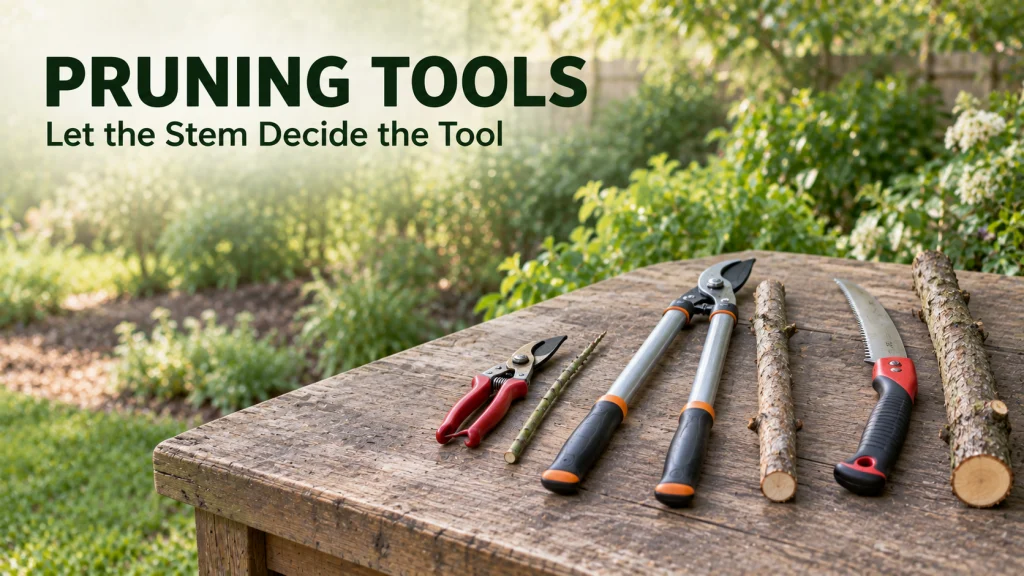
One bench, three different cutting jobs
Pruning tools can look interchangeable in a drawer until you put a soft stem, a thumb-thick woody branch, and an awkward overhead cut beside each other. The soft stem asks for control and a clean one-handed cut, while the thicker branch asks for leverage or a sawing action. The overhead branch adds a reach problem that a longer handle does not automatically solve safely. That is why the useful question is not which tool looks strongest, but what kind of cut is in front of you.
A good pruning tool guide should help you stop escalating before the tool becomes awkward, damaging, or unsafe to use. If a hand pruner needs two hands, twisting, or repeated squeezing to close, the branch has already told you that the tool class is wrong. If long lopper handles fit around the branch but cannot move through a controlled arc, extra leverage is not actually helping. The rest of the kit should be built around those handoff points, not around owning every cutter on the wall.
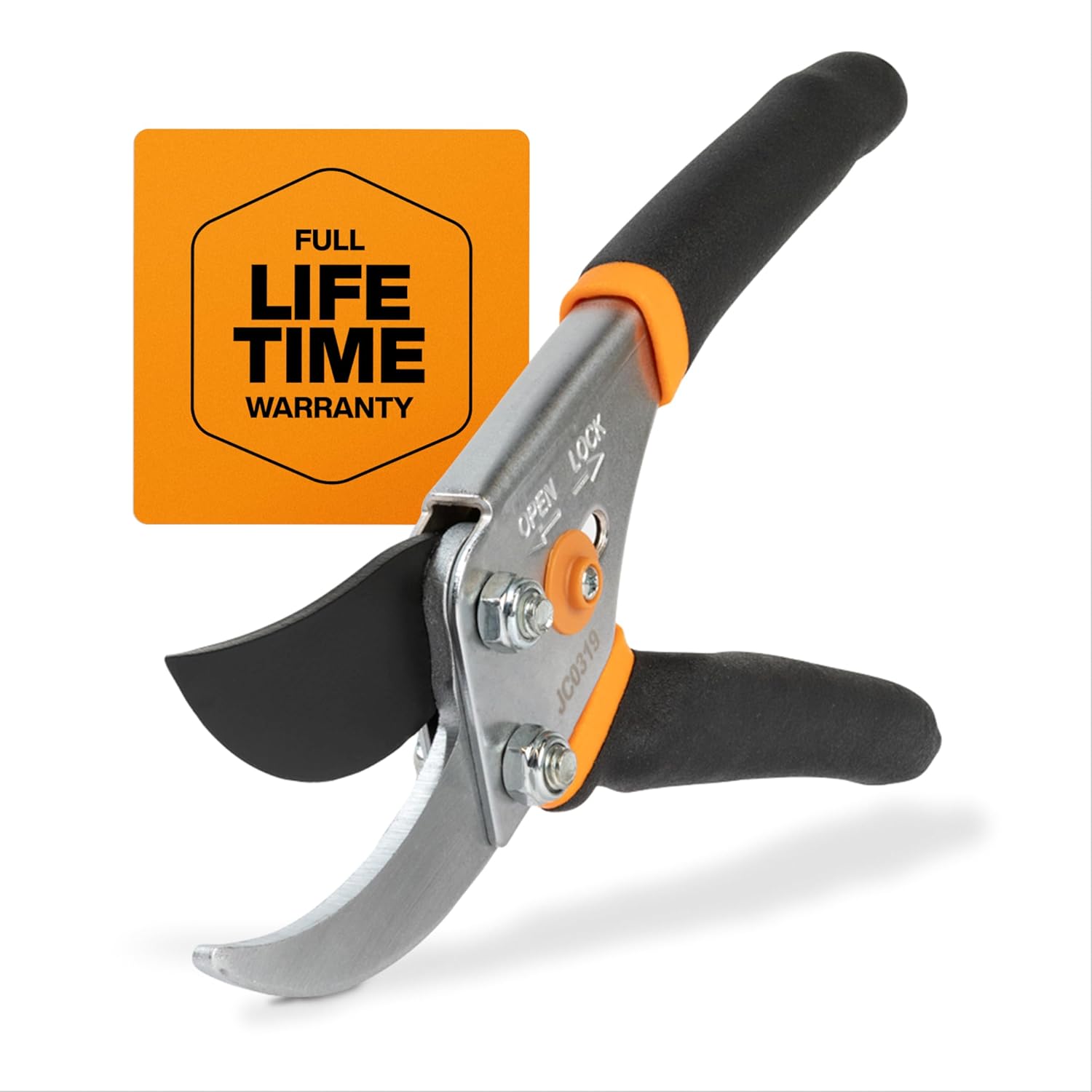
This bypass pruner cuts live stems and small branches up to 5/8 inch. Its precision-ground steel blade has a low-friction coating and a sap groove to reduce sticking. The non-slip handle and easy-open lock support controlled everyday pruning and compact storage.
Check On AmazonIf you click this link and buy, we earn a commission at no additional cost to you.
Start with stem material and cut size
The useful way to compare types of pruning tools is to look at what the blade must pass through and how much room you have to control the cut. A green flexible stem behaves differently from dry hard wood even when both measure about the same across. Published capacity ranges also vary among tool designs and guidance sources, so diameter should be treated as a routing clue rather than a universal promise. The exact tool rating, blade opening, wood hardness, and your ability to make one clean controlled cut still matter.
Start with the smallest tool that can make the cut without strain, then move to a different mechanism when the stem resists. Hand pruners suit small individual stems where placement matters, loppers add leverage for larger material, and pruning saws remove the need to force two blades through wood that is beyond comfortable shearing. Manual hedge shears solve a different problem because their long blades make many light shaping cuts across soft growth. If reach changes the job, reassess access and control instead of assuming that longer handles alone make the cut appropriate.
| Escalation stage | Stem material and cut | Access and control check | Tool direction | Handoff signal |
|---|---|---|---|---|
| Stage 1: detail cut | Small individual live stem or light woody growth | One hand can place the blades accurately around nearby buds and stems | Hand pruners | Move up when one-handed control is no longer comfortable or the blades do not close cleanly through the stem. |
| Stage 2: leverage cut | Thicker woody branch that is still suitable for a shearing action | There is enough room for both handles to open, close, and stay aligned | Loppers | Move up when leverage is no longer producing one controlled cut, or when the handle arc is blocked by surrounding growth. |
| Stage 3: sawing cut | Woody branch that resists comfortable shearing because of size, hardness, or both | The branch is visible, the blade path is clear, and the cut can be made without hazardous overhead work | Pruning saw | Stop escalating homeowner tools when reach, falling wood, utilities, instability, or branch position makes the work hazardous. |
| Separate route: surface shaping | Many soft shoots forming a hedge face or similar repeated light growth | Long blades can sweep the surface without being asked to remove isolated woody branches | Manual hedge shears | Switch back to a selective tool when individual woody stems interrupt the shaping work. |
| Access override | Any cut that is outside comfortable ground-level reach | Reach changes visibility, balance, falling-material risk, and fine control | Reassess the cut before choosing a longer tool | Do not treat extra length as a reason to continue when the job has moved beyond ordinary residential garden work. |
Read the first three rows as the practical escalation ladder: pruner first, lopper when leverage is the missing piece, then pruning saw when shearing is no longer the clean mechanism. Read across each row as the stem-material and access matrix, because the same branch thickness can lead to a different decision when the wood is harder, the working arc is blocked, or the cut is outside controlled reach. The handoff is therefore based on what changes at the cut, not on a single universal diameter threshold. Exact tool capacity still belongs to the model-specific instructions or current manufacturer information.

This forged steel bypass pruner is rated for live stems and branches up to 1 inch. Its fully hardened precision-ground blade can be sharpened or replaced, and the low-friction coating helps reduce sap buildup and rust. It suits gardeners who want a stronger hand-pruner step before moving to a two-handed tool.
Check On AmazonIf you click this link and buy, we earn a commission at no additional cost to you.
Choose hand pruners before adding leverage
For ordinary selective pruning, hand pruners are the first tool to evaluate because they keep the cutting point close to your hand. That short distance gives better placement around buds, stems, and nearby branches than a long-handled tool can provide. Bypass pruners use a moving blade that passes another blade in a scissor-like action, and Extension guidance generally favors that action for clean cuts on living stems. Anvil designs close a cutting blade against a flat surface, which can be useful in some dry material but may crush softer living tissue.
Fit matters almost as much as blade style when a pruner will be opened and closed repeatedly. A grip that is too large can make your hand stretch for every cut, while a tool that is too small may not give comfortable leverage. Look for a lock you can operate without fighting the tool, a spring action that opens predictably, and a cutting head that can be positioned without scraping adjacent stems. If you are choosing tools for pruning a mixed home garden, comfortable control is a better reason to keep a pruner than a large capacity number printed on the package.
The main warning sign is not simply branch diameter, but whether the pruner still gives you the precise one-handed control that justified choosing it. If the cut becomes awkward, the blade cannot close cleanly, or your grip has to change just to finish the stem, the advantage of the hand pruner has disappeared. At that point, reassess the cutting mechanism instead of treating a difficult cut as a grip-strength problem. The next tool should solve the lost leverage or control without sacrificing placement.

The Felco F2 uses a precision bypass blade with hardened steel and forged aluminum handles. Its replaceable parts and sharpenable cutting components support long-term maintenance. The 9.25-inch format keeps the cutting point close to the hand for selective pruning where placement and control matter.
Check On AmazonIf you click this link and buy, we earn a commission at no additional cost to you.
Move to loppers when reach or leverage is the real need
Loppers are not just oversized pruners, even though the cutting heads can look similar. Their longer handles multiply leverage and let two hands share the effort, which makes them useful when a woody stem has moved beyond comfortable one-handed cutting. They can also help you reach slightly into a shrub without putting your hands directly into dense branching. That extra reach is useful only when the head can still be positioned correctly and the handles have enough room to open and close.
This is where gardeners sometimes buy more handle than the garden can use. Long handles need a wide working arc, and that can be a problem inside a dense shrub, beside a fence, or between crossing branches. A tool that technically reaches the stem may still be a poor fit if one handle hits another branch before the blades close. In that situation, a different cutting mechanism or a more accessible cut path can be more practical than simply moving to longer loppers.
Leverage can also hide the moment when a branch is too demanding for a shearing tool. If the blades are barely spanning the wood, the handles flex, or the cut stalls despite a controlled two-handed squeeze, the pruning saw becomes the more appropriate mechanism. Extension guidance commonly places loppers between hand pruners and pruning saws, but the published diameter bands are not identical across sources. Use the tool’s verified capacity as a ceiling and a clean controlled cut as the practical test below that ceiling.

This 28-inch bypass lopper is built for green living branches and is rated for cuts up to 1.5 inches. Its hardened steel blade has a low-friction coating that helps reduce sap buildup and rust. The long two-handed format adds leverage when a hand pruner no longer gives a comfortable controlled cut.
Check On AmazonIf you click this link and buy, we earn a commission at no additional cost to you.
Use pruning saws instead of forcing long handles
A pruning saw changes the job from shearing the entire branch at once to removing wood with repeated tooth strokes. That makes it the logical next class when a woody branch resists pruners or loppers, especially if extra handle length would only add awkwardness. Pruning saw blades are shaped and toothed for branches rather than general carpentry work, and many garden saws are made to work efficiently in crowded growth. Folding designs can also protect the teeth and make storage easier, although the hinge and lock become parts that should be checked for secure operation.
The useful handoff is simple: pruners handle controlled small cuts, loppers add leverage while a shearing action still makes sense, and a pruning saw takes over when the wood is better removed by sawing than by squeezing two blades together. That sequence is more reliable than stretching one tool class to cover every borderline branch. A saw still requires a visible cut and a clear blade path, so changing mechanisms does not cancel the access check. The plant-specific question of exactly where to place a pruning cut belongs to the care guidance for that plant or pruning task, not to the tool-selection decision here.
Reach needs a separate safety check. A pole-mounted cutter can extend access from the ground, but longer reach also reduces fine control and puts falling material farther from your hands and closer to your head and surroundings. Do not treat a pole tool as permission to work near utility lines, unstable limbs, or branches whose size and position create a hazardous drop. When the job moves from ordinary ground-level garden pruning into hazardous tree work, the correct tool decision is to stop homeowner-level work rather than keep escalating equipment.

This manual pruning saw uses a 10-inch curved blade for cutting woody branches. The blade folds into the handle for storage and the folding mechanism includes a secure latch. It fits the point where a branch is better removed by sawing than by forcing a shearing tool.
Check On AmazonIf you click this link and buy, we earn a commission at no additional cost to you.
Keep manual hedge shears for soft repeated shaping
Manual hedge shears earn their place when the task is repeated light clipping across a hedge face or other soft growth. Their long blades cover more surface with each closing motion, so they are efficient when you are maintaining a line rather than selecting one woody branch at a time. That broad cutting action is also why they are a poor substitute for hand pruners on individual structural cuts. Trying to capture a thick branch near the tip of the blades trades control for leverage in exactly the wrong way.
The distinction becomes clearer if you separate shaping from pruning. Shaping asks whether many small shoots need to be shortened to maintain a surface, while selective pruning asks which particular stem or branch should be removed and where the cut belongs. Hedge shears are built around the first job, not the second. If a hedge has occasional thicker woody stems mixed into soft outer growth, use a selective cutting tool for those stems instead of asking the shears to do two jobs at once.
This separation also prevents a common buying mistake. A gardener with one small hedge may not need a larger, heavier, or powered system just because powered equipment exists. Manual shears can be enough when the cutting volume is modest, the stems are soft, and the gardener is comfortable with the repeated motion. If the workload becomes large enough that powered equipment enters the decision, that is a different comparison involving power source, weight, guarding, maintenance, storage, and the exact safety instructions for the equipment.

These manual hedge shears use 8-inch serrated blades for trimming and shaping hedges, shrubs, and similar garden growth. The Power Lever mechanism increases leverage while the non-slip handles and shock-absorbing bumper improve control during repeated cuts. A low-friction blade coating helps reduce gumming and improves resistance to rust.
Check On AmazonIf you click this link and buy, we earn a commission at no additional cost to you.
Keep blade care separate from powered equipment decisions
A small manual pruning kit stays useful only if the cutting edges remain clean, sharp, and mechanically sound. Sap and plant debris can interfere with blade movement, moisture can encourage corrosion on susceptible metal, and a dull edge can turn a controlled cut into a squeeze-and-tear exercise. Clean visible debris after use, dry metal surfaces, and follow the tool maker’s instructions for sharpening, lubrication, adjustment, and disassembly. If a blade is chipped, badly misaligned, loose at the pivot, or no longer closes correctly, maintenance may not be enough to restore a safe clean cut.
Sanitation is a separate issue from ordinary cleaning. When you are cutting visibly diseased material or moving between plants where disease transmission is a concern, Extension guidance recommends cleaning debris first and then using an appropriate disinfection method. The exact disinfectant, contact method, and material compatibility matter because some chemicals can corrode metal or damage finishes. Do not turn a generic cleaning habit into a disease-control guarantee, and follow plant-specific disease guidance when sanitation is part of managing a known problem.
Powered hedge trimmers, powered pruners, chainsaws, and other motorized cutters should not be treated as automatic upgrades from manual tools. They add operating instructions, guarding, power-system care, storage, and safety requirements that change the decision beyond simple cutting capacity. For a broader look at how hand tools fit into a practical residential setup, see the essential garden tools guide. The best next addition is the tool that solves a repeated cutting constraint you actually have, not the one that simply adds the most power.

This compact handheld sharpener is made for pruning shears, loppers, hedge clippers, and other garden blades. The AC 8300 uses a manual steel sharpening element in a small portable format. It gives a dedicated maintenance option for restoring an edge without moving into powered sharpening equipment.
Check On AmazonIf you click this link and buy, we earn a commission at no additional cost to you.
Final Thoughts: let stem size, material, and access build the kit
A useful pruning kit can stay surprisingly small when each tool has a distinct job. Hand pruners cover precise small cuts, loppers cover the leverage step, and pruning saws take the branches that no longer suit a clean shearing action. Hedge shears stay in their own shaping role instead of becoming long-bladed branch cutters. Building the kit around those jobs avoids buying overlapping tools that do not solve a new constraint.
Before adding anything, look at the stems you actually cut, the space around them, and the maintenance burden the new tool brings. Check exact capacity and care instructions for the tool you own or are considering, because material hardness and design change what a diameter number means in practice. Stop when reach, falling branches, utilities, or unstable work moves the job outside ordinary residential garden care. The right pruning tool is the one that lets you make the intended cut cleanly and controllably without forcing the mechanism or expanding the job into unsafe work.

This leather holster is designed to carry Felco pruning shears and compatible compact cutting tools. It includes both a belt loop and clip, keeping a frequently used pruner accessible while moving through the garden. The molded leather body adds simple storage to a small pruning kit without adding another cutting mechanism.
Check On AmazonIf you click this link and buy, we earn a commission at no additional cost to you.
Explore the pruning tool choices in more detail
The broad routing above tells you when the tool class should change, but each class still has its own fit and mechanism decisions. Use the articles below when you already know which cutting problem you are trying to solve and need a narrower comparison. That keeps a pruner question from turning into a saw question, or a leverage problem from being mistaken for a blade-style problem. It also makes it easier to verify the feature that actually matters before you buy or replace anything.
You do not need to read every topic before making a simple cut. Start with the row that matches the tool or handoff point you are dealing with, then return to the larger route if the branch still does not fit that tool class. The goal is a small kit with clear jobs, not a collection built around overlapping capacity claims. Where two tools overlap, choose based on control, access, and how often that exact kind of cut appears in your garden.
| Topic | What you’ll find |
|---|---|
| How pruning shears fit everyday garden cuts | Use this when hand pruners are the likely starting tool and you need to understand fit, control, and ordinary cutting limits. |
| Bypass vs anvil pruners | Compare the two common hand-pruner cutting actions and the plant material each mechanism handles more appropriately. |
| When loppers make more sense than pruners | Use the handoff when one-handed cutting has become strained or the extra reach and leverage solve a real access problem. |
| How to choose loppers for garden work | Focus on handle length, leverage, cutting head, access, and the practical burden of a larger two-handed tool. |
| Where anvil loppers fit | Look at the anvil mechanism separately when wood condition and cutting action make it relevant to the job. |
| When a pruning saw should take over | Use this when a woody branch has moved beyond comfortable shearing and a saw is the cleaner mechanical choice. |
| How folding pruning saws trade storage for moving parts | Compare compact storage and blade protection with hinge, lock, and handling considerations. |
| When to use loppers or a pruning saw | Resolve the overlap where a branch may be cuttable by either leverage or sawing, but one route offers better control. |
| How hedge shears fit repeated shaping | Keep broad soft-growth shaping separate from selective woody branch pruning. |
| Where garden scissors belong in a cutting kit | Use scissors for light detail work where a larger pruning mechanism would add bulk without adding useful control. |
These narrower guides are most useful after you have identified the cut rather than before it. If the job keeps crossing several rows, separate the work by stem type instead of forcing one tool to cover everything. That approach usually makes both tool choice and maintenance simpler. It also gives you a clearer reason to skip a tool that does not solve a recurring problem in your garden.

These 6-inch pruning scissors use stainless steel micro-tip blades for flower stems, herbs, buds, and small plants. The narrow tips cut to the end of the blade for light detail work in tight growth. They give the broader kit a distinct fine-cut role instead of overlapping with loppers, saws, or hedge shears.
Check On AmazonIf you click this link and buy, we earn a commission at no additional cost to you.
Frequently asked questions
✂️ What pruning tool should I buy first?
For many home gardens, a comfortable pair of hand pruners is the logical first cutting tool because it handles small selective cuts with good control. Add another tool only when the stems you regularly cut, the reach you need, or the workload shows a repeated limitation.
🌿 When should I use loppers instead of hand pruners?
Move to loppers when a branch no longer cuts comfortably with one hand or when modest extra reach and leverage clearly solve the job. Do not use them just because their handles are longer if the working space is too tight to open and close them cleanly.
🪚 How do I know when I need a pruning saw?
Use a pruning saw when woody material resists a clean controlled cut with pruners or loppers. If you are twisting, bouncing on handles, or crushing the branch to finish the cut, you have already passed the practical handoff point.
🌳 Are hedge shears good for cutting branches?
Manual hedge shears are best for repeated light shaping across soft hedge growth, not isolated woody branches. Use hand pruners, loppers, or a pruning saw for selective branch removal based on the size and condition of the wood.
🧼 Do pruning tools need to be disinfected after every cut?
Not every ordinary cut carries the same disease risk, but sanitation becomes important when working with diseased material or moving between susceptible plants. Remove visible debris first, then follow appropriate Extension or plant-disease guidance for the disinfectant and contact method.
🖐️ Is a longer pruning tool always easier to use?
No. Longer handles can add leverage and reach, but they also need more room to move and can reduce control in dense growth. Choose added length only when it solves a real access or leverage problem in the place where you will make the cut.
References and Sources
- UC Marin Master Gardeners pruning tools guidance: Supports the hand-pruner, saw, blade-care, and tool-escalation distinctions used in this article.
- Iowa State University Extension pruning equipment guide: Supports the practical separation among hand pruners, loppers, pruning saws, reach tools, and hedge shears.
- University of Georgia Extension pruning guidance: Supports pruning-tool care, sharpening, cleaning, and the handoff from shearing tools to a pruning saw.
- University of Minnesota Extension tool sanitation guidance: Supports cleaning and disinfection boundaries when disease transmission is a concern.