Home lawn maintenance works better when the routine follows the grass, the site and the problem in front of you instead of a universal checklist. Mowing is the foundation, while watering, overseeding, aeration, dethatching, weed control and fertilizing should be added only when the lawn gives you a reason. Cool-season and warm-season grasses respond differently to weather and maintenance, so the same task can be useful in one lawn and poorly timed in another. The goal is a practical residential routine that keeps turf functional without treating every brown patch, thin area or seasonal change as a reason to add another product or service.
Start by deleting lawn tasks you do not need
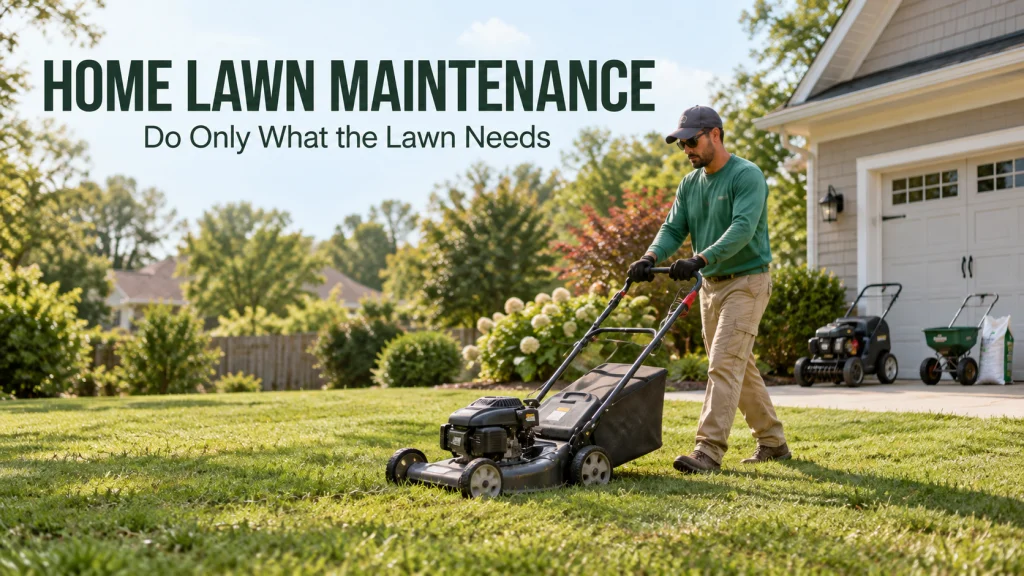
A new homeowner can inherit a lawn and, within a few conversations, collect a surprisingly long list of instructions: mow lower, water more, fertilize, dethatch, aerate, overseed and spray the weeds. Good home lawn maintenance does not begin by scheduling all of those jobs. It begins by identifying the grass type, looking at the current condition and deciding what standard the household actually wants to maintain. A healthy residential lawn may need regular mowing and occasional corrective work, but it rarely benefits from treating every possible maintenance task as mandatory.
The useful question is not, “What should a lawn owner do every year?” It is, “What is this lawn asking for now, and what can be skipped?” A dense lawn that drains well has a different workload from a thin lawn on compacted soil. An established lawn has different water needs from newly seeded turf. Grass that is dormant or slowed by weather should not be managed as if it were actively growing. Once those distinctions are clear, the routine becomes shorter, easier to maintain and less likely to create a second problem while trying to solve the first.

This acrylic rain gauge measures up to 5 inches of rainfall with an enlarged reading scale. It gives homeowners a simple record of recent precipitation before deciding whether lawn watering is needed. The gauge supports an evidence-first routine instead of adding maintenance from a fixed checklist.
Check On AmazonIf you click this link and buy, we earn a commission at no additional cost to you.
Identify the grass type and the lawn standard you actually want
The first practical split is between cool-season and warm-season turf. Cool-season grasses put their strongest growth into cooler conditions, while warm-season grasses do their best growing when conditions are warmer. That difference affects mowing response, seeding strategy, fertilizing windows, recovery from mechanical work and what seasonal color changes mean. If you do not know which group dominates the lawn, local Extension guidance, seed records, a close look at leaf and growth characteristics, or a local turf identification resource is a better starting point than copying a neighbor’s schedule.
The second decision is more personal: decide what “good enough” means for the property. A family lawn used for play, pets and casual outdoor time does not need to imitate a highly managed sports surface, and a low-traffic front lawn may not justify the same inputs as a heavily used backyard. More uniform color and density usually require more monitoring and intervention, while a functional lawn can tolerate some seasonal color change and a modest amount of weed presence. Setting the standard first keeps maintenance proportional to the result you actually value, which matters because extra irrigation, fertilizer, mowing and corrective work all add cost and labor.

This handheld tool provides 5X magnification for close outdoor inspection. Its quick-release bug catcher design is intended for indoor and outdoor observation. The magnifier can help a homeowner examine turf leaves and surface features while comparing grass characteristics.
Check On AmazonIf you click this link and buy, we earn a commission at no additional cost to you.
Make mowing height and growth rate the routine foundation
Mowing is the task most lawns need most consistently, but frequency should follow growth rather than a fixed weekly habit. Turfgrass species differ in their preferred cutting range, and weather, soil moisture and fertility can speed or slow growth. A useful general rule is to avoid removing more than about one third of the leaf blade in a single mowing, then adjust the interval so you are not repeatedly scalping tall growth back to the target height. If the lawn has grown too long, bringing it down gradually is usually less stressful than taking off a large amount at once.
Cut quality matters as much as the schedule. A sharp mower blade makes a cleaner cut, while a dull blade tears the leaf and can leave the lawn looking ragged or brown at the tips. Edging is a separate finishing task: use it where turf is creeping across sidewalks, drives or bed lines, but do not treat a sharply cut edge as a substitute for healthy mowing height and density. Grass clippings can usually stay on the lawn when mowing is frequent enough that they are small and dispersed, and the lawn mowing guide goes deeper into height, frequency and practical mowing choices without turning equipment features into the starting point.

The Smiths 50603 uses a preset carbide blade to sharpen lawn mower blades. Its oversized handle and large finger guard support controlled hand use, and a wire-bristle cleaning brush stores in the handle. Keeping the mower blade sharp directly supports cleaner cuts when mowing is the routine foundation.
Check On AmazonIf you click this link and buy, we earn a commission at no additional cost to you.
Water established turf from root-zone need, not automatic runtime
An established lawn should not be watered simply because the controller says it is a watering day. Look for a combination of soil dryness and turf stress, then water enough to rehydrate the root zone without creating runoff. Footprints that remain visible, folded or dull-looking leaves and dry soil below the surface can all be useful clues, but they should be read together with recent rainfall and the lawn’s grass type. Clay, compaction, slope and thatch can slow infiltration, while sandy soil can lose water more quickly, so identical sprinkler runtime does not mean identical root-zone moisture.
New seed is the important exception because the surface must stay consistently moist while germination and early establishment are underway. That short, frequent watering pattern is not a good default for established turf, where repeated shallow irrigation can favor shallow rooting and keep the surface wetter than necessary. If water begins to run off before the root zone is rehydrated, split the application into shorter passes with soak time between them rather than forcing more water onto the surface. For method, coverage and adjustment details, use the lawn watering guide and keep the decision tied to actual soil moisture rather than a generic timer setting.

The XLUX meter gives an instant soil-moisture reading without batteries. It uses a durable 304 stainless steel probe and is intended for indoor and outdoor soil checks. Checking moisture below the surface makes it useful before deciding whether an established lawn needs water.
Check On AmazonIf you click this link and buy, we earn a commission at no additional cost to you.
Use overseeding when density is the problem and new grass can establish
Overseeding makes sense when the lawn is thin, has small bare areas or needs new plants to improve density, but seed cannot compensate for a site that still cannot support turf. Before spreading seed, check why the lawn became thin. Heavy shade, repeated traffic, poor drainage, persistent compaction, unsuitable grass selection or a watering problem can defeat new seedlings just as effectively as they weakened the old turf. Correcting the limiting condition first gives the seed a realistic chance to establish instead of turning overseeding into an annual repair ritual.
Grass type also changes the decision. Many cool-season lawns are commonly refreshed by overseeding, while warm-season lawns may be repaired or established through seed, sod, plugs or other methods depending on the species. Seed-to-soil contact is important, so compacted soil or a heavy surface layer may need preparation before seeding. The overseeding a lawn guide covers the full preparation and establishment process, but the main screening question stays simple: if density is not the actual problem, or the site still cannot support new turf, adding seed is unlikely to fix what you see.

The Scotts Whirl is a hand-powered spreader for grass seed, fertilizer, salt and ice melt. Its adjustable arm support is designed for comfort, and the hopper holds enough Scotts product to cover up to 1,500 square feet. For a small lawn, it provides a practical way to distribute grass seed after site problems have been addressed.
Check On AmazonIf you click this link and buy, we earn a commission at no additional cost to you.
Aerate for compaction and dethatch only for measured thatch
Aeration and dethatching are often sold as a pair, but they solve different physical problems. Core aeration is useful when soil has become compacted from traffic, construction or repeated use and air and water movement into the root zone is restricted. Dethatching removes an excessive layer of stems, roots and other turf material that accumulates between the green canopy and the soil surface. Surface clippings or loose dead grass are not proof of harmful thatch, so cutting into a small section and looking at the profile is more useful than judging the lawn from above.
Neither treatment belongs on an automatic annual checklist for every property. Mechanical work stresses turf, so it should be done when the grass is actively growing and able to recover, with the exact window based on the turf type and local conditions. If compaction is the main issue, follow the lawn aeration guide; if a real thatch layer is interfering with water movement or turf health, use the lawn dethatching guide. When both conditions exist, plan the sequence around the repair goal instead of assuming that renting two machines automatically produces a better lawn.

The Yard Butler ID-6C is a manual lawn coring aerator designed for spot aeration. Its coring action removes small soil plugs rather than relying on surface spikes alone. It fits compacted residential areas where core aeration is the specific corrective task instead of an automatic annual treatment.
Check On AmazonIf you click this link and buy, we earn a commission at no additional cost to you.
Read lawn weeds as targets and as clues to weak turf conditions
Weeds matter, but the presence of weeds also tells you where the turf is failing to occupy space. Thin grass from shade, low mowing, compaction, poor drainage, drought stress or weak establishment can open gaps that weeds exploit. Removing the weed without improving the condition that created the gap may produce a short-lived cosmetic change rather than a durable improvement. Start by identifying the weed accurately, then look at the turf around it and ask why the desirable grass is not competing well in that spot.
Control choices depend on the weed, grass species, lawn condition and current product label. This is not a place for one universal treatment recipe. Some problems can be reduced by improving mowing, density or watering before a herbicide becomes necessary, while other infestations may justify targeted control. Never assume a product is safe for every turf species just because the front label says “lawn.” The lawn weeds guide is the next stop for identification and control logic, including when the better first move is strengthening the turf rather than escalating chemical inputs.

The Fiskars stand-up weeder uses four serrated stainless steel claws to grip weeds and roots. Its long ergonomic handle, foot platform and easy-eject design reduce the need to bend or kneel during removal. It fits a section that recommends identifying weeds and improving turf conditions before escalating chemical control.
Check On AmazonIf you click this link and buy, we earn a commission at no additional cost to you.
Fertilize from turf demand, soil evidence and product analysis
Fertilizer should support growth the turf can use, not function as a general response to any lawn that looks pale or thin. Soil testing can clarify pH and several nutrient conditions, while grass type and growth stage still matter for nitrogen needs. Too much nitrogen can push soft leaf growth, increase mowing demand and make some stress or disease problems worse. A lawn with poor drainage, severe shade or compacted soil may not respond well to extra fertilizer because nutrients are not the limiting factor.
Read the fertilizer analysis and current label before applying anything, then match the product and rate to the grass, region and local rules. Phosphorus is a good example of why guessing is a poor strategy: mature lawns may not need additional phosphorus unless soil evidence or establishment needs support it, and local restrictions can apply. Sweep stray granules off hard surfaces so they stay out of runoff, and do not exceed label directions in an attempt to force faster color. For the full decision process, the lawn fertilizer guide covers soil evidence, turf demand and label-based use in more detail.

The Rapitest kit is designed for gardens and lawns and checks soil pH and nutrient conditions. It provides at-home measurements that can inform fertilizer decisions before an application is chosen. That evidence helps keep fertilizing tied to a documented soil condition instead of lawn color alone.
Check On AmazonIf you click this link and buy, we earn a commission at no additional cost to you.
Build seasonal timing around cool-season or warm-season growth
A national lawn calendar is convenient, but it can be misleading because the same month can mean active growth in one region and stress or dormancy in another. Cool-season and warm-season grasses have different growth cycles, and unusual heat, drought, cold or rainfall can shift the safest window for seeding, fertilizing, aerating or dethatching. Use the grass’s active growth and recovery capacity as the first timing signal, then refine the plan with local Extension guidance. The calendar should describe what to watch for, not overrule what is happening in the lawn.
This approach also prevents unnecessary work during dormancy or environmental stress. A lawn that has slowed because of heat or drought may need less mowing and careful water decisions, not an aggressive renovation. Warm-season turf naturally loses green color when it becomes dormant in cold conditions, while cool-season turf can slow or brown during hot, dry conditions, so color alone does not tell you what treatment to apply. The seasonal lawn care guide helps translate those growth patterns into a practical routine without pretending one schedule fits the entire country.

The Taylor soil thermometer uses a 4-inch stem for direct temperature checks in garden or lawn soil. It is a simple outdoor tool for reading soil temperature at the point of use. That measurement can complement local guidance when seasonal lawn work is timed around active growth and changing conditions.
Check On AmazonIf you click this link and buy, we earn a commission at no additional cost to you.
Keep yard cleanup functional rather than spotless
Cleanup should protect turf function, access and safety, not chase a perfectly bare surface. Thick mats of leaves can block light and trap moisture over grass, and storm debris can interfere with mowing or create obvious hazards. Small amounts of finely chopped leaf material can often be mulched into the lawn if they disperse instead of forming a smothering layer. Grass clippings can usually remain as well when they are short and evenly distributed, so bagging every mowing is not a requirement for a healthy yard.
The practical line is whether debris interferes with the grass or the way the yard is used. Remove heavy piles, branches, litter and anything that blocks drainage or creates a mowing hazard, but avoid turning cleanup into repeated disturbance for no clear benefit. Larger property cleanup also includes edges, access paths and places where material accumulates against structures or drains. For a broader property-level process, the yard cleanup guide separates useful cleanup from cosmetic work that adds effort without improving the lawn.

This adjustable metal leaf rake uses an expandable 8-to-17-inch head and a long handle for lawn and yard cleanup. The narrow setting can reach tighter spaces, while the wider setting covers more open ground. It is suited to removing heavy leaves and debris when they begin to interfere with turf function or mowing.
Check On AmazonIf you click this link and buy, we earn a commission at no additional cost to you.
Diagnose brown patches and other turf problems before treating
Brown turf is a symptom, not a diagnosis. Drought, heat, dormancy, scalping, compaction, pet urine, insects, disease, irrigation gaps and root problems can produce overlapping patterns, and some turf diseases can resemble environmental stress closely enough that visual inspection alone is not definitive. Before applying an insecticide, fungicide or fertilizer, compare the pattern, recent weather, soil moisture, grass species and what changed in the area. A treatment aimed at the wrong cause can waste money and add stress while the real problem continues.
Start with reversible checks: verify moisture, inspect the cut quality, look for obvious traffic or drainage patterns, and examine the boundary between healthy and affected turf. If the evidence points toward a pest or disease, identify the organism or use a qualified diagnostic resource before choosing a pesticide, then follow the current label exactly. The lawn problems guide is designed for that symptom-first process. The important boundary is simple: lawn color and patch shape can narrow the possibilities, but they should not be treated as proof of a single cause.

These Orbit catch cups are designed to collect sprinkler output across a lawn. Comparing the collected water helps reveal distribution differences that can point to irrigation coverage gaps. The set is useful when a brown patch may be related to uneven watering rather than a pest, disease or fertilizer problem.
Check On AmazonIf you click this link and buy, we earn a commission at no additional cost to you.
Use a need-or-skip check before adding another maintenance task
When several lawn jobs seem plausible at once, screen each one against the condition it is supposed to correct. This avoids the common pileup where a lawn is mowed, fertilized, aerated, dethatched and overseeded simply because those services are available. The table below is not a treatment schedule. It is a way to decide which question deserves attention first and which task can stay off the list until there is evidence for it.
| Task | Consider it when | Skip or delay it when |
|---|---|---|
| Mowing adjustment | Growth outruns the interval, cutting is too low, or leaf tips are torn. | Turf is dormant, stressed, too wet, or has barely grown. |
| Watering | The active root zone is becoming too dry. | Rain supplied enough moisture, soil is wet, or dormancy is intentional. |
| Overseeding | Density is low and the site can support new grass. | An unresolved site problem is likely to defeat seedlings. |
| Core aeration | Compaction restricts root-zone air or water movement. | Soil is not meaningfully compacted. |
| Dethatching | Measured thatch is excessive and interfering with turf. | You see only loose debris or a thin normal layer. |
| Fertilizing | Turf demand, soil evidence and growth support an application. | Stress or another limiting factor is the real issue, or the planned use is not supported. |
The value of the matrix is subtraction, not another checklist. If only mowing and a watering check are justified, that is a complete maintenance plan for the moment, not an incomplete version of a larger program. When conditions change, reassess rather than automatically carrying every task forward. That keeps corrective work tied to evidence. A smaller routine that responds to grass growth and actual problems is easier to maintain and less likely to create unnecessary cost, disturbance or chemical use.

The Zozen measuring wheel tracks distance in feet and inches with a mechanical counter and one-key reset. Its 4-inch wheel and telescoping handle make it portable for measuring lawn dimensions. Accurate dimensions help homeowners scale seeding, watering and treatment plans before adding another maintenance task.
Check On AmazonIf you click this link and buy, we earn a commission at no additional cost to you.
Compare cool-season and warm-season lawns before choosing timing
Grass type does not answer every lawn question, but it changes enough of them that it deserves a place near the top of the decision process. The overview below keeps the comparison at homeowner level and avoids turning regional turf management into a single national recipe. Local cultivars, soil, shade, water and weather still matter. Use this as a routing check rather than a substitute for local recommendations.
| Decision | Cool-season turf | Warm-season turf |
|---|---|---|
| Main growth pattern | Growth is strongest in cooler conditions, while heat can slow it. | Growth is strongest in warmer conditions, while cold can bring dormancy. |
| Renovation timing | Seed and do mechanical work during a local active-growth recovery window. | Repair during active growth using local establishment guidance. |
| Seasonal color | Heat and drought can cause stress, slowing or dormancy. | Cold can bring normal dormancy and brown color. |
| Fertilizer timing | Nitrogen timing should follow local cool-season guidance. | Nitrogen timing should follow active warm-season growth and local guidance. |
| What not to assume | Brown turf in heat is not automatically dead or diseased. | Dormant brown turf does not automatically need fertilizer or water. |
Mixed lawns require another layer of judgment because one maintenance choice can favor one grass over another. Where grass types occupy separate areas, managing each area according to its dominant turf is usually clearer than averaging them into one schedule. Where species are intermingled, decide which turf you are trying to favor and use local guidance for the compromise. That distinction helps prevent mistimed corrective work. It keeps seasonal maintenance tied to the lawn you actually have rather than the lawn pictured on a generic calendar.

This Taylor wireless digital thermometer displays indoor and outdoor temperature on an LCD screen. Its easy-read format gives a homeowner a simple local temperature reference near the yard. That information adds context when comparing cool-season and warm-season growth patterns without treating the calendar alone as the answer.
Check On AmazonIf you click this link and buy, we earn a commission at no additional cost to you.
Route each lawn job to the right next step
This page is meant to keep the whole maintenance system visible, not replace the detailed process for every task. Once you know the real job, move to the topic that owns that decision instead of trying to solve mowing, edging, irrigation, weeds, soil and equipment all in one pass. The same boundary matters outside turf: general garden soil belongs with soil guidance, irrigation hardware belongs with watering systems, and mower selection belongs with tool and equipment guidance. Keeping those questions separate prevents a turf symptom from turning into an unrelated shopping list.
- Is the routine problem cutting height, frequency or turf creeping over hard edges?
- Use lawn mowing for cutting height and frequency.
- Handle edging as a boundary-maintenance task where grass is spreading across sidewalks, drives or bed lines, rather than as a treatment for thin or unhealthy turf.
- Is the established lawn actually short on water?
- Use lawn watering for root-zone checks, coverage and irrigation decisions.
- Is the problem low turf density?
- Use overseeding a lawn when the site can support new grass.
- Is compacted soil restricting the root zone?
- Use lawn aeration.
- Is there a measured excessive thatch layer?
- Use lawn dethatching.
- Are weeds the visible problem?
- Use lawn weeds for identification, turf-condition clues and control logic.
- Does the turf need nutrients rather than a correction to light, water, drainage or compaction?
- Use lawn fertilizer.
- Is timing the main question?
- Use seasonal lawn care to match work to cool-season or warm-season growth.
- Is the issue leaves, debris or broader property cleanup?
- Use yard cleanup.
- Is the lawn thinning, browning or showing an unexplained patch pattern?
- Use lawn problems before choosing a pesticide or other treatment.
Use the narrowest guide that matches the job you are actually doing. If the issue is a mower model, edger model, replacement part or equipment feature, treat the equipment as its own decision rather than assuming a better machine fixes the turf. If the problem is garden-bed weeds, general plant disease or non-lawn soil improvement, follow the guidance for those subjects instead of applying turf rules outside their scope. This separation is what keeps residential lawn care practical: identify the need first, then use the method that actually addresses it.

The Orbit 62061Z is a single-outlet programmable hose watering timer for outdoor irrigation. It lets users program watering from one hose outlet after the watering schedule has been chosen. In the routing section, it represents irrigation hardware that belongs to the watering-system decision rather than a shortcut for diagnosing turf problems.
Check On AmazonIf you click this link and buy, we earn a commission at no additional cost to you.
Final Thoughts: keep the routine smaller than the problem list
A manageable lawn routine starts with grass type, current growth and the condition you can actually observe. Mow in response to growth and water from root-zone need. Add renovation or corrective work only when the lawn shows evidence for it. When a task does not solve a defined problem, skipping it is a maintenance decision too.
That approach will not produce the same lawn in every climate, soil or household. It should not. The useful standard is a lawn that meets the property’s needs without demanding unnecessary inputs. Recheck the site when conditions change, use local turf guidance for regional timing, and let the grass tell you which job comes next.
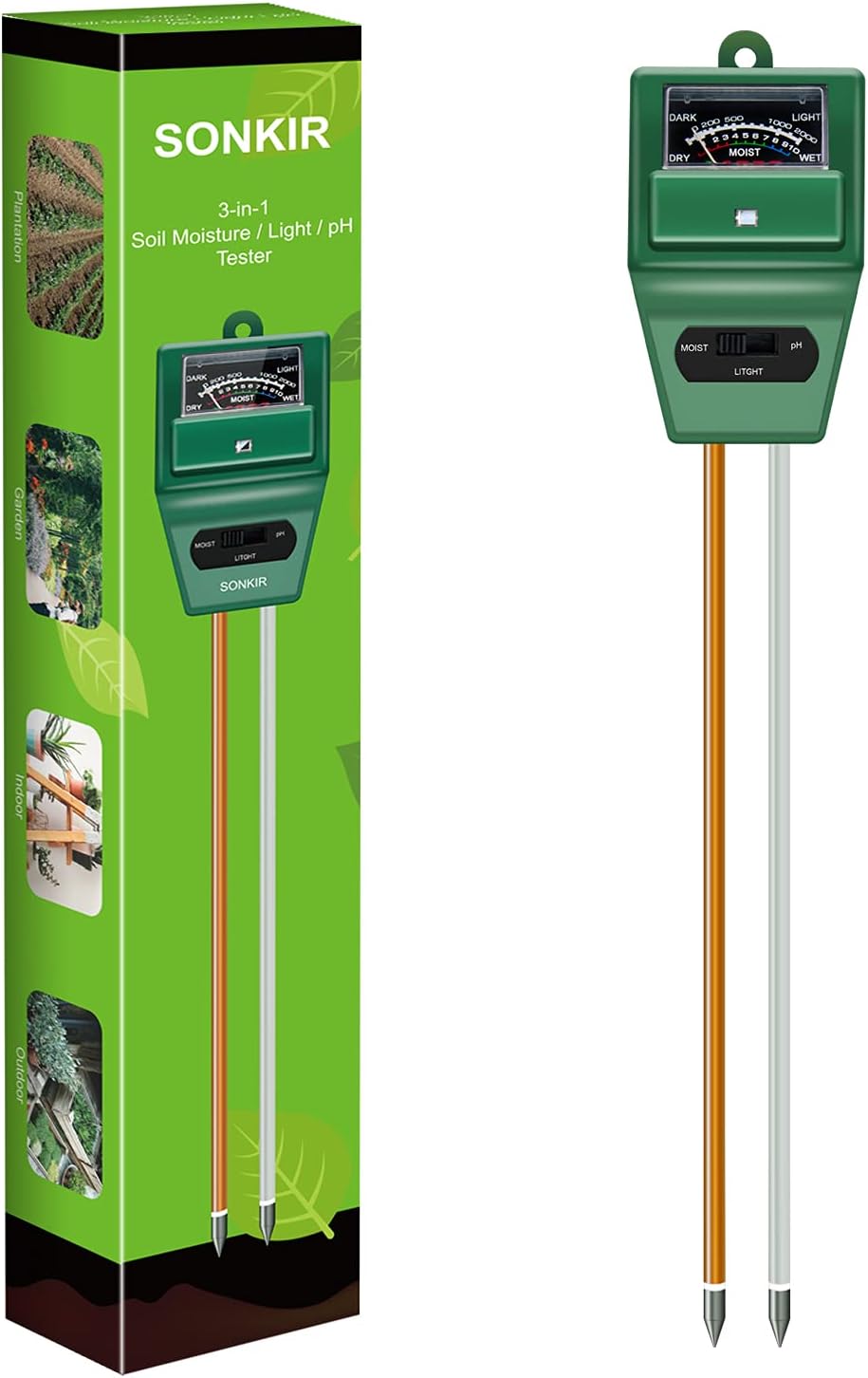
The SONKIR MS02 combines soil moisture, light and pH checks in one manual meter. It is designed for garden, lawn, farm, indoor and outdoor use. As a final-check tool, it supports looking at actual site conditions before adding another input or corrective step.
Check On AmazonIf you click this link and buy, we earn a commission at no additional cost to you.
Frequently asked questions
🌱 What is the most important part of a lawn care routine?
Start with correct mowing for the grass type, then add tasks only when site conditions justify them. Watering, fertilizer, aeration and dethatching cannot compensate for poor mowing.
✂️ How often should I mow my lawn?
Mow according to growth, not a fixed calendar. Avoid removing more than about one third of the leaf blade at once, then adjust for grass type and conditions.
💧 How do I know when an established lawn needs water?
Check turf stress and soil moisture together. Persistent footprints, dull leaves and a dry root zone support watering, while wet soil or dormancy support waiting.
🌾 Can I overseed without aerating first?
Yes, when seed can contact soil and compaction is not limiting the site. Aeration helps when compaction or surface preparation is part of the problem.
🪴 Should I aerate or dethatch my lawn?
Aerate for compacted soil; dethatch for a measured excessive thatch layer. Do not choose based only on a spongy feel or loose surface material.
🔎 Why is my lawn turning brown in patches?
Brown patches can come from drought, dormancy, mowing injury, compaction, insects, disease or other stress. Check conditions and the pattern first, then identify the cause before treating.
References and Sources
- University of Maryland Extension, Maintaining an Established Lawn: Supports core maintenance decisions for established residential turf.
- Alabama Cooperative Extension System, Home Lawn Maintenance: Supports grass-specific mowing, watering, compaction and homeowner turf care.
- Penn State Extension, Lawn Management through the Seasons: Supports growth-based seasonal timing and local conditions.
- Penn State Extension, Lawn and Turfgrass Diseases: Supports diagnosis before treatment and separating common turf problems.