Good garden care starts by naming the problem before choosing the response. A yellow leaf, chewed edge, wilted stem, crowded shrub, or messy bed can point to very different jobs, and the right next step depends on the plant, site conditions, recent weather, and what changed first. This guide helps you sort routine maintenance from symptoms, confirmed pests or diseases, environmental stress, and cleanup so you can act at homeowner level without treating the wrong cause. It also shows when soil, watering, lawn, equipment, laboratory diagnosis, tree work, or pesticide decisions belong somewhere more specific.
The visible problem is not yet the category of solution
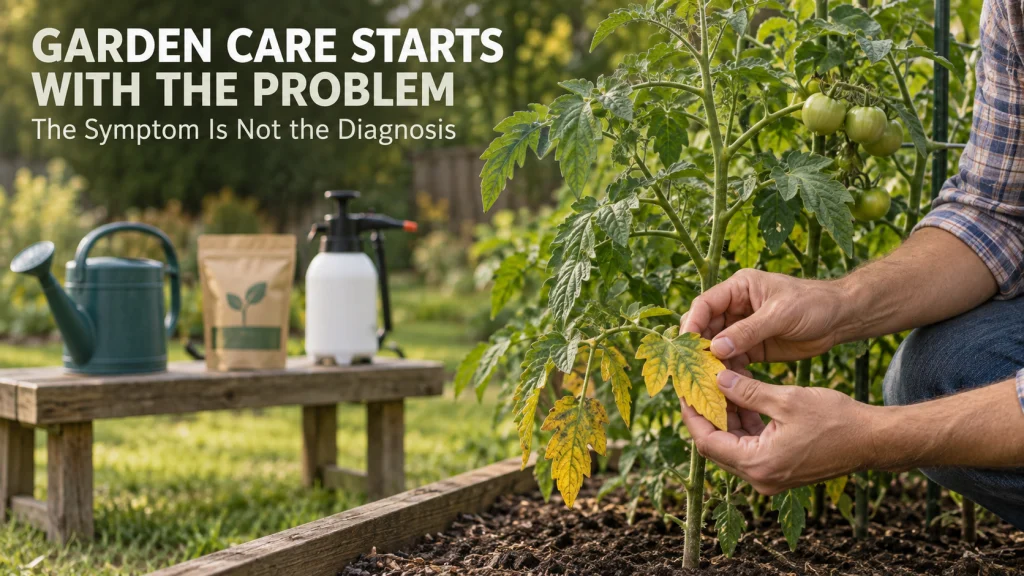
A plant turns yellow and three reactions can arrive almost at once: water it, feed it, or spray it. That is exactly where good garden care needs to slow down, because the same visible symptom can come from very different causes. Yellowing can be related to roots, moisture, nutrition, normal aging, environmental injury, pests, disease, or more than one factor at the same time. The first useful question is not what to apply, but what kind of problem you are actually looking at.
Start with what you know rather than what you suspect. A branch that clearly broke in wind is an environmental event, a bed full of known annual weeds is a maintenance task, and an insect that has been identified from reliable signs is different from mysterious holes in leaves. If all you have is a symptom, keep the diagnosis open and gather more context before choosing a treatment. That simple separation prevents a large share of unnecessary watering, fertilizing, spraying, cutting, and cleanup.
| Start here | Ask next | If the answer points to this | Continue with |
|---|---|---|---|
| Known task | Which plant and why? | Prune, weed, or clean | Matching section |
| Symptom only | What pattern and recent change fit? | Cause unconfirmed | Troubleshooting |
| Pest or disease identified | Is damage active and action needed? | Biological problem | IPM or disease guidance |
| Weather or site event | Do timing and pattern fit? | Abiotic stress | Recovery guidance |
Use the branches as a starting filter, not a diagnosis. Once the starting point is clear, move to the section that owns the actual job.

This handheld magnifier provides 10X magnification through a 75 mm shatterproof lens. Its nonslip handle is designed for close work, reading, and nature observation. It gives you a simple way to inspect leaf and stem details more closely before deciding whether you are looking at a task, symptom, pest sign, or something else.
Check On AmazonIf you click this link and buy, we earn a commission at no additional cost to you.
Decide whether you have a task, symptom, confirmed problem, or environmental event
A maintenance task is usually the clearest starting point because the job already has a name. You may need to remove weeds, reduce an overgrown shrub, clean damaged plant material, or inspect a bed after a storm. Even then, the correct method still depends on plant identity, growth habit, site conditions, and the reason for doing the work. Routine does not mean automatic, and a familiar task can still cause damage when timing or technique is wrong.
Symptoms require a different mindset because a symptom describes what the plant is doing, not why it is doing it. Look for whether the problem affects one plant or several species, old growth or new growth, one side of the plant or the entire plant, and whether roots, stems, leaves, flowers, or fruit are involved. Then connect that pattern with recent watering changes, soil disturbance, weather, pruning, fertilizer, pesticide exposure, transplanting, or construction around the site. For a structured way to work through those clues, use the guide to troubleshooting plant problems from visible symptoms before committing to a remedy.
- Identify the plant as closely as practical.
- Separate symptoms from visible signs of a pest or pathogen.
- Check whether the issue is isolated or repeated across the garden.
- Review what changed before the problem appeared.
- Choose an action only after the likely problem class is narrow enough.
A confirmed pest, confirmed disease, or obvious weather injury gives you a narrower path, but confirmation still does not automatically mean treatment. The next decision is whether the plant needs action, what homeowner level action is appropriate, and whether the issue belongs with a diagnostic lab or qualified professional.

These weatherproof top-spiral notebooks measure 3 x 5 inches and come in a 3-pack. The black-cover Universal Pattern format is made for notes in wet or outdoor conditions. Use one to record plant identity, affected parts, symptom timing, and recent site changes while you narrow the problem category.
Check On AmazonIf you click this link and buy, we earn a commission at no additional cost to you.
Prune by branch role, plant response, and homeowner safety
Pruning works best when every cut has a reason. Dead, broken, rubbing, poorly placed, or structurally troublesome growth presents a different decision from simply making a plant smaller, and some shrubs respond to repeated heading or shearing with dense regrowth. Flowering habit also matters because removing the wrong stems can remove future blooms even when the plant itself remains healthy. Before cutting, identify the plant, decide what the branch is doing, and understand how that type of plant is likely to respond.
Small homeowner pruning should stay within work that can be reached and controlled safely from the ground with ordinary hand tools. Large limbs, climbing work, trees near power lines, unstable storm damage, and situations where a falling branch could injure someone or damage property are not ordinary garden maintenance. When the job is routine and safely accessible, the detailed guide to pruning plants by growth habit and purpose can help you choose between removal, thinning, heading, and leaving the branch alone. The important point is that pruning is a plant response decision, not just a tidiness decision.
Warning: Stop homeowner pruning when the task involves climbing, large or suspended limbs, electrical lines, unstable trees, or any cut whose fall path cannot be controlled safely.
After pruning, watch the plant rather than assuming the job ended with the cut. Vigorous regrowth, reduced flowering, recurring rubbing branches, or repeated size problems can show that the pruning goal and the plant’s natural habit are working against each other.
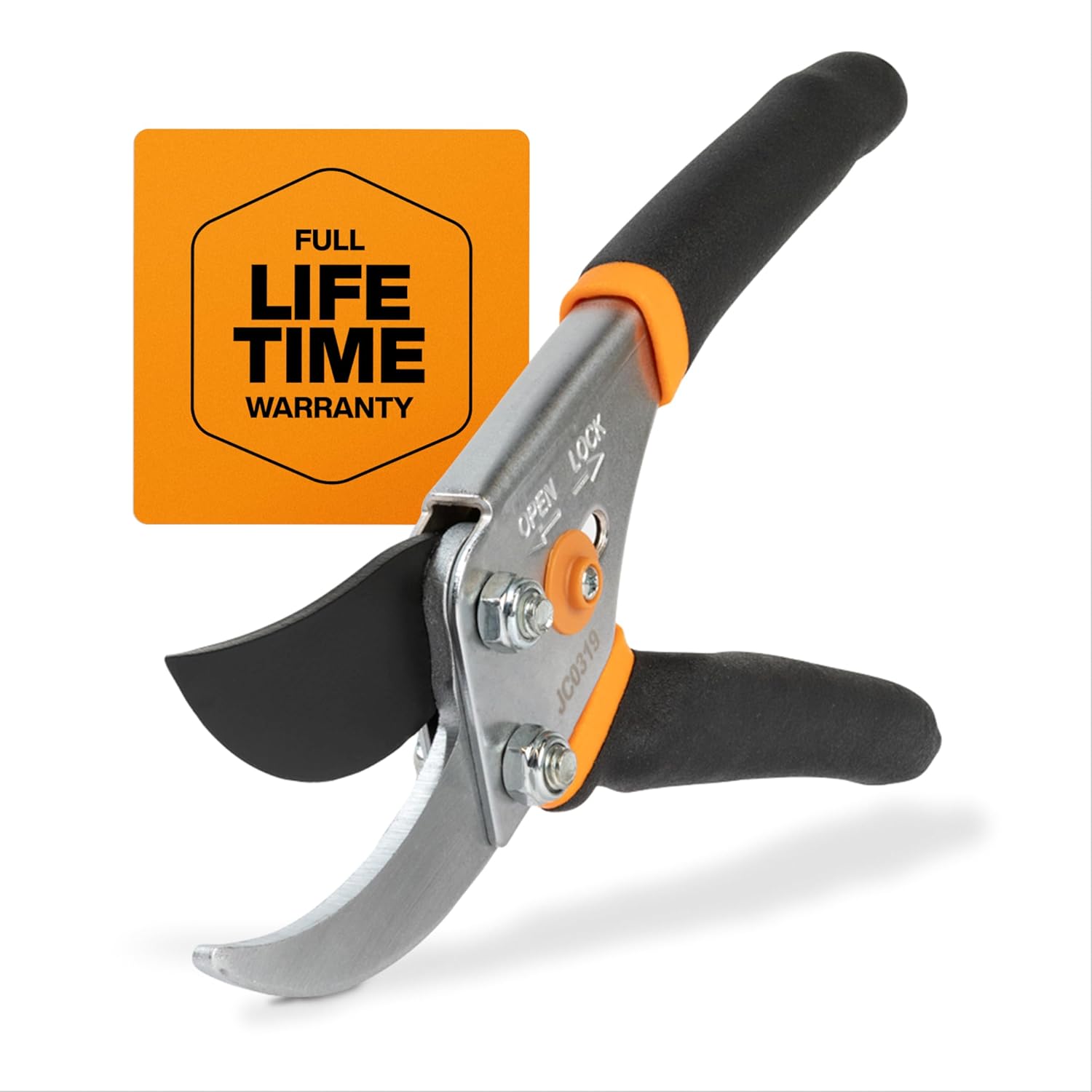
These bypass pruning shears have a verified 5/8-inch cut capacity and steel blades with a low-friction coating. A self-cleaning sap groove helps reduce sticking, and the handle uses a nonslip grip. They fit the section's small, ground-level homeowner pruning role without implying that larger limbs or elevated work are appropriate.
Check On AmazonIf you click this link and buy, we earn a commission at no additional cost to you.
Control garden weeds by identification and regrowth strategy
Weeding is not one job repeated with different plants. A young annual that has not set seed can often be removed with a shallow, simple method, while a perennial spreading from roots, rhizomes, or other persistent structures may return quickly when only the top is removed. The useful distinction is how the weed survives and spreads, not how annoying it looks on the day you notice it. Correct identification also matters because seedlings can resemble desirable plants, and aggressive disturbance can bring more buried weed seed into conditions that favor germination.
Start with the least disruptive method that fits the weed and the planting. Hand pulling, careful hoeing, preventing seed production, maintaining appropriate mulch, and reducing open soil can all have a role, but none is universal. If you need to match removal to annual, biennial, perennial, spreading, or seed producing behavior, see the guide to garden weed control based on regrowth strategy. When an herbicide is being considered, identify the weed first, confirm that the product is labeled for the site and target, and follow the current label rather than improvising a rate or use.

This hand weeder and cultivator uses a forged steel blade with a recycled plastic handle. The tool is designed for digging, edging, planting, and hand weeding around garden beds. It supports the section's least-disruptive manual approach when the weed and regrowth habit have already been identified.
Check On AmazonIf you click this link and buy, we earn a commission at no additional cost to you.
Confirm pest damage before choosing an IPM action
Chewed leaves, stippling, curled growth, sticky residue, holes, webbing, or frass can suggest insect or mite activity, but damage alone is not always enough to identify the culprit. Look at the whole plant, then inspect leaf undersides, stems, growing tips, soil surface, and nearby plants for the organism or stronger identifying signs. Also ask whether the damage is current or old, whether the plant is still growing normally, and whether beneficial predators are already present. A few damaged leaves on an established plant can call for observation rather than immediate control.
Integrated pest management begins with identification, monitoring, and choosing the least disruptive action that can reasonably manage the problem. Physical removal, barriers, sanitation, plant care changes, or simply tolerating minor damage may be enough in some situations, while other confirmed pests need more specific timing and control. The guide to common garden pests and homeowner IPM decisions is the right next step once you are actually dealing with pest damage. Pesticides should come after identification and need are established, and any pesticide use must follow the current product label for the plant, pest, site, application method, and safety requirements.
Key point: Seeing an insect on a damaged plant does not prove that the insect caused the damage, and confirming a pest does not automatically prove that control is necessary.
Keep monitoring after any action. If damage continues while the suspected pest disappears, the original assumption may have been incomplete, and repeating the same treatment can add risk without solving the actual problem.

The BugView combines a 5X magnifying glass with a quick-release insect catcher for indoor or outdoor use. Its handheld design lets you view small insects without turning identification into an immediate pesticide decision. That makes it useful for the section's inspect, confirm, and monitor sequence before deciding whether control is needed.
Check On AmazonIf you click this link and buy, we earn a commission at no additional cost to you.
Treat plant disease as a diagnosis, not a synonym for spots or wilt
Leaf spots, wilt, dieback, discoloration, cankers, distortion, and poor growth can occur with disease, but they can also come from environmental stress, root injury, watering problems, chemical injury, nutrient problems, or normal plant development. That is why a photo of one leaf is often less useful than a pattern across the whole plant and its surroundings. Disease becomes more plausible when the host, symptom pattern, signs of a pathogen, recent conditions, and known disease behavior line up. Until that evidence is strong enough, keep the language tentative and avoid treatment that assumes a pathogen is present.
When disease is reasonably identified, management still depends on the specific host and problem. Sanitation, spacing, airflow, watering method, resistant plant choices, removal of affected material, or no treatment may be more important than a spray, and some diseases cannot be corrected after symptoms are advanced. Use the guide to plant disease identification and garden management for the next level of detail. If confirmation would change a major treatment decision or the plant is valuable, a plant diagnostic laboratory can be more useful than guessing from appearance.

This foldable loupe provides 30X and 60X magnification with built-in LED illumination. It is designed for close inspection of small details such as gems, jewelry, coins, and stamps. In a garden context, the same close-view function can help you examine visible surface details while keeping disease diagnosis separate from simple observation.
Check On AmazonIf you click this link and buy, we earn a commission at no additional cost to you.
Start symptom troubleshooting with pattern, distribution, and recent events
When the problem does not have a name yet, pattern is one of the most useful pieces of evidence you can collect. Compare affected and unaffected plants, note whether multiple species show the same problem, and look for a boundary that follows a bed edge, irrigation zone, driveway, low spot, fence line, or recently disturbed area. Symptoms that appear across unrelated plants can point toward a shared environmental or cultural factor rather than a host specific pest or disease. A problem limited to one species may push the investigation in a different direction, but it still does not prove a single cause.
Recent events give that pattern a timeline. Think through watering changes, heavy rain, dry periods, heat, cold, wind, salt exposure, transplanting, pruning, fertilizer, pesticide use, construction, soil compaction, root disturbance, and changes in shade or drainage. Work backward from what changed before the symptoms, then check whether the plant parts and distribution make that explanation plausible. This is not about building a long list of everything that can go wrong, but about eliminating explanations that do not fit the evidence.

This set includes 100 T-type plastic plant labels, a marker pen, and waterproof garden tags measuring 3.9 x 2.4 inches. The labels are intended for outdoor plants and give you many separate markers. Use them to mark affected and unaffected plants or observation groups so distribution patterns are easier to track over time.
Check On AmazonIf you click this link and buy, we earn a commission at no additional cost to you.
Recognize heat, frost, drought, wind, salt, hail, and winter injury as abiotic possibilities
Environmental injury can imitate pest or disease damage because stressed tissue still shows familiar symptoms such as scorch, wilt, browning, dieback, spotting, splitting, or distorted growth. The clue is often distribution and timing rather than a unique visual mark. Damage that appears suddenly after an extreme weather event, follows the exposed side of plants, affects several unrelated species, or matches a low, windy, salty, flooded, or heat reflected part of the property deserves an abiotic explanation before a biological one. The plant may also be showing delayed effects from earlier root or weather stress rather than something that happened that day.
For a more focused review of weather and site related damage, use the guide to plant stress from environmental conditions. Recovery decisions should be conservative because stressed plants can be damaged further by unnecessary fertilizer, heavy pruning, repeated watering, or treatment aimed at a pest that is not present. Remove only what is clearly dead or hazardous when appropriate, maintain suitable soil moisture for the plant and site, and give uncertain tissue time to declare whether it is alive. If damage involves a large tree, unstable limbs, utility lines, or a safety risk, move from garden troubleshooting to qualified professional help.

This floating row cover measures 10 x 30 feet and uses 0.9 oz per square yard garden fabric. The listing presents it for freeze protection and winter frost coverage. It fits the section as a weather-protection tool after frost risk is identified, not as a generic treatment for unexplained plant damage.
Check On AmazonIf you click this link and buy, we earn a commission at no additional cost to you.
Clean garden beds by risk and function instead of stripping everything
Garden cleanup should solve a reason, not just remove every dead stem and fallen leaf. Diseased or heavily pest infested debris may need to be removed, weeds that are ready to seed may need attention, and material blocking access or smothering small plants can become a practical problem. At the same time, sound leaves and standing stems can protect soil, shelter beneficial organisms, support wildlife, and reduce unnecessary hauling. A bed can look less manicured and still be functioning well.
Use the guide to garden cleanup based on plant health and bed function when you need to decide what should stay, what should be cut, and what should leave the site. Keep diseased material separate when reliable guidance for that disease recommends sanitation, and do not assume a home compost pile will neutralize every pathogen, pest stage, or weed seed. For ordinary healthy debris, consider whether it can remain as useful cover or be handled in a way that returns organic material without burying crowns or creating a wet mat. Cleanup is most useful when it reduces a known risk while preserving what the bed still needs.

This metal leaf rake has an expandable head that adjusts from 8 to 17 inches and a handle that adjusts from 30 to 58 inches. The sectional handle screws together without extra assembly tools. Its narrow-to-wide adjustment makes it practical for collecting ordinary leaves and debris around garden beds without implying that every stem or leaf should be removed.
Check On AmazonIf you click this link and buy, we earn a commission at no additional cost to you.
Send soil, watering, lawn, and equipment problems to the system that actually needs work
Some garden problems begin with a plant symptom but turn out to be a system problem. If the real question is soil pH, fertility, compost, amendment choice, drainage, or the growing medium itself, move to improving garden soil based on the measured constraint rather than continuing to troubleshoot the leaf. If the issue is irrigation design, watering frequency, delivery method, pressure, flow, or checking the root zone, use the guide to watering a garden by soil and root zone need. Treating those systems as plant disease questions usually produces more guesses than useful answers.
| If the question starts with | Keep it in plant troubleshooting when | Move to system guidance when |
|---|---|---|
| Yellowing, wilt, spots, or dieback | Cause still unknown | Question becomes pH, fertility, drainage, or growing medium |
| Dry or drooping plants | Cause still being tested | Question becomes irrigation design, frequency, pressure, or flow |
| Weeds, cleanup, or maintenance | Garden bed is the subject | Subject becomes lawn, yard, or the tool itself |
The same boundary applies beyond planting beds. Lawn mowing, lawn weeds, turf irrigation, overseeding, aeration, dethatching, and yard cleanup belong with home lawn maintenance decisions, while tool fit, maintenance, storage, and homeowner use belong with essential garden tools and equipment choices. These handoffs keep plant symptoms from replacing soil, irrigation, turf, or equipment guidance. Name the system correctly before trying to fix the plant.

This XLUX soil moisture meter is designed for indoor and outdoor use and works without batteries. The single-probe meter provides an instant soil-moisture reading through a clear display. It supports the section's handoff from plant symptoms to root-zone moisture checking when the real question becomes watering rather than disease.
Check On AmazonIf you click this link and buy, we earn a commission at no additional cost to you.
Know when plant labs, arborists, utilities, or pesticide professionals are the safer next step
Home gardeners can observe patterns, identify many common weeds and pests, make routine pruning cuts, remove ordinary debris, and correct straightforward care problems. The boundary changes when the diagnosis is uncertain and the consequence of being wrong is high, when a valuable plant has a complex decline, or when a treatment depends on exact pathogen or pest identification. A plant diagnostic laboratory or local Extension service can help when photos, history, and homeowner level checks do not narrow the cause enough. Samples should follow the receiving lab’s instructions because sample quality affects what can be evaluated.
Safety creates an even clearer stop point. Large tree work, climbing, unstable limbs, trees or branches near electrical lines, and work that could contact utilities should move to qualified tree or utility professionals. Restricted pesticide work and any pesticide use outside the current label are also outside normal homeowner improvisation, and local rules may add requirements. If the task feels difficult because of height, weight, electricity, chemical exposure, or uncertainty about what is being treated, that is a reason to change the person doing the job rather than just buy more equipment.
Stop boundary: Do not turn diagnosis uncertainty into repeated treatments, and do not turn a safety problem into a do it yourself challenge.
Professional help still benefits from good observation. Bring plant identity, symptom history, site changes, watering information, photos, and a record of what has already been done.

This Rite in the Rain model 954 pocket notebook measures 3.5 x 5 inches and uses a weatherproof soft cover with Universal Pattern pages. The compact format is intended for field notes in wet conditions. It gives you a durable place to carry plant identity, symptom history, watering notes, site changes, and prior actions when you hand a difficult case to a lab or professional.
Check On AmazonIf you click this link and buy, we earn a commission at no additional cost to you.
Final Thoughts: choose the problem before the treatment
The most useful garden maintenance habit is not a fixed schedule of products or treatments. It is the ability to separate a routine task from a symptom, a confirmed pest or disease, an environmental event, and a system problem. Once that classification is right, pruning, weed control, IPM, disease management, cleanup, or a handoff to soil and watering guidance becomes much easier to choose. It also becomes easier to leave a plant alone when action would add more stress than help.
Observe first, identify what you can verify, and keep the action proportional to the evidence. Use the least disruptive homeowner level response that fits the actual problem, then watch what happens before adding another change. When the evidence is weak or the work crosses a safety boundary, use Extension, a diagnostic lab, an arborist, a utility, or another qualified professional as appropriate. Good care is not doing more to the garden, but doing the right job for the problem that is really there.

This four-pack of Elan field notebooks measures 3.5 x 5.5 inches and is described as waterproof, tearproof, and weatherproof. The lined memo-book format is made for written field notes. It supports the article's observe-first habit by giving you a repeatable place to log what changed and what happened before adding another garden intervention.
Check On AmazonIf you click this link and buy, we earn a commission at no additional cost to you.
FAQs
Many garden care questions sound like requests for a treatment, but the useful answer usually starts with classification. Watering, feeding, pruning, spraying, and cleanup can all be reasonable in the right context and counterproductive in the wrong one. The questions below focus on the checks that most often change what a homeowner should do next. Keep plant type, site conditions, recent weather, and the pattern of symptoms in view while using them.
These answers stay at homeowner level and do not replace a diagnosis when one is needed. A visible symptom can narrow the investigation without proving the cause, and a pesticide decision must still follow the current label. Large tree hazards and electrical conflicts need qualified help rather than a garden workaround. When in doubt, collect better evidence before making the next change.
🌱 What should I check first when a garden plant looks unhealthy?
Identify the plant, look at the whole plant and surrounding site, then note where symptoms occur and what changed recently. Check water, drainage, weather, root disturbance, pruning, fertilizer, pesticide exposure, and whether other plants show the same pattern before assuming disease or pests.
💧 Does yellowing mean a plant needs more water?
No. Yellowing can appear with water stress, saturated roots, root damage, nutrient issues, normal aging, disease, pests, or environmental injury, so check soil moisture and the broader symptom pattern before changing irrigation.
🐛 Should I spray as soon as I see insect damage?
Not automatically. Identify the pest or stronger signs first, judge whether damage is still active and important, and consider physical, cultural, or biological options before a pesticide. If a pesticide is needed, use only a product labeled for the pest, plant, and site and follow its current directions.
🍂 Should I remove all dead leaves and stems from garden beds?
No. Healthy leaves and stems can provide soil cover and habitat, while diseased, pest infested, seedy, or physically obstructive material may need removal. Base cleanup on plant health and bed function rather than a rule that everything dead must go.
✂️ Can I prune an overgrown shrub until it fits the space?
Sometimes, but repeated heavy pruning may trigger vigorous regrowth or reduce flowering, and some plants tolerate severe cuts poorly. Identify the shrub and its growth habit first, then decide whether selective pruning, gradual renewal, or eventual replacement with a better sized plant is the more practical route.
🔬 When is a plant diagnostic lab worth using?
Use a lab when the cause remains uncertain and the diagnosis would change an important management decision, especially for valuable plants or recurring problems. Follow the lab’s sample and submission instructions so the material sent is suitable for evaluation.
References and Sources
The guidance above relies on university Extension and university IPM references. They support diagnosis boundaries, pruning, weed management, pest decisions, and cleanup. They also support the safety limits around tree work and pesticide decisions. Only sources directly used in this guide are listed here.
Local conditions can still change the practical answer. Regional Extension, a diagnostic lab, a current pesticide label, or a qualified professional may be needed. Species, climate, site conditions, regulations, and safety can make general guidance too broad. Use the linked source when you need the technical detail behind a step.
- University of Maryland Extension IPM guidance: Supports problem identification, monitoring, abiotic possibilities, least disruptive management, and the need to avoid jumping from symptoms to treatment.
- Washington State University plant problem diagnosis: Supports systematic diagnosis, the difference between symptoms and signs, and the need to consider multiple possible causes.
- University of Maryland Extension pruning basics: Supports planned pruning cuts, plant response to pruning, and the safety boundary for branches near power lines.
- Penn State Extension weed management: Supports weed identification, competition, mulching, and management choices for home gardens.
- UC Statewide IPM Program home and landscape resources: Supports pest identification tools, alternatives to pesticides, and science based home garden pest management.
- Iowa State University Extension garden cleanup guidance: Supports selective cleanup, leaving useful plant material in place, and removing diseased or pest infested debris when appropriate.