Pruning plants is easier when you decide what the branch is doing before deciding when to cut it. A dead branch, vigorous shoot, flowering stem, and storm-broken limb can require different responses. The useful sequence is purpose first, cut type second, timing third, with disease risk and safety checked before wood is removed. That approach helps preserve useful growth instead of pruning simply because a calendar says it is time.
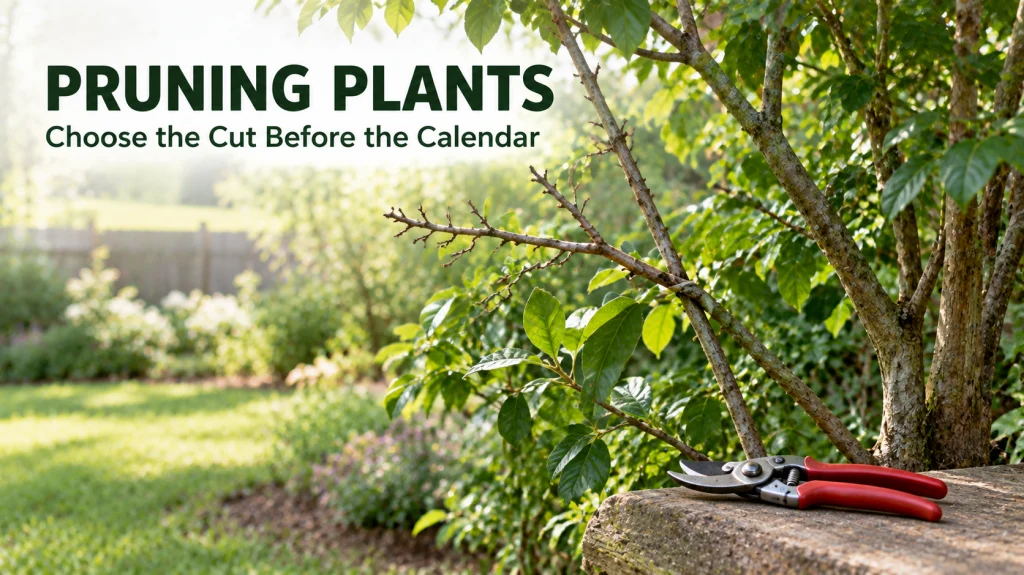
One visible branch can represent several different pruning jobs
A branch can be dead, badly placed, diseased, structurally useful, carrying flower buds, or simply growing in a direction you do not like. That is why pruning plants should start with identification of the branch’s role rather than a universal pruning season. If you cut first and interpret later, you may remove flowering wood, trigger dense regrowth, or turn a small structural issue into a larger one. The branch looks like one object, but the gardening decision depends on what that branch is contributing to the plant.
This is also why pruning basics are more useful when they are organized around decisions instead of memorized dates. A healthy shrub that flowers on older wood does not need the same timing as a damaged branch that should be removed for safety or plant health. A young tree being trained for better structure is another job again, and a large hanging limb is not a routine homeowner pruning task at all. The rest of the process becomes much clearer once you decide which of those jobs is actually in front of you.
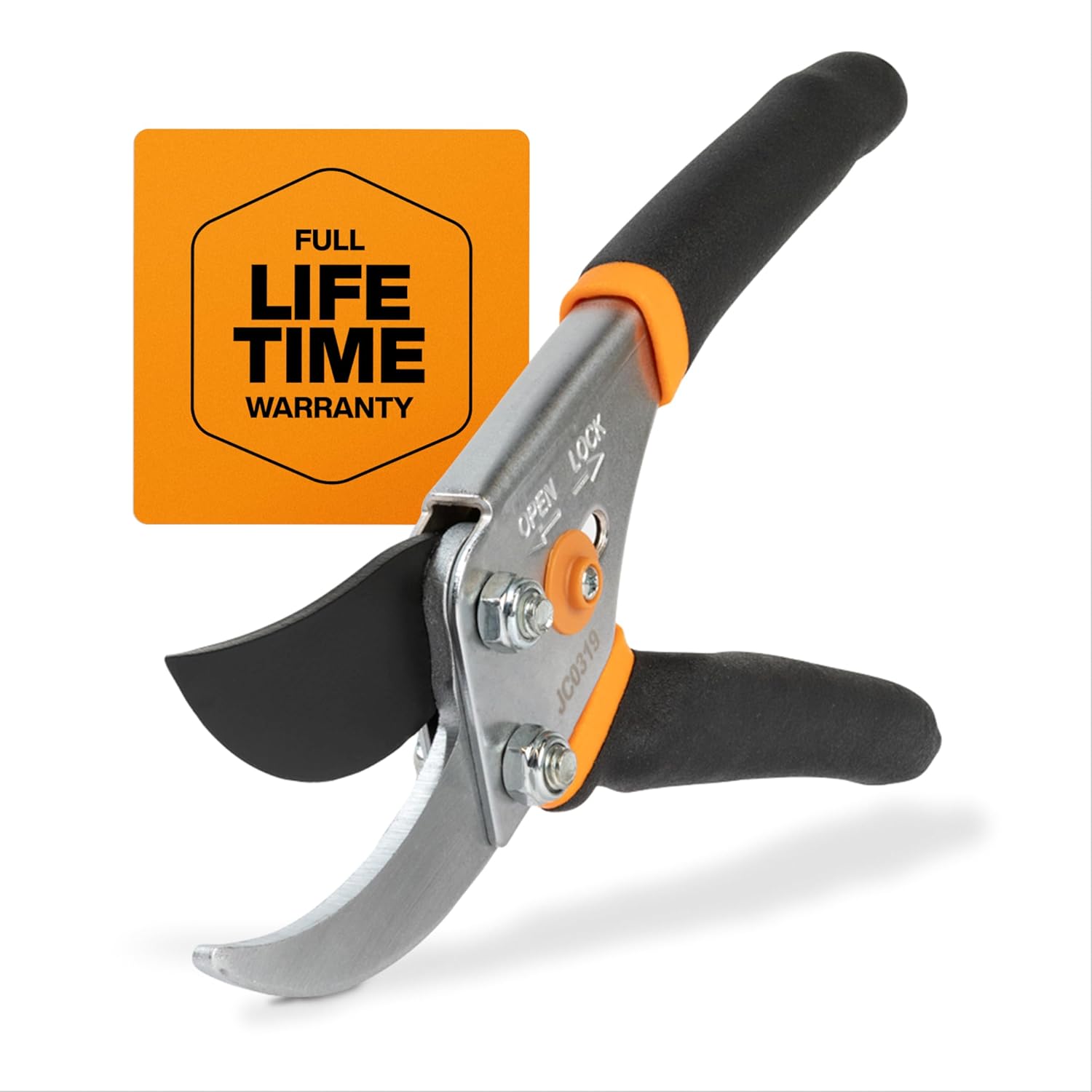
These bypass pruning shears cut live stems and small branches up to 5/8 inch in diameter. Precision-ground steel blades use a low-friction coating, while a sap groove helps reduce sticking during cuts. A non-slip handle and safety lock support controlled everyday pruning and storage.
Check On AmazonIf you click this link and buy, we earn a commission at no additional cost to you.
Start with why the branch is being considered for removal
Before making a cut, name the problem you are trying to solve in plain language. You might be removing dead or broken wood, reducing rubbing between branches, opening a crowded shrub, preserving a useful framework, managing size, improving flowering, or correcting growth from a rootstock. Those are different goals, and each goal changes which wood should stay. If you cannot explain what improves after the cut, leaving the branch in place is often safer than pruning by habit.
Plant pruning also works better when you distinguish a plant that is genuinely misplaced from one that merely needs selective maintenance. Repeatedly cutting a naturally large shrub into a space that is too small can create dense regrowth and ongoing work without solving the original site mismatch. The broader garden care framework is useful here because pruning should support the plant’s long-term fit, not substitute for every other care decision. The more often you need to force a plant back into an unsuitable footprint, the more important it becomes to reconsider the plant, the space, or the long-term maintenance burden.
- Remove dead, broken, or clearly damaged wood when the cut can be made safely.
- Reduce crossing or rubbing growth when it is likely to keep injuring nearby branches.
- Thin selected stems when crowding is the actual problem rather than shortening every tip.
- Protect flower, fruit, and structural wood when those parts are still serving the plant.
- Stop before the task requires climbing, hazardous positioning, or work near utility lines.
Use that list as a check, not as permission to remove everything that looks imperfect. A branch may be awkward but still be structurally important, while a vigorous upright shoot may be expendable even though it looks healthy. The reason for pruning should be specific enough that you can point to the wood that solves the problem and the wood that should remain. That simple discipline prevents a surprising amount of unnecessary cutting.

This forged steel bypass pruner is rated for live branches, stems, and green wood up to 1 inch in diameter. An integrated sap groove helps reduce sticking, and the spring-loaded action supports repeated pruning cuts. Contoured non-slip handles and a built-in safety lock add control during use and secure the blades for storage.
Check On AmazonIf you click this link and buy, we earn a commission at no additional cost to you.
Separate thinning cuts from heading cuts before you reach for the pruners
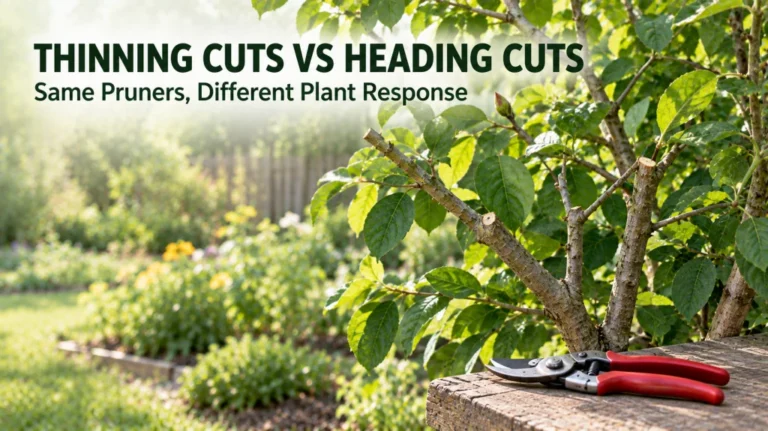
Thinning and heading cuts are not interchangeable because the plant responds differently to each one. A thinning cut removes a shoot or branch back to its point of origin or to an appropriate lateral branch, which can reduce crowding without shortening every remaining stem. A heading cut removes only part of a shoot and leaves buds below the cut to produce new growth. Heading often creates denser regrowth near the cut, while thinning generally keeps the framework more open.
This is where pruning garden plants can go wrong even when the blades are sharp. Shortening the outside of every branch on an oversized shrub may produce a crowded shell of new shoots instead of solving congestion. Selective thinning may better address crowding, while heading can be useful when the goal is to redirect young growth or manage a plant that responds well to that treatment. Choose the cut for the growth response you want, not simply because one branch is easier to reach.
Cut location matters as much as cut type. When removing a woody branch at its origin, locate the branch collar and the bark ridge where the branch joins the larger stem, then place the final cut just outside those tissues rather than slicing flush with the trunk or leaving a long stub. The collar may be more obvious on some species than others, so follow the plant’s natural attachment instead of forcing one fixed angle. Preserving that junction helps the plant compartmentalize the wound around the cut.
For a small heading cut, finish just beyond a healthy bud or the lateral that will continue the branch. Cutting too close can damage that bud, while leaving a long stub creates dead tissue that the plant still has to close off around. The bud or lateral also influences where new growth goes, so its position should match the direction you want the shoot to take. That makes the physical location of the cut part of the pruning decision rather than an afterthought.
Key point: Topping a tree is not a routine version of heading. Removing large portions of the crown without regard for natural branch structure can promote weakly attached regrowth and long-term structural problems.

These 9.25-inch hand pruners use a precision bypass blade for garden pruning. The model has an aluminum body and replaceable parts. Its manual bypass format gives the user direct control when making selective thinning or heading cuts on appropriately sized growth.
Check On AmazonIf you click this link and buy, we earn a commission at no additional cost to you.
Let flowering and fruiting biology control timing where it matters
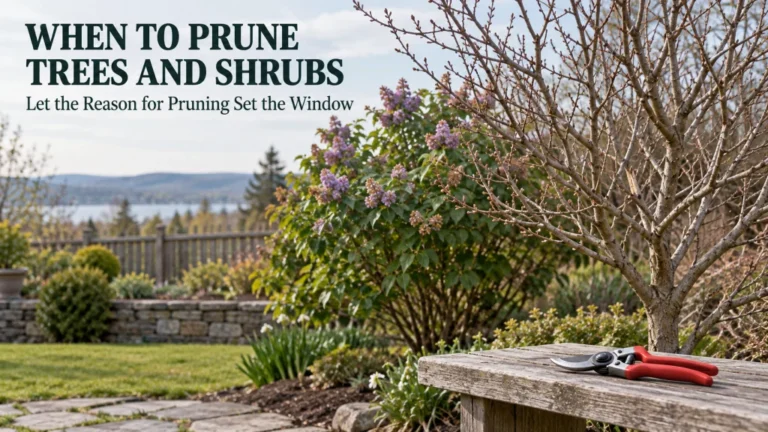
Pruning time changes when flowers or fruit depend on wood that is already carrying buds. Many spring-flowering shrubs bloom on growth produced earlier, so pruning before flowering can remove much of the display even when the plant survives the cut perfectly well. Plants that flower on new growth can follow a different schedule because the flowers develop on shoots produced after pruning. The correct question is not simply when a shrub should be pruned, but where and when that particular plant forms the buds you want to keep.
Fruiting plants add another layer because pruning affects both structure and productive wood. Removing too much live wood can reduce the crop, while leaving crowded, weak, or poorly placed growth can make future management harder. Species and training system matter, so a general pruning article should not pretend that apples, peaches, grapes, berries, and ornamental flowering shrubs all follow one rule. When crop production is the main goal, use plant-specific guidance after you have identified the general pruning job.

These 6-inch pruning scissors are designed for flower stems, herbs, buds, and other small plants. Stainless steel micro-tip blades cut all the way to the tip for precise work in tight growth. An easy-action spring and SoftGrip handle support repeated fine pruning, and the included sheath covers the blades for storage.
Check On AmazonIf you click this link and buy, we earn a commission at no additional cost to you.
Use dormant or summer pruning for the job each one actually serves
Dormant pruning is useful partly because bare branches make structure easier to see on many deciduous woody plants. It can be easier to spot crossing branches, weak attachments, damaged wood, and competing stems when foliage is out of the way. Pruning during dormancy can also fit plants whose flowering biology will not be harmed by that timing. Even so, dormancy is not a universal answer because species, disease risk, region, and the reason for pruning can change the best window.
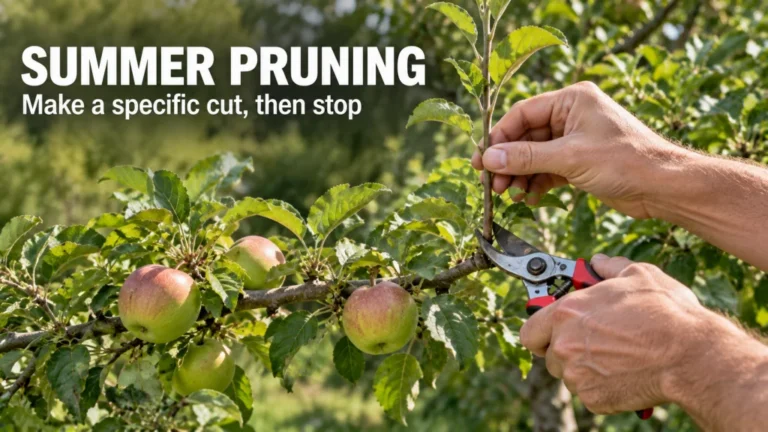
Summer pruning can be useful when you need to see the plant in active growth, manage selected vigorous shoots, or make a limited correction after spring growth has revealed the structure. The trade-off is that you are removing functioning leaf area, so the amount of live wood removed should still match the actual goal. Avoid turning summer pruning into repeated indiscriminate shearing just because new growth is easy to see. A small, purposeful correction is very different from a major size reduction on a mature woody plant.

These 28-inch bypass loppers have a 1.75-inch cut capacity for woody garden branches. The Power-Lever design uses compound leverage to increase cutting power. A precision-ground steel blade and low-friction coating support controlled manual pruning on branches that fit the tool's rated capacity.
Check On AmazonIf you click this link and buy, we earn a commission at no additional cost to you.
Handle diseased wood as a sanitation decision, not ordinary shaping
Diseased-looking wood should not be treated as a normal cosmetic pruning problem until the symptom is reasonably identified. Dieback, discoloration, cankers, wilted shoots, and dead tips can have different causes, and similar symptoms do not guarantee the same disease. The safe general move is to separate obvious dead or affected material from healthy pruning decisions and avoid spreading sap or debris from a questionable branch onto healthy plants. If the diagnosis changes where the cut must be made, when it should be made, or how tools should be disinfected, use guidance for that specific plant and disease.
Tool sanitation is also conditional rather than ceremonial. Cleaning blades between plants or cuts becomes more important when a pathogen can be moved mechanically, but the best method can vary with the disease and disinfectant. That is why this article does not give one chemical recipe for every pruning job. When infection is a real concern, identify the problem first, then follow current Extension or label guidance for cleaning, disinfecting, drying, and protecting the tool.
Warning: Do not jump from a visual symptom to a pesticide recommendation. Identification, plant condition, disease biology, and the current product label must support any treatment decision before a pesticide is considered.
Sanitation also includes what happens to the removed material. Diseased branches should not automatically be mixed back into the garden without considering the pathogen and local disposal guidance. Some problems are managed partly by removing infected tissue, while others require a different response or professional diagnosis. The pruning cut is only one part of the decision when disease is involved.
Identify water sprouts and suckers before removing vigorous growth
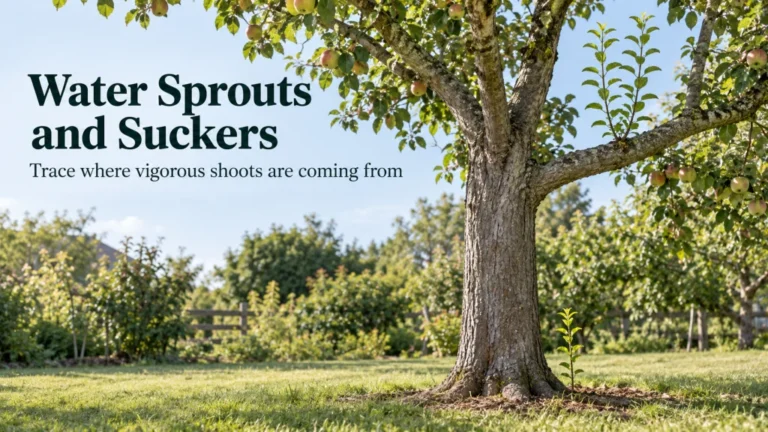
Fast upright growth can look impressively healthy while still being unwanted in the plant’s structure. Water sprouts typically arise as vigorous shoots from trunks or branches, while suckers commonly arise from the base, roots, or below a graft union. Their location matters because removing a rootstock sucker serves a different purpose from thinning ordinary new growth in the canopy. Correct identification helps you avoid cutting productive shoots simply because they are growing quickly.
These shoots can also be a response to stress, damage, or heavy pruning, so removal alone may not explain why they keep returning. If a tree produces a flush of vigorous shoots after severe cutting, more heading may create the same cycle again. Look at the recent pruning history, physical damage, graft location, and overall vigor before deciding whether repeated removal is the whole solution. A small shoot is easier to manage than a large one, but the underlying reason for excessive regrowth is still worth noticing.
Do not assume every vertical shoot is a water sprout or every basal shoot is useless. Young plants, multi-stemmed shrubs, and plants being renewed can produce legitimate new stems that belong in the future framework. The practical test is whether the shoot is contributing to the intended structure or competing with it. That keeps the decision tied to plant form instead of to a visual stereotype.
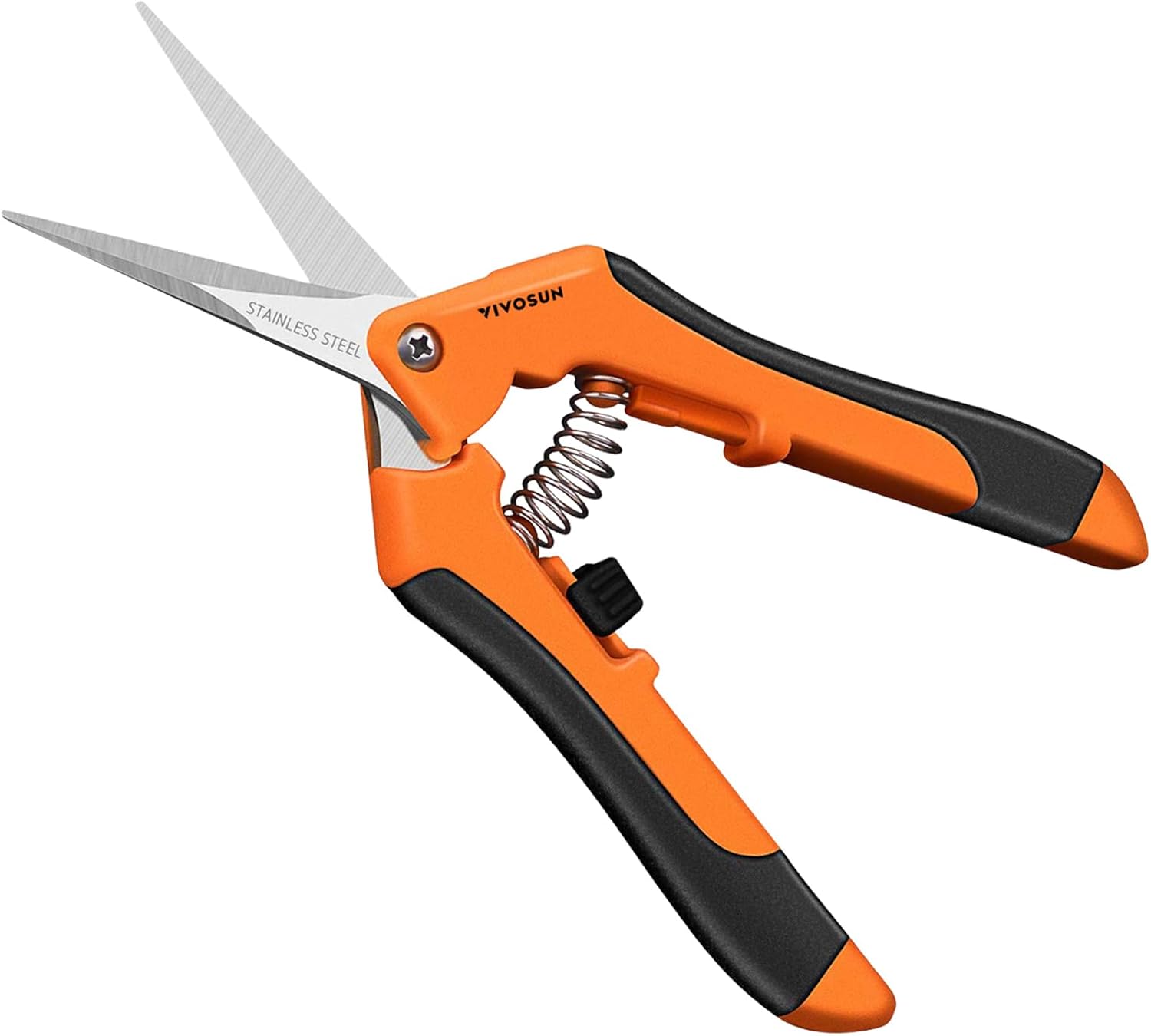
These 6.5-inch hand pruners use straight stainless steel blades for detailed trimming and shaping. The micro-tip format is designed to reach between nearby plant parts for precise one-handed cuts. A sideways locking mechanism keeps the blades closed when the tool is not in use.
Check On AmazonIf you click this link and buy, we earn a commission at no additional cost to you.
Treat storm damage as a structural and safety triage problem
Storm damage changes the order of operations because safety comes before plant appearance. Small broken branches that are clearly accessible from the ground may be ordinary pruning work, but split trunks, hanging limbs, partially failed trees, or branches under tension can behave unpredictably. A cut that would be routine on an intact shrub can become dangerous when wood is twisted, loaded, or suspended. The first job is therefore to decide whether the area is safe to enter and whether the branch can be handled without climbing or working beneath unstable wood.
Utility lines create an immediate stop condition. Do not assume a line is safe because power appears to be off, and do not try to free a branch that is touching or near electrical infrastructure. Large storm-damaged trees may also hide cracks or imbalances that are not obvious from the ground. In those situations, keep people away from the area and route the work to the utility or a qualified tree professional as appropriate.
For smaller damage, avoid the temptation to reshape the entire plant just to make the injury look symmetrical. Remove what is broken or clearly compromised, preserve sound structure where possible, and give the plant time to reveal how it will recover. Heavy topping after a storm can create new structural problems instead of preventing them. Triage should reduce immediate damage without turning one weather event into years of unnecessary corrective pruning.

These 28-inch bypass loppers have a 1.5-inch cutting capacity for garden branches. The blades are stainless steel, and the handles include SoftGrip and shock-absorbing bumpers. The manual bypass format is suited to controlled ground-level cutting when a damaged branch is small, stable, and within the tool's rated capacity.
Check On AmazonIf you click this link and buy, we earn a commission at no additional cost to you.
Route fruit-tree pruning without turning general guidance into a crop recipe
Fruit trees belong in this discussion because the same pruning principles still apply, but the productive structure is more crop-specific. You still need to identify dead, damaged, crossing, crowded, or badly placed wood, and you still need to choose cuts based on the response you want. What changes is the importance of training system, fruiting habit, tree age, vigor, and the location of productive wood. A general pruning framework can get you to the right question, but it should not pretend to replace crop-specific instructions.
That boundary matters most when a gardener copies a technique from one fruit species to another. A cut that helps manage one tree’s fruiting wood may remove useful buds or encourage the wrong growth pattern on another. Regional climate can also change timing and disease considerations, so local guidance matters even when the species is the same. Use general plant pruning to identify the job, then move to the specific fruit-tree guidance before making extensive cuts.
Keep the same restraint with neglected fruit trees. A tree that has been unpruned for a long time can tempt you into removing a large amount of wood in one session, but drastic correction can create vigorous regrowth and a new management problem. Decide which structural issues matter most and whether the work can be staged safely. When the tree is large enough that the work requires climbing, large-limb removal, or hazardous positioning, the task has moved beyond routine home pruning.

This 25-inch bypass lopper is rated for tree branches up to 1.75 inches in diameter. PowerGear2 technology multiplies leverage, while the low-friction blade coating helps the steel blade move through stems and branches. SoftGrip handle surfaces provide added control for routine tree pruning within the tool's rated capacity.
Check On AmazonIf you click this link and buy, we earn a commission at no additional cost to you.
Stop at large limbs, power lines, climbing, or unstable wood
A homeowner pruning job should stay within a stable working position and a clearly understood cut. Once the task requires climbing into the tree, balancing on a ladder while cutting, handling a large suspended limb, or working near a utility line, the risk changes faster than the horticultural benefit. Large branches can shift, split, or tear in ways that are difficult to predict without training and proper equipment. The plant may need pruning, but that does not mean the homeowner should be the person making the cut.
Unstable storm damage deserves the same boundary. Hanging branches, split trunks, major cracks, uprooted trees, and wood resting under tension can fail suddenly when disturbed. Keep people, pets, vehicles, and garden work away from the hazard zone until it has been evaluated. A qualified arborist or the utility company is the appropriate next step when the risk involves large tree structure or electrical infrastructure.
Stop boundary: If you cannot make the cut from a stable position on the ground, cannot clearly predict how the branch will move, or are anywhere near utility lines, do not treat the job as routine pruning.
This boundary keeps ordinary garden maintenance separate from tree work where branch weight, stored tension, height, or electricity dominates the decision. Shrubs and small accessible branches can remain normal home-garden tasks when the cuts are clear and controlled. Hazardous tree work belongs with people equipped to manage those risks. Sometimes the correct pruning decision is simply to stop.
Final Thoughts: Choose the pruning job before choosing the season
Start with purpose, then confirm branch role, cut type, timing, sanitation needs, and safety. That order helps preserve useful structure, flowers, and fruiting wood while limiting unnecessary removal. It also keeps a calendar from deciding a question that really belongs to plant biology or branch condition. Fewer intentional cuts are usually easier to evaluate than repeated trimming without a clear goal.
Before removing live wood, identify the plant and the job, then check whether flowering habit, disease, or branch location changes the decision. Make the cut only when its purpose and location are clear and the work can be done safely from a stable position. If the question becomes species-specific, disease-specific, or structurally hazardous, move to the guidance that owns that narrower problem. The useful endpoint is not more pruning, but a better reason for every cut.

This garden tool sharpener uses a reversible diamond-honed tungsten carbide blade for single-edged tools. It is designed for pruning shears, limb loppers, hoes, shovels, scythes, and lawn mower blades. A full-length finger guard separates the user's hand from the sharpening edge during maintenance.
Check On AmazonIf you click this link and buy, we earn a commission at no additional cost to you.
Explore specific pruning decisions in more detail
Once you know whether the issue is cut type, timing, disease, vigorous regrowth, fruiting structure, or storm damage, the next step can be more specific. Use the guides below when broad advice is no longer precise enough. Each one narrows a different decision. Start with the reason for the cut, then follow the topic that matches it.
| Topic | What you’ll find |
|---|---|
| Thinning cuts vs heading cuts | How the two main cut types change regrowth, density, and branch structure. |
| When to prune trees and shrubs | How flowering habit, plant condition, and seasonal timing change the pruning window. |
| Dormant pruning | When bare-season structure makes pruning easier to plan and when another timing may be better. |
| Summer pruning | How active-season pruning changes visibility, vigor, and the amount of leaf area removed. |
| How to prune fruit trees | How productive wood, training system, age, and crop type shape fruit-tree decisions. |
| Pruning diseased branches | How diagnosis, cut location, disposal, and sanitation change when disease is involved. |
| Water sprouts and suckers | How to tell vigorous unwanted shoots from growth that belongs in the plant’s future structure. |
| Pruning storm-damaged trees | How to separate small accessible cleanup from unstable or hazardous tree damage. |
| Sanitize pruning shears | When cleaning and disinfection matter and how disease context changes the method. |
Choose the guide that matches the reason for pruning rather than the easiest branch to reach. If several issues are present, handle safety and diagnosis first. That keeps timing from becoming a cut-type mistake and disease from being treated like ordinary shaping. The next step should narrow the decision, not merely add cuts.
FAQs
✂️ What is the difference between thinning and heading cuts?
A thinning cut removes a shoot or branch back to its origin or an appropriate lateral, while a heading cut shortens a shoot and leaves buds below the cut to regrow. Thinning generally opens the plant more, while heading tends to stimulate denser growth near the cut. Choose the cut based on the response you want.
🌸 Should I prune flowering shrubs before or after they bloom?
It depends on where the shrub forms its flower buds. Many spring-flowering shrubs carry buds on older growth, so pruning before bloom can remove flowers, while many plants that flower on new growth can be pruned earlier. Identify the plant and its flowering habit before making extensive cuts.
🌿 Can I remove dead branches whenever I notice them?
Dead, broken, or clearly damaged branches can often be removed when they are safely accessible. Species-specific disease concerns can still affect timing or sanitation, so check local guidance when disease is suspected. Do not treat a large or unstable dead limb as routine homeowner pruning.
🧼 Do I need to disinfect pruning tools after every cut?
Not every ordinary cut requires the same disinfection routine. Sanitation matters most when there is a realistic risk of moving a plant pathogen, and the recommended method can vary with the disease. Identify the disease concern and follow current Extension or product-label guidance rather than using one recipe for every plant.
⚡ Can I prune a branch that is close to a power line?
No homeowner pruning plan should include work near utility lines. Keep away from the branch and line, even if power appears to be off, and contact the utility or an appropriately qualified tree professional. Electrical clearance work is not a routine garden task.
🍎 Is fruit-tree pruning the same as pruning ornamental trees?
The basic ideas of removing damaged wood and choosing intentional cuts still apply, but fruit trees add crop-specific questions about training systems and productive wood. Species, tree age, vigor, and region can change the right approach. Use fruit-tree guidance once the general pruning job has been identified.
References and Sources
- University of Maine Extension pruning techniques: Supports branch collar protection, avoiding flush cuts and stubs, and heading near a healthy bud.
- University of Maryland Extension pruning basics: Supports branch-purpose decisions, growth response, water sprout and sucker identification, and homeowner boundaries around power lines.
- Iowa State University Extension pruning timing: Supports timing differences based on plant type, flowering habit, and plant condition.
- University of Wisconsin Extension dormant pruning guidance: Supports dormant-season structural visibility, cut selection, branch collar protection, and professional referral for large trees.
- University of Minnesota Extension tool sanitation guidance: Supports disease-aware cleaning and disinfection of pruning tools rather than a universal sanitation routine.
- Penn State Extension storm recovery guidance: Supports safety-first storm triage, avoiding utility lines and unstable limbs, and routing hazardous tree work to a qualified arborist.