Plant propagation works best when the method matches both the plant and the result you want. Seed can create useful variation, while vegetative methods usually aim to preserve the characteristics of a particular parent plant. Cuttings, division, layering, runners, offsets, grafting, and seed saving each depend on different plant structures and practical constraints. The simplest reliable choice is usually the method the plant is already biologically equipped to support.
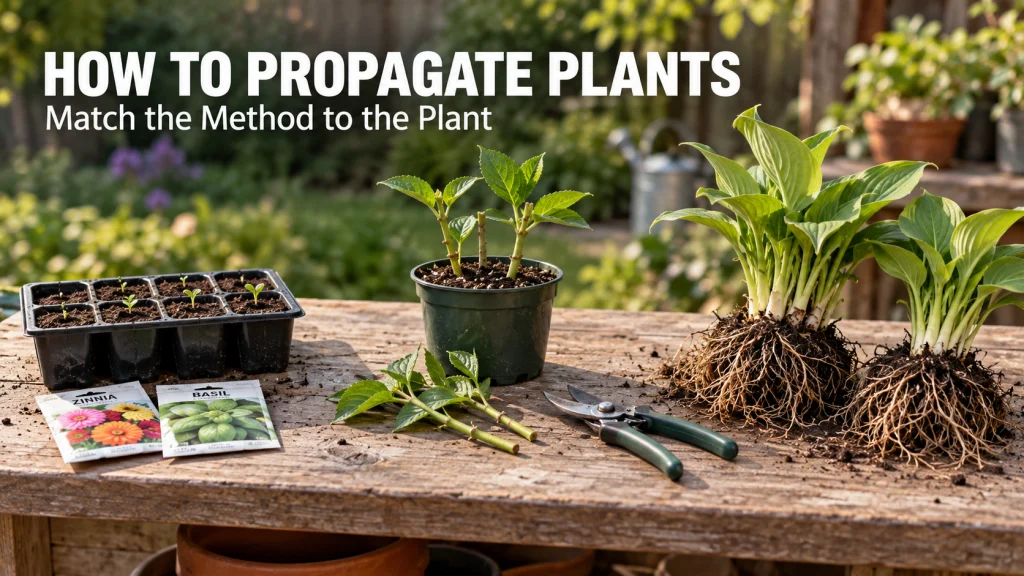
One goal, several biologically different ways to make another plant
Put a seed packet, a stem cutting, and a divisible clump on the same bench and they may look like three versions of the same project. Learning how to propagate plants starts with recognizing that they are not interchangeable starting points. A seed begins with sexual reproduction, while a cutting or division depends on living vegetative tissue already produced by a parent plant. The right route is determined before you choose a tray, rooting medium, knife, or other propagation supply.
The first decision is what you are trying to preserve. If the goal is simply to raise more plants, seed may be practical for a species that grows readily from seed, but it may not reproduce a particular parent exactly. If the goal is to retain the characteristics of one selected plant, a suitable vegetative method is usually the more direct route. That is why useful plant propagation methods start with plant structure and genetic expectations rather than with equipment.
Decide whether the new plant should come from seed or vegetative tissue
Seed propagation produces a new individual from sexual reproduction, so the offspring can differ from the parent plants. Vegetative propagation starts with roots, stems, leaves, crowns, runners, offsets, or other living structures and is used to reproduce a plant without starting from seed. That distinction matters when a gardener is trying to preserve a particular flower color, growth habit, fruit characteristic, or other trait. It also matters when the plant simply does not respond well to the vegetative method a gardener first had in mind.
Instead of asking which method is easiest in general, ask which living structure can realistically produce the next plant. A clump with several viable crowns invites a different decision from a long flexible stem, and both differ from a plant that produces obvious daughter plants. Some species support more than one route, so workload and the importance of matching the parent can then break the tie. The table below keeps the first decision focused on outcome rather than on supplies.
| Starting point | What it usually means | What to verify next |
|---|---|---|
| Seed | New genetic combination rather than a guaranteed copy of one parent | Whether seed propagation fits the species and whether variation is acceptable |
| Cutting | Detached vegetative tissue must regenerate the missing plant parts | Which tissue type the species can regenerate from |
| Division | Existing growing units are separated rather than regenerated from scratch | Whether each division can retain viable roots and shoots |
| Layering | New roots form while the stem remains attached to the parent | Whether the plant has a suitable stem and growth habit |
| Runner or offset | The parent has already produced a daughter structure | Whether the daughter plant is developed enough to separate |
| Graft | Two compatible plant parts are joined and kept as distinct components | Compatibility and whether grafting solves a real propagation goal |
Use that first distinction to narrow the field, not to declare one method universally better. A plant that divides cleanly may make division far less complicated than trying to root detached pieces. A plant with flexible stems may make layering attractive because the stem remains supported by the parent while roots form. Once the plant structure is clear, the next step can stay specific and manageable.
Use seed starting when seed propagation fits the plant and goal
Seed makes sense when the species is normally and practically raised that way, when some genetic variation is acceptable, or when vegetative reproduction would add unnecessary complexity. A packet can also offer many potential plants from a small starting volume, but that does not mean every seed has the same requirements. Light, moisture, temperature, dormancy, and pretreatment needs vary widely among species. The useful question is whether seed is the correct biological route before refining the setup.
For a gardener who has already chosen seed, the next decisions belong in a focused seed starting approach rather than in a broad list of every propagation technique. That keeps container choice, medium, sowing depth, labeling, light, and moisture tied to the actual seed being handled. It also prevents a common beginner mistake, buying a large propagation setup before checking whether the seed requires a special treatment or a simpler direct sowing route. Seed starting is a workflow, but the seed’s species-specific requirements still set the limits.
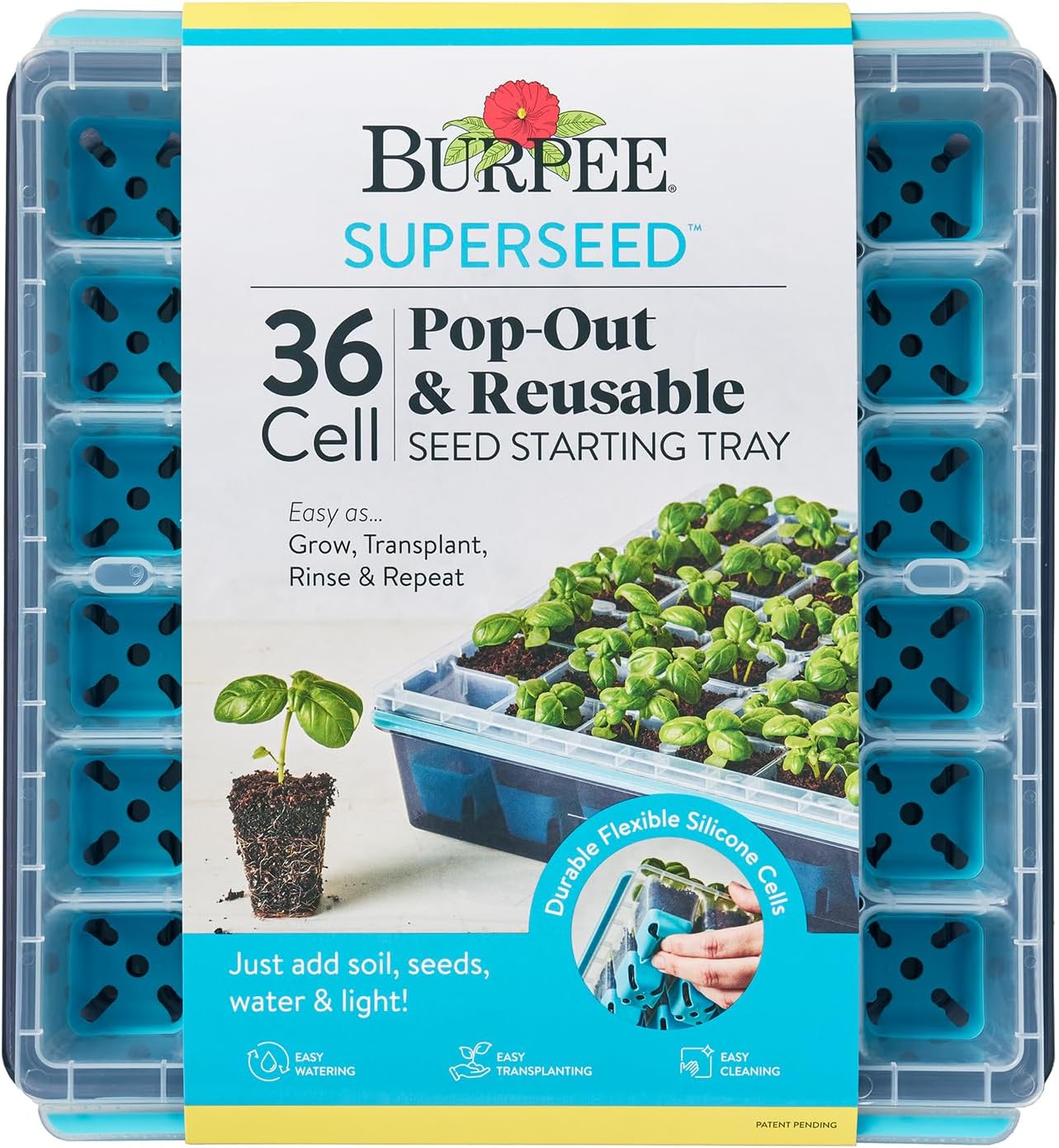
This reusable tray has 36 flexible silicone cells for starting vegetable, flower, and herb seeds indoors. Molded corner slots improve drainage and soil aeration, while the flexible cells help seedlings release for transplanting. Burpee lists the tray at about 11.5 by 10.4 by 2.25 inches.
Check On AmazonIf you click this link and buy, we earn a commission at no additional cost to you.
Separate germination from later seedling care
Germination is the transition from a viable seed to active early growth, while seedling care begins after that transition is underway. Treating both as one vague step can hide why a tray performs well at first and then declines later. Conditions that help a seed germinate are not automatically the same conditions that support sturdy continued growth. Once emergence occurs, light, airflow, moisture management, spacing, and root development become a different practical problem.
If the immediate question is why or whether a seed will sprout, use a dedicated seed germination guide before changing several variables at once. After emergence, move the decision to seedling care so the plant is managed according to its new stage rather than the conditions that existed before it emerged. This separation makes troubleshooting more disciplined because it identifies when the failure happened. It also reduces the temptation to keep a successful germination environment unchanged long after the seedling needs have shifted.

VIVOSUN states that this 10 x 20.75-inch mat maintains temperatures around 68–86°F for seedling starting and cutting propagation. It uses 20 watts and fits a standard 1020 tray. The IP67-rated surface and 5.9-foot power cord are designed for indoor propagation setups.
Check On AmazonIf you click this link and buy, we earn a commission at no additional cost to you.
Treat hardening and transplanting as an establishment handoff
A healthy seedling is not finished simply because it has roots and leaves. Moving from protected conditions to an outdoor bed or container changes light, wind, temperature exposure, moisture demand, and the physical environment around the root system. Hardening helps make that transition gradual, while transplanting completes the move into the new growing space. The exact pace and timing depend on the crop, local conditions, and the environment in which the seedling was raised.
That makes this stage less about propagation itself and more about establishment. Before moving plants outside, use a focused hardening and transplanting process that matches the plant and current conditions rather than following a fixed calendar date. A seedling that was raised under gentle indoor conditions may need a different transition from one already exposed to stronger light and airflow. The handoff is successful when the plant can continue growing in its destination, not merely when it survives being moved there.

This hand trowel uses a cast-aluminum head for digging and planting tasks. The ergonomic grip is designed to improve control during garden work. Fiskars lists the tool at 12.25 inches long and about 6.4 ounces.
Check On AmazonIf you click this link and buy, we earn a commission at no additional cost to you.
Use cuttings only when the selected tissue can regenerate a complete plant
A cutting is detached from the parent, so the selected piece must be capable of replacing the plant parts it no longer has. Depending on the species, that may involve a stem, leaf, leaf section, or root, but those tissue types are not interchangeable across plants. A leaf that roots is not automatically capable of producing a complete new shoot system, and a stem without the right structures may simply decline. Species-specific method choice matters more than the fact that a cutting looks healthy on the day it is taken.
This is where broad advice such as “take a cutting and put it in water” becomes unreliable. A better approach is to identify the tissue the species can actually regenerate from, then choose the rooting environment around that biology. Gardeners comparing the different ways to propagate plants from vegetative material should treat cutting type as a plant-specific decision, not a universal recipe. If the plant already offers a viable division, runner, or offset, forcing a cutting method may add work without improving the outcome.

This two-count pack contains 4 ounces total of TakeRoot rooting powder. The active ingredient is indole-3-butyric acid, and Garden Safe directs users to moisten a cutting, dip the cut end in the powder, tap off the excess, and plant. It is intended for propagating cuttings from common home, garden, and greenhouse varieties.
Check On AmazonIf you click this link and buy, we earn a commission at no additional cost to you.
Use division when viable growing units already exist in the clump
Division works because the gardener is separating existing growing units rather than asking a detached fragment to build everything from scratch. A suitable clump may contain multiple crowns, shoots, rhizomes, bulbs, or other structures that can remain functional after separation. The practical requirement is that each resulting piece has enough viable plant structure to continue growing. That is why a dense clump can be an excellent candidate for division while a single stemmed plant may not be divisible at all.
The easiest visual mistake is to treat any plant that looks crowded as a division candidate. Crowding describes how the plant occupies space, not whether it has separable growing units. Before cutting or pulling a plant apart, identify where shoots and roots actually connect and whether the species is commonly divided that way. When those structures are already present, division can be simpler and less setup intensive than trying to create new roots on a detached cutting.

The NJP650 has a 7.25-inch stainless-steel blade with both straight and serrated edges. Inch markings on the blade can help gauge planting depth during garden work. The tool pairs the steel blade with a wood handle and is intended for digging, planting, and root-cutting tasks.
Check On AmazonIf you click this link and buy, we earn a commission at no additional cost to you.
Use layering when staying attached lowers the rooting risk
Layering allows a stem to form roots while it is still connected to the parent plant. That continued connection can reduce the immediate water and carbohydrate stress that a detached cutting faces before it has a functioning root system of its own. The method is especially useful when the plant has a stem that can be positioned for rooting or when detaching tissue first would make establishment less reliable. Growth habit still determines whether simple layering, air layering, or another variation is appropriate.
The key decision is not whether layering sounds safer, but whether the plant has a suitable stem and the gardener can maintain the rooting zone without damaging the parent. Flexible stems close to the growing medium make one kind of setup possible, while rigid or upright stems may require a different approach. Once roots are sufficiently established, the new plant can be separated and managed on its own. Layering earns its place because attachment solves a real constraint, not because it is inherently better than cuttings or division.
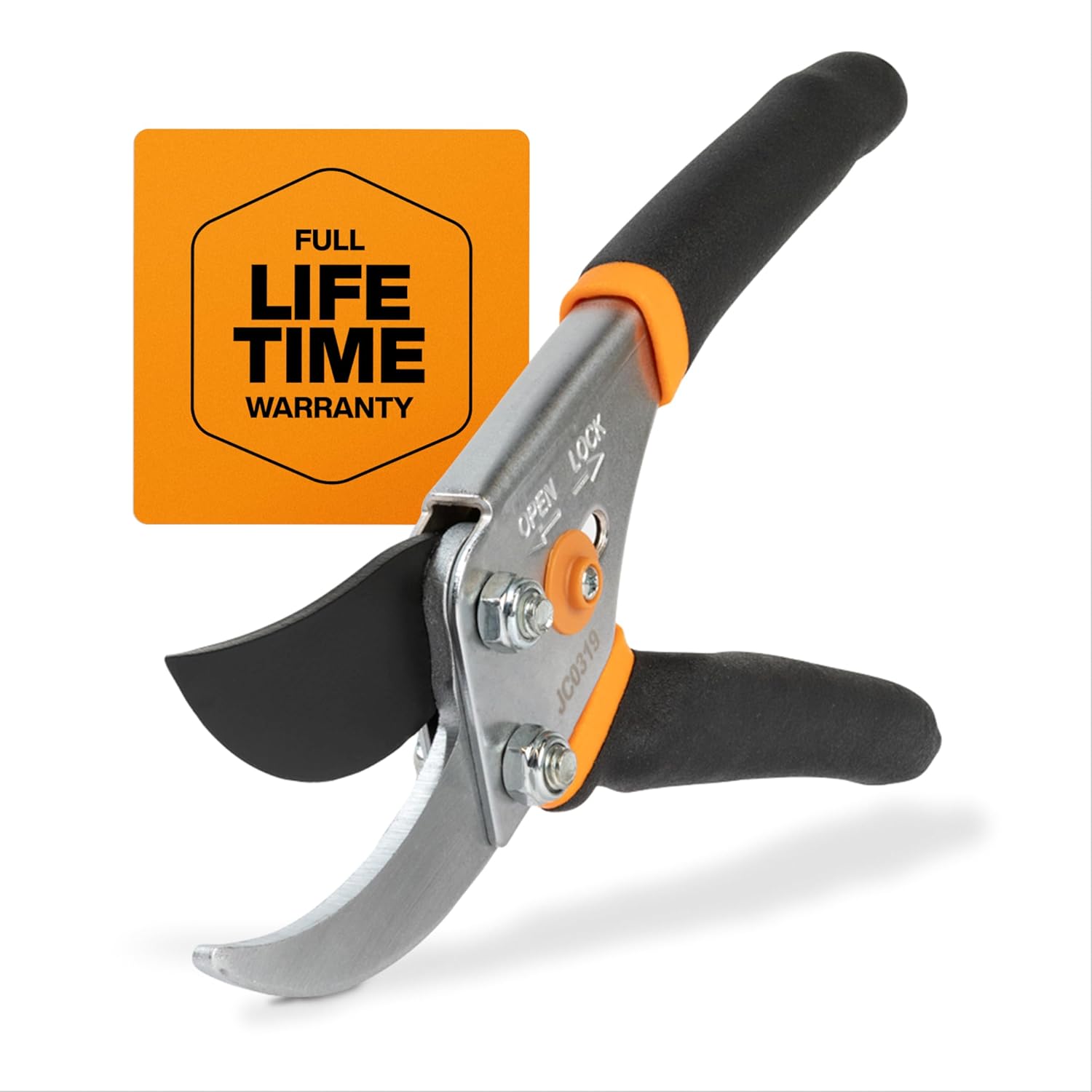
These bypass pruning shears are designed for live stems and small branches up to 5/8 inch in diameter. Precision-ground steel blades use a low-friction coating and sap groove to reduce sticking during cuts. The non-slip handle includes an easy-open safety lock for controlled use and storage.
Check On AmazonIf you click this link and buy, we earn a commission at no additional cost to you.
Treat runners and offsets as existing daughter structures
Some plants do part of the propagation work before the gardener intervenes. Runners, stolons, offsets, pups, and plantlets can produce recognizable daughter structures that may already have roots or may be able to root while still attached. In those cases, the practical job is usually to identify the daughter structure correctly and wait until separation will not leave it without enough support. This is different from taking a random piece of the parent and hoping it can regenerate.
That distinction can make propagating plants at home much simpler. If a plant routinely produces offsets with their own roots, separating a developed offset may require less environmental control than rooting a stem cutting from the same plant. Runners can also create natural rooting points that are easier to work with than detached tissue. The method should follow what the plant is already producing, especially when the simpler route preserves the same goal.

This 30-pot assortment includes 3.5-inch, 4-inch, and 5-inch clear PET nursery pots plus 20 plant labels. The pots have bottom drainage holes, and the clear walls allow roots and soil moisture to remain visible. The assortment is intended for seedlings and plants at different growth stages.
Check On AmazonIf you click this link and buy, we earn a commission at no additional cost to you.
Keep grafting at compatibility and basic homeowner depth
Grafting joins a scion to a rootstock so the two plant parts continue as one growing plant while retaining distinct roles. Success depends on biological compatibility, healthy material, and good contact between the tissues that must unite. It is useful for certain plants and goals, but it is not a generic upgrade from cuttings, division, or seed. If the same homeowner goal can be met reliably with a simpler method, grafting may add precision work without adding practical value.
At home garden depth, the important first check is compatibility rather than technique collecting. Closely related plants are more likely to form a workable union, but even related combinations can differ in long-term compatibility, so exact plant information matters. Grafting also does not merge two plants into a new genetic blend in the way sexual reproduction does. More advanced graft repair, production systems, and specialized nursery techniques belong outside a basic home propagation decision.

Flexible grafting and budding tape designed to help hold plant stems and graft unions securely in place while reducing moisture loss. The 1-inch-wide Parafilm stretches to more than twice its original length, conforms easily around irregular stems, and allows oxygen and carbon dioxide to pass through. Its self-sealing, moisture-resistant design makes it useful for grafting fruit trees, shrubs, nursery plants, and other propagation work.
Check On AmazonIf you click this link and buy, we earn a commission at no additional cost to you.
Save seed only after checking hybrid, open-pollinated, and crossing consequences
Seed saving is not simply the last step of growing a plant from seed. The seed you harvest carries the consequences of the parent plant’s genetics and the pollination that produced it. Open pollinated varieties can be useful candidates when the goal is to grow plants similar to the parent population, but cross-pollination can still change what appears in the next generation. Hybrid plants may produce viable seed, yet the offspring should not be expected to reproduce the hybrid parent predictably.
Before collecting seed, identify whether the variety is hybrid or open-pollinated and whether nearby compatible plants could have crossed with it. Then use a focused seed saving process for harvest maturity, cleaning, drying, storage, and species-specific handling. This is especially important when preserving a named trait matters more than simply seeing what grows. Saving seed is a strong propagation option when the genetic uncertainty is understood rather than ignored.

This pack contains 100 kraft-paper envelopes measuring 2.25 by 3.5 inches. The listing identifies seed storage as a recommended use and provides a sealable closure for small contents. The plain paper exterior leaves room to write variety names, harvest dates, or other seed-saving notes.
Check On AmazonIf you click this link and buy, we earn a commission at no additional cost to you.
Choose the least complicated method that preserves the goal
Once several methods look biologically possible, complexity becomes a legitimate deciding factor. A route that needs more humidity control, careful tissue preparation, compatibility matching, or prolonged attachment may be worthwhile when it preserves a trait or solves a rooting problem. It is not automatically worthwhile when a naturally produced offset or clean division reaches the same goal with fewer failure points. The best method is the least complicated one that still respects the plant’s biology and the gardener’s intended outcome.
A practical selector can be kept short. Start with the plant part already available, decide whether matching the parent matters, and check whether the tissue will be detached before roots form. Then consider setup burden, recovery risk, and whether the plant already provides a simpler daughter structure. These checks keep method choice ahead of shopping.
- Choose seed when seed propagation fits the species and genetic variation is acceptable.
- Choose a cutting only when the chosen tissue can regenerate a complete plant.
- Choose division when viable rooted or root-capable growing units already exist.
- Choose layering when keeping the stem attached solves a real rooting constraint.
- Choose runners or offsets when the plant has already produced daughter structures.
- Choose grafting only when compatibility is known and the graft solves a specific goal.
The same logic also prevents unnecessary equipment from driving the method. A humidity setup does not make an unsuitable cutting viable, and a grafting tool does not make incompatible plant material compatible. Likewise, seed trays do not solve a seed that needs a different propagation route or treatment. Method first, conditions second, supplies last is the more reliable sequence.

This pack contains 100 white T-type plant labels measuring about 6 by 10 centimeters. The PVC plastic labels are designed to resist water and weather in nursery or garden use. Their writable faces can help track plant identity, propagation method, or other notes while several propagation routes are being compared.
Check On AmazonIf you click this link and buy, we earn a commission at no additional cost to you.
Final thoughts: identify the propagation route before buying propagation supplies
The most useful propagation decision happens before anything is cut, sown, divided, wrapped, or purchased. Identify whether you are working with seed or vegetative tissue, then check what the species can actually do with that starting material. If several methods are valid, use the desired genetic fidelity, attachment status, plant structure, and setup burden to narrow the choice. This keeps the method aligned with the plant instead of forcing the plant into a favorite technique.
From there, move into the specific workflow that owns the next decision, such as seed starting, germination, seedling care, transplanting, vegetative propagation, or seed saving. Keep species-specific exceptions and environmental requirements attached to that next step rather than turning one broad article into a universal recipe. A simpler route is often the better route when it preserves the same goal with less intervention. The point is not to collect propagation methods, but to choose one that the plant can realistically support.
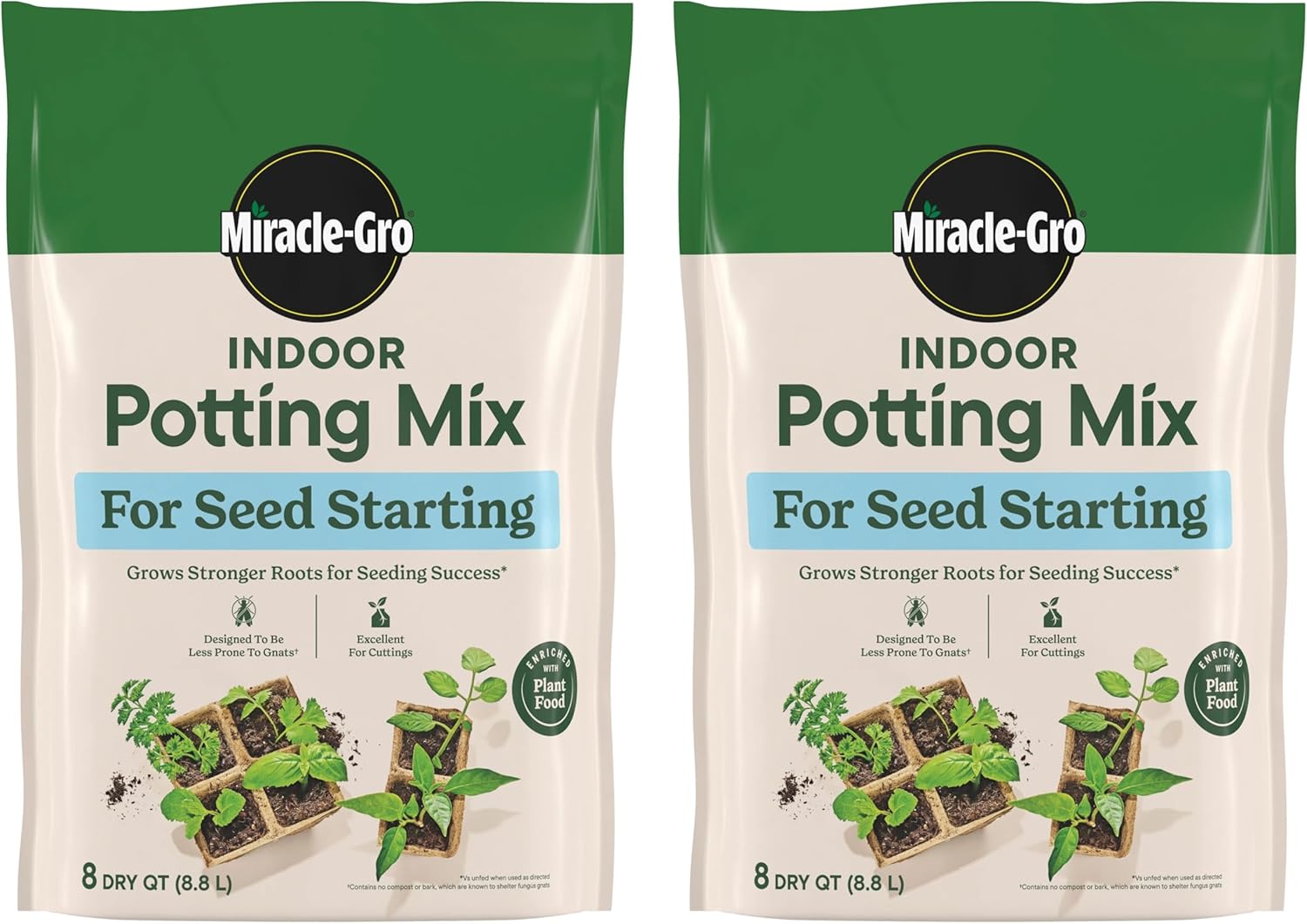
This bundle contains two 8-quart bags of ready-to-use seed starting potting mix. Miracle-Gro specifies it for germinating vegetable, flower, and herb seeds and for starting leaf, stem, and root cuttings. One 8-quart bag is listed to fill about three 72-cell seeding trays, although actual use varies.
Check On AmazonIf you click this link and buy, we earn a commission at no additional cost to you.
Frequently asked questions
🌱 What is the easiest way to propagate a plant?
The easiest method is the one the species naturally supports with the least extra intervention. A rooted offset or clean division may be easier than a cutting, while another species may be most practical from seed.
✂️ Are cuttings always clones of the parent plant?
Vegetative cuttings are used to reproduce the parent plant genetically, but the cutting still has to be capable of regenerating a complete plant. Choose the correct tissue type for the species rather than assuming any leaf or stem piece will work.
🪴 Is division better than taking cuttings?
Division is often simpler when the plant already forms separable growing units with viable roots and shoots. If the plant does not have that structure, a suitable cutting or another method may be more appropriate.
🌿 Why would I layer a stem instead of cutting it off first?
Layering keeps the stem attached to the parent while roots form, which can reduce the stress of establishing detached tissue. It only makes sense when the plant has a suitable stem and growth habit for the method.
🌼 Will saved seed grow exactly like the parent plant?
Not necessarily. Open pollinated varieties may produce similar offspring when crossing is controlled, while hybrid seed can produce unpredictable combinations of traits.
🧬 Can grafting combine the genetics of two plants?
No. Grafting joins compatible plant parts so they grow together, but the scion and rootstock retain their own genetic identities rather than becoming a new sexual hybrid.
References and sources
- Iowa State University Extension and Outreach: Supports the distinction between sexual and vegetative propagation and the need to match the method to plant growth habit.
- Virginia Cooperative Extension: Supports homeowner guidance on cuttings, layering, division, runners, offsets, and the role of attached versus detached tissue.
- University of Missouri Extension: Supports the grafting compatibility boundary and the roles of scion, rootstock, and cambial contact.
- University of Minnesota Extension: Supports the distinction between open-pollinated and hybrid seed and the consequences of cross-pollination for saved seed.