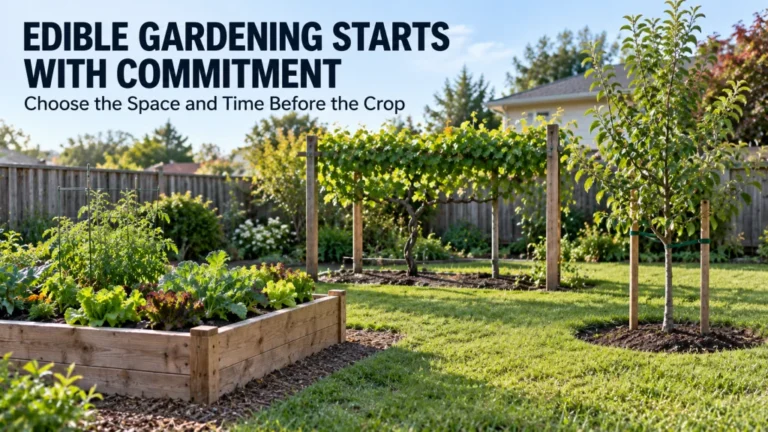
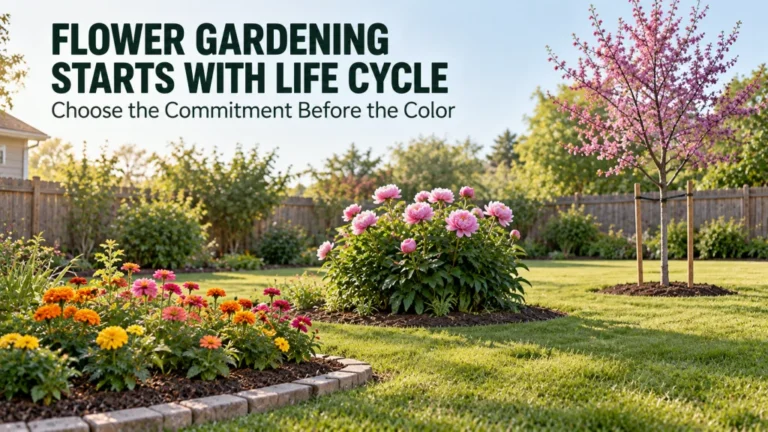
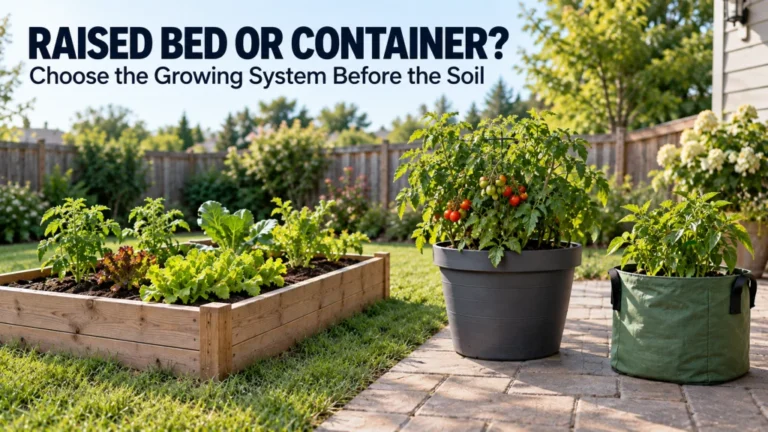
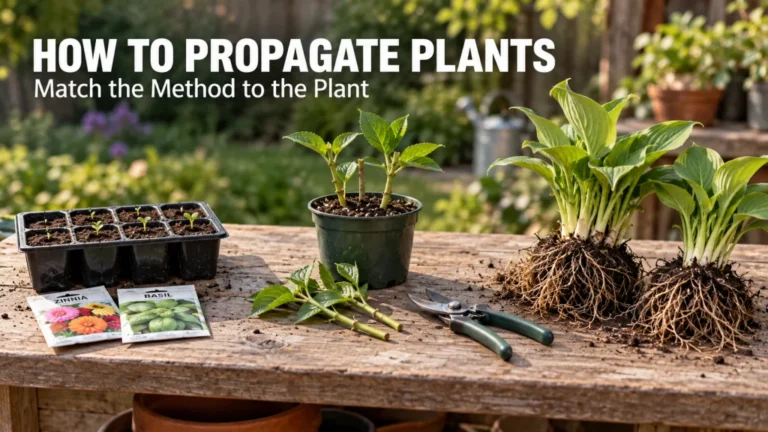
Learning how to start a garden gets easier when the first season is treated as a sequence of decisions, not a list of everything a gardener could learn. Start by defining what you want from the space, setting a workload limit, checking the site, and choosing a growing format that fits the conditions you actually have. Regional climate information helps with plant selection and seasonal risk, but local conditions and crop requirements still control planting decisions. The goal is a first garden small enough to maintain, observe, and improve without turning the project into a second job.
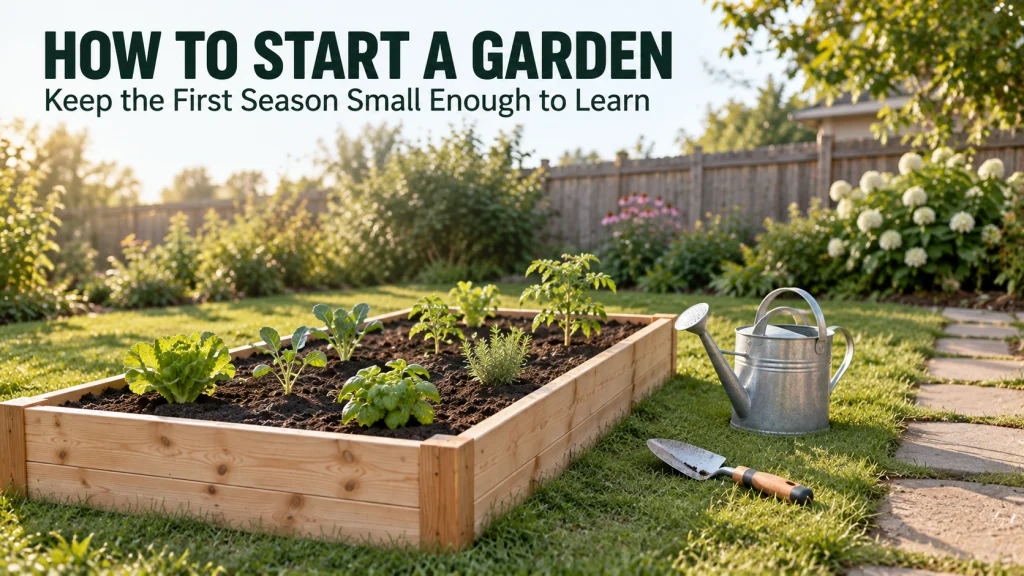
A first garden does not need every gardening skill at once
A first garden can become a shopping list, a soil-science course, and a construction project before one plant goes into the ground. That is usually a sequencing problem, not proof that gardening itself is too complicated. The first job is to decide what must be known before planting and what can wait until a real question appears. Gardening for beginners works better when the next decision is clear and the rest stays off the table for now.
You do not need irrigation design before confirming the site, or propagation gear before deciding what to grow. Soil improvement, pest troubleshooting, pruning, and seed starting matter later, but they are not simultaneous entry requirements. A small first season gives you useful information for later decisions. That keeps learning tied to the garden instead of to possible future problems.

This hand trowel has a cast aluminum head for digging and planting in beds or containers. Its ergonomic grip supports routine hand work around a small first garden. A handle hang hole provides a simple storage option between tasks.
Check On AmazonIf you click this link and buy, we earn a commission at no additional cost to you.
Define what you want the garden to do before choosing plants
The same yard can support very different garden plans depending on what the gardener wants from it. Herbs near the kitchen, a vegetable bed, a flower border, and a mixed garden create different demands for light, space, water, and maintenance. Write the outcome in one plain sentence before choosing plants. That sentence filters out decisions that expand the project without improving the result you want.
Keep the goal specific enough to guide choices but flexible enough to adjust. “Grow a small amount of food we actually eat” is more useful than “become self-sufficient,” because it can be matched to a real footprint and workload. “Add flowers near the patio” is more useful than “transform the whole yard,” because it gives you a place to evaluate first. Once the garden has a job, plant choice becomes a fit question rather than a wish list.

This three-pack of composition notebooks includes 100 double-sided wide-ruled sheets per notebook. One notebook can hold the first-season goal, workload limit, and short crop list in one place. Writing the goal before plant shopping gives later choices a simple reference point.
Check On AmazonIf you click this link and buy, we earn a commission at no additional cost to you.
Put a hard ceiling on first-season space and maintenance
New gardeners often estimate space before they estimate recurring work. Decide how much routine attention can realistically fit around work, family, travel, and weather. Every extra bed, container, row, or crop adds recurring care such as watering, weeding, harvesting, or cleanup. The first-season limit should reflect repeatable workload, not the ground you could technically fill.
Set the ceiling as a maximum footprint, number of growing areas, or short crop list. Leave expansion as an option rather than making it part of the starting plan. If the first area stays manageable, adding more later is easy; if it already feels neglected, more space will not fix that. A small garden is complete when its size matches the gardener’s available attention.
- Confirm the site has workable light, drainage, water access, and a practical route.
- Choose one primary garden goal for the first season.
- Set a maximum number of beds, containers, or planting zones before buying plants.
- Leave room for watering, weeding, observation, harvest, and cleanup.
- Before buying more, name the repeated garden problem the purchase would solve.
This ceiling also prevents buying solutions for problems the garden has not created. If a new idea adds recurring work, it belongs inside the workload budget just like another planting area. The question is not whether the idea sounds useful alone. The question is whether it improves the first garden enough to justify the extra work it creates.

This 25-foot tape measure has fraction markings and a self-locking retractable blade. It can help set a clear maximum bed, container, or planting-zone footprint before purchases begin. The compact tool also works for checking paths and access widths while keeping the first-season scope measurable.
Check On AmazonIf you click this link and buy, we earn a commission at no additional cost to you.
Screen the site before buying or building anything
Evaluate the location before committing plants, soil, containers, or construction. Start with hard-to-change conditions: light, drainage, roots, slope, water access, traffic, and the route to the garden. Many vegetables need substantial direct sun, while other plants tolerate less, so site fit depends on what you plan to grow. A spot that looks bright from the kitchen window can still be shaded for much of the day by buildings, fences, or trees.
Notice where water sits after rain, where traffic compresses soil, and whether carrying tools or water there will become annoying. Good drainage matters because waterlogged root zones reduce available air and create problems plant care alone may not solve. If site selection is the bottleneck, use a detailed guide to choose a garden site around light, drainage, access, and daily use. It is usually cheaper to reject the wrong site now than to redesign the garden after planting.

SunCalc is designed to measure accumulated sunlight at a garden location. It reports full sun, partial sun, partial shade, or full shade for comparing the site with plant light needs. That makes it useful before committing plants or construction to a spot that only appears bright.
Check On AmazonIf you click this link and buy, we earn a commission at no additional cost to you.
Decide whether the ground is usable or the growing-space format must change
In-ground planting is one option, not the default when the site makes it impractical. Usable ground needs drainage, workable soil, acceptable contamination risk, enough light, and practical access. If those conditions are workable, improving existing ground may be simpler than building a new system. If not, change the growing format without turning the season into a construction project.
Containers can make sense on patios or where only small pockets of suitable light are available, while raised beds can separate the growing area from compacted or difficult ground. Those formats change maintenance because smaller soil volumes and elevated beds can dry faster than surrounding ground. Do not choose a format because it looks advanced or a generic beginner list says you need it. Choose it because it solves a named site constraint, then account for the watering, fill volume, access, and upkeep that come with that choice.

This set includes five 5-gallon fabric grow bags with handles. The container format can create a defined growing space when in-ground planting is not the practical choice. Five-gallon bags also make fill volume, watering, and access part of the format decision from the start.
Check On AmazonIf you click this link and buy, we earn a commission at no additional cost to you.
Read regional climate signals without confusing zone with planting date
The USDA Plant Hardiness Zone Map is useful, but it answers a narrower question than many beginners expect. It is based on average annual extreme minimum winter temperature and helps judge perennial cold hardiness. It does not tell you when a warm-season seedling should go outside or whether a late cold event will occur. Use plant hardiness zones for the decisions they actually support rather than treating the zone number as a universal gardening calendar.
Seasonal planting depends on local freeze patterns, current weather, soil conditions, and crop tolerance. Historical frost or freeze information is a planning signal, not a guarantee about a specific cold event. A better starting point is to understand how local frost dates and freeze risk fit into planting decisions, then compare that information with the requirements of the exact crop. Climate data narrows the window, but the plant and current conditions still control the decision.

This wireless thermometer uses a remote outdoor sensor and an indoor display to show current outside temperature. The sensor works without a hub or app and is rated for a transmission range up to 500 feet. It helps keep regional hardiness information separate from conditions actually occurring at the site.
Check On AmazonIf you click this link and buy, we earn a commission at no additional cost to you.
Turn the usable space into a simple garden plan
Once site and format are known, sketch the garden around access before filling it. Mark planting areas, paths, the hose route, nearby shade, and fixed obstacles that affect movement. Assign only space you can reach, water, weed, and harvest without creating awkward access. A simple garden plan built around space, access, and workload beats a decorative layout that ignores maintenance.
The first drawing does not need precise landscaping software or a complete crop-by-crop map. It only needs to prevent conflicts such as shading, narrow paths, or a hose crossing the only walkway. Keep some space unassigned instead of filling every square foot. Empty space is cheaper to live with than an overcrowded first garden that becomes difficult to reach and harder to observe.
| Worksheet prompt | Minimum answer needed | Your first-season choice |
|---|---|---|
| What is the garden for? | One clear first-season purpose | Write the goal in one sentence |
| What is the workload ceiling? | A fixed maximum area or number of growing zones | Write the limit you will not exceed |
| Which site and format fit? | A workable location and the simplest format that solves its constraints | Record the location, format, and reason |
| Which plants fit? | A short list matched to space, season, and household use | Write the first-season plant list |
| What controls timing and care? | Local timing inputs plus a repeatable care routine | Record what you will verify and repeat |
Treat the third column as a minimum viable garden worksheet, not a wish list. Fill it with the smallest answer that lets the next decision move forward. An unanswered row identifies the decision that still needs work. Once every row has a usable answer, the plan is ready to move toward planting.

This hardcover notebook has graph-ruled pages for a simple garden sketch that can be revised by hand. Its 240 pages leave room to mark beds, paths, hose routes, shade, and fixed obstacles without design software. The 5 by 8.25-inch format is compact enough to carry outside while checking the layout.
Check On AmazonIf you click this link and buy, we earn a commission at no additional cost to you.
Reduce the crop wish list to plants that fit space, season, and workload
A long crop list can create incompatible demands in the garden. Some plants occupy space for long periods, need support or repeated harvest, or simply do not fit the light or season. Remove anything that conflicts with the site before deciding what is easiest or popular. A plant is not beginner-friendly when its basic needs do not match the garden you actually have.
Then compare the remaining choices with household use and maintenance tolerance. If no one wants to eat a crop, it does not become a smart first-season choice just because it grows quickly. If a plant requires frequent picking during a period when you are usually away, that workload matters as much as its space requirement. Keep the first list short enough to learn what each plant is doing instead of managing a crowded assortment.

This reusable seed organizer has 32 clear pockets and holds up to 64 seed packets. Keeping packets visible in one place can make it easier to compare the short crop list with what is already on hand. The organizer supports selection and storage without requiring every packet to become part of the first-season plan.
Check On AmazonIf you click this link and buy, we earn a commission at no additional cost to you.
Separate cool-season and warm-season crops before assigning planting windows
Vegetable crops do not all respond to temperature the same way, so one national planting month cannot serve as a reliable calendar. Cool-season crops can tolerate cooler conditions than warm-season crops, while heat-loving plants can be damaged or stalled when planted into cold conditions. The exact timing still varies by crop, local climate, soil temperature, and whether you are direct-seeding or transplanting. Grouping crops by temperature response prevents the common mistake of assigning every seed packet to the same weekend.
This distinction also helps you avoid reading a local freeze signal as permission to plant everything immediately. A statistical end to regular freeze risk can be relevant without making the soil or air suitable for every crop. Use the packet, transplant label, or crop-specific guidance to identify the temperature and planting requirements for the plant in question. The garden calendar should be assembled from crop requirements plus local conditions, not from one date treated as a universal starting gun.

This analog soil thermometer uses a 4-inch stainless-steel stem and measures from 20 to 180 degrees F. It adds an actual soil-temperature check to crop timing instead of treating one calendar date as suitable for every seed or transplant. The dial includes marked ranges intended for seed germination and planting.
Check On AmazonIf you click this link and buy, we earn a commission at no additional cost to you.
Decide when the garden project starts and when planting starts
The garden project often starts before anything should be planted. Site observation, soil testing when needed, layout, bed preparation, container setup, and weed control can all happen before the correct planting window arrives. Separating preparation from planting reduces the pressure to put plants into unsuitable conditions simply because the project is already underway. It also gives you time to solve access or drainage problems before roots occupy the space.
This is especially useful when seasonal conditions are unpredictable. Preparation can move forward while planting remains conditional on the crop and local weather. If the bed is ready early, that does not create an obligation to fill it immediately. A prepared empty garden is still progress when waiting protects the planting from a poor start.

This soil test kit is designed to check soil pH and garden nutrients. It gives a concrete soil-condition check during preparation before roots occupy the space. That fits a project phase where bed preparation can move forward while planting timing remains conditional on the crop and current weather.
Check On AmazonIf you click this link and buy, we earn a commission at no additional cost to you.
Build a planting calendar from local timing inputs instead of a national month
A useful planting calendar begins with location-specific climate information and then narrows down to crop requirements. Note the local freeze pattern, the expected seasonal temperature trend, and any meaningful microclimate difference at the site, such as a low spot where cold air settles or a paved area that warms quickly. Then place each crop into the window supported by its own cold tolerance and planting method. The calendar is a planning tool that should change when conditions change, not a contract with the weather.
Keep the first version simple enough to use. Instead of scheduling every gardening task, record when each crop can reasonably be considered for direct seeding, transplanting, or later succession if that is relevant to your plan. Check current conditions before acting, especially around cold-sensitive planting. A calendar that tells you what to verify is more practical than one that pretends the season will follow an exact national schedule.

This hardcover garden journal combines a five-year planner with a planting calendar and plant logs. It provides one place to record local timing inputs, crop windows, and what actually happened each season. That structure suits a planting calendar meant to change as local conditions and observations change.
Check On AmazonIf you click this link and buy, we earn a commission at no additional cost to you.
Use companion planting only after spacing, light, and crop requirements are satisfied
Companion planting can be interesting, but it should not override the basic requirements of the plants involved. A pairing is not useful if one plant shades the other, crowds its root area, blocks access, or forces incompatible watering and spacing decisions. Start with mature size, light, planting distance, season, and care needs before considering whether two plants are described as companions. Good garden fit is still the first test.
If companion planting is part of the plan, treat it as a secondary layout decision rather than a substitute for ordinary horticulture. Use evidence-based companion planting guidance to evaluate whether a claimed benefit is documented, plausible, or mostly repeated tradition. The most important result may simply be that two plants can share space without interfering with each other. That is a useful outcome even when there is no special benefit to prove.

Carrots Love Tomatoes is a dedicated reference on companion planting for home gardens. It can be consulted after spacing, light, season, and ordinary care requirements have already been satisfied. Using a separate companion-planting reference keeps that secondary layout question from replacing basic crop fit.
Check On AmazonIf you click this link and buy, we earn a commission at no additional cost to you.
Know when soil, propagation, watering, or plant-specific guidance becomes the next question
A broad starting plan should narrow when a real decision needs more detail. Poor drainage points toward soil guidance, an indoor-start requirement points toward propagation, and inconsistent moisture points toward watering strategy. Each condition creates a specific next question. That is more useful than researching every gardening subject before the need exists.
Carry the actual site and plant conditions into deeper research so the answer stays specific. A symptom without a clear cause, for example, needs identification before treatment rather than a generic control plan. The same principle applies to soil, propagation, and watering questions. Broad planning should route the next question instead of trying to contain every technical topic in one article.
| What you notice | Next question to investigate |
|---|---|
| Water stands or soil stays difficult to work | Soil condition and drainage |
| The chosen crop must begin before outdoor conditions fit | Seed starting and propagation |
| The growing area dries unpredictably | Watering method and moisture management |
| One crop develops a specific care problem | Crop-specific growing guidance |
| A symptom appears without a clear cause | Identification before treatment |
Use this topic map when a condition creates a question the starting plan cannot answer. It keeps deeper research connected to an observed need. The next guide should address the issue that is actually blocking progress. Other specialist topics can stay outside the plan until they matter.

This single-probe soil moisture meter gives an instant soil moisture reading without batteries. It can help turn inconsistent moisture into a specific watering question instead of relying only on the soil surface. The meter is intended for indoor and outdoor soil, making it relevant when moisture management becomes the next specialist issue.
Check On AmazonIf you click this link and buy, we earn a commission at no additional cost to you.
Write the first-season sequence from site check to planting to routine care
Put the plan into a short sequence that can be followed without reopening every decision each time you walk outside. Start with the goal and workload ceiling, confirm the site, choose the growing format, identify the crop list, and then assign local planting windows. After planting, shift attention to the recurring basics: moisture, weeds, support needs, plant development, harvest, and signs that something is changing. The sequence should be short enough to keep the garden moving even when you do not have time for more research.
Review the sequence when a real condition changes, not because a new gardening idea appears online. A crop failure, drainage issue, heat problem, access problem, or workload problem can justify a different method in the next round. A garden that is simply doing its job does not need constant optimization. The first season is successful as a learning system when it shows you which constraints are real and which upgrades were never necessary.
| Decision gate | If yes | If no |
|---|---|---|
| Is the first-season goal clear? | Set the workload ceiling. | Choose one practical purpose first. |
| Can the planned size fit repeatable care? | Screen the site. | Reduce the footprint or plant list. |
| Does the site fit for light, drainage, water, and access? | Keep the simplest workable format. | Change the location or growing format. |
| Do the plants fit the space and season? | Set planting windows. | Remove or replace the poor fits. |
| Do current conditions fit the crop requirements? | Plant and begin routine care. | Wait or adjust instead of forcing the date. |
| Can routine care stay within the workload ceiling? | Keep observing and maintaining. | Reduce scope or solve the specific bottleneck. |
Read the table as a branching first-season decision tree, not a checklist that always moves forward. A no answer sends you back to the decision that created the mismatch. A yes answer moves the garden to the next gate. That keeps progress tied to actual conditions instead of to completing more research.

This kneeling pad measures 17.5 by 11 inches and is 1.5 inches thick. It provides a cushioned surface for recurring low-to-ground garden tasks such as weeding and routine plant care. That makes it relevant after the first-season sequence shifts from planning and planting to repeated maintenance.
Check On AmazonIf you click this link and buy, we earn a commission at no additional cost to you.
What a beginner does not need to buy yet
A first garden does not automatically require raised beds, purchased soil, irrigation hardware, seed-starting equipment, specialized fertilizers, or many tools. Any of those can be useful when they solve a specific constraint, but they are not entry tickets to gardening. Start with the site and the job, then add only what the chosen format and plants actually require. That order protects the budget and also prevents extra setup and maintenance from becoming part of the garden by accident.
Before buying something, name the recurring task or constraint it addresses and compare it with the simplest workable option. Water, access, soil, plant performance, and maintenance are better buying signals than a generic beginner checklist. A useful purchase should have a clear job in the current setup. If that job is hard to name, it is probably not part of the minimum setup.

This 2-gallon watering can has two handles, a wide mouth, and a removable nozzle spout. It covers a basic recurring watering job without requiring an irrigation system before the garden proves it needs one. The simple tool keeps the purchase tied to an immediate task rather than an assumed future upgrade.
Check On AmazonIf you click this link and buy, we earn a commission at no additional cost to you.
Final Thoughts: make the first garden small enough to learn from
Starting well means settling the decisions that determine whether the garden can function: purpose, workload, site fit, growing format, plant fit, and timing. Those choices create a structure that can be maintained and reviewed as conditions change. Later adjustments are easier to judge because each one can be tied to a specific mismatch. The first plan only needs to guide the work in front of you.
If you are still deciding how to start your first garden, put the decision gates and worksheet on one page and complete the answers you can verify now. Soil correction, propagation, irrigation design, crop-specific care, and troubleshooting can follow when one becomes the actual bottleneck. The useful outcome is a garden whose choices make sense for the site, season, plants, and available care. That gives later changes a clear reason instead of making expansion the default.

This set includes 100 plastic T-type plant labels measuring 6 by 10 cm. Labels can keep crop names and planting identities visible as the first season develops. That supports observation and later review without turning the garden into a larger or more complicated system.
Check On AmazonIf you click this link and buy, we earn a commission at no additional cost to you.
Frequently asked questions
🌱 What should I do first when starting a garden?
Define what you want the garden to do, then set a realistic size and workload limit before choosing plants. After that, evaluate the site for light, drainage, water access, and everyday usability.
☀️ How much sun does a beginner garden need?
It depends on what you plan to grow. Many vegetables need substantial direct sun, while some leafy crops, herbs, and ornamentals tolerate less, so match the plant list to the light the site actually receives.
🪴 Do I need raised beds to start a garden?
No. In-ground gardens, containers, raised beds, and simple combinations can all work when they fit the site, access, drainage, soil, and maintenance needs.
❄️ Is my hardiness zone the same as my planting schedule?
No. Hardiness zones describe average annual extreme minimum winter temperature, while planting decisions also depend on local freeze risk, current weather, soil conditions, crop tolerance, and planting method.
🥕 How many vegetables should a beginner grow?
There is no universal number. Choose a short list that fits the available space, seasonal window, household use, and the amount of recurring care you can realistically provide.
🛠️ What garden supplies should I buy before planting?
Buy only what the chosen site, growing format, and plants require for the next step. Specialized systems can wait until a repeated problem shows that they solve a real constraint.
References and Sources
- UNH Extension getting started with gardening: Supports the broad beginner sequence of site selection, preparation, planning, planting, and ongoing garden care.
- USDA Plant Hardiness Zone Map: Supports the distinction between winter hardiness information and crop-specific planting timing.
- Penn State Extension planting and growing a home garden: Supports site decisions involving sunlight, moisture, and matching plants to the available location.
- National Weather Service frost and freeze information: Supports using local frost and freeze climatology as planning guidance rather than a guaranteed planting date.