A useful garden plan starts with fixed facts about the space, then adds crops, timing, spacing, access, and workload in that order. The goal is not to make every seed packet fit, but to make the garden workable through planting, maintenance, harvest, and seasonal change. Local climate, crop requirements, soil conditions, and the amount of time you can realistically maintain the space can all change the final plan. A reusable plan also records what happened so the next season begins with evidence instead of guesswork.
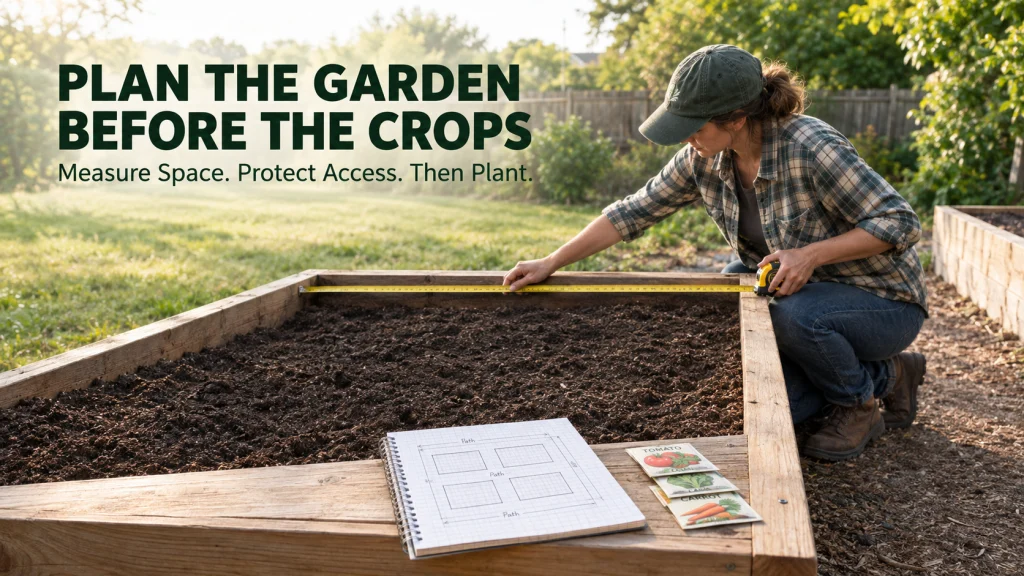
The garden plan fails when the decisions are made in the wrong order
Garden planning often fails before planting because the crop list becomes the starting point instead of the space. Seed packets take little room on a desk, while mature plants, paths, supports, watering access, and harvest work compete for real ground. That mismatch can turn a neat sketch into a crowded bed. If you are still deciding what the project should include, begin with starting a garden from the ground up before assigning crops.
- Measure the usable space.
- Reserve access and work routes.
- Set a maintainable garden size.
- Build and rank the crop shortlist.
- Classify crops by seasonal timing.
- Apply crop-specific spacing.
- Turn the finished map into a calendar.
The better sequence is to lock in fixed constraints, then make plant choices inside them. Measure first, reserve access, set a maintainable size, choose crops, check timing, apply crop-specific spacing, and then finalize the calendar. When a later check removes a plant, the plan is doing useful work. It is cheaper to find that conflict on paper than after the bed is crowded. That order also makes later revisions easier because each change has a clear reason.

This five-subject spiral notebook has 200 college-ruled sheets and a water-resistant cover. Separate subject sections can keep measurements, crop choices, timing notes, and revisions from becoming one mixed list. It supports the planning sequence on paper without adding a garden-specific system the reader has to maintain.
Check On AmazonIf you click this link and buy, we earn a commission at no additional cost to you.
Start with a measured base map
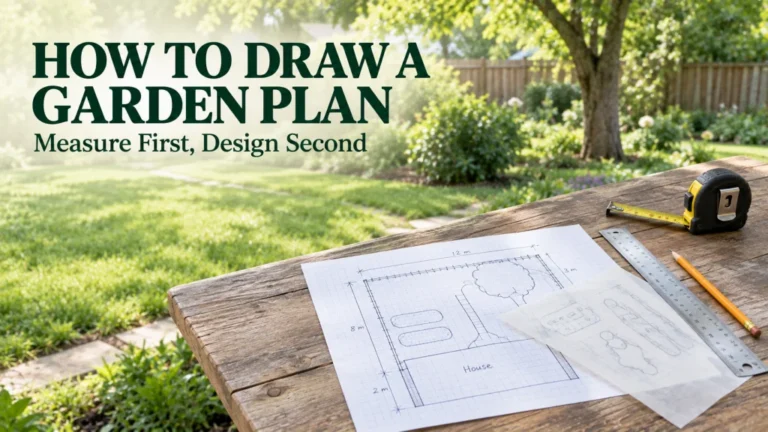
A base map should show the usable growing area as it exists now, not after imagined future projects. Mark bed edges, fences, trees, sheds, gates, paths, water access, and areas that cannot reasonably be planted. Add movement constraints such as narrow passages or places where you need room to kneel. Use the guide to drawing a garden plan that reflects the real site for the mapping process. If the location itself is unsettled, first decide which garden site fits the property.
Keep the first version plain enough to revise without feeling attached to the drawing. The map is a working constraint sheet, not a landscape design, so accuracy matters more than decoration. Separate total property area from genuinely usable planting area after access and fixed features are counted. That usable area becomes the foundation for later decisions about quantity, layout, spacing, and timing. Keep that original map available for comparison after revisions.

This open-reel fiberglass tape measures up to 100 feet and includes inch and metric scales. The long reach suits mapping beds, paths, fences, and other fixed features across a residential yard. Use the measured distances to draw usable planting area before assigning crops.
Check On AmazonIf you click this link and buy, we earn a commission at no additional cost to you.
Decide how much garden can actually be maintained
The largest area you can plant is not automatically the right area to use. Weeding, watering, checking plants, tying supports, harvesting, and removing spent crops all add work after planting. Extension guidance warns beginners against starting larger than they can maintain, and the same logic applies whenever available time changes. The guide on choosing a manageable vegetable garden size helps when area is the main uncertainty.
I would rather leave intentional empty space than fill every corner with crops that depend on time you do not have. A smaller active area also makes it easier to observe light, drainage, watering effort, and harvest patterns before expanding. Containers or separate small beds can fit fragmented space, but they still create recurring maintenance. Size the plan around the work you can repeat, not the number of plants that look interesting. Leave room to learn what the site demands before committing to more recurring work.

This 17.5 by 11-inch foam pad is 1.3 inches thick and gives knees a cushioned surface for ground-level work. It is useful when judging whether a bed layout leaves practical kneeling and tending access. Maintenance size is easier to assess when routine tasks are considered in the posture they actually require.
Check On AmazonIf you click this link and buy, we earn a commission at no additional cost to you.
Build the crop shortlist
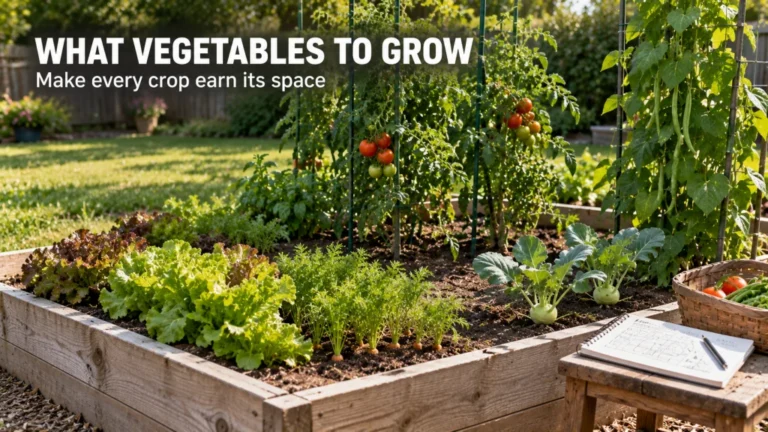
Once space and workload limits are visible, make a crop shortlist around what the household actually wants to eat, preserve, share, or try. The list should be shorter than everything that can grow locally because a plan needs priorities. Separate frequent-use crops from occasional crops and experiments so novelty does not crowd out a weekly staple. The guide to choosing vegetables that fit your garden and household goes deeper into that filter.
Do not assign positions yet because a crop can belong on the shortlist and still fail a later check. Treat each choice as a candidate that must fit season, space, support, and maintenance. Flag crops that are long-lived, need structures, or take a large footprint for their value to you. Keep companion planting questions separate so pairing claims do not replace those basic checks. A short list makes later spacing and timing conflicts easier to see.

This organizer includes 16 inner 4 by 6-inch cases inside a larger storage box. The separate cases provide simple compartments for sorting seed packets or crop notes while the shortlist is narrowed. It is a storage aid rather than a crop recommendation, so final choices still need to pass space, season, and maintenance checks.
Check On AmazonIf you click this link and buy, we earn a commission at no additional cost to you.
Decide how much of each crop the household actually needs
Quantity should come after crop choice because the same vegetable can deserve very different space in different households. Consider how often you use it, whether you want fresh eating or storage, and how much harvest you are prepared to handle. Published planting-per-person figures can be useful starting references, but they cannot predict your yield, appetite, climate, soil, or variety. Use household planting estimates as a planning check, then adjust them to actual use.
For a simple example, imagine the map leaves six equal planting spaces after access is protected. If greens and beans are weekly foods, tomatoes matter for seasonal meals, and squash is occasional, give more spaces to the first priorities and one trial space to squash. That is a planning example, not a horticultural rate or yield promise. If the priorities do not fit, reduce quantity or remove a lower-priority crop before shrinking paths or ignoring spacing.

This planting template uses color-coded holes, a dibber, seed spoon, ruler, and planting guide to organize seed placement. The one-square-foot format helps translate a crop quantity decision into repeatable planting positions. Treat its guide as a layout aid and still follow crop-specific recommendations when the article calls for them.
Check On AmazonIf you click this link and buy, we earn a commission at no additional cost to you.
Classify vegetables by cool-season and warm-season timing
A flat crop list hides an important difference: not every vegetable belongs in the same weather window. Grouping crops into cool-season and warm-season categories helps you see which plants may occupy the same bed at different parts of the growing cycle and which ones compete for the same prime period. It also keeps a single attractive layout from becoming a false promise that everything will grow there at once. The guide to cool-season and warm-season vegetables explains how that distinction changes planting decisions.
This classification is a planning layer, not a universal calendar. The planting window still depends on local climate, frost risk, crop tolerance, and variety. A cool-season crop may be useful before or after a heat-loving crop, while a long-season warm crop may occupy one place for much of the usable season. Mark those differences now so the next version of the map can show time as well as physical space.

This 10 by 30-foot floating row cover uses 0.9-ounce-per-square-yard garden fabric for frost, sun, and pest protection. It can support a cool-season or shoulder-season plan when protection is part of the actual crop strategy. The cover does not replace local planting-window checks or crop-specific temperature guidance.
Check On AmazonIf you click this link and buy, we earn a commission at no additional cost to you.
Use soil temperature when calendar and air temperature are not enough
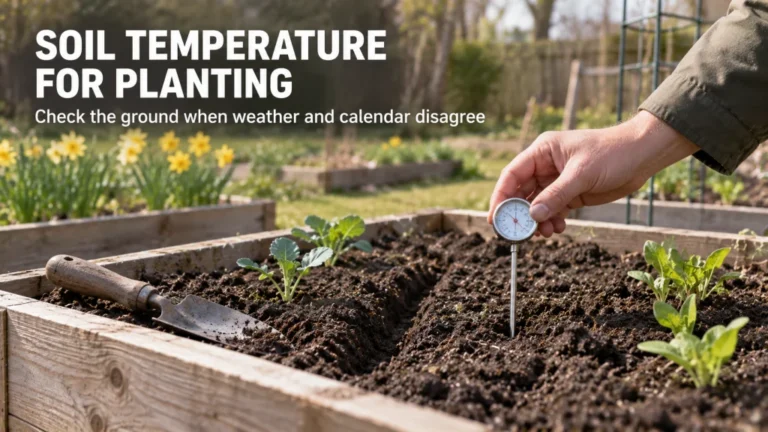
Air can feel mild while the seed zone remains colder than a crop needs for reliable germination. Extension references show that vegetable seeds differ in the soil temperatures they tolerate and prefer, so one threshold should not be applied to every crop. Use soil temperature alongside local frost risk, crop requirements, and the weather trend. The guide to using soil temperature for planting decisions explains that signal without turning it into a rigid rule.
Add this check where it changes a real decision, especially for direct-seeded crops or an early planting. The useful number should come from crop-specific guidance rather than a generic chart applied across the garden. If soil conditions are not ready, a calendar entry does not make them ready. A useful planting calendar therefore records conditions and decision windows instead of pretending the season follows a fixed script. That check matters most when the planting window is close to a crop’s lower tolerance.

This digital soil meter combines soil temperature, moisture, pH, and sunlight readings in one tool. The temperature function is directly relevant when a planting decision depends on soil conditions rather than air temperature alone. Use the reading as one input alongside crop-specific guidance, frost risk, and the weather trend.
Check On AmazonIf you click this link and buy, we earn a commission at no additional cost to you.
Choose the layout family from usable space and access
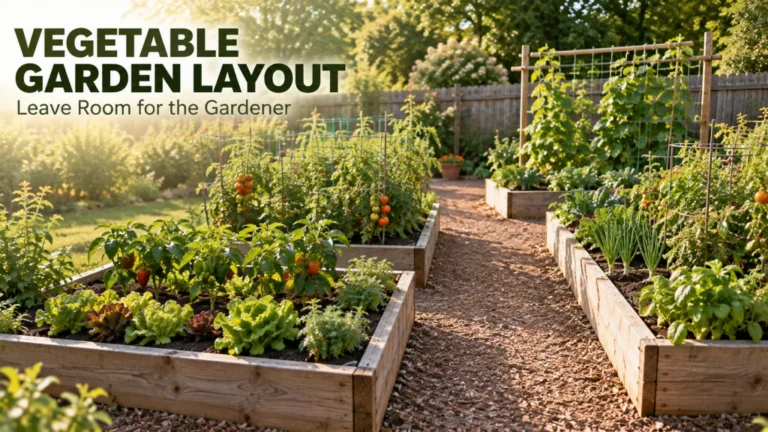
Layout comes after measurement and crop filtering because rows, blocks, raised beds, containers, and mixed arrangements solve different site problems. Iowa State Extension notes that access, space use, crop height, and room for foot traffic or equipment all matter. A compact block may save space, while separate plots or wider paths may make maintenance easier. The guide to choosing a vegetable garden layout compares those arrangements in more detail.
Use the matrix below to tie layout to constraints. It separates physical capacity from seasonal use because a full bed can still be hard to reach. The right layout lets you plant, tend, harvest, and revise without stepping into growing soil. Then redraw the base map with actual planting zones.
| Planning question | What to record | What it changes |
|---|---|---|
| Where can plants actually grow? | Measured planting areas after fixed features and access are removed | Real capacity rather than total yard size |
| How will you reach the crop? | Paths, bed edges, gates, turning space, and harvest routes | Bed shape, path placement, and usable width |
| When is the space occupied? | Cool-season, warm-season, and long-season crop windows | Whether one area can support more than one crop over time |
| What creates shade or support needs? | Tall crops, trellises, permanent structures, and nearby obstacles | Placement within the chosen layout |
The matrix is not a scoring system, and no layout wins every row. Identify which constraint drives the design. If saving space harms access, revise the layout instead of postponing the problem. Keep the drawing connected to how the garden will be used.

This galvanized raised bed measures 4 by 2 feet and creates a defined planting zone for a residential garden layout. Its fixed footprint makes access, path clearance, and usable bed area easier to plan on a measured base map. It is most relevant when the chosen layout already calls for a separate raised bed.
Check On AmazonIf you click this link and buy, we earn a commission at no additional cost to you.
Convert recommended spacing into actual plant quantity
Spacing is where a hopeful crop list becomes a physical capacity check. Use crop-specific spacing from a reliable plant profile, Extension reference, or the seed packet, then apply it to the planting pattern you are actually using. Do not mix row spacing, in-row spacing, and intensive bed spacing as if they were interchangeable numbers, because they describe different arrangements. The guide to turning plant spacing into a realistic garden layout covers that distinction in more detail.
If the recommended spacing means fewer plants fit than the quantity plan expected, reduce the plant count before shrinking access or crowding every gap. Some experienced gardeners test tighter spacing, but that choice brings trade-offs in airflow, competition, harvest, and observation. Start from the documented recommendation, then change it only for a clear reason. Capacity becomes more trustworthy when the math follows the crop and layout instead of the desired number of seedlings.

This 25-foot tape measure has fraction markings and a retractable self-locking blade. It is well suited to checking bed width, path clearance, and plant-spacing distances after the layout is chosen. Measure the actual planting pattern instead of treating row spacing, in-row spacing, and intensive-bed spacing as interchangeable.
Check On AmazonIf you click this link and buy, we earn a commission at no additional cost to you.
Decide whether row direction matters at this site
Row direction is not a universal rule that should override every other site constraint. Tall crops can shade shorter crops, but slope, bed shape, access, nearby structures, and existing shade may matter more on a particular property. Iowa State recommends placing tall crops to the north of shorter crops when possible, which is a shading principle rather than a command for every row. The guide on deciding what direction garden rows should run separates useful light management from oversimplified rules.
Look at the actual shadows across the growing area and place tall structures where they are least likely to block shorter sun-loving plants. In a small or irregular space, moving crops within the layout may matter more than rotating the entire system. Record why you chose the orientation so you do not have to rediscover the reason later. A plan is easier to revise when it preserves the decision logic, not just the final drawing.

The SUUNTO A-10 is a compact, simple recreational hiking compass. It gives a practical way to establish direction when comparing row orientation with actual shade and site constraints. Direction remains one input, so the compass should support the site check rather than turn north-south orientation into a universal rule.
Check On AmazonIf you click this link and buy, we earn a commission at no additional cost to you.
Add previous-year history before repeating crop families
Before assigning the same crop family to a familiar bed, check what grew there previously. Crop rotation can reduce repeated nutrient demand and support pest and disease management, although Extension guidance notes limits in small home gardens. That makes crop history useful without turning rotation into a guarantee. The guide to using crop rotation in a home garden explains what the practice can and cannot accomplish at residential scale.
Mark crop families on last season’s map before placing the current shortlist, then move families when there is a practical alternative. If the space is too small to create meaningful separation, keep the record anyway because it still helps explain repeated patterns and prevents accidental repetition. Do not let rotation force a poor light or access decision just to make the map look tidy. It is one constraint among several, and the final placement still has to fit the crop’s basic site requirements.

This set includes 100 T-type plastic plant labels with a marker pen and 3.9 by 2.4-inch label faces. The waterproof garden signs can identify crop families or bed assignments where previous-year history needs to stay visible. Pair field labels with the saved map so rotation decisions remain tied to documented history.
Check On AmazonIf you click this link and buy, we earn a commission at no additional cost to you.
Add time as a second dimension with succession planting
A bed is not occupied by one drawing for the entire growing cycle. Succession planting can mean replacing a finished crop with another crop, or sowing smaller groups of the same crop at different intervals so harvest does not arrive all at once. University of Maryland Extension recommends planning those sequences on paper because one crop’s timing determines whether the next has a realistic window. The guide to planning succession planting without overbooking the bed covers that scheduling problem in detail.
Start by identifying areas that truly become available, rather than assuming a crop will be finished exactly when another needs the space. Long-season crops can block a second use, while short-season crops may create an opening before or after the main summer planting. Keep a backup for any succession that depends on uncertain harvest timing. Time adds capacity only when the crop windows fit; it does not create extra space by itself.
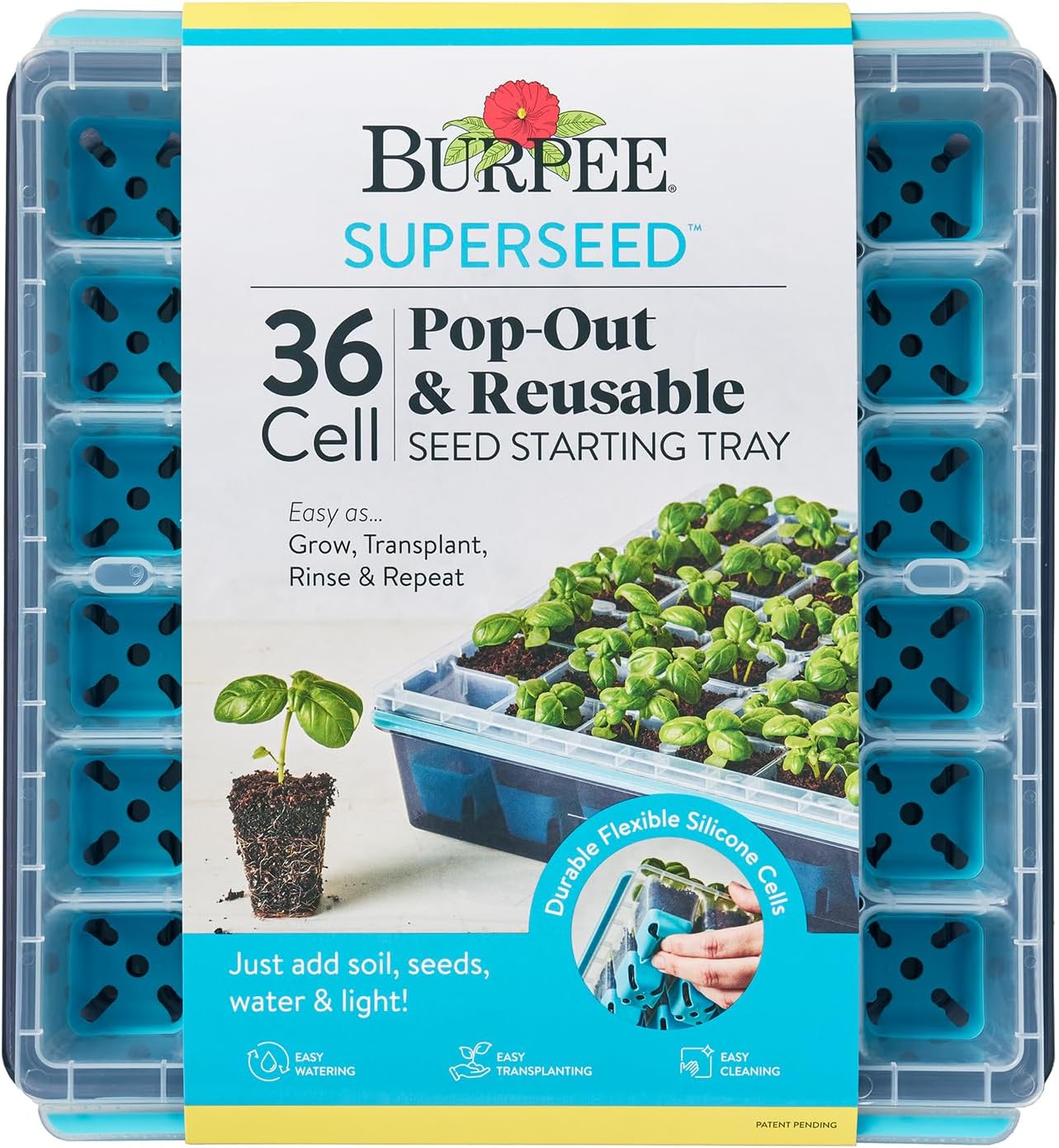
This reusable tray provides 36 cells for starting vegetable, flower, and herb seeds. Separate cells make it practical to start a later crop while an earlier crop is still occupying its planned bed. The tray supports succession timing, but the second crop still needs a realistic planting window and available space.
Check On AmazonIf you click this link and buy, we earn a commission at no additional cost to you.
Turn local timing inputs into a personal planting calendar
The calendar should come from local conditions and crop requirements, not a universal schedule. Use local frost information, crop tolerance, soil temperature when relevant, maturity timing, propagation method, and the space each crop must occupy. Those inputs turn a static map into a schedule that explains when each area becomes active. The guide to building a personal planting calendar shows how to organize them. When frost timing is uncertain, check local frost-date context before setting the window.
Give each planting a window and a condition check instead of relying on one rigid day. That makes it easier to respond when soil stays cold, weather shifts, seedlings are not ready, or an earlier crop remains productive. The calendar should expose conflicts when two crops need the same space at the same time. Finding that collision early gives you room to change quantity, location, or sequence. That flexibility is part of the calendar’s job.

This garden planner wheel is a perpetual vegetable planting chart for indoor, outdoor, and greenhouse planning. It can serve as a compact reference while you build a personal calendar around crop and seasonal timing. Local frost, soil conditions, maturity, and crop-specific guidance still take priority over a generalized planning wheel.
Check On AmazonIf you click this link and buy, we earn a commission at no additional cost to you.
Record what happened so the next plan uses evidence
The final planning step happens during the season, when the real garden starts correcting the assumptions on paper. Note hard-to-reach areas, crops that used unexpected space, changing shade, succession windows that worked, and quantities that were too large or too small. Those observations turn the next plan into an update instead of a fresh guess. The guide to keeping a garden journal that supports future decisions explains what is worth recording without making the process burdensome.
Keep records simple enough that you will use them. A marked-up map, a crop list with short notes, and a few observations about timing and workload can be enough. Save the reason behind a change, such as moving a trellis because of shade or reducing a crop because the household did not use the harvest. The goal is not perfect data, but enough evidence to avoid preventable planning mistakes. Keep it practical.

This three-pack contains 3 by 5-inch top-spiral notebooks with weatherproof pages and a universal page pattern. The pocket size makes them practical for recording shade, timing, workload, and harvest observations in the garden. Transfer useful observations back to the main plan so the next season starts with evidence instead of memory.
Check On AmazonIf you click this link and buy, we earn a commission at no additional cost to you.
Final Thoughts: a useful plan exposes what does not fit
A strong plan is valuable partly because it says no before the garden has to. It shows when the crop list exceeds the space, the workload exceeds available time, two crops need one bed, or a planting window does not fit local conditions. Those conflicts are easier to solve on paper than after plants are established. Keep the plan flexible enough to change when the site or season gives you better information.
Before planting, run one final fit check across space, time, and workload. Confirm that every area is reachable, every crop uses crop-specific spacing, every major planting has a realistic window, and every succession has room for delay. Turn any remaining constraint into a requirement before buying anything, and separate what is necessary from what is merely convenient. Skip purchases that add cost, setup, storage, or maintenance without solving a problem already visible in the plan. Remove anything that fits only by ignoring access, timing, or maintenance.
- Show fixed features, paths, and working access.
- Match crop quantity to household use.
- Separate cool-season and warm-season timing.
- Use crop-specific spacing for the chosen layout.
- Check shade from tall crops and supports.
- Leave timing room for succession changes.
- Let local conditions move the calendar.
The checklist is useful when it forces a change rather than confirming every first idea. If a crop fails a check, change its quantity, location, or timing before weakening the constraint that revealed the problem. Record the adjustment so its reason survives into the next plan. That final audit turns a wish list into a working system.

This one-outlet hose timer lets you set watering start time, duration, frequency, and rain-delay periods. It is relevant when the final audit shows that repeatable watering is a real workload constraint rather than a convenience purchase. The timer does not fix poor access, bad crop spacing, or a planting schedule that already overbooks the garden.
Check On AmazonIf you click this link and buy, we earn a commission at no additional cost to you.
Explore the planning decisions in more detail
The main plan works best when each difficult decision can be checked separately. Use the topics below only when one part of your plan needs more detail. Each page owns a specific decision, from the base map to the planting calendar. That keeps this page focused on sequence instead of turning it into an encyclopedia.
| Topic | What you will find |
|---|---|
| How to draw a garden plan | Measure fixed features, access, and usable space. |
| Vegetable garden layout | Compare layouts by space, reach, and paths. |
| How big should my vegetable garden be | Match size to workload and household goals. |
| Cool-season vs warm-season vegetables | Separate crops by seasonal behavior. |
| Soil temperature for planting | Use crop-specific soil conditions as a signal. |
| What vegetables to grow | Build a shortlist around household priorities. |
| How much to plant per person | Translate demand into realistic crop quantity. |
| Plant spacing | Apply spacing to the chosen planting pattern. |
| What direction should garden rows run | Judge orientation against real site constraints. |
| Crop rotation in the garden | Use crop-family history without overpromising. |
| Succession planting | Add replacement crops and staggered plantings. |
| Garden journal | Record observations that improve the next plan. |
| How to make a planting calendar | Combine local timing signals into a schedule. |
| When to start a garden | Separate planning time from planting conditions. |
You do not need every topic before making a useful first plan. Follow the table where your map reveals uncertainty about capacity, timing, spacing, or history. Resolve that point, then return to the main plan. This keeps each research step tied to a decision you actually need to make.

This four-pack contains 5-gallon nonwoven fabric grow bags with handles. The separate containers can support a small trial or fragmented-space plan when a permanent bed is not the chosen layout. Use them only where the detailed planning step shows that container space, maintenance, and crop requirements actually fit.
Check On AmazonIf you click this link and buy, we earn a commission at no additional cost to you.
Frequently asked questions
Most planning questions are really questions about which constraint should be decided first. The answers below keep space, timing, and workload in the right order. They also reflect common concerns about crowding, size, orientation, and seasonal changes. Use them as quick checks before moving into a narrower topic.
Site conditions can still change the answer. Light, climate, soil, crop variety, spacing guidance, and maintenance time all matter. A plan should stay flexible enough to absorb those differences. The goal is to make the next decision with better information.
📏 How detailed does a garden plan need to be?
Show usable planting space, access, crop placement, and timing conflicts. A simple measured sketch you can update is enough.
🌱 How do I know if I am trying to grow too much?
Apply crop-specific spacing and reserve paths before counting plants. Then compare that capacity with the maintenance time you actually have.
🧭 Do vegetable garden rows always need to run north to south?
No. Orientation can affect shade, but beds, slope, access, structures, and tall-crop placement may matter more at your site.
🌡️ Should soil temperature be part of every planting decision?
Use it when it changes the decision, especially for direct-seeded crops or early planting. Check a crop-specific reference instead of one threshold for everything.
🔄 Can the same bed hold more than one crop in a season?
Often, if the first crop finishes early enough and the next still has a suitable window. Plan around realistic harvest timing and local conditions.
📝 Do I need a garden planning app or spreadsheet?
No. Paper or a simple digital file works if it records measurements, crop placement, timing, and changes without creating extra work.
References and Sources
These references support the horticultural parts of the planning system rather than its editorial sequence. They were used for garden size and access, seasonal grouping, succession, rotation context, and soil temperature. Exact crop spacing and exact planting thresholds remain on crop-specific pages because those values vary. That keeps a general planning page from presenting variable guidance as a universal rule.
Match Extension guidance to your location and crop when a decision becomes specific. Local sources may narrow a planting window or management choice further. Seed packets and crop profiles can add details that do not belong in a general plan. Use the sources below as evidence anchors, then verify exact numbers where they matter.
- Iowa State University Extension and Outreach: Supports manageable size, access, space use, and shading decisions.
- University of Maryland Extension: Supports seasonal grouping, resource limits, and succession planning.
- University of Maryland Extension on succession and rotation: Supports crop sequencing and home-garden rotation context.
- Penn State Extension: Supports crop-specific soil-temperature guidance for seed germination.