A useful garden setup can become complicated long before the plants or the site actually demand it. The better question is not whether another tool, amendment, bed accessory, or watering part could help, but whether it solves a constraint you can already name. A simple setup is not incomplete just because more specialized options exist. This piece offers a practical way to separate curiosity from a real reason to add something.
One useful purchase can quietly create five imagined problems
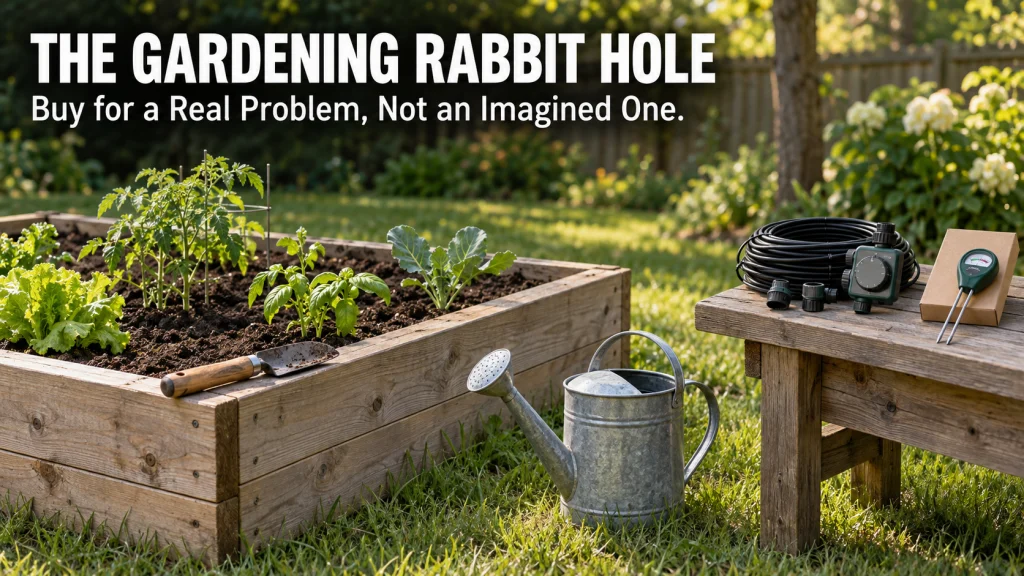
The gardening rabbit hole often starts with a perfectly sensible decision. You add a raised bed, then start thinking about a trellis, a moisture meter, a special fertilizer, a timer, and a different watering setup before the bed has even shown you what it needs. None of those ideas is automatically foolish, and some may become useful later. The problem begins when the existence of an option starts feeling like evidence that your current setup is missing something.
I would rather let the next real task expose the next real constraint. If watering by hand is easy and consistent, there is no failure to solve yet; if plants repeatedly flop because they need support, then the need for a support system is no longer theoretical. That shift sounds small, but it changes the order from buy first and diagnose later to observe first and add only when the garden gives you a reason. Curiosity can stay part of the hobby without becoming a standing purchase order.
The garden did not ask for every item on the shopping list
A shopping list can grow faster than a planting plan because every new item suggests another decision. A container suggests a stand, the stand suggests a drip line, the drip line suggests a timer, and the timer suggests fittings and replacements that were not part of the original task. Garden overbuying becomes worth noticing when the list is being driven by imagined future friction rather than something you are actually doing now. At that point, the list is describing possibilities, not requirements.
Before adding another item, I would write down the task it is supposed to improve in one plain sentence. If the sentence is vague, such as making the setup better or more complete, the purchase probably does not have a job yet. If the sentence names a repeated burden, such as carrying water farther than is practical or supporting plants that keep falling into the path, you have something concrete to evaluate. A product should enter the setup because a task asked for help, not because a catalog made the setup feel unfinished.
Curiosity is not the same thing as a garden problem
There is nothing wrong with reading about better soil mixes, smarter watering, sturdier beds, or more specialized tools. Learning often changes what you notice, and that can make an ordinary setup look crude beside the polished systems in guides and videos. But learning that another method exists does not prove that your current method is failing. The useful distinction is whether you are exploring an option or responding to a condition that is already affecting the work.
- Curiosity: I wonder whether this would be easier or more interesting.
- Constraint: This task is repeatedly difficult, inconsistent, wasteful, or hard to maintain.
- Evidence: I can point to what is happening now, not just what might happen later.
- Decision: I know what improvement would count as success before I buy anything.
That distinction also keeps experimentation from turning into a hidden standard you feel obliged to meet. You can try a new method because you enjoy experimenting, but it helps to call that what it is instead of pretending the garden required it. When the purchase is recreational, you can judge it as recreation; when it is meant to solve a problem, you can judge it against that problem. Clear labels make it easier to enjoy new ideas without turning every idea into a deficiency.
Why specialized advice can make a simple setup feel incomplete
Specialized advice usually starts after a writer has narrowed the question. A piece about seed information focuses on what appears on packets, a tool article focuses on durability and support, and a raised bed comparison focuses on dimensions that affect use. Read several narrow pieces in a row and it can feel as though all of those distinctions belong on one mandatory shopping list. They do not, because each article is solving a different decision at a different moment.
For example, our look at what seed packets actually disclose is useful when you are comparing the information available before planting, not as a reason to replace seeds that already fit your plan. The same principle applies across the rest of the setup: a useful distinction becomes relevant when your decision reaches that distinction. Good research should narrow uncertainty, not manufacture a new obligation every time you learn something. If an article gives you a sharper question, keep the question and wait until your garden actually needs the answer.
The one question I would ask before adding another tool, amendment, or system
The question is simple: what specific problem will this solve in the setup I have right now? I would not accept better, easier, healthier, or more efficient as complete answers because those words do not identify the failure. A useful answer names the task, the friction, and the condition that keeps repeating. Once those are clear, you can compare a purchase against a real need instead of comparing your garden against an idealized setup.
| What you notice | What to ask next | What would justify adding something |
|---|---|---|
| A task feels slow once | Was this unusual or is it becoming a pattern? | Wait for repetition before treating it as a constraint. |
| A result is inconsistent | Can you identify the cause before changing the setup? | Add something only if it addresses the identified cause. |
| A new option looks appealing | What current task would it replace or improve? | Buy for a named job, or treat it honestly as optional experimentation. |
| Your current method works | What problem would an upgrade remove? | Keep the current method if there is no meaningful problem to remove. |
This question does not tell you never to upgrade. It simply forces the upgrade to compete against the method already working in your space, with your workload, rather than against a theoretical best setup. Sometimes the answer will be obvious because the current approach is creating repeated extra work or limiting what you can do. Sometimes the honest answer will be that nothing is wrong yet, which is a perfectly good reason to keep your money and keep gardening.
Buy when a repeated task or failure creates a clear constraint
A real constraint tends to show up more than once. You keep making the same awkward trip for water, the same plants need support, the same storage problem slows cleanup, or the same setup step keeps becoming the part you dread. Repetition matters because it separates a one-off inconvenience from a workload problem that will keep charging you time or attention. The more clearly you can describe that pattern, the easier it is to judge whether a new item would actually change it.
I would also look for the smallest change that removes the constraint before rebuilding the whole system around it. A better location, a different routine, a reused container, a shorter route, or a simpler support method may solve the problem without creating a new set of parts to store and maintain. If those low-burden changes fail, then a purchase has a stronger case because you know what the simpler options could not fix. Buying after that process is not anti-product or pro-product; it is simply a decision tied to a demonstrated job.
Keep the cheap or simple solution when it already works
A simple solution does not become inferior just because you discover a more specialized version. If the inexpensive hand tool fits your grip, does the job cleanly, and is easy to store, an upgrade needs to offer something more specific than prestige or extra features. The same applies to watering, supports, containers, and other parts of a home setup. Working reliably in your conditions is evidence, even when the method is not impressive enough for a gear shelf.
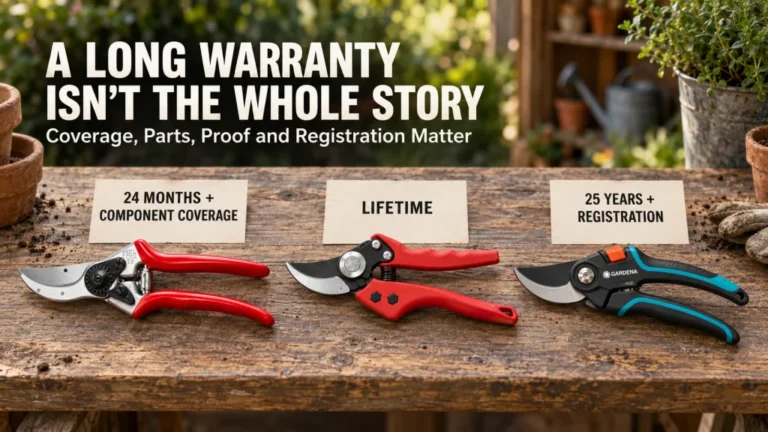
When durability or support is the concern, it is more useful to check what the coverage actually says than to assume a more expensive tool automatically removes risk. Our garden tool warranty review shows why the wording behind support can matter more than the impression created by a premium position. That kind of information is valuable when you are choosing between options, but it does not create a reason to replace a tool that still meets the task. A working simple solution earns the right to stay until the garden gives you a practical reason to change it.
What I would not call an upgrade without a problem to solve
I would not call extra complexity an upgrade by itself. More settings, more fittings, more materials, more specialized inputs, or more capacity can all be useful, but each one also creates something else to choose, store, clean, refill, check, or remember. If the added capability never changes a task you actually perform, then the setup has become more elaborate without becoming more useful. Complexity deserves the same burden-of-proof test as price.
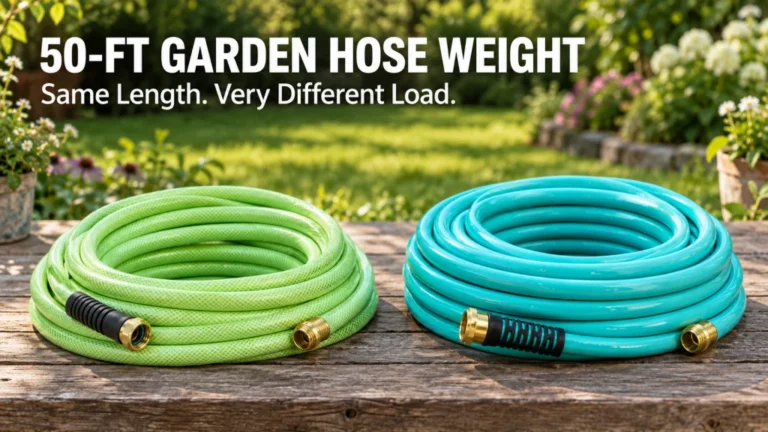
I would also be cautious with changes justified only by a bigger number or a more premium label. A taller bed, heavier tool, larger container, longer hose, or more feature-rich timer can be useful in the right setting, but none is automatically an improvement in every yard. Bigger or more elaborate often shifts the burden somewhere else through added fill, storage, setup, reach, or maintenance. The useful comparison is what extra capability you will actually use versus what extra work the change adds to the routine.
When a specific garden problem needs a specific guide
Once the problem is specific, broad anti-overbuying advice stops being enough. If you know the issue is bed capacity, hose weight, packet information, tool support, watering reach, or another defined constraint, that is the moment to move into the guide that owns that decision. Specific research is most useful after you know what you are trying to compare. Otherwise, every specification can look important simply because it is measurable.
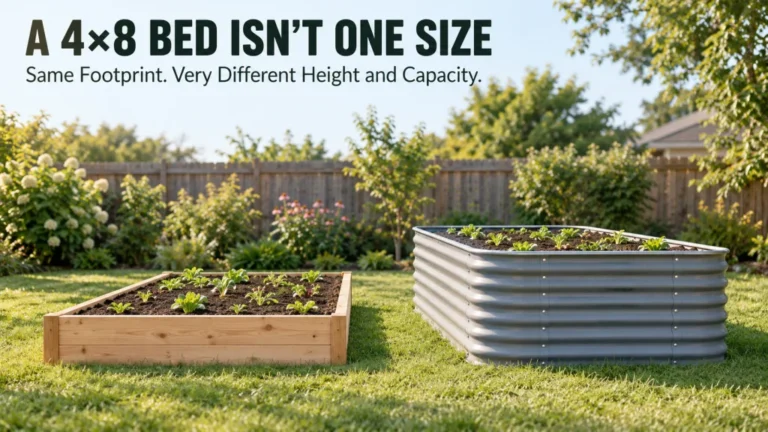
For raised beds, for example, our comparison of published 4 by 8 raised bed dimensions is useful when height and capacity have become part of the actual decision. It is not a command to replace a bed that already fits the plants, site, and workload you have. Use detailed guides as tools for resolving named choices, not as audits of everything your current garden lacks. That keeps research attached to the next real decision instead of letting research generate an endless queue of hypothetical ones.
Final thoughts: let the garden make the next request
You do not have to make a simple setup defend itself against every specialized option on the market. Let the plants, the site, and the repeated work show you where the friction actually lives, then decide whether a change is worth carrying into the routine. If you cannot name the problem yet, keeping the current setup is not falling behind. It is choosing to wait for better information.
The next useful purchase may still be a tool, an amendment, a support, a bed component, or a watering change. The difference is that it will arrive with a job description instead of a vague promise to make the garden more complete. That makes it easier to compare options, easier to skip features you do not need, and easier to notice when the simplest answer is already in your hands. Buy when the garden gives you a reason, not when the rabbit hole gives you another tab to open.
Frequently asked questions
Most questions about buying less are really questions about timing and proof. A tool or system can be useful without being necessary today, and waiting does not mean you have ruled it out forever. The goal is to connect the purchase to a task you can describe, not to reach an arbitrary minimum amount of gear. That makes the decision easier to revisit when the garden changes.
These questions are also easier to answer when you separate recurring friction from one-time inconvenience. A single annoying afternoon may call for a small adjustment, while a pattern that repeats across normal garden work may justify a more durable change. Space, growing style, workload, and the plants involved can all change what counts as useful. The answers below keep the focus on that fit rather than on collecting more equipment.
🛒 How do I know if I am buying too much garden gear?
Look at whether each planned purchase has a current job you can name. If several items are meant to solve problems that have not happened yet, pause and let the next real task show which one matters first.
🌱 What do I actually need before starting a garden?
You need enough to plant, provide the growing conditions your chosen plants require, and handle the basic work in your actual space. The exact setup depends on whether you are growing in the ground, beds, or containers, so start from the site and plants rather than a universal shopping list.
🧰 When is it worth upgrading a garden tool?
An upgrade makes more sense when the current tool repeatedly creates a fit, durability, reach, effort, or task problem that a different design can address. If the current tool is comfortable, reliable, and appropriate for the job, a more expensive replacement does not automatically improve the work.
💧 Should I install a watering system before I know I need one?
Not necessarily. If your current watering method is consistent and manageable, wait until distance, time, plant count, or another repeated constraint gives you a clear reason to change it.
🔍 Is researching garden products a problem if I enjoy it?
No. Research can be part of the hobby, but it helps to separate learning for enjoyment from shopping for a current need so every interesting option does not become a perceived requirement.