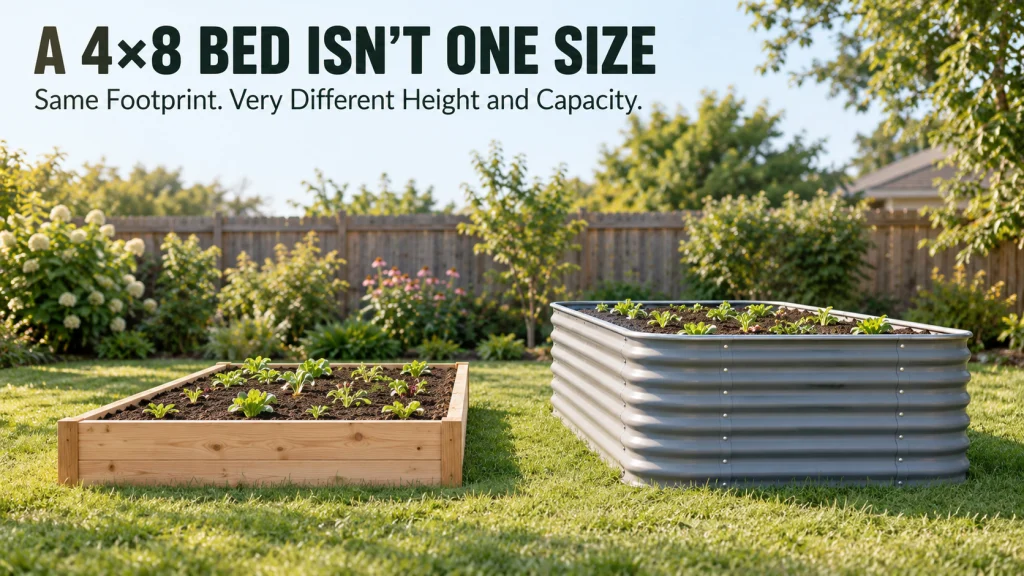
A 4×8 label tells you the nominal footprint, but it does not tell you the bed height, wall construction, configuration, or published fill capacity. In a current same-footprint sample, published capacity ranges from 28 cubic feet for a 10.5-inch cedar bed to 69 cubic feet for a 26-inch modular metal configuration. That difference matters when you are estimating how much material you may need to move, buy, or have delivered. The useful comparison is not simply “4×8 versus 4×8,” but the exact dimensions and capacity fields attached to each product.
The same 4×8 label can hide a very different bed
Two beds can both be sold around a 4-foot by 8-foot footprint and still ask very different things from your garden plan. The 4×8 raised bed dimensions that change the comparison most are often the third dimension, the wall construction, and whether the manufacturer publishes a fill-capacity figure for the exact configuration. In the sample here, one bed is 10.5 inches high, another is 24 inches high, and a modular 4 x 8 configuration is 26 inches high. That is enough variation to make the footprint label a starting point rather than a complete specification.
Published 4×8 raised bed soil capacity also varies sharply across those exact products. Greenes Fence lists up to 28 cubic feet, Best Choice Products lists 64 cubic feet and 478 gallons, and Vego Garden lists 69 cubic feet for its 4 x 8 x 26-inch configuration. Those numbers are manufacturer-published capacity fields, not measurements I made and not proof of identical usable interior volume. If I were planning a soil order, I would treat the exact product page as the specification to verify before treating any “4×8” label as enough information.
How the 4×8 comparison set was selected
The core set is deliberately narrow: current U.S. product pages for open-bottom raised beds sold with a nominal 4 x 8 footprint or an exact published 4 x 8 configuration. That keeps the comparison focused on a real buyer problem instead of mixing in elevated planters, smaller beds, or products whose capacity has to be guessed from outside dimensions. I also kept the sample to pages that publish enough information to code the row honestly, especially height and fill capacity. A product that says only “4×8” without the third dimension or a usable capacity field would not add much to this audit.
The comparison sample contains three different construction approaches: a cedar frame, a fixed 24-inch steel bed, and a modular metal kit that can be assembled as 4 x 8 x 26 inches. The point is not to declare a winner or turn the table into a recommendation. It is to show how much specification can sit behind the same nominal footprint. That distinction is part of the wider garden buying rabbit hole, where a familiar size label can look more standardized than the products actually are.
| Product in the comparison sample | Why it qualifies | Exact product page fields used |
|---|---|---|
| Greenes Fence premium cedar 4 ft x 8 ft x 10.5 in | Fixed 4 x 8 footprint with published height and soil capacity | Size, board thickness, material, capacity |
| Best Choice Products 8 ft x 4 ft x 2 ft metal bed | Fixed 8 x 4 footprint with published overall dimensions and fill capacity | Overall dimensions, material, weight, cubic feet, gallons |
| Vego Garden 26-inch 10-in-1 modular metal bed | Exact 4 x 8 configuration published within a multi-configuration kit | Configuration dimensions, cubic feet, cubic yards, material system |
This source ledger matters because product-family names can hide configuration changes. The Vego kit, for example, can be assembled in several footprints, so the capacity number has to stay attached to the 4 x 8 x 26-inch configuration rather than to the kit in general. Best Choice Products publishes the 8 x 4 x 2-foot dimensions directly on the product page, while Greenes Fence publishes the 4 x 8 x 10.5-inch size on its exact model page. Keeping each row tied to its own source prevents a clean-looking table from becoming a mixture of mismatched variants.
Separate nominal footprint from published height and fill volume
A 4 x 8 footprint describes an area of 32 square feet, but that area alone does not tell you how much material the frame is intended to hold. Height changes the gross space available inside the frame, and wall thickness can also affect the interior dimensions that actually contain soil. University of Georgia Extension specifically notes that wall thickness should be included when planning bed dimensions and layout. That is why I would not take an outside 4 x 8 label, multiply it by wall height, and quietly rename the result usable growing volume.
Published capacity is more useful because it is a product-specific field, but it still needs the right label. It tells you what the manufacturer says the bed holds, not what every gardener will actually pour into it after leaving headspace, adding a mulch layer, using existing soil beneath an open bottom, or choosing a different fill strategy. A tall frame can also be used differently from a shallow one even when both occupy the same patch of yard. For a data audit, the cleanest boundary is to report published dimensions and published capacity without converting those fields into unverified root depth or crop suitability.
Key point: The 4 x 8 footprint is only two dimensions. Height, wall thickness, configuration, and the manufacturer’s published capacity are separate fields that can materially change a soil-order estimate.
If your real question is which bed size or height fits your garden rather than how current products differ on paper, use the separate guide to choosing the right raised bed size. That decision depends on access, site conditions, what you want to grow, and what is beneath the bed. This audit stays narrower on purpose. It compares what exact product pages publish around the same nominal footprint.
Compare 4×8 open-bottom products by exact published dimensions
The table below normalizes the fields that are actually published for the comparison sample. It does not invent internal length or width, and it does not treat exterior height as guaranteed soil depth. Where a manufacturer publishes more than one capacity unit, both are retained rather than replacing the source with a new estimate. A blank weight field means the visible product page did not give me a clear product-weight figure I was comfortable using in this comparison.
The spread is large enough to matter before any gardening advice enters the picture. The Greenes Fence bed is 10.5 inches high with a published capacity of 28 cubic feet, the Best Choice Products bed is 24 inches high with 64 cubic feet, and the Vego 4 x 8 configuration is 26 inches high with 69 cubic feet. In other words, the same nominal footprint can sit beside a published capacity difference of 41 cubic feet from the lowest to the highest row. That is a specification difference, not proof that the tallest bed is the best choice.
| Exact product or configuration | Published dimensions | Published height | Material | Published capacity | Published product weight |
|---|---|---|---|---|---|
| Greenes Fence premium cedar RC6T21B | 4 ft W x 8 ft L x 10.5 in H | 10.5 in | Untreated North American cedar, 3/4-inch boards | Up to 28 cu ft | Not stated on the visible specification block |
| Best Choice Products 8 x 4 x 2 ft metal bed | 96 in L x 48 in W x 24 in H | 24 in | Powder-coated steel | 64 cu ft; 478 gal | 47 lb |
| Vego Garden 26-inch 10-in-1 kit, 4 x 8 configuration | 4 ft W x 8 ft L x 26 in H | 26 in | VZ 2.0 coated steel system | 69 cu ft; 2.56 cu yd | Not stated in the visible configuration specification |
Standard-height beds
The Greenes Fence row is the shallowest product in this frozen set. Its exact page publishes a 4-foot by 8-foot frame, a height of 10.5 inches, 3/4-inch cedar boards, and a stated capacity of up to 28 cubic feet. Those fields are useful because they let you separate the nominal footprint from the construction that occupies part of that footprint. They do not, by themselves, tell you how much rootable depth a plant will have once the bed is placed over a particular site.
Tall and extra-tall beds
The Best Choice Products and Vego rows are much taller at 24 and 26 inches. Their published capacities, 64 and 69 cubic feet, are also much higher than the 28-cubic-foot figure in the shallow cedar row. That does not mean the extra height has the same value for every gardener, because the soil beneath the frame, the fill method, access needs, and crop choice can change what the height is doing for you. What the data does show is that a buyer who orders soil from the words “4×8 raised bed” alone can miss a large change in the manufacturer’s own capacity figure.
Modular beds with a published 4×8 configuration
Modular kits need one extra check because the product name can cover several possible footprints. Vego publishes ten configurations for the 26-inch kit and gives the 4 x 8 option its own dimensions and capacity. That makes the 69-cubic-foot row usable in this audit because it is attached to the exact 4 x 8 x 26-inch configuration. The same number should not be copied to the kit’s 2.5 x 9.5, 6 x 6, or other layouts.
Where external dimensions stop short of usable-space information
Outside dimensions are excellent for checking whether a bed fits the patch of ground you have available. They are less reliable for telling you the exact volume between the walls because wall thickness, corner posts, panel geometry, braces, and other construction details can reduce interior space. The Greenes Fence page, for example, publishes board thickness along with outside size, which is a reminder that the frame itself occupies space. Without a manufacturer-published interior length and width, I would not reverse-engineer a supposedly exact usable volume from the outside box.
That boundary becomes even more important with shaped or modular metal panels. A nominal rectangular configuration may have rounded corners, overlapping panels, bracing, or other details that make simple exterior math an approximation. Manufacturer capacity can still be reported as the manufacturer’s number, but it should not be presented as an independent physical measurement. If your soil order is expensive enough that a few cubic feet matter, measuring the assembled interior is more defensible than assuming the nominal label is the fillable box.
- Use outside length and width to check garden footprint and path clearance.
- Use published height to compare the third dimension, not to claim exact root depth.
- Use published capacity as a source-specific planning field, not as a universal physical standard.
- Use interior measurements from the assembled bed when you need a tighter soil-order estimate.
The practical takeaway is simple: dimensions answer different questions depending on which face of the product they describe. Exterior dimensions help with layout, while interior dimensions would be the stronger input for calculated fill volume. When only the exterior box and a manufacturer capacity are available, keep those as separate pieces of evidence. Combining them into a more precise-looking number can create confidence the source never provided.
Convert published capacity only when the source supports it
Unit conversion is useful when it normalizes an already-published capacity, but it should not disguise a geometry assumption. Vego already publishes both 69 cubic feet and 2.56 cubic yards for its 4 x 8 configuration, so no independent conversion is needed to compare those units. Best Choice Products already publishes both 64 cubic feet and 478 gallons on the exact bed page. Those paired figures are stronger than calculating capacity from the outside dimensions because the manufacturer has explicitly attached them to the product.
Greenes Fence publishes up to 28 cubic feet but does not need a second unit for this comparison. If I converted that figure to cubic yards, I would label the result as derived from the published 28-cubic-foot capacity rather than present it as another manufacturer specification. The same rule applies to bag counts: dividing a published capacity by a bag size can be useful planning math, but it is not a new product specification. A clean audit should make it obvious which numbers came from the product page and which numbers came from transparent arithmetic.
| Product | Capacity directly published | What can be normalized safely | What should not be inferred |
|---|---|---|---|
| Greenes Fence | Up to 28 cu ft | Cubic-yard equivalent if clearly labeled as derived | Exact internal growing volume from outside dimensions |
| Best Choice Products | 64 cu ft and 478 gal | Either published unit can be used directly | Guaranteed soil purchase amount for every fill method |
| Vego Garden 4 x 8 configuration | 69 cu ft and 2.56 cu yd | Either published unit can be used directly | Capacity of the kit’s other configurations |
This may seem fussy, but it keeps two different jobs from getting blurred together. Product auditing asks what the manufacturer actually publishes for the exact model or configuration. Soil purchasing asks how much material you personally intend to place in the bed after considering headspace, site conditions, and the fill plan. The first question can inform the second without pretending they are identical.
Keep elevated beds separate from the core open-bottom comparison
An elevated 4 x 8 planter can share the same footprint words while functioning as a different container system. It has a bottom, structural support under the growing medium, and a defined planting depth that is not the same as an open-bottom frame sitting over soil. That changes how capacity, weight, drainage, and site load should be interpreted. Mixing elevated products into the same capacity ranking would make the table look larger while weakening the comparison.
For context, an elevated 4 x 8 bed can have a much smaller planting depth than its overall height suggests because much of the structure is legs and support. That is exactly why this article does not use overall standing height as a substitute for soil depth. Open-bottom frames let roots interact with the soil below when site conditions allow, while elevated planters confine the growing medium to the supported container. The two groups can both be useful, but they should not be treated as interchangeable rows in a same-footprint soil-capacity audit.
Note: Elevated beds are a separate contextual group here. They are not included in the 28 to 69 cubic-foot range reported for the frozen open-bottom sample.
Separating the groups also keeps the article from drifting into accessibility claims that dimensions alone cannot support. A taller or elevated bed may change reach and bending, but an exact fit depends on the gardener, path width, approach angle, work surface, and other site details. Those questions deserve their own evaluation rather than a shortcut from one height number. For this dataset, the only job is to keep like with like.
What product dimensions cannot tell you about soil recipe, settling, or crop suitability
A capacity number does not choose your soil mix. It does not tell you how much compost to add, whether you should use native soil, whether a deep bed should be filled uniformly, or how much the material will settle after watering. Those decisions depend on the growing system, the soil beneath an open-bottom bed, the crop, and the materials you actually plan to use. A manufacturer can publish 64 or 69 cubic feet without that number becoming a prescription for what every cubic foot should contain.
Dimensions also do not prove that a bed is suitable for a particular crop. Rooting behavior, drainage, fertility, moisture, and the condition of the soil below the frame can matter as much as wall height. University of Georgia Extension notes that higher beds require more imported soil and that beds over hard surfaces can need different depth consideration than beds over workable ground. The responsible reading is that height changes the physical setup, not that one taller number automatically solves plant needs.
Limitations: This audit compares manufacturer-published exterior dimensions, configuration details, materials, weights when available, and stated capacity. It does not measure assembled interior volume, usable root depth, settlement after filling, crop performance, durability, or the amount of soil an individual gardener will ultimately use. Those questions require measurements or evidence beyond the product-page fields used here.
The measurements I would verify before ordering a 4×8 bed and soil
I would start with the exact configuration, not the collection name or the thumbnail label. For a fixed bed, that means confirming overall length, width, and height on the exact product page. For a modular kit, it means confirming that the published capacity belongs to the 4 x 8 configuration you plan to assemble. I would also check whether the stated capacity is in cubic feet, gallons, or cubic yards so I do not accidentally compare unlike units.
Then I would separate the bed purchase from the soil order. The product page can tell me the manufacturer’s dimensions and capacity, but the assembled interior and my intended fill level are the stronger inputs for a final quantity. Wall thickness matters, and headspace or a different fill strategy can change what I actually need. The checklist below is the minimum I would want in front of me before scheduling a bulk delivery or stacking bags beside the bed site.
- Exact model or configuration name.
- Published overall length, width, and height.
- Whether the bed is open-bottom or elevated.
- Published wall or panel thickness when available.
- Published fill capacity and its unit.
- Interior measurements after assembly when a precise soil order matters.
- Your intended fill level rather than an assumption that soil reaches the absolute top edge.
This is also where I would stop using a nominal label as a shopping shortcut. A 4 x 8 footprint is helpful for rough layout, but the data in this sample shows that it is not a complete proxy for material demand. The bed height and published capacity need their own line on the checklist. Once those are verified, the soil estimate becomes a garden-specific calculation instead of a guess based on the front of the box.
Final thoughts: verify the third dimension before ordering soil
The cleanest finding from this audit is not that one 4 x 8 bed is better than another. It is that the nominal footprint hides enough variation to make height and published capacity worth checking every time. In the comparison sample, the listed capacity moves from 28 cubic feet to 64 and 69 cubic feet while the products still sit around the same nominal footprint. That is a large enough spread to affect how you plan delivery, handling, and fill cost.
I would use the 4 x 8 label to narrow the garden footprint, then verify the exact product page before making a soil order. Keep exterior dimensions, manufacturer capacity, and your own final fill calculation as separate steps. If the page does not publish enough information, measure the assembled interior rather than inventing precision from the nominal size. The extra check is small, and it is much easier than discovering that the bed and the soil order were based on two different ideas of what “4×8” meant.
Frequently asked questions
📏 Are all 4×8 raised beds actually the same size?
No. The 4 x 8 label usually describes a nominal footprint, while height, wall thickness, corner construction, and modular configuration can still differ. Verify the exact overall dimensions on the product page before treating two beds as dimensionally equivalent.
🪴 How much soil does a 4×8 raised bed hold?
There is no single capacity for every 4 x 8 product because height and interior construction differ. In this same-footprint sample, manufacturers publish capacities from 28 to 69 cubic feet. Use the exact bed’s published capacity or assembled interior measurements for planning.
📐 Should I calculate soil from the outside dimensions?
Not if you need a precise order. Outside dimensions include the frame, and wall thickness or panel geometry can reduce the fillable interior. Interior measurements are the stronger basis for your own calculated volume.
🌱 Does a taller raised bed automatically give plants more usable root depth?
Not automatically. Usable rooting space depends on the fill level, what sits beneath an open-bottom bed, soil condition, and the crop. Treat wall height as a product dimension, not a complete crop-suitability answer.
🛒 What should I verify before ordering soil for a 4×8 bed?
Confirm the exact model or configuration, overall dimensions, published capacity, and whether the bed is open-bottom or elevated. Then decide your actual fill level and measure the interior if the order needs to be tight. Keep any settling or top-up allowance separate from the manufacturer’s capacity figure.
References and sources
- Vego Garden 26-inch 10-in-1 modular raised bed: Publishes the 4 x 8 x 26-inch configuration, 69 cubic feet, and 2.56 cubic yards.
- Best Choice Products 8 x 4 x 2-foot metal raised bed: Publishes dimensions, 64 cubic feet, 478 gallons, material, and weight.
- Greenes Fence premium cedar 4 x 8 x 10.5-inch raised bed: Publishes size, 3/4-inch cedar boards, and capacity up to 28 cubic feet.
- University of Georgia Extension raised garden bed dimensions: Supports the discussion of wall thickness, height, site conditions, and imported-soil needs.