
I compared the disclosure fields shown for San Marzano type tomatoes and Genovese type basils across five U.S. seed companies, keeping packet evidence separate from information that appears only on official product pages. The strongest pattern was not that one company told gardeners everything and another told them nothing, but that the same useful field often appeared in a different place or with a different definition. Identity, seed amount, planting depth, spacing, germination, and maturity information were common across the wider evidence set, while lot and packed-for information could not be verified consistently from the public packet representations available for this audit. The practical takeaway is simple: compare like with like, and read the exact packet or official listing before turning a familiar phrase into a universal planting rule.
Two useful seed packets can disclose different things
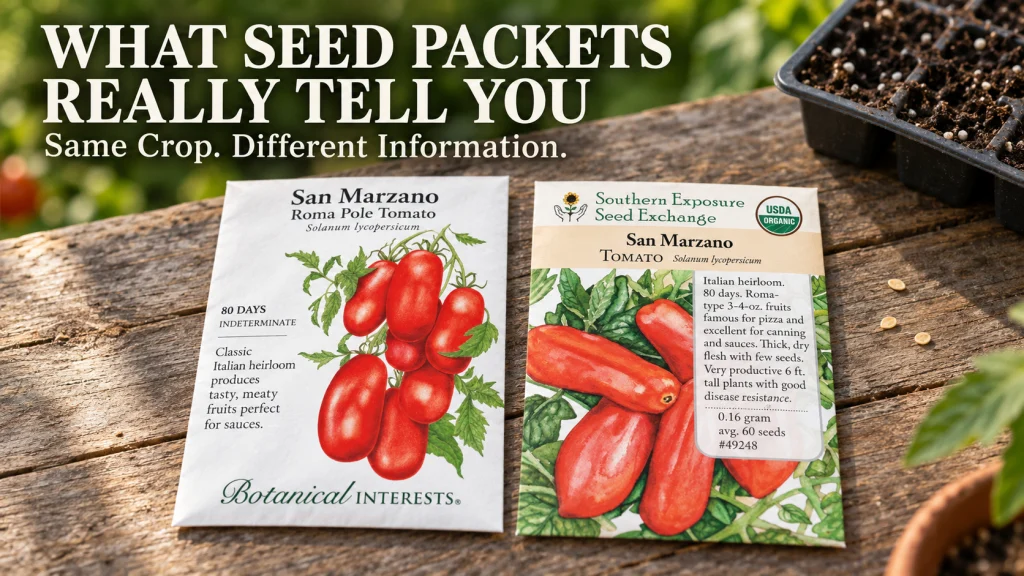
Put two San Marzano type tomato packet representations next to each other and the difference is obvious before any seed touches soil. Botanical Interests makes several growing cues visible in its official packet representation, including organic status, heirloom wording, an indeterminate growth habit, and a maturity range tied to transplanting. Southern Exposure also identifies the crop and heirloom status in its official packet material, but its visible information emphasizes a different mix of identity, maturity, packet amount, and variety description. Neither difference, by itself, tells me that one seed is better than the other.
That is the reason I treated this as a disclosure audit rather than a seed quality ranking. A field can be useful, omitted from the visible front, moved to the packet back, explained on the seller’s website, or expressed with terminology that needs more context before it can be compared. The brands in this sample are evidence rows, not buying picks, and the crop pairing matters more than the logo at the top of the packet. If I compared a tomato packet with a basil packet and blamed the company for every difference, I would mostly be measuring crop biology instead of disclosure practice.
How the seed packet sample was defined
I froze the sample around San Marzano type tomatoes and Genovese type basils. The five sources were Botanical Interests, Territorial Seed, Johnny’s Selected Seeds, Park Seed, and Southern Exposure Seed Exchange. I did not treat every cultivar name as genetically identical, because names such as San Marzano II, Aroma II, and Sweet Genovese are not interchangeable. They still keep the crop type stable enough to compare disclosure without confusing tomato fields with basil fields.
Each row was coded as brand by crop by field rather than reducing a company to one packet. I tracked identity, seed amount, sowing route, depth, spacing, thinning, germination, maturity language, status claims, and packet or lot details that could be verified. A value shown only on an official product page was coded online only. That keeps website information from becoming evidence for unseen packet text.
| Code | What it means in this audit |
|---|---|
| PF | The field is readable on an official packet front representation. |
| PB | The field is readable on an official packet back representation. |
| OL | The official product page discloses the field, but the available packet representation does not establish that it is printed on the packet. |
| A | The field is present, but its meaning or starting point is ambiguous in the evidence being coded. |
| NA | The field is not applicable to that crop, route, or stated method. |
| U | The available official evidence is not sufficient to verify the field on the packet. |
| Absent | Used only when the relevant packet surface is actually available and the applicable field is not there. |
Limit: An unavailable packet back is not the same thing as a blank packet back. When the official source did not expose enough of the physical packet, I used U instead of claiming what the company prints. That keeps the code tied to visible evidence. It also leaves room for a later packet scan to resolve the field.
Packet front, packet back, and online only are different evidence
Illinois Extension notes that seed packets do not all present the same information in the same place. A packet front may carry identity, seed amount, sowing cues, and an organic mark, while the back may carry directions, lot information, depth, spacing, emergence, and thinning. An official product page can add growing tables, temperature ranges, and definitions. Those surfaces are related, but they are not interchangeable evidence.
Botanical Interests combines detailed online planting tables with visible packet cues for its tomato. Territorial and Johnny’s publish substantial online growing information, but those webpage values do not prove identical packet wording. Southern Exposure exposes useful packet-front identity and timing fields while leaving other planting details outside the visible packet evidence. Park Seed supplied substantial product-page information, so I kept those fields online only unless packet text could be verified.
| Brand and crop row | Identity | Seed amount | Status labels | Depth | Spacing | Thinning | Germination | Maturity or timing |
|---|---|---|---|---|---|---|---|---|
| Botanical Interests, San Marzano type tomato | PF + OL | OL | PF + OL | OL | OL | OL | OL | PF + OL |
| Botanical Interests, Genovese type basil | PF + OL | OL | PF + OL | OL | OL | OL | OL | OL |
| Territorial Seed, San Marzano type tomato | OL | OL | OL | OL | OL | U | OL | OL |
| Territorial Seed, Genovese type basil | OL | OL | OL | U | OL | U | OL | OL + A |
| Johnny’s Selected Seeds, San Marzano type tomato | OL | OL | OL | OL | OL | U | OL | OL |
| Johnny’s Selected Seeds, Genovese type basil | OL | OL | OL | OL | OL | NA | OL | OL |
| Park Seed, San Marzano type tomato | OL | U | OL | U | OL | U | U | OL |
| Park Seed, Genovese type basil | OL | OL | OL | OL | OL | OL | OL | OL + A |
| Southern Exposure, San Marzano type tomato | PF + OL | PF | PF + OL | U | U | U | U | PF + A |
| Southern Exposure, Genovese type basil | PF + OL | PF | PF + OL | U | U | U | U | PF + A |
The matrix is intentionally conservative. It rewards evidence that can be located, not the brand with the longest webpage. It leaves U in place when the packet itself cannot be reconstructed from public material. That is less dramatic than declaring a winner, but it answers the question this audit actually asked.
Identity fields were easier to verify than lot fields
Crop and variety identity were the most consistently recoverable fields because every exact product source has to tell a shopper what seed is being offered. Seed amount was also commonly disclosed somewhere, whether as a seed count, gram weight, or package option, although the unit changed by seller and listing. Organic or heirloom language was easy to locate when the company used it as part of the product identity. These are useful comparison fields because a reader can usually establish them without guessing what an unseen packet panel might contain.
Lot number, packed-for year, sell-by information, and company contact information were different. Illinois Extension identifies these as common packet-back fields, but the public representations in this sample did not expose enough packet backs for me to code them consistently across brands. I therefore did not label those fields brand-level absent when I could not see them. A disclosure audit becomes unreliable very quickly if “not visible to me online” is silently changed into “not printed on the packet.”
Depth, spacing, and thinning cannot be collapsed into one number
The planting rows showed why similar numbers need labels. Botanical Interests gives its San Marzano tomato a 1/4 inch depth, a grouped seed spacing, and a separate thinning instruction. Territorial also lists a 1/4 inch depth but separates row spacing from final tomato spacing. Johnny’s Genovese basil instead gives direct-seeding density, row spacing, final spacing, and says thinning is not necessary.
Those are not three versions of one spacing number. Seed spacing describes the starting distribution, row spacing separates rows, and final spacing describes retained plants. A packet may emphasize one because the sowing route changes what matters at that stage. I would not move a value between columns just because each is measured in inches.
| Field | What the field is describing | Why the label matters |
|---|---|---|
| Sowing depth | How deeply the seed is covered at sowing. | It is not a spacing instruction. |
| Seed spacing | How seed is distributed before emergence. | It may intentionally be tighter than final plant spacing. |
| Row spacing | The distance between rows. | It cannot substitute for within-row plant spacing. |
| Thinning | What to remove or retain after seedlings emerge. | A “thin to” value is not necessarily the original sowing density. |
| Final plant spacing | The intended distance between retained plants. | It may apply after thinning or after transplanting. |
This is also why I would not use one company’s planting table to fill a blank on another company’s packet. The numbers may look compatible while the variety, growth habit, sowing route, or definition behind the field is different. A familiar value is not a transferable instruction by itself. The exact packet or official listing should stay attached to the exact seed being planted.
Germination and timing fields are not standardized enough to compare blindly
Timing language produced the clearest comparison risk. Botanical Interests lists germination windows, Territorial uses days to emergence for its tomato and a temperature code for basil, and Johnny’s ties basil germination to a temperature range. Each field helps with early growth, but they are not the same measurement. A number without its label and conditions loses much of its meaning.
Maturity language needs the same discipline. Botanical Interests and Park Seed tie their San Marzano maturity figures to transplanting, while Johnny’s defines tomato maturity from transplanting and herb maturity from seeding. Southern Exposure shows maturity numbers for both sample crops, but the visible number alone does not establish the same starting point. I coded that situation as present but ambiguous rather than forcing a standardized comparison.
Germination window
A germination window is useful only with its conditions. Johnny’s Genovese basil pairs its window with temperature, while Territorial’s tomato separates days to emergence from soil temperature. The fields may overlap in use, but the wording does not prove identical measurement. The safer comparison is field plus definition, not number versus number.
Days to maturity
“Days to maturity” looks standardized until the clock has to start. Johnny’s explicitly explains that transplanted crops are counted from transplanting and that herbs are calculated from seeding, which makes its numbers unusually easy to interpret in a cross-crop audit. Other listings may state a number with less visible context, and a packet front has even less room to explain the clock. When the start point is not stated in the evidence, I would rather mark the definition ambiguous than pretend two equal-looking numbers mean the same thing.
Indoor versus direct sow timing
Indoor-start and direct-sow instructions describe different routes. Botanical Interests separates them, Territorial does not recommend direct sowing for its tomato, and Johnny’s basil gives both routes. Those differences can be legitimate within the same crop group because variety and method still matter. The audit records the stated route instead of replacing it with a generic rule.
| Timing phrase | What must be known before comparing it |
|---|---|
| Days to germination | Temperature range, medium, and whether the seller is describing germination or visible emergence. |
| Days to emergence | Whether emergence is being used as a distinct observation from germination. |
| Days to maturity | Whether counting begins at seeding, transplanting, or another stated stage. |
| Start indoors | What event the interval is counted back from, such as transplanting or local frost conditions. |
| Direct sow | Whether the variety is recommended for direct sowing and what temperature or seasonal condition is attached. |
The practical rule is to carry the definition with the number. Stripping the label away may make a comparison table look cleaner, but it can make the comparison less accurate. A tidy cell is not useful if its starting point has disappeared. For planting decisions, clarity beats a falsely tidy spreadsheet.
Organic, untreated, and heirloom labels need exact definitions
These labels describe different things, so I did not combine them into a single quality field. USDA organic is a regulated labeling framework tied to organic production standards, including rules around seed and allowed or prohibited treatments. Territorial separately states on its site that its seed is untreated, which is a treatment-status statement rather than a synonym for organic certification. A packet can therefore carry one term, both terms, or neither without those combinations meaning the same thing.
Heirloom is different again. Johnny’s glossary defines heirloom as an open-pollinated seed line maintained and passed down over generations, which is a lineage and breeding description rather than an organic certification. In this audit, I recorded the exact language the seller used and did not infer one label from another. That approach is especially important when a packet front has little space, because an attractive badge or familiar word can look more comprehensive than it really is.
Missing, ambiguous, and not applicable are different outcomes
A useful audit needs more than present and absent. When the documented route makes a field irrelevant, not applicable may be more accurate than missing. When a maturity number lacks a clear start point, ambiguous preserves the value without inventing a definition. When the packet back cannot be seen, unverifiable is safer for fields that may live there.
I used absent sparingly for that reason. It means the relevant evidence surface is available and an applicable field is not there, not merely that a webpage failed to show it. The distinction avoids unfair negatives and false certainty. It also lets a later packet scan replace U with verified evidence without changing the code’s meaning.
- Present: the field is explicitly disclosed in the evidence being coded.
- Absent: the relevant evidence surface is available and the applicable field is not present.
- Ambiguous: the field appears, but its definition, unit, route, or starting point is unclear.
- Not applicable: the field does not fit the stated crop or sowing route.
- Online only: the official website supplies the field, but the packet representation does not prove that it is printed there.
- Unverifiable: the public evidence does not expose enough of the packet to make a packet-level claim.
That vocabulary looks fussy until two nearly identical rows disagree. Then it becomes the difference between documenting what is known and merely filling empty cells. The reason for an empty cell is part of the data. For a cross-brand audit, empty cells need reasons.
Packet disclosure cannot prove seed quality or garden success
This audit measures documentation, not germination performance, genetic purity, disease resistance in a particular garden, flavor, yield, or overall seed quality. A packet with more printed fields may be easier to use at the potting bench, but extra text does not prove that the seed itself will perform better. Likewise, a field that moves to an official website is not automatically a defect if the gardener can still find the exact information and match it to the exact variety. The evidence boundary matters because packaging convenience and biological performance are different questions.
Garden results also depend on conditions that a packet cannot control, including temperature, moisture, light, soil or growing medium, transplant handling, and local season length. That is part of why a simple garden purchase can turn into a comparison rabbit hole: the label can help define the job, but it cannot erase the conditions around the job. I would use a packet to understand what the seller is telling me about that seed, then keep broader garden advice separate unless the two sources clearly refer to the same situation. A disclosure audit should make that boundary easier to see, not blur it.
The packet fields I would verify before buying or planting
Before buying, I would compare the exact variety, seed amount, sowing route, and maturity wording. Similar crop names can hide different varieties or timing definitions. Organic, untreated, heirloom, and open-pollinated labels may matter, but each answers a different question. If one of those fields affects the choice, I would verify it before treating two listings as equivalent.
After purchase, the focus changes to planting instructions. I want the stated depth, spacing stage, germination conditions, and the event that starts any maturity count. I would not carry a number from another seller just because the crop name looks familiar. That separates buying evidence from instructions for the seed actually in hand.
- Exact crop and variety identity.
- Seed count, weight, or package amount when quantity affects the comparison.
- Direct sow, indoor start, or transplant route.
- Sowing depth.
- Seed spacing, row spacing, thinning, and final plant spacing as separate fields.
- Germination or emergence window together with its stated conditions.
- Maturity value together with the event that starts the count.
- Organic, untreated, heirloom, or other status language exactly as stated.
- Lot, packed-for, or seller contact information from the physical packet when those details are needed.
This checklist is narrower than a general seed-packet explainer. For shopping, it flags differences that can make two listings less comparable than they look. For planting, it keeps route, stage, and timing attached to the exact seed. More text is not automatically better; the useful question is whether the needed field is clear.
Final thoughts: compare the information you actually need
The biggest difference in this sample was not simply how much each company disclosed. It was whether a useful field was easy to locate and defined well enough for the next decision. Before buying, that may mean variety identity, packet amount, status labels, sowing route, or maturity wording. Before sowing, depth, spacing stage, germination conditions, and timing become more important.
I would not choose a packet by counting fields. I would ask whether the information that matters to my purchase or planting plan is clear enough to compare without guessing. If a key definition is missing, I would verify it rather than borrow a familiar rule from another brand or crop. The useful packet is the one that gives enough context for the decision in front of me.
Frequently asked questions
🌱 Why do two seed packets for the same crop show different information?
Companies can organize packet and website information differently, and not every field has to appear in the same visible place. Compare the exact crop and exact field before treating a layout difference as a contradiction.
📏 Is seed spacing the same as final plant spacing?
No. Seed spacing describes the starting distribution, while final plant spacing describes the distance between retained plants after thinning or transplanting. A packet may list both because they answer different steps.
⏳ Does days to maturity always start when I sow the seed?
No. Some sellers define maturity for transplanted crops from the transplant stage, while herbs or direct-seeded crops may be counted from seeding. Check the seller’s definition before comparing two maturity numbers.
🧾 If I cannot see a lot number online, does that mean the packet has none?
No. An online product page or packet front image may not expose the packet back where lot and packed-for information can appear. Without the relevant packet surface, the safer result is unverifiable rather than absent.
🌿 Does organic mean the same thing as heirloom or untreated?
No. Organic is tied to a regulated production standard, heirloom describes a seed-line tradition, and untreated is a treatment-status statement. Read each label on its own terms instead of using one to infer the others.
🔎 Can an official product page replace the physical packet?
It can add useful official information, but it cannot prove that unseen wording is printed on the packet. For a packet-disclosure question, keep online-only evidence separate from packet-visible evidence.
References and Sources
- Illinois Extension seed packet guidance: used as the neutral baseline for common packet fields and the point that information does not always appear in the same location.
- Botanical Interests: San Marzano Roma Pole tomato and Italian Genovese basil: used for official packet representations and planting-field disclosures in the two frozen crop groups.
- Territorial Seed: San Marzano tomato and Aroma II basil: used for official growing fields, germination or emergence language, spacing, timing, organic seed, and untreated seed statements.
- Johnny’s Selected Seeds: San Marzano II organic tomato and Genovese basil: used for product identity, packet count, growing information, and explicit maturity definitions.
- Park Seed: San Marzano organic tomato and Large Leaf Italian organic basil: used for official product-page maturity and planting disclosures.
- Southern Exposure Seed Exchange: San Marzano packet and Sweet Genovese basil packet: used for official packet-facing identity, amount, status, and maturity evidence.
- USDA organic standards: used to distinguish the organic label from non-regulatory variety descriptors and treatment-status language.
- Johnny’s grower glossary: used for the heirloom definition applied when separating lineage language from organic certification.