A 50-foot label tells you reach, but it does not tell you how much hose you will actually drag, lift, or coil. In this frozen sample of current manufacturer-published specifications, manufacturer-published 50-foot product weights vary sharply. Diameter and construction matter, and manufacturer disclosure is not equally precise about what the listed weight includes. The practical takeaway is to treat published product weight as its own specification instead of assuming every 50-foot hose creates the same load.
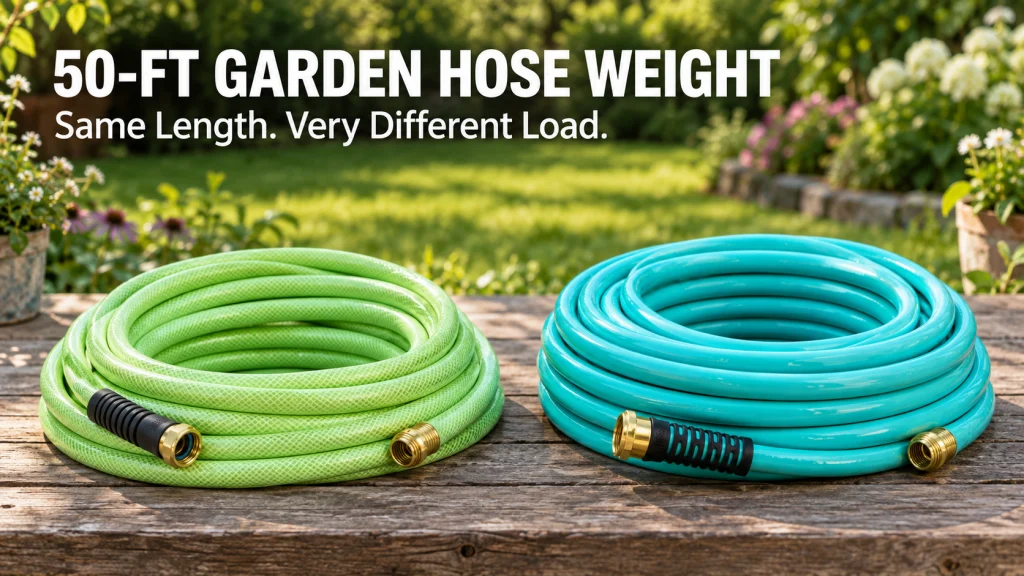
Two 50-foot hoses can carry very different published weights
Garden hose weight is easy to overlook because length is usually the number printed most prominently. Swan lists its 5/8-inch by 50-foot Green&GROW hose at 4.6 pounds, while its 5/8-inch by 50-foot FlexritePRO is listed at 8.4 pounds. That is the same nominal reach and the same inside diameter, yet the published weight gap is 3.8 pounds. The heavier figure is about 83 percent above the lighter one, based only on the two published numbers.
That difference does not make the lighter hose automatically better, and it does not make the heavier hose automatically tougher in every real use. Weight is one buying variable that sits beside diameter, construction, fittings, intended duty, storage, and the route you expect the hose to travel. I would check it separately because a long hose can be perfectly acceptable on paper and still create more material to move than another hose with the same length label. The first step is therefore to compare actual 50-foot products before deriving anything from shorter or longer versions.
The current 50-foot sample and disclosure rules
I froze this sample around manufacturer pages that publish an actual 50-foot option and a weight for that option. The core table does not turn a 25-foot or 100-foot listing into a fictional 50-foot product, because fittings and other fixed components can break simple linear scaling. It also keeps Flexzilla outside the exact-weight rows because its manufacturer guide labels the weight table as estimates rather than exact SKU product weights. That boundary matters more than making the table look larger.
The sample records brand, exact model, inside diameter, nominal length, manufacturer duty or construction wording, published product weight, and whether the page clearly defines the weight condition or fitting and accessory inclusion. A blank or unclear inclusion statement stays unclear instead of being filled by assumption. Every weight-per-foot number later in the article is derived from the published 50-foot weight and is labeled as a secondary calculation. This keeps the source number separate from the math built on top of it.
| Brand and model | Inside diameter | Length | Construction or duty wording | Published product weight | Fitting or accessory inclusion |
|---|---|---|---|---|---|
| Water Right Everyday Garden Hose | 7/16 in. | 50 ft. | Polyurethane | 3.0 lb. (condition not explicitly stated) | Not explicitly tied to the weight statement |
| Swan Green&GROW | 5/8 in. | 50 ft. | Medium duty | 4.6 lb. (condition not explicitly stated) | Not explicitly stated |
| Swan WeatherFLEX | 5/8 in. | 50 ft. | Medium duty | 5.2 lb. (condition not explicitly stated) | Not explicitly stated |
| ELEY 5/8-inch Polyurethane Garden Hose | 5/8 in. | 50 ft. | Polyurethane | 7.0 lb. (dry explicitly stated) | Not explicitly stated in the weight line |
| Swan Soft&SUPPLE | 5/8 in. | 50 ft. | Heavy duty | 7.11 lb. (condition not explicitly stated) | Not explicitly stated |
| Swan ContractorPLUS | 5/8 in. | 50 ft. | Heavy duty | 7.58 lb. (condition not explicitly stated) | Not explicitly stated |
| Swan PressureMASTER | 5/8 in. | 50 ft. | Heavy duty | 8.4 lb. (condition not explicitly stated) | Not explicitly stated |
| Swan FlexritePRO | 5/8 in. | 50 ft. | Heavy duty | 8.4 lb. (condition not explicitly stated) | Not explicitly stated |
Dataset boundary: These are manufacturer-published product weights for actual 50-foot options in the frozen sample. They are not independent scale measurements, and they should not be treated as proof of handling comfort, kink resistance, durability, or flow.
Compare actual published 50-foot products before deriving anything
The cleanest comparison starts with products that already exist in the same nominal length. Within the 5/8-inch rows, the sample runs from 4.6 pounds for Green&GROW to 8.4 pounds for PressureMASTER and FlexritePRO. ELEY sits at 7 pounds, while Soft&SUPPLE and ContractorPLUS sit slightly above that figure. Those numbers show why a generic statement such as “a 50-foot garden hose weighs about X pounds” can hide a very wide range.
Water Right adds useful context but should not be blended casually into the 5/8-inch group. Its Everyday Garden Hose is a 7/16-inch polyurethane model, and the manufacturer lists 3 pounds for every 50 feet. That lighter figure belongs in a separate diameter group because inside diameter changes the amount of hose material and the water volume the hose can hold. Keeping diameter visible prevents a true number from becoming a misleading comparison.
| Comparison group | Lowest published 50 ft. weight | Highest published 50 ft. weight | What the range can support |
|---|---|---|---|
| 5/8 in. actual products | 4.6 lb. | 8.4 lb. | Same length and diameter can still produce a large published-weight spread |
| 7/16 in. context row | 3.0 lb. | 3.0 lb. | Useful diameter context, not a direct 5/8 in. comparison |
The table is intentionally narrow in what it claims. It does not say why every pound differs, because a manufacturer weight figure alone cannot isolate jacket thickness, reinforcement, coupling mass, wall geometry, or every construction choice. It does show that equal length is not enough to predict published product weight. For a buyer, that is already a useful reason to check the exact specification instead of relying on the 50-foot label.
Which manufacturers define the published weight clearly
There are two separate questions in a useful weight specification: is there a number, and is the scope of that number clear. ELEY and the Swan product pages in this sample publish a weight tied to a specific length, which makes exact 50-foot comparison possible. Water Right also publishes a 50-foot weight figure for the current 7/16-inch product page. The remaining uncertainty is whether the stated number explicitly includes couplings, strain reliefs, packaging, or any other fixed component.
That distinction is easy to miss because a precise decimal can look more complete than it really is. A number such as 7.58 pounds is highly specific, but precision does not automatically answer what the manufacturer put on the scale. I would rather carry that uncertainty into the table than silently decide the couplings must be included. Good documentation lets the reader separate a measured value from an assumption about what the value contains.
Published weight with fittings or accessories defined
Only ELEY explicitly separates dry and filled weight in this frozen sample. The current Swan pages use the label “Weight,” while Water Right says the hose weighs 3 pounds for every 50 feet, so I keep those figures labeled as published product weight rather than silently upgrading them to dry or empty weight. None of those current core pages explicitly states, in the same weight specification, that the listed product weight includes the couplings or other accessories. Water Right lists brass fittings on the same product page as its 50-foot weight, but the weight sentence does not explicitly connect the two. ELEY lists the complete hose by length and also lists its fittings elsewhere on the page, yet the weight line itself does not define inclusion. I therefore do not promote any row into a stricter “fittings explicitly included” category.
Published weight with inclusion unclear
All eight exact-weight rows land here. That does not make the published weights useless, because they still let us compare the manufacturers’ own product specifications at the stated length and diameter. It simply means a very close comparison should avoid pretending that accessory scope has been standardized when the pages do not say so. If two products differ by only a tiny amount, this missing disclosure can matter more than it does when the gap is several pounds.
No current exact product weight found
Flexzilla is the important boundary example. Its manufacturer buying guide includes estimated empty weights by diameter and length, including about 8 pounds for a 5/8-inch by 50-foot hose, and it explicitly labels those values as estimates. That is useful context for a shopper, but it is not the same evidence type as an exact current SKU product-weight specification. For that reason, I keep Flexzilla out of the exact-weight core table rather than quietly upgrading an estimate into a measured product row.
Compare weight within similar diameter and construction groups
Matching diameter first removes one obvious source of distortion. In the 5/8-inch group, the two medium-duty Swan hoses in this sample weigh 4.6 and 5.2 pounds at 50 feet, while the Swan heavy-duty rows run from 7.11 to 8.4 pounds. ELEY’s 5/8-inch polyurethane hose is listed at 7 pounds, so material and duty language still need to stay visible instead of being collapsed into one ranking. This is a better frame than sorting every hose from lightest to heaviest and calling the first row the winner.
Construction labels also have limits because manufacturers do not necessarily use duty terms as a standardized engineering taxonomy. “Heavy duty” can help describe how a manufacturer positions a product, but the words alone do not quantify wall thickness, reinforcement mass, or long-term durability. The published weight is therefore most useful when paired with diameter and the manufacturer’s own construction description, not when treated as a substitute for those details. A like-for-like group narrows the question without pretending every variable has been controlled.
| 5/8 in. by 50 ft. product | Manufacturer wording | Published product weight |
|---|---|---|
| Swan Green&GROW | Medium duty | 4.6 lb. |
| Swan WeatherFLEX | Medium duty | 5.2 lb. |
| ELEY Polyurethane Garden Hose | Polyurethane | 7.0 lb. |
| Swan Soft&SUPPLE | Heavy duty | 7.11 lb. |
| Swan ContractorPLUS | Heavy duty | 7.58 lb. |
| Swan PressureMASTER | Heavy duty | 8.4 lb. |
| Swan FlexritePRO | Heavy duty | 8.4 lb. |
The most defensible reading is simple: at the same 5/8-inch diameter and 50-foot length, published product weight still varies materially across current products. The table does not establish which construction is stronger, easier to use, or more durable. It tells you the product weight the manufacturer publishes for the same nominal reach, while preserving any uncertainty about whether that figure is explicitly defined as dry or empty. That is a narrower claim, but it is one you can actually verify.
Weight per foot is a secondary derived metric, not an actual 50-foot SKU weight
Weight per foot can make a spread easier to see, but it should come after the actual product table rather than replace it. For each 50-foot row, I divided the published product weight by 50 and kept the result labeled as derived. Green&GROW works out to 0.092 pound per foot, while PressureMASTER and FlexritePRO work out to 0.168 pound per foot. Water Right’s 7/16-inch hose works out to 0.060 pound per foot, but it remains a separate-diameter context row.
The calculation is descriptive for the exact 50-foot product already in the sample. It should not be reversed to claim that a 25-foot or 100-foot version must weigh exactly two times or one-half as much, because fixed fittings and model-specific construction can make that assumption wrong. A derived rate is useful for normalization, not for inventing a product specification the manufacturer did not publish. If the exact length you want has an official weight, use that number first.
| Product | Published 50 ft. product weight | Derived weight per foot |
|---|---|---|
| Water Right Everyday 7/16 in. | 3.0 lb. | 0.060 lb./ft. |
| Swan Green&GROW 5/8 in. | 4.6 lb. | 0.092 lb./ft. |
| Swan WeatherFLEX 5/8 in. | 5.2 lb. | 0.104 lb./ft. |
| ELEY Polyurethane 5/8 in. | 7.0 lb. | 0.140 lb./ft. |
| Swan Soft&SUPPLE 5/8 in. | 7.11 lb. | 0.142 lb./ft. |
| Swan ContractorPLUS 5/8 in. | 7.58 lb. | 0.152 lb./ft. |
| Swan PressureMASTER 5/8 in. | 8.4 lb. | 0.168 lb./ft. |
| Swan FlexritePRO 5/8 in. | 8.4 lb. | 0.168 lb./ft. |
Key point: Weight per foot is calculated from an actual published 50-foot row here. It is not being used to create a fictional 50-foot weight from a different hose length.
Separate dry hose weight from water-filled weight
Dry weight answers one practical question, but a hose can become substantially heavier once it contains water. ELEY makes this distinction unusually visible by listing its 5/8-inch by 50-foot hose at 7 pounds dry and 14 pounds filled with water. That does not mean every 50-foot hose in this dataset doubles in weight when filled, because the inside diameter and internal volume matter. It does show why dry product weight should not be mistaken for the maximum load present during use.
The distinction also prevents another bad comparison: mixing a dry manufacturer weight from one product with a filled or shipping weight from another. Before comparing numbers, look for words such as dry, filled, shipping, package, or product weight and make sure the measurement refers to the hose itself. If the page does not define the condition, keep that uncertainty visible. A clean dataset is less impressive than a messy one only until you need to make a real decision from it.
- Use dry or empty weight only when the manufacturer explicitly labels the measurement that way.
- Keep filled-with-water figures in a separate column or note.
- Do not substitute shipping weight for hose weight unless the manufacturer explicitly defines it that way.
- Do not assume two hoses hold the same water mass when their inside diameters differ.
The ELEY dry-versus-filled pair is useful because both figures come from the same manufacturer specification for the same product and length. It gives a real example without requiring a generic water-capacity formula or an invented estimate for the other rows. For every other product in the table, the article stays with the published product-weight figure without relabeling it as dry or empty. That keeps the evidence boundary consistent.
What weight cannot tell you about kinking, flow, durability, or handling
A scale number cannot prove how a hose behaves when bent around a planter, pulled across concrete, left in cold weather, or connected to a sprinkler. A heavier hose is not automatically more durable, and a lighter hose is not automatically easier for every person to manage. Weight alone also cannot tell you whether the hose will kink less, deliver more flow, resist abrasion better, or last longer. Those are separate performance questions that need construction details, exact specifications, or appropriate testing.
I would also avoid turning a published-weight difference into a medical or comfort claim. A lower listed product weight means the manufacturer’s published figure is lower, but it does not quantify fatigue, injury risk, grip demand, or ease of coiling for a particular user. Route shape, how much hose stays on the ground, reel use, surface friction, diameter, water inside the hose, and lifting height can all change the real task. The useful claim is simply that published product weight changes one load-related variable, not that it predicts the whole handling experience.
| Weight can support | Weight cannot establish by itself |
|---|---|
| Published product weight of the exact hose | Kink resistance |
| Difference between two stated product weights | Durability or service life |
| A secondary weight-per-foot calculation | Flow performance |
| Whether weight deserves a separate buying check | Comfort, fatigue, or injury risk |
This is where a data article can stay useful without turning into a generic buying guide. Weight deserves attention precisely because it is measurable, but its value comes from keeping the claim narrow. If your actual problem is kinking, flow, cold-weather flexibility, or durability, check evidence built for that question. Do not ask one specification to answer four different ones.
The documentation check I would make before buying a long hose
Before I compare two long hoses, I would put the exact variant on paper first: length, inside diameter, product name, and manufacturer-published product weight. Then I would check whether the number belongs to that exact length or was derived from a different size. I would also look for any statement about fittings, accessories, packaging, or filled weight so unlike numbers do not end up in the same column. This takes a little more work than reading the front label, but it prevents false precision later.
The same discipline helps with broader product research because specifications can lead into a garden buying rabbit hole when each page uses a different set of numbers. Weight should earn a place in the decision only if moving, lifting, routing, or storing the hose is a real constraint for your yard. If your route is short and the hose mostly stays on a reel, a few pounds of published-weight difference may matter less than it does for repeated carrying across a larger property. The point is not to chase the lightest number, but to know whether the number changes your job.
- Confirm the exact model and nominal length.
- Confirm the inside diameter before comparing weight.
- Use the manufacturer’s exact weight for that length when available.
- Check whether the number is dry, filled, shipping, or package weight.
- Look for a statement about couplings or accessories included in the figure.
- Keep estimates separate from exact product specifications.
That checklist is also the reason I would not extrapolate an “actual 50-foot weight” from a 25-foot product. The arithmetic can be easy while the assumption is wrong. Fixed couplings, strain reliefs, reinforcement, and construction changes do not have to scale perfectly with length. When an exact manufacturer row exists, it should outrank a cleaner-looking estimate.
Final thoughts: treat hose weight as its own specification
The strongest finding in this sample is not that one hose is light and another is heavy. It is that current manufacturer specifications for actual 5/8-inch by 50-foot products span from 4.6 to 8.4 pounds, even though most pages in this sample do not explicitly label those figures as dry or empty. That is enough variation to make weight worth checking separately when a long hose must be carried, routed, lifted, or stored. It is not enough evidence to declare a universal winner.
I would start with the exact 50-foot product weight, keep diameter and construction beside it, and then ask whether the manufacturer defines the measurement as dry, empty, filled, shipping, or another condition and what the weight includes. Derived weight per foot can help normalize the table, but it should stay secondary to the actual SKU figure. Filled weight belongs in its own comparison, and performance claims such as kink resistance or durability need their own evidence. A simple weight check works best when it remains exactly that: one verified input in a larger garden decision.
Frequently asked questions
⚖️ How much does a 50 ft garden hose weigh?
There is no single reliable weight for every 50-foot hose. In this manufacturer-published sample, exact 50-foot products range from 3 pounds for a 7/16-inch Water Right hose to 8.4 pounds for several 5/8-inch Swan hoses, so diameter and construction need to stay visible.
📏 Does a 100 ft hose weigh exactly twice as much as a 50 ft hose?
Not necessarily. Fixed components such as couplings and strain reliefs can prevent weight from scaling perfectly with length, so use the manufacturer’s exact weight for the length you want whenever it is published.
💧 Is dry hose weight the same as filled hose weight?
No. ELEY, for example, lists its 5/8-inch by 50-foot hose at 7 pounds dry and 14 pounds filled with water, so the two conditions should be kept separate.
🧮 Is garden hose weight per foot useful?
It can be useful as a secondary comparison when it is calculated from an actual published product weight. Do not use it to invent an exact SKU weight for a different length unless the manufacturer provides that specification.
🪴 Does a lighter garden hose mean it is better?
No. A lower published product weight may matter when moving or storing the hose is a real constraint, but weight alone does not establish kink resistance, flow, durability, comfort, or service life.
References and sources
- ELEY polyurethane garden hose: supports the 5/8-inch dimensions and the published dry and water-filled weights by hose length.
- Swan Green&GROW hose: supports the 5/8-inch diameter, 50-foot option, medium-duty label, and 4.6-pound published weight.
- Swan WeatherFLEX hose: supports the 5/8-inch diameter, 50-foot option, medium-duty label, and 5.2-pound published weight.
- Swan Soft&SUPPLE hose: supports the 5/8-inch 50-foot heavy-duty row and 7.11-pound published weight.
- Swan ContractorPLUS hose: supports the 5/8-inch 50-foot heavy-duty row and 7.58-pound published weight.
- Swan PressureMASTER hose: supports the 5/8-inch 50-foot heavy-duty row and 8.4-pound published weight.
- Swan FlexritePRO hose: supports the 5/8-inch 50-foot heavy-duty row and 8.4-pound published weight.
- Water Right Everyday Garden Hose: supports the current 7/16-inch product, available 50-foot size, polyurethane construction, and 3-pound-per-50-foot weight statement.
- Flexzilla garden hose guide: supports keeping its weight figures outside the exact core dataset because the manufacturer labels the table as estimated empty weights.