A garden tool warranty can sound generous while covering a much narrower set of failures than the headline suggests. In the current U.S. sample below, lifetime, 25-year, and 24-month language changes meaning once you separate the tool body from wear parts, registration, proof of purchase, seller restrictions, and claim remedies. The useful comparison is not which brand prints the longest number, but what the exact product family actually covers and what you must provide when a claim starts. The named products are evidence anchors for warranty terms, not product recommendations.
The same word lifetime can describe very different coverage
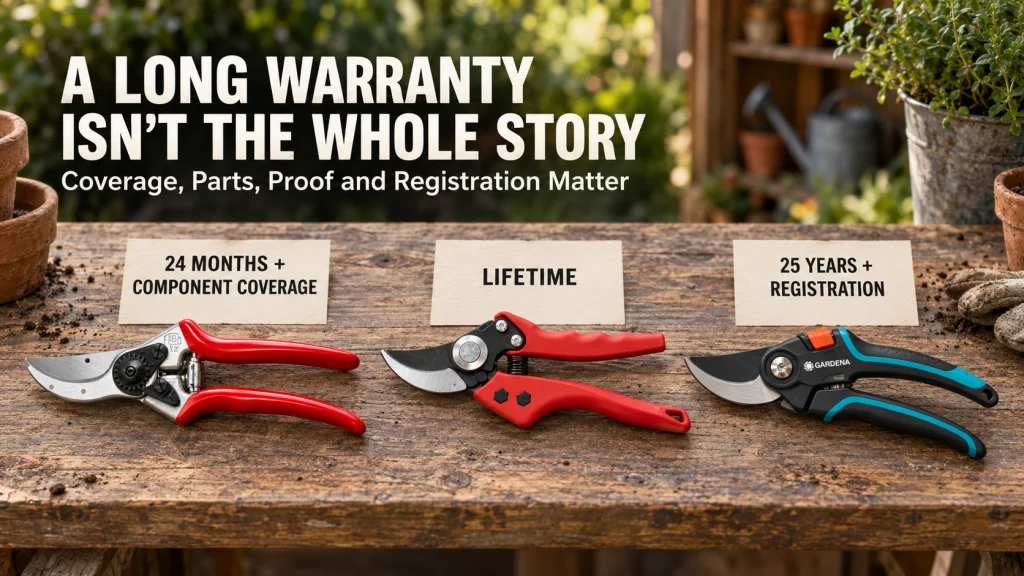
A garden tool warranty becomes confusing when the headline is compared without the contract underneath it. Fiskars uses lifetime wording on many current hand tools, while a separate axe registration page advertises a 25-year extension for eligible X-Series and Norden axes. FELCO gives manual pruning tools a 24-month base term but lifetime coverage for forged aluminum components, while selected GARDENA cutting tools advertise 25 years after registration. Similar-looking promises can therefore require different proof, registration, covered parts, and claim steps.
I would not treat any of those durations as a durability score. A long term does not show how long a blade stays sharp, how a spring ages, or whether misuse is covered. It tells us what the manufacturer says it will address when a failure meets stated conditions. The better question is not which number is longest, but what must be true for the claim to qualify.
How the U.S. warranty sample was defined
I froze the sample at the product-family level instead of assigning one slogan to an entire brand. It covers Fiskars hand tools and axes, FELCO manual pruning tools, Corona hand tools, and GARDENA manual cutting tools for U.S. consumers. An exact sample stays visible in every row so a family term is not mistaken for a promise on every item with the same logo. When a general policy and product page use different wording, both are recorded rather than quietly choosing the more favorable phrase.
Each row uses the same codebook: base duration, component exception, consumables, registration, proof, seller requirement, remedy, exclusions, and shipping or return conditions. I did not use non-U.S. terms to fill gaps because country-specific policies can change the contract. An unstated requirement remains unstated rather than becoming an assumption. That keeps the comparison focused on documented coverage instead of brand reputation.
- Duration: the stated period for the exact sample or product family.
- Coverage: the defect standard and the failures explicitly left outside it.
- Component treatment: whether structural parts and wear parts follow the same term.
- Claim conditions: registration, proof, seller eligibility, shipping, and remedy.
The codebook keeps unlike promises from being flattened into one brand-level label. A family-specific exception, a registration rule, or an unstated field stays visible instead of being averaged into a simpler claim. That makes the rows comparable without pretending every product under the same logo follows identical terms. Choosing the right tool remains a separate decision from reading its warranty.
Duration is only the first column
Duration becomes useful only when the conditions beside it are visible. Fiskars’ general U.S. policy can cover an unlisted, non-excluded product while the original purchaser or giftee owns it, and many product pages use lifetime wording. The separate axe registration page advertises a 25-year extension for X-Series and Norden axes, while current axe product pages can also show lifetime language. I would verify the exact axe and registration terms rather than silently choosing whichever phrase sounds better.
The other brands vary in different ways. FELCO separates a 24-month manual-tool term from lifetime forged-aluminum coverage, while common wear components are consumables. Corona says tools may carry either a 1-year or lifetime term, and the sampled hand pruner shows lifetime coverage. GARDENA’s sampled secateurs show a 25-year term tied to registration, while the broader policy adds private-use, proof, wear-part, and remedy conditions.
| Brand | Product family | Exact product or sample | Base duration | Component exception | Consumables | Registration | Proof of purchase | Authorized seller requirement | Claim remedy | Misuse or storage exclusions | Shipping or return |
|---|---|---|---|---|---|---|---|---|---|---|---|
| Fiskars | Garden hand tools | Big Grip Trowel 370730-1002 | Lifetime on the product page; general policy ties eligible coverage to original-owner or giftee ownership | No longer component term stated for this sample | Parts, accessories, spare blades, replaceable attachments, normal wear, and sharpening are excluded under the general policy | No registration condition stated for this sample | Receipt or invoice details and photos may be required | Direct purchase or authorized reseller | Repair, equivalent replacement, or partial or full refund at Fiskars’ option | Improper use or maintenance, accident, environmental factors, improper storage, unauthorized repair or modification | Return may be required at the claimant’s cost |
| Fiskars | X-Series axes | X7 Hatchet 378501-1005 | Lifetime on the current product page; separate registration page advertises a 25-year extension | No separate component term identified on the pages reviewed | General policy excludes parts, accessories, consumables, spare blades, replaceable attachments, normal wear, and sharpening | Required for the advertised 25-year axe extension | General claim process may require proof details and photos | Direct purchase or authorized reseller under the general policy | Repair, equivalent replacement, or partial or full refund at Fiskars’ option | General policy excludes misuse, poor maintenance or storage, unauthorized repair, and external causes | Return may be required at the claimant’s cost |
| FELCO | Manual pruning tools | FELCO 2 pruning shears | 24 months for material and manufacturing defects | Forged aluminum components have lifetime coverage; non-slip coverings are excluded from that provision | Blades, counter-blades, anvils, shock absorbers, and springs are treated as consumables | No registration condition stated for the base manual-tool warranty | Copy of purchase invoice | No authorized-seller condition stated in the manual-tool warranty section reviewed | Repair or replacement at FELCO’s discretion after inspection | Improper use or storage, poor maintenance, corrosion from neglect, non-original parts, modification, or accident | Buyer pays shipping |
| Corona | Garden hand pruners | Ergonomic Bypass Pruner BP-4180 | Lifetime on the current product page | No separate longer component term stated on the warranty page reviewed | Normal wear and lost or stripped parts are excluded | Registration is offered, but not stated as a condition for this sample’s term | Original proof and images | Unauthorized-reseller purchases are excluded | Replacement for an accepted materials or manufacturing defect | Alteration, modification, negligence, misuse, or abuse | No specific claimant shipping rule stated on the page reviewed |
| GARDENA | Manual cutting tools | Garden Secateurs B/M 08904-81.000.00 | 25 years on the current product page | No separate longer component term stated for this sample | Broader policy excludes normal wear, wear parts, and consumables, including blades | Required for the extended term shown on the product page | Copy of original proof | Broader policy covers new products bought from a dealer and excludes secondhand products | Repair or fully functional replacement at GARDENA’s option | Commercial or unintended use, unauthorized opening or repair, non-original parts, and normal wear | Claimant sends the product and pays postage under the broader policy |
The table is not a winner board. A component-specific lifetime provision is structurally different from a whole-product headline, and a long term can still depend on registration or private use. Lifetime wording also does not erase normal-wear exclusions or make every service part free. Compare the whole row, then save the records the claim process may require.
Compare what counts as a covered defect
Across this sample, the recurring foundation is defects in materials or workmanship, not a promise that the tool will never wear out or break under any circumstance. That distinction matters when a claim involves a cracked casting, a loose connection, corrosion after poor storage, a blade that has simply been sharpened many times, or damage from using the tool outside its intended job. Fiskars, FELCO, Corona, and GARDENA all use exclusions that separate manufacturing problems from wear, misuse, maintenance failures, alteration, or other outside causes. The exact language differs, but the basic claim question is usually whether the failure came from a covered defect rather than the ordinary life of a service part.
I would document a questionable failure before trying to repair it, especially where unauthorized modification or non-original parts can affect coverage. Photos, the product number, a short failure description, and the purchase record create a cleaner claim file than saying the tool simply broke. That evidence does not guarantee approval because the manufacturer still applies its own terms. It does keep the claim focused on the defect distinction the warranty is written to evaluate.
Separate the tool body from blades, springs, grips, and other wear parts
Wear parts are where a large warranty badge can become misleading if you read it as whole-tool protection. FELCO makes the separation unusually visible by giving forged aluminum components lifetime coverage while classifying blades, counter-blades, anvils, shock absorbers, and springs as consumables. Fiskars’ general policy likewise excludes parts, accessories, consumables, spare blades, replaceable attachments, normal wear, and sharpening. GARDENA’s broader policy excludes normal wear and a range of wear parts and consumables, while Corona excludes normal wear and lost or stripped parts.
For pruning tools, that distinction is especially practical because the cutting parts are often the parts you expect to sharpen, adjust, replace, or service over the life of the tool. A replaceable blade can be a useful ownership feature, but replaceability does not automatically mean free replacement under warranty. I would check the price and availability of common service parts separately from the warranty term when comparing tools meant for long use. That keeps maintenance economics in the decision without pretending a warranty is a maintenance plan.
Check original-purchaser, proof-of-purchase, and authorized-reseller requirements
A long warranty can still depend on paperwork that is easy to lose. Fiskars limits coverage to the original end-user purchaser or giftee and requires a direct or authorized-reseller purchase, while Corona requires original proof and excludes unauthorized-reseller purchases. GARDENA’s broader policy requires original proof and excludes secondhand products, and FELCO asks for a purchase invoice. The headline duration means little if the claimant cannot establish the purchase required by the contract.
I would save a digital receipt, exact model or article number, seller identity, and any registration confirmation together. If seller authorization matters, the order confirmation is more useful than a bank charge that does not identify the seller or model. These records can outlast a retailer’s normal return window and make the manufacturer’s review easier. Proof storage is therefore part of ownership, not paperwork to reconstruct only after a failure.
Registration can change the warranty on some product families
Registration is not a universal garden-tool requirement, which is exactly why I would never assume it from a brand name alone. Fiskars has a separate registration path that advertises a 25-year extended warranty for X-Series and Norden axes, while many ordinary Fiskars hand tools use lifetime wording without a registration condition on the pages reviewed. GARDENA’s current Garden Secateurs B/M page also ties its 25-year warranty to product registration. FELCO’s manual pruning-tool base warranty and the Corona hand-tool warranty page reviewed do not present registration as the condition that activates the base term.
The safest approach is to read the exact product page and warranty page at the time of purchase, then complete registration when the extended term depends on it. Save the confirmation rather than assuming the manufacturer account will always be easy to reconstruct later. If the product page and general policy appear to describe the term differently, keep both records and ask the manufacturer which set of conditions applies to the exact model. Record registration as a product-family condition rather than assuming it applies across the brand.
Shipping, repair, and replacement terms matter after a claim starts
The practical value of a warranty depends partly on what happens after the manufacturer accepts that there may be a covered defect. Fiskars can choose among repair, replacement, or a partial or full refund and may require the product to be shipped back at the claimant’s cost. FELCO’s manual-tool language allows repair or replacement after inspection and places shipping costs on the buyer. Corona’s policy centers on replacement for an accepted materials or manufacturing defect, while GARDENA reserves the choice between repair and a fully functional replacement under its stated conditions.
Those remedies are not interchangeable from a homeowner’s point of view. Shipping a long-handled tool can be more inconvenient than shipping a hand pruner, and waiting for inspection can matter if the tool is needed for a seasonal task. I would therefore check whether photos can start the claim, whether physical return is mandatory, who pays postage, and whether the remedy is repair, equivalent replacement, or something else. A warranty can still be useful when the claimant pays shipping, but that cost belongs in the real ownership calculation rather than being hidden behind the duration badge.
What a long warranty cannot prove about tool performance or durability
A warranty is evidence of stated coverage, not a controlled durability test. It does not tell us which pruner stays aligned longer, which trowel is more comfortable in dense soil, which spring lasts through more cycles, or which tool will feel better in a particular hand. It also cannot turn excluded normal wear into a manufacturing defect simply because the headline says lifetime. Using warranty length as a shortcut for product quality would therefore go beyond what these documents actually support.
I would choose the tool type and fit first, then use warranty structure as one ownership factor among several. If you are still deciding what belongs in a basic setup, the essential garden tools guide is a better place to sort the job, tool family, and practical need before comparing warranty fine print. After that, the warranty can help distinguish how brands handle defects, service parts, proof, and remedies. That sequence prevents a generous contract from becoming the reason you buy the wrong tool for the work.
Final thoughts: read the warranty as a claim process, not a quality score
The useful comparison is a row of conditions, not a race between lifetime, 25 years, and 24 months. Coverage can change by product family, component, registration, proof, seller, and remedy even when the front-facing wording sounds simple. Wear parts deserve their own check, especially on tools designed to be sharpened or serviced. A longer term has value only for failures and ownership conditions the contract actually includes.
Before paying more because of a warranty badge, I would save the exact model page, read the current U.S. terms, complete required registration, and store the receipt with the product number. I would then compare service parts and claim logistics separately from duration. That keeps the decision tied to the tool’s job and the owner’s maintenance burden. A warranty should reduce uncertainty about covered defects, not imply performance the document never promised.
Frequently asked questions
Most warranty questions become easier once you separate the headline term from the claim conditions. The same words can lead to different answers depending on the exact tool, component, seller, registration status, and proof available. The questions below focus on the recurring issues that matter across the current U.S. manufacturer pages used in this audit. They do not replace the exact warranty terms for a model you already own or plan to buy.
If your tool has already failed, start with the manufacturer page for that exact model and preserve the tool before making changes that could affect inspection. Gather the receipt or invoice, model number, photos, and any registration confirmation before opening the claim. If the policy leaves a condition unclear, ask the manufacturer to confirm it in writing. That creates a cleaner record than relying on a retailer badge or a remembered slogan.
🛠️ What does a lifetime warranty on a garden tool actually mean?
It means only what the manufacturer defines in the applicable warranty. In this sample, lifetime language can still exclude normal wear, sharpening, consumables, misuse, unauthorized repair, or specific components, so the exact policy matters more than the badge.
🧾 Do I need a receipt for a garden tool warranty claim?
Often, yes. Fiskars may require proof details, FELCO asks for a copy of the purchase invoice, Corona requires original proof of purchase, and GARDENA’s policy relies on original proof, so keeping a digital receipt is a practical precaution.
✂️ Are replacement blades covered by a lifetime warranty?
Not automatically. Several policies in this sample treat blades, springs, sharpening, attachments, or other service parts as wear items or consumables, so check the component language for the exact tool rather than assuming the headline term applies to every part.
📝 Does registering a garden tool extend the warranty?
For some product families, registration changes or activates the extended term. Fiskars advertises a 25-year axe extension through registration, and current GARDENA secateur pages tie their 25-year term to registration, while the other sampled base warranties do not use registration in the same way.
♻️ Does a garden tool warranty transfer to a second owner?
Do not assume that it does. Fiskars limits the reviewed U.S. warranty to the original end-user purchaser or giftee, and GARDENA’s broader policy excludes secondhand products, so transferability has to be checked brand by brand and product by product.
📦 Does the manufacturer pay return shipping for a warranty claim?
Not always. Fiskars may require return shipment at the claimant’s cost, FELCO places shipping costs on the buyer for the manual-tool warranty reviewed, and GARDENA’s broader policy tells the claimant to cover postage, while Corona’s warranty page does not state a specific shipping rule for the sample reviewed.
References and sources
This article needs manufacturer sources because the subject is the warranty contract itself. I used current U.S. brand pages and exact product pages where a family-level statement could hide a registration rule or a different product term. Retailer summaries were not used to fill missing warranty fields. Where manufacturer pages do not cleanly reconcile their own wording, the article preserves that uncertainty instead of choosing the more favorable phrase.
The links below are limited to sources that support the comparison table and claim-process details. They are not included as a general brand directory or a list of recommended products. Product pages are used only to anchor the exact sample and displayed warranty language. The manufacturer warranty pages control the broader exclusions, proof requirements, remedies, and claim conditions discussed above.
- Fiskars warranty and registration: supports the U.S. limited-warranty scope, original-purchaser and authorized-reseller rules, exclusions, remedies, proof requirements, and possible return shipping.
- Fiskars Big Grip Trowel: anchors the exact garden hand-tool sample and its current lifetime-warranty wording.
- Fiskars axe registration: supports the separate 25-year extended-warranty registration language for X-Series and Norden axes.
- Fiskars X7 Hatchet: anchors the exact axe sample and its current lifetime-warranty wording.
- FELCO warranty and repairs: supports the manual pruning-tool base term, lifetime forged-aluminum exception, consumable parts, exclusions, invoice requirement, remedy, and buyer-paid shipping.
- FELCO 2: anchors the exact pruning-shear sample used in the audit.
- Corona warranty: supports the 1-year or lifetime structure, defect standard, proof and photo requirement, unauthorized-reseller exclusion, and other exclusions.
- Corona Ergonomic Bypass Pruner: anchors the exact hand-pruner sample and its current lifetime-warranty wording.
- GARDENA Garden Secateurs B/M: anchors the exact manual cutting-tool sample and its current 25-year registration-based warranty wording.
- GARDENA manufacturer warranty policy: supports private-use limits, proof requirements, wear-part exclusions, repair or replacement remedies, and claimant-paid postage.