Plants per person tables are useful starting points, but household size alone cannot tell you how much of each vegetable belongs in a home garden. The better method is to begin with what the household actually eats, separate fresh use from preserving or storage goals, then account for harvest pattern, repeat sowings, and the space available. Published Extension estimates can supply a defensible baseline, but they should not be treated as yield promises or dietary requirements. The final quantity should fit both the household and the measured garden before exact spacing is applied.
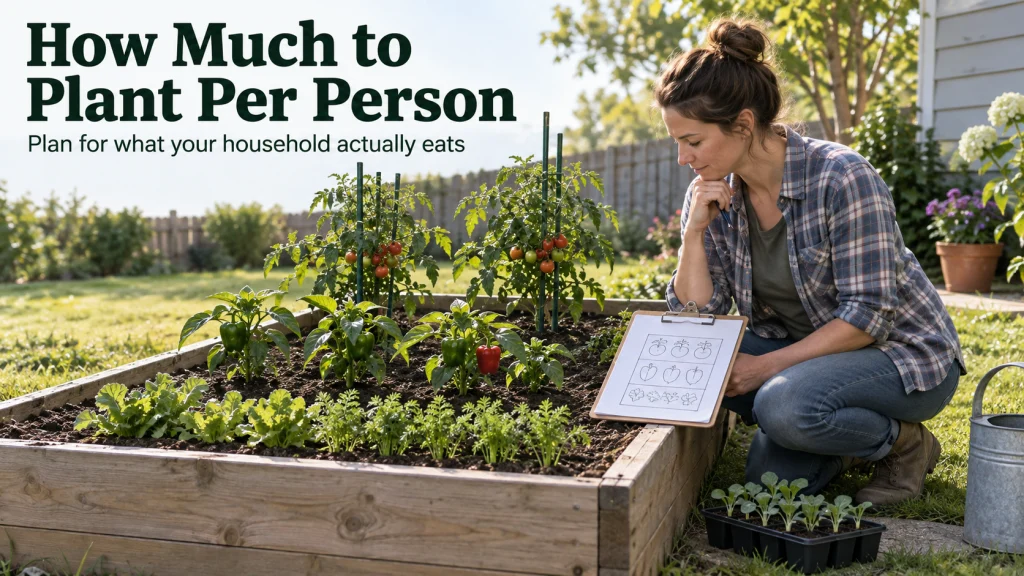
Household size is only the first number
If you are deciding how much to plant per person, a four-person household does not automatically need four tomato plants, four rows of beans, or four times every number in a chart. One household may eat tomatoes almost every day while another mostly wants a few for sandwiches. The same four people may freeze beans, make tomato sauce, store onions, and barely touch summer squash. Household count gives you a multiplier, but household use decides whether that multiplier makes sense.
I would start by treating every published quantity as a planning baseline rather than a prescription. Virginia Tech Extension makes the same point by tying planting amounts to vegetable preferences, garden size, available time and energy, cooking habits, and plans for canning or freezing. That is a much safer frame than assuming every adult consumes the same amount of every crop. It also keeps a planning number from turning into an implied guarantee about how much food a plant will produce.

This Mead notebook has 100 graph-ruled sheets in a 7.5 x 10.5-inch one-subject format. The grid gives household members and crops separate rows or columns when a planting baseline needs to be adjusted. Its compact page size keeps the first household-use calculations together before bed space is assigned.
Check On AmazonIf you click this link and buy, we earn a commission at no additional cost to you.
Start with what the household actually eats
Before multiplying any chart value, sort the vegetables you already chose by how often they are likely to be used. A crop that appears in several meals each week deserves a different starting quantity from a crop that is eaten occasionally or by only one person. Preference also matters within a household, because two enthusiastic pepper eaters can create more demand than four people who only use peppers as an occasional ingredient. That makes the plant count a household-use question first and a math question second.
A simple use check is enough to prevent the first round of overplanting. Write down whether each crop is a frequent staple, a regular seasonal crop, an occasional crop, or mostly an experiment. Then note who in the household actually eats it and whether the harvest will be used fresh, preserved, stored, shared, or some combination of those uses. These notes give you a reason to move a published estimate up or down instead of changing it by instinct.
- Frequent staple: used repeatedly in normal meals and worth allocating more garden space.
- Regular seasonal crop: wanted during its harvest window, but not necessarily in large storage quantities.
- Occasional crop: useful in smaller amounts, especially when garden space is limited.
- Experiment: planted in a deliberately small quantity until the household knows whether it wants more.
The point is not to build a complicated consumption spreadsheet before planting anything. It is to stop a generic family-size chart from overruling what people in the house actually cook and eat. If a crop has low household demand, a smaller first quantity leaves room for vegetables that will be used more often. If demand is high, the next step is deciding whether that demand is for fresh eating or for preserving.

This Five Star one-subject notebook provides 100 college-ruled sheets in an 8.5 x 11-inch format. It gives one place to record which crops are staples, seasonal choices, occasional crops, or experiments. Keeping those household-use notes together makes later quantity changes easier to trace.
Check On AmazonIf you click this link and buy, we earn a commission at no additional cost to you.
Separate fresh eating from preserving and storage goals
Fresh eating and preserving can require very different quantities even when the household size stays the same. A family that wants tomatoes for salads and sandwiches is solving a different problem from a family that also wants enough fruit for sauce or canning. Virginia Tech specifically notes that gardeners may choose to grow more of a crop when they plan to can or freeze it. The useful adjustment is therefore based on intended use, not on the idea that preservation automatically requires a fixed extra percentage.
For example, Virginia Tech lists tomatoes at roughly two to four plants per person per planting. For a four-person household, that creates a broad baseline of eight to sixteen plants before household habits are considered. A household interested mainly in fresh tomatoes could choose to begin toward the lower end, while one planning substantial preservation may decide that a higher starting quantity better matches its goal. Neither choice promises a particular harvest because weather, cultivar, disease pressure, season length, and plant performance can change the result.
| Planning question | Fresh-use household | Preserving or storage household |
|---|---|---|
| How often will the crop be used? | Focus on normal meals during the harvest period. | Include the amount intended for freezing, canning, curing, or storage. |
| What should change first? | Start near a reasonable source baseline and adjust for real household demand. | Increase only when the preservation plan and garden capacity support it. |
| What should not be assumed? | Do not assume every person wants the same amount. | Do not assume preserving requires a universal multiplier. |
That distinction also prevents storage crops from quietly taking over a small garden. If the household wants onions or potatoes for extended storage, the quantity decision should include where that harvest will go after it leaves the bed. Preserving goals add work as well as plants, so the plan should account for harvest, cleaning, processing, freezer or pantry capacity, and time. A larger planting only helps when the household can actually use and handle the larger harvest.

These Ball regular-mouth jars hold 32 ounces each and come as a two-pack with lids and bands. They provide a concrete container for separating produce intended for preserving from produce meant for fresh use. Using a known jar capacity also helps make storage volume part of the planting discussion.
Check On AmazonIf you click this link and buy, we earn a commission at no additional cost to you.
Use plants per person tables as starting estimates
Extension tables are valuable because they give you a traceable place to begin, but different sources do not always publish identical numbers. That variation is a reason to keep the source attached to the estimate instead of averaging several charts into a number that no source actually recommends. Virginia Tech and West Virginia University both present per-person guidance, and their figures overlap for some crops while differing for others. The differences are useful because they reveal how much context sits behind a seemingly simple number.
The table below keeps each estimate with its source and shows a small set of common vegetables. Virginia Tech expresses these as approximate plants per person per planting, while West Virginia University presents suggested plants per person and notes that the amount can vary when preserving. I would use one source consistently for the first draft of the garden, then make household-specific adjustments rather than switching between sources crop by crop to get a preferred number. That keeps the method understandable and makes later changes easier to explain.
| Crop | Virginia Tech starting estimate | West Virginia University starting estimate |
|---|---|---|
| Tomatoes | 2 to 4 plants per person per planting | 3 to 5 plants per person |
| Peppers | 3 to 5 plants per person per planting | 3 to 5 plants per person |
| Cucumbers | 2 to 4 plants per person per planting | 3 to 5 plants per person |
| Carrots | 10 to 30 plants per person per planting | 15 to 20 plants per person |
| Summer squash | 1 to 2 plants per person per planting | 2 to 3 plants per person |
| Potatoes | 10 plants per person per planting | 10 to 15 plants per person |
Do not read the wider ranges as an invitation to choose the largest number. A small garden, limited maintenance time, low household demand, or a desire for more crop variety may all support a lower starting quantity. A household that preserves heavily may have a reason to move higher, but only when the growing space and postharvest workload also fit. Choose the number you can justify from source guidance, household demand, and available space.
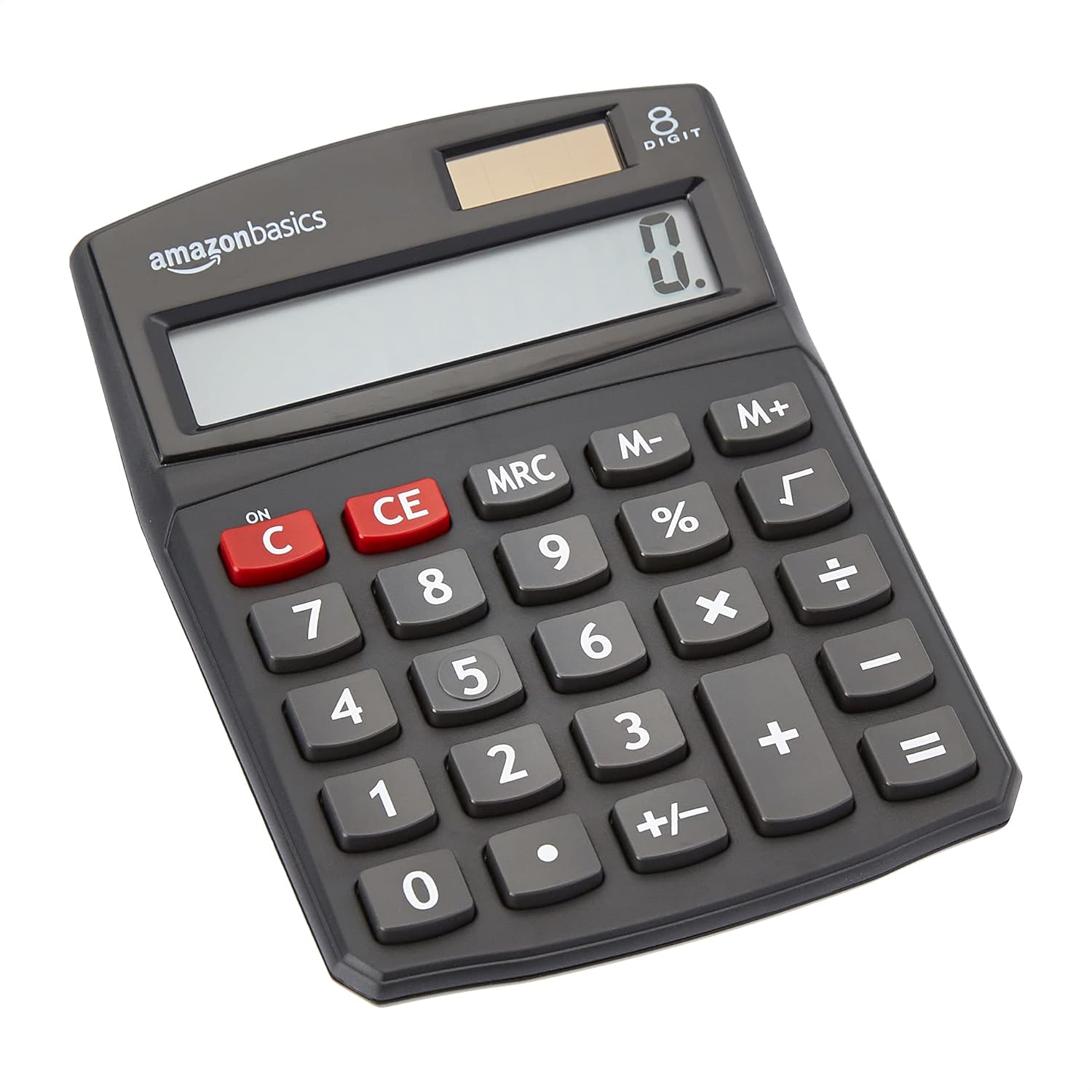
This Amazon Basics desktop calculator uses an 8-digit LCD display in a compact standard-function format. It is useful for multiplying source estimates by the number of household members who actually eat a crop. Keeping the arithmetic separate from the source table makes it easier to check a planting baseline before adjusting it.
Check On AmazonIf you click this link and buy, we earn a commission at no additional cost to you.
Account for crops harvested once and crops that keep producing
Two crops with the same plant count can behave very differently in the kitchen because their harvest patterns are different. A head of cabbage is largely a one-time harvest, while a tomato or pepper plant can be picked repeatedly over a longer period when conditions are favorable. Root crops and heading vegetables can also create a concentrated harvest if many plants reach usable size together. That means plant count alone does not tell you whether the household will receive a short burst of food or a continuing stream.
Virginia Tech explicitly separates crops that provide a continuous harvest from those harvested once or twice, which is useful when interpreting its per-person table. For a one-time crop, ask how many usable units the household wants at one harvest and whether part of that harvest will be stored or preserved. For a continuing crop, ask how much the household wants available during a normal week and whether repeated picking is realistic. The goal is not to predict yield per plant, but to match the pattern of harvest to the way the household expects to use the crop.
This distinction can change the garden even before spacing enters the calculation. A large one-time planting may be reasonable for a crop intended for storage, but inconvenient for a crop the household wants in small amounts over many weeks. A continuously producing crop may need fewer plants in the ground than a beginner expects, while a once-harvested crop may need repeated sowings to spread availability. Harvest pattern therefore belongs beside household preference when you decide how much space each crop deserves.

The Tierra Garden GP184 is a 22 x 12 x 4.75-inch plastic colander trug designed for collecting, carrying, rinsing, and draining produce. Its shallow basket shape gives a practical way to handle crops that arrive in one concentrated harvest. The integrated colander area also lets produce move from garden to rinse without transferring it to a second container.
Check On AmazonIf you click this link and buy, we earn a commission at no additional cost to you.
Let succession planting change what must be in the ground at once
Succession planting changes the quantity question because the household may not need the entire seasonal total growing at the same time. Virginia Tech recommends multiple plantings for several crops and notes that repeat plantings can extend the harvest period. If the crop and local planting window allow it, smaller batches can spread harvest and reduce the amount of bed space occupied at one moment. That can be more useful than planting one large block simply because a per-person table produced a large seasonal number.
The important distinction is between total plants over the season and plants per planting. If a source gives a per-planting estimate, multiplying it by every suggested planting without checking household demand can create far more produce than intended. Instead, decide how much of a crop you want available from each planting, then use the local season and the crop’s growth cycle to determine whether another planting is practical. This keeps succession from becoming an automatic multiplier.
A small bed makes this especially important because later plantings may need space that an earlier crop is still using. Keep a simple sequence on the garden plan so you know which bed is expected to open and what crop follows it. If the timing is uncertain, leave some flexibility instead of assigning every square foot to a later planting before the first crop is even established. Succession should reduce bottlenecks in harvest and space, not create a schedule the garden cannot physically support.

This VITEVER set includes 100 T-type plastic plant labels and a marker pen, with each label measuring 3.9 x 2.4 inches. The labels can mark separate sowing dates or batches when the same crop is planted in succession. That makes later plantings easier to distinguish from the first planting without relying on memory.
Check On AmazonIf you click this link and buy, we earn a commission at no additional cost to you.
Convert the estimate into plants or row feet only after checking the source
Not every planning table uses the same unit, so check the column heading before doing any multiplication. Virginia Tech mostly gives plants per person per planting, but some entries are expressed as feet of row, and its guide also provides the amount of seed or transplants needed for a ten-foot row. West Virginia University presents plants per person for many crops. Mixing plant counts, row feet, and seasonal totals without noticing the unit is an easy way to create a garden that looks precise on paper but is mathematically inconsistent.
When a source gives plants, multiply only after deciding how many people in the household actually use the crop and where within the source range you intend to start. When it gives row feet, keep the result in row feet until you check the source’s spacing or the crop’s exact spacing guidance. Do not convert a row-foot recommendation into a plant count by guessing how tightly the crop will be spaced. The conversion should preserve the assumptions behind the source instead of replacing them with new ones.
| Worksheet field | What to record | Decision it supports |
|---|---|---|
| Source baseline | Crop, source, range, and whether the source uses plants or row feet | Keeps the starting estimate traceable and prevents mixed units. |
| Household adjustment | Number of people who eat the crop plus fresh, preserving, or storage use | Explains why the household is moving above, below, or within the source range. |
| Quantity per planting | Planned plants or row feet for one planting | Separates what must be in the ground now from later succession plantings. |
| Spacing or row requirement | Reliable crop-specific spacing, row length, or bed footprint used for the layout | Converts the chosen quantity into a physical space requirement without guessing tighter spacing. |
| Available space | Usable bed length, row length, or bed area assigned to that crop | Shows the actual capacity available after paths, supports, and other crops are accounted for. |
| Fit check | Fits as planned, needs fewer plants, needs less row length, or must move to another planting window | Turns the estimate into an actionable garden decision before seed or transplant quantities are finalized. |
The worksheet should end with a space decision, not just a plant count. If the chosen quantity requires more row length or bed area than the garden can provide at reliable crop spacing, reduce the quantity or move part of it into a later planting rather than compressing the layout. That also gives you a practical number to use when deciding how much seed or how many transplants the plan actually calls for. The fit check belongs before purchasing quantity is finalized because the garden, not the chart, sets the final physical limit.

This Amazon Basics open-reel fiberglass tape measures up to 100 feet and includes both inch and metric scales. The long reel is well suited to checking row length before converting a source estimate into a physical garden requirement. Its shock-absorbing handle and impact-resistant shell are built into the open-reel design.
Check On AmazonIf you click this link and buy, we earn a commission at no additional cost to you.
Put the quantity back into the measured garden and see whether it fits
A household-based quantity is not finished until it is placed back into the actual growing area. A list can look reasonable while the combined crops require more bed length, support space, or seasonal turnover than the garden can provide. If that happens, reduce lower-priority crops, reduce preservation ambitions, or spread some crops across successive plantings instead of forcing every calculated number into the plan. The garden’s usable dimensions are a real constraint, not a failure of the planting table.
This is where a broader garden planning process becomes useful. Put each crop quantity beside its expected space requirement, support needs, and likely time in the bed, then compare the total with the measured layout. A sprawling crop can consume much more usable area than its plant count suggests, while a closely spaced root crop may fit many plants into a short row. Looking at quantity and space together keeps the plan physically believable.
If the first version does not fit, change the quantity before changing spacing. Squeezing extra plants into the same area can create a different set of problems and does not solve the original planning mistake. I would rather plant a smaller, intentional quantity of several crops than keep every chart number and remove the space each plant needs. Once the chosen quantities fit the garden, exact spacing becomes the next calculation.

The Zozen mechanical measuring wheel records distances in feet and inches up to 9,999 feet. It has a collapsible frame, kickstand, start-point arrow, and one-key reset for repeated layout measurements. Rolling the measured garden perimeter or longer bed runs provides a direct space check before calculated crop quantities are finalized.
Check On AmazonIf you click this link and buy, we earn a commission at no additional cost to you.
Use exact spacing only after crop quantity is chosen
Quantity and spacing answer different questions. Quantity asks how many plants or how much row length the household wants to grow, while spacing asks how those plants should be arranged for the crop and growing system. If you begin with spacing before deciding quantity, it is easy to fill every available foot simply because it is empty. That produces a full garden, but not necessarily a garden matched to household use.
Use crop-specific spacing from a reliable source after you know the provisional number of plants. Spacing can vary with crop, cultivar, bed layout, support method, and the source’s assumptions about row arrangement, so do not invent a tighter spacing just to make a large quantity fit. If the correct spacing pushes a crop beyond its allotted area, return to the quantity decision and reduce it or change the layout. The calculation should move back and forth until both the household goal and the physical garden agree.
A carefully measured layout can tell you how many plants fit at a chosen spacing, but it still cannot predict the harvest. Weather, pests, disease, soil conditions, watering, cultivar, and season all influence performance. Treat the final count as a reasoned planting plan rather than a forecast.

The CRAFTSMAN CMHT37225 is a 25-foot retractable tape measure with fraction markings and a self-locking blade. It is short enough for bed-scale work while still covering common row and spacing measurements. Using a tape after quantity is chosen helps transfer crop-specific spacing into the actual layout instead of tightening spacing by guesswork.
Check On AmazonIf you click this link and buy, we earn a commission at no additional cost to you.
Record what was too much and what was not enough
The first useful per-person number for your household comes from a credible source, but the best future adjustment comes from your own records. At harvest time, note which crops piled up faster than the household could use, which disappeared immediately, and which were planted in an amount that felt about right. Also note whether the problem was quantity or something else, such as poor germination, pest damage, disease, extreme weather, or a planting that matured all at once. That distinction prevents a disappointing harvest from automatically turning into a much larger planting next time.
Keep the record simple enough that you will actually use it. For each crop, record the planned quantity, whether it was one planting or several, the main household use, and a short note such as too much, about right, or not enough. If a preserved crop ran short, note whether the household wanted more fresh food, more freezer food, or more storage produce. Those observations turn a generic planting estimate into a household-specific planning history.
Do not treat one season as a perfect experiment because growing conditions change. A crop that struggled may need better timing, site conditions, or care rather than a larger plant count. Over several cycles, however, repeated notes can show a useful pattern in what the household actually uses and what the garden can reasonably support. That is a stronger basis for adjustment than copying a new chart every time the plan changes.

This Five Star notebook has 200 college-ruled sheets divided across five subjects in an 8.5 x 11-inch format. Its water-resistant cover helps protect written garden records during normal handling. Separate sections can keep planned quantities, planting dates, harvest notes, and end-of-season adjustments from being mixed together.
Check On AmazonIf you click this link and buy, we earn a commission at no additional cost to you.
Final Thoughts: multiply household preference, not just household count
A plants-per-person chart is most useful when it starts a decision instead of ending one. Begin with a reputable estimate, then adjust for who actually eats the crop, whether the harvest is for fresh use or preserving, how the crop is harvested, and whether succession changes the amount that must be in the ground at once. After that, place the quantity into the measured garden and check whether it fits at appropriate spacing. This sequence keeps the numbers practical without pretending they can predict a guaranteed harvest.
If you are still building the rest of the site, light, soil, water, access, and workload decisions around those quantities, the broader guide to starting a home garden can help connect the crop list to the rest of the setup. Keep the first plan adjustable rather than trying to solve every crop with one perfect number. Record what the household actually used, what the garden could support, and what became surplus. Those notes will make the next quantity decision more useful than any generic family-size multiplier.

The Samsill Seed Organizer uses 3.5 x 5-inch clear sleeves with 32 pockets and capacity for up to 64 seed packets. Its reusable pocket format keeps seed packets visible while separating varieties for future planting cycles. Storing packets beside the notes from this season makes it easier to carry an adjusted crop plan into the next one.
Check On AmazonIf you click this link and buy, we earn a commission at no additional cost to you.
FAQs
🌱 How many vegetable plants should I grow for one person?
There is no single plant count that works across all vegetables. Start with a crop-specific Extension estimate, then adjust for how often that person eats the crop, whether any will be preserved, and whether the crop is harvested once or repeatedly.
🍅 How many tomato plants does one person need?
Virginia Tech lists roughly two to four tomato plants per person per planting, while West Virginia University lists three to five. Use those as starting ranges, then adjust for fresh eating versus processing and for the space and season available in your garden.
🥕 Should I multiply every plants-per-person number by my family size?
No. Multiply only after considering who actually eats each crop and how the harvest will be used. A household of four can reasonably need very different amounts of tomatoes, carrots, peppers, and squash.
🥫 Do I need more plants if I plan to can or freeze vegetables?
Often, but there is no universal multiplier for preserving. Increase the starting quantity only when the household wants a larger preserved harvest and has enough garden space, processing time, and storage capacity to handle it.
🌿 Does succession planting mean I should double the plant count?
Not automatically. Succession planting can divide the desired seasonal quantity into smaller batches, so focus on how much you want from each planting and how many plantings your local season can realistically support.
📏 Should I calculate spacing before deciding how many plants to grow?
Choose a provisional crop quantity first, then apply reliable crop-specific spacing to see whether that quantity fits. If it does not fit, reduce the quantity or revise the layout instead of crowding plants closer than the guidance supports.
References and Sources
- Virginia Tech Extension vegetable planting guide: Supports the plants-per-person baselines, per-planting units, harvest-pattern distinctions, succession guidance, and the need to adjust quantities for household preferences and preserving.
- West Virginia University Extension garden planning guide: Provides an additional source-attributed set of plants-per-person estimates and notes that amounts vary when preserving the harvest.