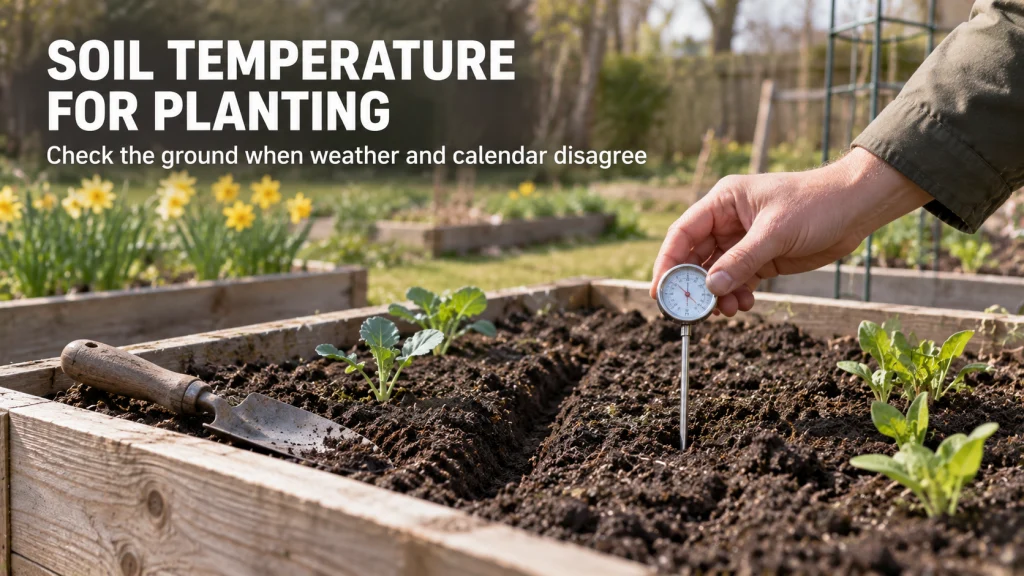
Soil temperature for planting is useful when the calendar, the forecast, and the ground are giving you different signals. Warm air can arrive while the root zone is still cool, so a planting decision should account for where a seed or transplant will actually meet the soil. The practical approach is to measure at a relevant depth, repeat the check under comparable conditions, and then compare the pattern with crop-specific guidance. Soil temperature refines a planting decision, but it does not replace frost risk, crop season, or local planting context.
Warm air can arrive before warm soil
The forecast can say 72 F while a garden bed still holds the feel of early spring a few inches below the surface. That mismatch is where soil temperature for planting becomes useful, because air temperature and soil temperature describe different parts of the planting environment. A run of mild weather may make outdoor work comfortable without warming the seed zone or transplant root zone to the same degree. When those signals disagree, I would check the ground before treating warm air as permission to plant.
Use the reading to resolve uncertainty after you have already considered the crop, the season, local frost context, and the broader planting window. It can show that the bed is lagging behind mild weather or that the ground has warmed more steadily than a cool morning suggests. That gives the thermometer a defined job instead of letting it become another calendar. The useful question is whether the measured layer fits the specific planting decision you are making.

The 5-inch stainless steel stem is made for checking temperature below the soil surface. Its analog dial uses color-coded tick marks to make changing soil conditions easy to read. This fits a bed check when warm air arrives before the soil at planting depth has caught up.
Check On AmazonIf you click this link and buy, we earn a commission at no additional cost to you.
Soil temperature and air temperature answer different planting questions
Air temperature tells you what stems, leaves, and exposed growing points are experiencing above the soil surface. Soil temperature tells you about the environment around a seed or the roots of a newly placed transplant, and that environment usually changes more slowly than the air above it. Sun exposure, recent cold, moisture, surface cover, bed construction, and soil condition can all influence how quickly a particular spot gains or loses heat. That is why a warm forecast by itself cannot describe what is happening at planting depth.
The distinction matters most when a gardener is tempted to use one pleasant weather signal as a shortcut for the whole site. A mild spell can push the air well ahead of the soil, especially where the bed has been wet, shaded, or slow to warm. The reverse can also happen when a protected or elevated growing area has accumulated warmth over several days. Treat the air reading as one condition and the soil reading as another, then ask which one is relevant to the part of the plant you are putting into the ground.

A wireless sensor sends outdoor conditions to the indoor display from up to 500 feet away. The LCD shows current indoor and outdoor temperature and humidity readings. This keeps the air-temperature signal separate from a soil probe when a gardener is comparing above-ground weather with conditions at planting depth.
Check On AmazonIf you click this link and buy, we earn a commission at no additional cost to you.
Frost context does not tell you the temperature at seed depth
A local last-frost estimate is useful for understanding the chance of freezing conditions, but it is not a soil thermometer. It does not tell you whether the upper soil layer is still cold, whether a wet bed has been slow to warm, or whether one part of the garden is behaving differently from another. That matters because a direct-sown seed responds to the conditions surrounding it, not to the date printed on a calendar. The soil check fills that missing piece without changing what the frost estimate is meant to tell you.
The common beginner mistake is to turn a frost milestone into a universal planting switch. That approach collapses several separate questions into one answer, even though cool-season crops, warm-season crops, direct-sown seeds, and transplants do not all use the same timing logic. A better sequence is to ask whether the crop belongs in the current seasonal window, whether damaging cold is still a concern, and whether the soil at the relevant depth supports the next step. Keeping those questions separate makes a marginal planting decision much easier to judge.

The 4-inch stainless steel stem measures soil temperature from 20 to 180 degrees Fahrenheit. Its analog dial marks minimum, maximum, and optimal ranges for seed germination and planting. The short probe suits a seed-zone check when a frost date cannot tell you what the soil is doing at planting depth.
Check On AmazonIf you click this link and buy, we earn a commission at no additional cost to you.
Measure where the seed or transplant will actually encounter the soil
A soil temperature reading is only useful if the probe is sampling the layer that matters to the planting decision. For direct sowing, check near the depth where the seed will sit rather than pushing the probe much deeper simply because the thermometer can reach there. For a transplant, the relevant zone is deeper because roots and the root ball occupy more of the soil profile. The goal is not laboratory precision, but a repeatable homeowner check that represents the environment the new planting will actually encounter.
Use the same spot and depth when comparing readings, and avoid changing the method halfway through the sequence. A reading at the surface cannot be compared cleanly with one taken several inches deeper, because those layers warm and cool at different rates. If you are choosing a soil thermometer or probe for this workflow, prioritize a probe that reaches the relevant seed and transplant zones, a scale or display you can read without disturbing the placement, and a simple form that makes repeated checks easy to perform the same way. Those practical traits matter more here than extra features, because consistency is the point and a consumer tool should not be presented as calibrated scientific instrumentation.

This analog soil thermometer has a five inch metal stem intended for checking ground temperature before seed sowing, transplanting, or other seasonal planting decisions. A dedicated soil probe can be more useful than relying on air temperature alone because soil warms and cools at a different rate. Insert the stem to the recommended depth and allow the reading to stabilize before recording it. The probe length differs from longer seven inch models, so confirm that it reaches your intended measurement depth.
Check On AmazonIf you click this link and buy, we earn a commission at no additional cost to you.
Use repeated readings instead of one warm number
Shallow soil can change noticeably as weather shifts, so one warm reading is weak evidence for a planting decision. Extension guidance commonly recommends looking at a short run of readings rather than letting a single spike stand in for the general condition of the bed. The practical value is consistency: use the same location, the same depth, and a similar part of the daily weather cycle each time. What you want to see is a pattern that is holding, not a number that appeared briefly because conditions were unusually favorable.
A small log keeps this from becoming guesswork, especially when the air has been swinging between warm and cool conditions. You do not need a complicated worksheet, and you do not need to average a long season of data before making a homeowner decision. Record three comparable checks, note whether the bed was unusually wet or exposed to a sharp weather change, and look for a stable direction. If the readings are still bouncing widely, the uncertainty itself is useful information and can justify waiting for a clearer pattern.
| Check | Use the same location | Use the same depth | Note site conditions | Record the reading |
|---|---|---|---|---|
| Reading 1 | Yes | Seed or transplant depth | Moisture, shade, recent weather shift | Write down the observed temperature |
| Reading 2 | Yes | Same as Reading 1 | Note any meaningful change | Compare with Reading 1 |
| Reading 3 | Yes | Same as Reading 1 | Note any meaningful change | Look for a stable pattern |
The table is most useful when it prevents method changes from masquerading as temperature changes. If Reading 2 comes from a sunnier bed or a different depth, the comparison becomes less meaningful even if the number itself looks precise. Keep the setup ordinary and repeatable so the trend reflects the planting area rather than your measurement technique. Then use the pattern as one input alongside crop and weather guidance.

Four wireless TDR sensors are included, and the display can support up to 12 soil zones. Each sensor reports soil moisture, temperature, and sunlight for repeatable garden checks. The multi-sensor layout suits repeated observations when a gardener wants a pattern across beds instead of relying on one warm reading.
Check On AmazonIf you click this link and buy, we earn a commission at no additional cost to you.
Compare direct-sown seed and transplant checks without mixing their depths
Direct-sown seed and a transplant do not occupy the same part of the soil, so their temperature checks should not be treated as interchangeable. A seed is placed in a relatively shallow zone where temperature can move more quickly with sun, wind, and surface moisture. A transplant brings a larger root mass into a deeper layer that may still be cooler even when the surface feels mild. The decision should follow the planting depth, not a single standard depth used for every job.
This also keeps you from misreading a warm surface as proof that the whole root zone is ready. If the upper layer has warmed but the deeper zone remains cool, a shallow sowing decision and a transplant decision may deserve different conclusions. Likewise, a deeper reading should not be used to dismiss a crop whose seed is intentionally sown near the surface and whose crop-specific guidance supports that timing. Keep the measurement tied to the actual planting method, then route germination technique or exact crop thresholds to more specific guidance.

The 12-inch stem is designed for soil temperature measurement as well as smaller compost bins. Its case and bezel use 304 stainless steel, with a glass lens and waterproof, dust-proof construction. The longer probe can be inserted only to the depth needed when shallow seed zones and deeper transplant zones must be checked separately.
Check On AmazonIf you click this link and buy, we earn a commission at no additional cost to you.
Let seasonal crop class set the first expectation
Before looking for an exact soil number, start with whether the crop is generally suited to cooler or warmer conditions. That classification sets the first expectation for planting timing and helps prevent a thermometer from becoming a false universal rule. A cool-season vegetable may belong in an earlier planting window than a heat-loving crop even when both beds show the same reading. Soil temperature refines that expectation, but it should not erase the biological differences among crops.
This is where broader garden planning guidance helps keep the decision in context. Climate, seasonal pattern, bed exposure, and crop sequence still matter before you ever check the probe. I would use the thermometer to answer a remaining question, not to rebuild the entire planting plan around one number. If the crop is clearly out of season for your area, a favorable soil reading by itself is not enough reason to force the planting.

This set contains 12 cool-season vegetable varieties, including beets, kale, cabbage, peas, and broccoli. The assortment is presented for autumn and winter planting and focuses on cold-hardy seasonal crops. It provides a concrete crop set for planning around seasonal class before a soil-temperature reading is treated as the main signal.
Check On AmazonIf you click this link and buy, we earn a commission at no additional cost to you.
Use the planting calendar and frost context as separate timing inputs
A planting calendar gives you a broad seasonal window, while frost information helps you judge exposure to damaging cold. Soil temperature adds site-level evidence from the bed itself. Instead of asking which signal should win, check whether they agree and pay attention when one exposes a specific mismatch. A reasonable calendar window paired with persistently cool planting depth is a different situation from a warm bed facing an immediate cold risk.
For a new gardener, the broader framework in starting a garden from scratch can help place timing beside site selection, sunlight, soil, and water rather than treating planting as a calendar-only task. Once that framework is set, soil temperature is most useful when the date looks reasonable but the ground still seems behind, or when warm weather makes the calendar feel more advanced than it really is. The measurement should narrow uncertainty, not create another rigid schedule. Keep the final decision tied to the crop and the conditions in the actual bed.

This five-year hardcover garden journal combines a planting calendar with plant logs. It includes space to track planting schedules, germination, growth milestones, harvest dates, and plant-specific notes. That structure fits a workflow where calendar timing, frost context, and bed observations remain separate inputs.
Check On AmazonIf you click this link and buy, we earn a commission at no additional cost to you.
Check crop-specific guidance before using an exact threshold
There is no single soil temperature that means every vegetable is ready to plant. Different crops germinate and establish across different temperature ranges, and the number labeled optimum for germination is not automatically a universal outdoor planting threshold. Some tables describe minimum germination conditions, some describe optimal germination, and others are written for a particular region or production system. Read what the number actually represents before applying it to a home garden.
For an exact crop decision, use guidance that names the crop and matches the planting method you are considering. Regional Extension resources, crop-specific planting information, and reliable seed guidance can help you distinguish a minimum, an optimum, and a practical outdoor planting range. Avoid borrowing a field-crop threshold and treating it as a rule for unrelated vegetables just because the units look familiar. The soil thermometer gives you the site measurement; crop-specific horticultural guidance tells you what that measurement means.

This vegetable gardening handbook organizes tasks into weekly to-do lists and builds a personalized schedule around the local last-frost date. It covers timing for starting seeds, transplanting, and harvesting across the season. That makes it useful when a soil reading needs to be interpreted alongside crop-specific timing instead of used as a universal threshold.
Check On AmazonIf you click this link and buy, we earn a commission at no additional cost to you.
Do not use soil temperature to ignore an immediate freeze risk
Warm soil does not protect tender top growth from freezing air. A bed can hold enough warmth to support root activity while exposed leaves, stems, or growing points remain vulnerable to a cold event above ground. That is why a favorable soil reading should never be read as a cancellation of short-term weather risk. Check the forecast and the crop’s cold tolerance separately before planting or setting out tender transplants.
This separation is especially important after a mild spell, when the ground may have accumulated warmth but the weather pattern is still unstable. If a crop would be damaged by the cold that is expected next, a favorable reading below ground does not remove that exposure. Conversely, a cool reading does not automatically keep every cool-season crop out of the garden when crop-specific guidance supports planting under those conditions. Treat the measurement as evidence about the root or seed zone and keep above-ground cold risk as its own check.
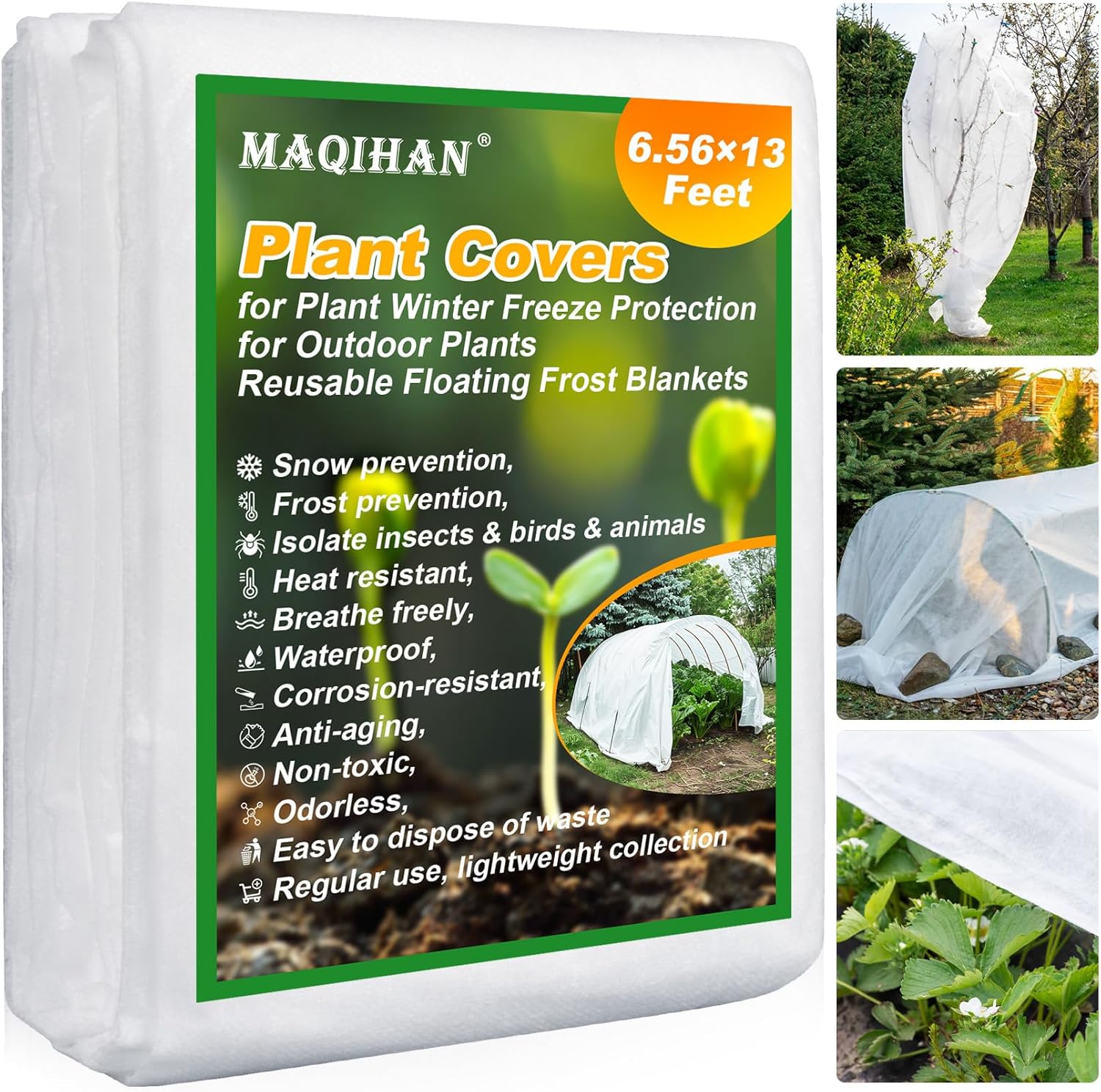
This 6.5-by-13-foot nonwoven plant cover is designed for frost, cold, and wind protection in outdoor gardens. The fabric can be laid loosely over plants or supported with hoops or frames. It addresses above-ground freeze exposure separately from the question of whether the soil below is warm enough for planting.
Check On AmazonIf you click this link and buy, we earn a commission at no additional cost to you.
Final Thoughts: check the ground when the calendar and weather disagree
Soil temperature is most useful when the usual timing signals do not line up cleanly. Measure at the depth that matches the planting method, repeat the check consistently, and look for a stable pattern rather than chasing one favorable reading. Then compare that pattern with crop-specific guidance, seasonal fit, and current cold risk. The goal is not to find one magic number, but to make a planting decision that matches what the crop will actually encounter in the bed.
If the calendar says go but the bed remains cool, the extra check can support waiting without turning delay into a rigid rule. If the readings are steady and the crop fits the season, move on to the remaining weather and crop-specific checks rather than searching for a more impressive number. A useful thermometer makes that workflow easier because it can reach the needed depth and be read consistently from one check to the next. The decision is complete when the measurement answers the question you actually had, not when the tool produces a perfect-looking number.

The digital tester combines soil temperature with moisture, pH, EC, TDS, fertility, and sunlight readings on an LCD. Its probe-based design gives the temperature check a defined place within a broader soil assessment. That makes it useful at the end of a planting workflow where ground conditions, crop timing, and freeze risk are still treated as separate inputs.
Check On AmazonIf you click this link and buy, we earn a commission at no additional cost to you.
FAQs
🌡️ How do I check soil temperature before planting?
Insert a soil thermometer at the depth relevant to the seed or transplant, then use the same location and depth for repeated checks. Compare the pattern with guidance for the crop you plan to grow rather than using one universal threshold.
🌱 Is soil temperature more important than the planting calendar?
They answer different questions. The calendar gives a broad seasonal window, while soil temperature shows what is happening in the bed, so use both along with frost risk and crop type.
🥕 Should I measure at the same depth for seeds and transplants?
No. Measure near the zone the planting will actually occupy, because shallow seed zones and deeper transplant root zones can differ in temperature.
☀️ Can one warm reading mean the soil is ready?
One reading can reflect a temporary weather swing. Repeated checks made with the same method give a better picture of whether the bed is holding a stable planting condition.
❄️ Does warm soil mean a tender transplant is safe from frost?
No. Soil warmth and freezing air are separate risks, so a favorable soil reading does not protect exposed tender growth from a cold event.
References and Sources
- Wisconsin Horticulture: Supports repeated soil-temperature checks and measuring at different depths for seed and transplant decisions.
- Oregon State University Extension Service: Supports using soil temperature as a planting-timing signal and recognizing regional differences in how quickly soil warms.
- South Dakota State University Extension: Supports using a short multi-reading average because shallow soil temperatures can fluctuate substantially.