A wheelbarrow should be chosen around the route and the recurring load, not around the largest tray number on the label. Narrow gates, tight turns, side slopes, soft ground, unloading height, and storage space can all make a high-capacity hauler harder to use than a smaller one. Start by mapping where the load must travel, then choose the platform, wheel count, tray material, capacity, and tire that solve those conditions. The result is a hauling tool that is easier to control and more useful for ordinary home-garden work.
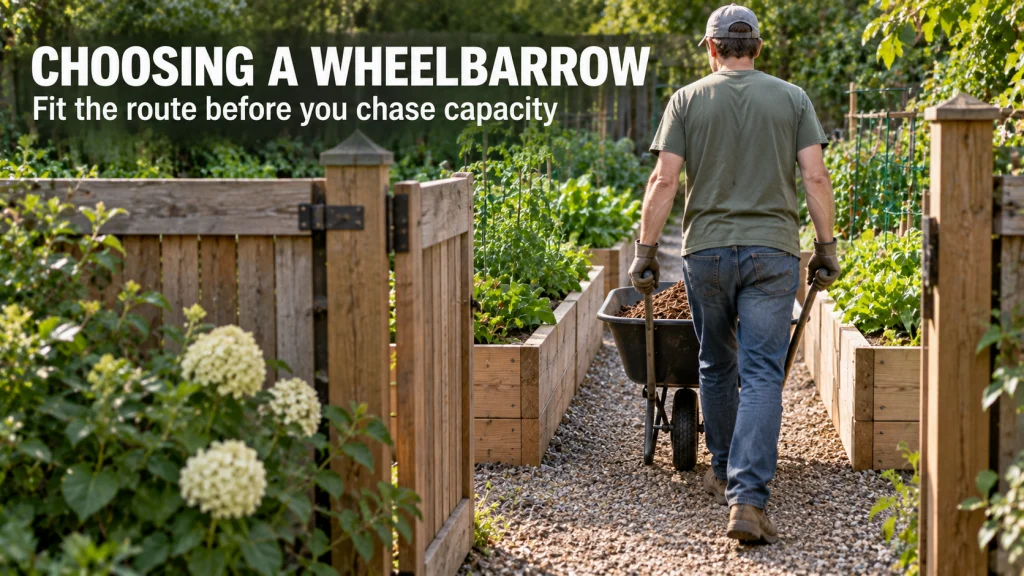
The same load changes when the route changes
Put the same pile of mulch in a wheelbarrow and the right choice can change three times before the load reaches the bed. A narrow gate favors compact handling, a side slope raises the value of lateral stability, and an open path gives a wider platform room to work as intended. The important point is not to memorize which format is best, but to notice that the route changes what “easy to haul” means. Tray volume only becomes useful after those handling demands are clear.
I would begin by thinking through where the load becomes hardest to control and how it must leave the tool at the destination. A wheelbarrow that feels fine while rolling straight can still become awkward when you need to pivot, stop on uneven ground, or tip material precisely into a bed. That makes route fit a handling question first and a measurement question second, which is where the next section becomes useful. If you are choosing several basic tools at once, the broader essential garden tools guide can help keep each purchase tied to a specific job rather than a feature list.

This garden wheelbarrow has a 3.7 cubic foot plastic bucket on a steel frame with a 330 pound weight capacity. Inflatable rubber wheels are designed for varied terrain. The tool tips upright for space saving storage between hauling jobs.
Check On AmazonIf you click this link and buy, we earn a commission at no additional cost to you.
Map gates, turns, and slopes before capacity
The first measurement is not the tray. Measure the narrowest clear opening on the route, then compare that with the assembled width of any hauler you are considering. Leave practical clearance for steering because a tool that technically fits while perfectly centered may still be frustrating when the gate is approached at an angle. Also notice whether handles, tires, or the tray overhang become the widest point.
Next, judge how much turning room the route provides and whether both sides of the tool can stay on firm ground. A single front wheel can track through a narrow strip, while two wheels need enough usable width for both tires at the same time. Side slopes deserve extra attention because the load naturally wants to move downhill as the tool crosses them. On a route with repeated tight corners or uneven edges, maneuverability can matter more than carrying one extra batch of material.
| Route check | What to measure or observe | What it changes |
|---|---|---|
| Narrowest opening | Clear width at gates, side yards, and between beds | Maximum practical assembled width |
| Tightest turn | Space available before and after the corner | How much turning radius you can tolerate |
| Cross-slope | Whether the route leans sideways under the load | How much lateral stability matters |
| Surface | Pavement, lawn, gravel, roots, soft soil, or mixed ground | Tire and wheel configuration |
| Unload point | Tip into a bed, lift bags out, or dump onto open ground | Tray shape, balance, and platform choice |
Use the route check as a rejection test before comparing capacities or materials. If a model cannot clear the narrowest point, make the required turn, or keep its wheels on usable ground, a larger tray will not rescue it. This simple order prevents a common buying mistake: choosing the impressive number first and discovering the physical fit problem later. It also gives you a clear reason to reject a model before smaller feature differences distract from the fit problem.

The SL2825 uses a 25 foot blade with an automatic self locking mechanism. A push button controls retraction, and the blade has a nylon coating for protection. Its ABS case uses a rubber overmold to help protect the tape during everyday measuring work.
Check On AmazonIf you click this link and buy, we earn a commission at no additional cost to you.
Choose a wheelbarrow or cart from balance and platform stability
A traditional wheelbarrow carries part of the load on its wheel while the user supports and steers the handles. That arrangement can be very useful when you need to pivot, place loose material precisely, or tip the tray into a bed. The trade-off is that the operator also controls side-to-side balance, especially with a dense or uneven load. The tool is not carrying the whole problem for you just because the tray is off the ground.
A garden cart shifts more of the load onto multiple wheels and a broader platform, which can feel steadier on an open route. That stability can suit bags, tools, flats of plants, or bulky material that you plan to remove rather than tip sharply from a narrow nose. The cost is usually more floor area, more turning room, and a different unloading motion. I would choose between the two by asking how the load must travel and leave the tool, not by assuming one format is automatically easier.
| Recurring job | Handling priority | Configuration direction |
|---|---|---|
| Loose mulch into a bed | Precise tipping and tight steering | Wheelbarrow-style tray may fit the job well |
| Bags and tools across an open yard | Platform stability and easy loading | Garden cart may reduce balancing work |
| Mixed route with narrow passages | Clearance and turning control | Favor the configuration that clears the route first |
| Bulky light debris | Useful volume without excessive empty weight | Compare tray shape and overall footprint |
The important distinction is where the user must actively stabilize the load. If a platform feels steady only when lightly loaded but awkward at the weight you normally move, it does not fit the job. Conversely, a wider cart that feels secure in an open yard may be a poor choice if it cannot pass the garden gate without repeated repositioning. Judge stability with the recurring load and route in mind rather than treating a wider base as an automatic upgrade.

This two wheel garden cart has a 4 cubic foot poly bed and a 300 pound hauling capacity. Its low center of gravity and two wheel layout are designed for balanced handling and maneuverability. The handle folds for compact storage, and the quick release dump mechanism supports easier unloading.
Check On AmazonIf you click this link and buy, we earn a commission at no additional cost to you.
Use wheel count to solve route and terrain
One wheel gives a wheelbarrow a narrow tracking point and lets the operator lean and steer around obstacles. That can be an advantage between beds, through tight openings, or when the dumping point requires a precise approach. The same design asks the user to manage balance, so a shifting load or a side slope can demand more control. It is a maneuverability choice with a stability trade-off, not a universal default.
Two front wheels widen the support base and reduce the amount of side-to-side balancing the operator must provide. That is useful on routes where there is enough width for both tires and where the tool can approach turns without binding against borders or bed edges. The wider stance can also make a sharp pivot more cumbersome than it would be with a single wheel. Before choosing two wheels for stability, confirm that the actual route gives those wheels room to work.
- Favor one wheel when the route is narrow, turning is frequent, and you can comfortably control the load.
- Favor two wheels when lateral stability matters more and the route is wide enough for both tires.
- Do not treat a side slope as a reason to overload a wider tool; the surface and load still affect control.
- Check the final dumping motion, because added stability during travel can change how easily the load tips out.
Wheel count should therefore answer a route problem you can name. If your main frustration is threading through tight beds, extra width may work against you. If your main frustration is keeping a top-heavy load upright on a broad path, a wider support base may be the feature that matters more. Match the wheels to the hardest part of the route, not to whichever configuration looks more substantial in a store.

This dual wheel wheelbarrow uses two 14 inch inflatable rubber wheels and a 5 cubic foot plastic bin. The powder coated steel frame supports a rated load of up to 330 pounds. A padded handlebar doubles as a stand, and the tool can be tipped upright for storage.
Check On AmazonIf you click this link and buy, we earn a commission at no additional cost to you.
Choose tray material from load and storage
Tray material matters because garden loads do not behave the same way. Mulch, compost, potting mix, plant debris, bags, stones, and sharp broken material place different demands on the tray. A lighter polymer tray can reduce empty tool weight and will not rust, which is useful when the recurring job is ordinary soil, mulch, leaves, or garden cleanup. A metal tray generally brings more weight but can be a better fit when abrasion and sharp material are regular parts of the load.
Storage changes the decision as well. Metal should not be treated as maintenance-free if it will routinely remain wet or exposed, while polymer should still be protected from unnecessary weathering and physical abuse. Compare where the tool will actually live, whether it needs to hang, stand on end, or fit beside other equipment, and whether the stored width is different from the working width. A durable tray that is too awkward to store can become its own household problem.
Key point: choose material after you know the recurring load and storage conditions. A tougher or lighter tray is useful only when that advantage matches what you actually move and how the tool is kept between jobs. If the tool spends most of its life carrying mulch and compost, low empty weight may matter more than extreme abrasion resistance. If sharp stone or rough debris is routine, durability may deserve more weight in the decision.
Do not use tray material as a substitute for checking the frame, fasteners, handles, and rated limits of the exact model. Two tools with trays made from the same general material can still differ in construction and allowable load. When those details affect the purchase, verify the current manufacturer specifications rather than inferring strength from appearance alone. The material name narrows the comparison, but the exact construction determines what that particular tool is designed to handle.

This True Temper wheelbarrow uses a seamless steel tray with a 6 cubic foot capacity. Steel handles with comfort grips sit above a heavy duty undercarriage. Its single flat free 4 by 8 inch tire does not require inflation.
Check On AmazonIf you click this link and buy, we earn a commission at no additional cost to you.
Size capacity from recurring batch weight and volume
Capacity is useful only after you separate bulky loads from dense ones. Leaves and dry mulch can fill a tray before they become especially heavy, while wet soil, stone, or bagged material can become difficult to control well before the tray looks full. That means cubic volume and practical load are not the same decision. The useful size is the one you can move repeatedly over your route without losing steering, braking, or dumping control.
I would estimate the batch you expect to haul most often rather than buying around the largest occasional project. If your normal job is moving a few bags, a compact load of compost, or cleanup debris from one side of the yard to the other, a huge tray may add width and empty weight without improving the routine. For a seasonal mulch delivery, making one extra trip can be a reasonable trade for easier turns during every other use. The right capacity should reduce work, not merely reduce the theoretical number of trips.
| Load pattern | What usually limits the batch | What to prioritize |
|---|---|---|
| Dry leaves and light mulch | Tray volume and containment | Useful volume without excessive overall width |
| Wet soil or compost | Controllable weight | Balance, frame rating, and tire support |
| Stones or sharp debris | Weight and abrasion | Tray durability and conservative loading |
| Bags, flats, and hand tools | Platform shape and load security | Stable base and easy loading or unloading |
Use the exact manufacturer’s load rating as a limit, not as a goal for every trip. A rated maximum does not tell you whether that amount is comfortable to steer through your narrowest turn or control on your slope. When the material is dense, reducing the batch is often the simplest way to make an otherwise suitable tool work better. Practical capacity is therefore the smaller of what the tool permits and what the route lets you control comfortably.

This Gorilla Carts dump cart has a 4 cubic foot poly bed and a 600 pound maximum load rating. The bed measures 36 by 20 inches and sits on a steel frame. A quick release dump mechanism supports unloading, while pneumatic tires are intended for yard and garden terrain.
Check On AmazonIf you click this link and buy, we earn a commission at no additional cost to you.
Treat tire construction as terrain plus maintenance
Pneumatic tires use air to provide cushioning, which can make rough ground, roots, gravel, and irregular lawn feel less abrupt under load. The trade-off is maintenance because air pressure must be checked and the tire can lose air or be punctured. A flat-free tire removes that part of the upkeep and can be attractive for a tool that sits unused for long stretches. The ride is usually firmer, so low maintenance is not the same thing as maximum cushioning.
The better tire is the one that matches both the surface and your tolerance for maintenance. If the route is rough and you are willing to maintain air pressure, pneumatic construction may make the trip feel more controlled. If thorns, sharp debris, infrequent use, or neglected inflation are the recurring problem, flat-free construction may remove a nuisance that matters more than ride softness. Always confirm the exact wheel and tire specification because replacement fit depends on the actual model rather than the generic label alone.
Also look beyond tire type to how the wheel meets the ground. A narrow hard tire can sink or chatter where a broader tire rolls more comfortably, and a small wheel can react more sharply to holes and roots than a larger one. Those effects are route-dependent, which is why the same tire advice does not fit a paved side yard and a soft garden path. Choose the wheel system as part of the whole route, not as an isolated feature.

This flat free wheel and tire assembly uses a 14.5 inch solid polyurethane foam tire with a 300 pound load capacity. It replaces listed 4.80/4.00-8, 3.50/2.50-8, and 4.00-6 tire sizes. The included adapter kit supports a 3/4 inch axle and hub lengths up to 6 inches when the measured fit matches.
Check On AmazonIf you click this link and buy, we earn a commission at no additional cost to you.
Final Thoughts: route, balance, and unloading matter before nominal hauling capacity
A useful hauling tool should clear the gate, make the turn, stay controllable on the surface, carry the recurring load, and unload where the material actually belongs. That sequence puts capacity in its proper place: important, but only after route and handling fit. A smaller wheelbarrow that moves cleanly through the whole yard can be more productive than a larger one that needs constant correction. The practical goal is fewer awkward trips, not the biggest tray.
Before buying, walk the route, measure the narrow points, identify the load you move most often, and decide how you prefer to unload it. Then compare wheel count, tray material, capacity, tire construction, stored footprint, and the exact manufacturer’s limits. If a feature does not solve a constraint you actually have, it should not drive the purchase. That keeps the decision grounded in the garden instead of the specification sheet.

The WG050 Aerocart combines wheelbarrow, hand cart, and dolly functions in an 8 in 1 design. Its two wheel layout and dual support legs are designed to improve balance during loading and steering. The all metal structure uses flat free tires and is rated to handle loads up to 300 pounds.
Check On AmazonIf you click this link and buy, we earn a commission at no additional cost to you.
Explore related hauling choices
Once the route and recurring load are clear, the next decision is usually a narrower comparison. Use the guides below to separate cart format, wheel count, tray material, size, and tire questions without trying to solve every trade-off at once. Each guide isolates one part of the hauling decision so the main route problem stays visible. Start with the factor that is actually limiting your current setup.
| Topic | What you’ll find |
|---|---|
| Choosing a garden cart | How cart layout, load support, route, and unloading shape the basic cart decision. |
| Cart or wheelbarrow | A direct comparison when you are deciding between the two hauling formats. |
| Two-wheel wheelbarrows | When added lateral stability helps and when extra width becomes a constraint. |
| Poly vs steel wheelbarrows | How tray weight, abrasion, corrosion, and storage change the material choice. |
| Garden cart vs wagon | How pulling, platform shape, steering, and unloading differ between these formats. |
| Choosing wheelbarrow size | How to match usable capacity to recurring loads instead of buying by volume alone. |
| Wheelbarrow tire types | How pneumatic and flat-free choices change ride, upkeep, and terrain fit. |
Start with the comparison that matches the constraint you found on your route. That keeps each follow-up decision specific and prevents one feature from dominating a tool choice it does not actually control. If width is the problem, solve width before tray material. If stability is the problem, solve the wheel and platform question before worrying about nominal capacity.

This CAMMOO garden dump cart has a 4 cubic foot polypropylene body and a 600 pound capacity. Its 10 inch no flat tires use deep tread and steel bearings for rolling support across common yard surfaces. A front handle frame allows the cart body to tilt for dumping.
Check On AmazonIf you click this link and buy, we earn a commission at no additional cost to you.
FAQs
🛞 Is one wheel or two wheels better for a wheelbarrow?
One wheel is easier to pivot through narrow routes, while two wheels provide a wider support base and require less side-to-side balancing. Choose from the actual path width, turns, terrain, and the loads you normally move.
🌿 What size wheelbarrow is useful for a home garden?
The useful size is the largest recurring batch you can still steer and unload comfortably on your route. Compare tray volume with the exact load rating, assembled width, empty weight, and your typical material instead of choosing by cubic capacity alone.
🪨 Is a steel or poly tray better for garden work?
Poly is lighter and does not rust, while steel can be a stronger fit for frequent abrasive or sharp loads. Storage, empty tool weight, and the exact model construction should decide which advantage matters more.
🌬️ Should I choose a pneumatic or flat-free tire?
Pneumatic tires add cushioning on rough surfaces but require air maintenance and can puncture. Flat-free tires remove inflation and puncture concerns but generally give a firmer ride, so choose from terrain and the maintenance you are willing to do.
🚪 How much clearance should a wheelbarrow have at a gate?
Do not plan around a zero-clearance fit. Measure the actual opening and compare it with the tool’s widest assembled point, then leave enough room to approach slightly off-center and steer without rubbing the gate or fence.
📦 Is a garden cart easier to use than a wheelbarrow?
A cart can reduce balancing work because more of the load rests on multiple wheels, especially on open routes. A wheelbarrow may still be easier where tight steering, precise tipping, or narrow access matters more than platform stability.
References and Sources
- UC Marin Master Gardeners essential tools: Confirms common garden hauling uses for wheelbarrows, carts, bags, and tubs.
- Penn State Extension garden ergonomics guidance: Supports planning a clear route, testing loads, and using wheelbarrows or carts to move heavy garden materials.
- True Value wheelbarrow and garden cart comparison: Supports practical distinctions in maneuverability, stability, storage, wheel configuration, and tire maintenance.