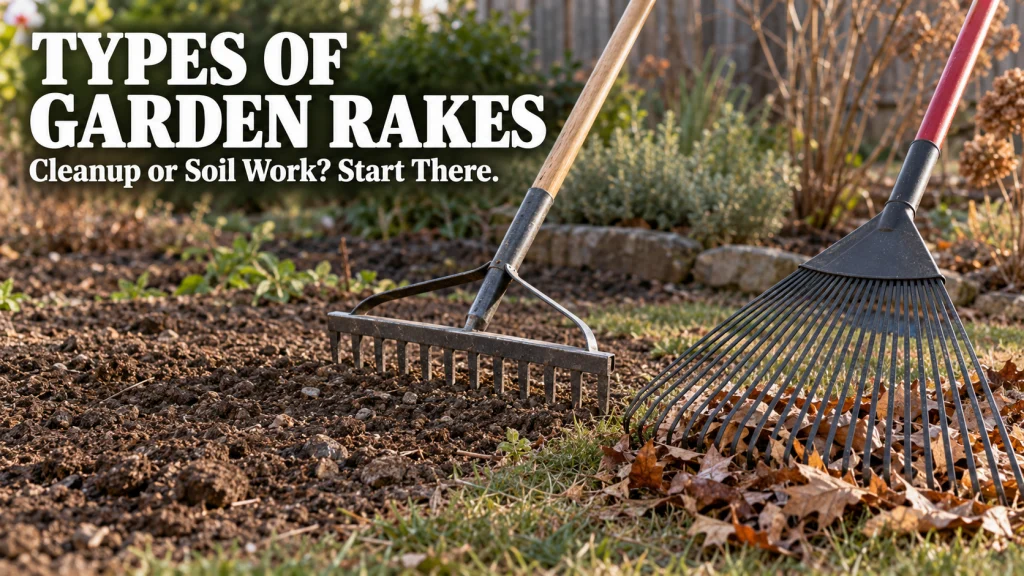
The useful way to sort garden rakes is by what the head must do against the surface. Flexible heads are better suited to gathering light debris without aggressively digging into the ground, while rigid heads are built to move, level, or break up loose soil and heavier material. Head width, access, tine material, handle fit, and storage matter after that first job split is clear. Choosing by function first keeps a simple cleanup task from turning into unnecessary ground disturbance, and it keeps a soil-working job from becoming a frustrating exercise with a rake that bends away from the work.
Start with what the rake has to do
The easiest way to understand the types of garden rakes is to picture two ordinary jobs a few minutes apart. First, you pull dry leaves across mulch and around established plants without wanting to scrape deeply into the bed. Then you move to a rough seedbed where clods, shallow stones, and uneven soil need a firmer pull before the surface can be leveled. The word rake stays the same, but the useful tine behavior changes almost completely. One job rewards flex and a light sweeping action, while the other needs rigidity and enough resistance to move material that pushes back.
That distinction should come before brand, handle material, tine count, or a wide head that looks efficient on a store wall. A rake that is excellent at gathering leaves can be a poor choice for leveling soil because its tines deflect instead of transmitting force into the surface. A rigid garden rake can do the opposite problem, catching too aggressively around soft growth or disturbing mulch and soil when the real goal is only cleanup. If you are building a basic tool kit, the same job-first approach is useful across essential garden tools for routine home garden work. Start with the surface and the task, then decide how much width, stiffness, reach, and durability the job actually requires.

This rigid bow rake has 17 steel tines and a dual-sided metal head for loosening soil, moving mulch, and gathering yard debris. Its adjustable handle extends to 68 inches for full-size garden work. It fits this section because the rake is built for resistant material rather than light surface sweeping.
Check On AmazonIf you click this link and buy, we earn a commission at no additional cost to you.
Split flexible cleanup heads from rigid soil-working heads
Flexible leaf-style rakes are meant to move loose, lightweight material at or above the soil surface. Their long tines can flex around small irregularities, stems, edging, and other fixed objects rather than digging hard into everything they touch. That makes them a natural fit for dry leaves, light clippings, and loose debris on lawns or established beds where preserving the surface matters more than pulling force. Flex is not a weakness in that setting, because giving slightly is what lets the head sweep instead of gouge. The limit appears when the material becomes dense, embedded, or resistant enough that the tines simply bend away from the job.
Rigid soil-working rakes reverse that behavior. A bow rake or similar stiff garden rake uses short, stout tines and a solid head to pull through loose soil, move small stones, break modest clods, and level a prepared bed. That rigidity is useful because the head transfers your pull into the material instead of flowing around it. It also means the tool can be too aggressive for delicate cleanup around plants, shallow roots, or a finished mulch layer. The practical choice is not which family is better, but whether you are collecting material resting on a surface or reshaping material that forms the surface.
| Garden situation | Head behavior that fits | Rake family to consider first |
|---|---|---|
| Dry leaves scattered over lawn or mulch | Flexes and sweeps around small obstacles | Leaf or lawn rake |
| Loose debris between established plants | Flexible and narrow enough to enter tight spaces | Hand rake or narrow cleanup rake |
| Rough soil that needs leveling | Rigid enough to pull and redistribute soil | Bow or garden rake |
| Small stones mixed through prepared soil | Stiff enough to move resistant material | Rigid garden rake |
| Large open area with loose soil or gravel to spread | Rigid head with enough working width for the area | Landscape-style rake when scale justifies it |
The table is a starting point, not permission to force one rake through every nearby task. Soil moisture, plant spacing, edging, stones, roots, and the amount of material can change how a rake behaves in a real yard. If a flexible head is folding backward without moving the material, the job is probably asking for more rigidity. If a rigid head is snagging plants, tearing at turf, or shifting soil you wanted to leave alone, the problem may be too much aggression rather than too little effort.

This metal leaf rake has an expandable head that adjusts from 8 to 17 inches for changing cleanup width. Its long-handle design is intended for gathering leaves on lawns and around garden areas. The adjustable head makes it especially relevant when access and working width matter within the cleanup-rake family.
Check On AmazonIf you click this link and buy, we earn a commission at no additional cost to you.
Choose full-size rakes from area and material
Once the rake family is right, working width becomes a practical question about area, obstacles, and how much material must move in each pass. A broader cleanup head can collect light leaves efficiently across open lawn, but that advantage shrinks near shrubs, bed corners, narrow paths, fences, and closely spaced ornamentals. A full-size rigid rake also benefits from usable width on an open bed, yet a broad head can become awkward when the soil area is divided by irrigation parts, plant crowns, edging, or supports. Wider is useful only when the whole head can reach the work without creating extra cleanup around the edges. A smaller effective pass is often faster than repeatedly snagging a head that is too wide for the site.
Material resistance matters just as much as square footage. Dry leaves, pine needles, light twigs, loosened soil, damp soil, gravel, and stones do not ask the same thing from the tines or from your hands. Before choosing a full-size rake, look at what must move and whether the surface underneath should remain mostly undisturbed. Then check whether the route to the work includes gates, steps, raised-bed corners, stored pots, or a shed opening that makes a large head annoying to carry and store. A rake that matches the garden on paper can still be the wrong tool if it is cumbersome every time you need to reach the job.
- Use a broader flexible head where light debris is spread across open ground and obstacles are limited.
- Use a narrower cleanup head where plants, fences, or bed edges interrupt the stroke.
- Use a rigid full-size head when loose soil or small stones need deliberate pulling and leveling.
- Reduce head width when access matters more than the amount moved per pass.
- Check handle length against your posture and reach instead of assuming one standard length suits everyone.
Those checks also help prevent buying a second rake that duplicates the first one without solving a new problem. If most of your work is leaf cleanup on an open lawn, a second rigid rake does not make the cleanup head more capable, and a much wider version may add little if the yard is broken into small zones. If you prepare beds as well as clean them, owning one flexible rake and one rigid rake can make more sense because the tools solve genuinely different jobs. The useful question is whether the next rake changes what you can do comfortably and cleanly, not whether it adds another variation of the same head to the shed.

This poly leaf rake uses a 24-inch head for broad cleanup passes. Its 48-inch hardwood handle includes a cushion grip, matching the full-size layout discussed in the section. The clog-free head design keeps the tool focused on leaf and light-debris cleanup rather than rigid soil work.
Check On AmazonIf you click this link and buy, we earn a commission at no additional cost to you.
Use hand rakes where access is the problem
A hand rake is not merely a smaller full-size rake. Its real advantage is control in spaces where a long handle and broad head cannot approach from a useful angle. Between perennials, beneath low shrubs, along a tight bed edge, or inside a densely planted container area, a compact head can reach debris without sweeping across several plants at once. Flexible, fan-shaped hand-rake tines are especially useful when the goal is to gather light material while reducing the chance of rough contact with nearby growth. The trade-off is obvious: the small head covers less area, so it becomes inefficient when the job expands into open ground.
That makes hand rakes a good example of choosing around the constraint instead of the product category. If the problem is access, a smaller head solves something a full-size rake cannot solve simply by being lighter or more expensive. If the problem is moving a large amount of soil, however, downsizing the head increases the number of passes without adding useful force. Consider how often you actually work under shrubs, around close plantings, or in narrow beds before adding one to the tool rack. A hand rake earns its space when tight access is a recurring condition, not because every gardener needs a miniature version of every long-handled tool.

This narrow shrub rake has 11 metal tines across an 8.5-inch-wide head for reaching into tighter garden spaces. Its 78-inch handle provides long reach around shrubs and planted beds without the width of a full-size leaf rake. The compact head directly matches a section where access is the limiting factor.
Check On AmazonIf you click this link and buy, we earn a commission at no additional cost to you.
Treat wide landscape rakes as a scale decision
Wide rigid rakes can make sense when the work is spread across a broad, open area and the material can be moved in long, uninterrupted passes. They are commonly associated with spreading or grading loose material, and the wider head can reduce the number of passes when there is enough room to use it properly. That benefit depends on scale, because a wide head also asks for more clearance and can be harder to control around planting beds, corners, edging, and established plants. On a small residential bed, extra width can turn into more repositioning rather than more productivity. The right comparison is between working width and usable working space, not between a large tool and a small tool in isolation.
It is also worth separating wide manual rakes from specialized lawn renovation or powered equipment. Lawn dethatching and power raking involve different goals, different turf decisions, and more aggressive interaction with the surface than ordinary garden cleanup or bed preparation. A homeowner choosing a garden rake does not need to solve those tasks by default, and this rake guide does not treat them as interchangeable. For garden use, stay focused on whether you need to gather surface debris, work loose soil, or spread material across an area large enough to justify the head. If the wide rake does not clearly reduce effort in the space you actually have, a conventional rigid rake may be the simpler tool to store, maneuver, and use.

This KYLIN landscape rake has a 36-inch aluminum head with 36 tines and a 60-inch handle for broad manual passes. The toothed side gathers or loosens material, while the smooth side can help level soil. Its wide head makes it directly relevant to comparing working width with usable open space.
Check On AmazonIf you click this link and buy, we earn a commission at no additional cost to you.
Compare tine materials only after the rake family is correct
Once you have the right head style for the job, tine material becomes a useful second-stage comparison. On cleanup rakes, metal, plastic, and bamboo can change weight, spring, surface feel, weather exposure, and how easily the head slides through the debris you usually collect. Material alone does not tell you whether a rake will feel gentle or aggressive, because tine length, spacing, thickness, and head geometry still shape how it behaves. A light plastic head can be convenient for routine dry-leaf cleanup, while a springy metal head may suit someone who wants a narrower profile or a different feel around obstacles. Compare those traits within the kind of rake you already know you need rather than using material as the starting category.
Construction deserves the same practical treatment. Check how securely the head meets the handle, whether the working parts can stay straight under the expected load, and whether the tool is easy to hang or store without leaving the tines bent or exposed to unnecessary moisture. Weight can help a tool feel planted, but more weight is not automatically a durability upgrade, especially if it makes repeated cleanup tiring. Likewise, a lighter head is useful only if it still holds its shape and gives enough control for the intended task. Material and construction should refine comfort, maintenance, and service life after the job, access, and working width have already narrowed the field.

This Walensee bow rake uses a heat-treated manganese-steel head with 17 steel tines for rigid soil work. Its 63-inch handle is stainless steel, giving the tool a distinct material combination to compare. The construction fits this section because material is being evaluated after the rigid rake family has already been chosen.
Check On AmazonIf you click this link and buy, we earn a commission at no additional cost to you.
Final Thoughts: Separate cleanup from soil work before comparing features
Most rake confusion becomes simpler once the surface and the job come before the feature list. Decide whether you are mainly collecting loose debris, working resistant ground material, reaching into tight planting spaces, or covering a broad open area. Then use working width, handle fit, storage, tine material, and construction to narrow the options that actually fit that job. This order makes it easier to ignore differences that sound important in isolation but do not change how the rake will work in your garden.
In a small home garden, fewer well-matched tools are usually more useful than a wall of overlapping rake shapes. Look at the surface you work most often, the tightest place the head has to enter, and the heaviest material you reasonably expect to move. Add another rake only when it solves a repeated task your current tool handles poorly. The result is a simpler tool kit and a clearer reason for every rake taking up space in it.

This steel garden tool rack is designed to hold up to 35 rakes, brooms, and other long-handled tools. Its compact 17 by 12 by 29-inch footprint keeps multiple tools together in a shed or garage. The organizer fits the section's emphasis on storing a smaller, purposeful tool kit instead of accumulating overlapping rake types.
Check On AmazonIf you click this link and buy, we earn a commission at no additional cost to you.
Explore rake choices by task
Once the cleanup-versus-soil distinction is clear, the next useful step is to narrow the choice around the exact job you do most often. Some gardeners need a better leaf tool, others need a rigid rake for bed preparation, and some mainly need a compact head that can work between plants. The guides below separate those decisions so material, width, and construction are compared inside the right use case. That keeps a specialized feature from being mistaken for a reason to use the wrong rake family.
| Topic | What you’ll find |
|---|---|
| Garden rake vs leaf rake | A direct comparison of rigid soil-working behavior and flexible cleanup behavior. |
| Leaf rakes | How head shape, flex, width, and access affect routine leaf and light-debris cleanup. |
| Bow rakes | When a rigid bow-style head makes sense for leveling and moving loose soil or small stones. |
| Hand rakes | How compact heads help with cleanup in tight beds, around shrubs, and between established plants. |
| Landscape rake vs garden rake | How working width and area scale change the value of a wider rigid rake. |
| Metal leaf rakes | Where metal tine construction fits within flexible cleanup work and what trade-offs to compare. |
You do not need every rake in that list. Use the individual guides only where your garden creates a distinct recurring job, such as tight access, broad leaf cleanup, or repeated bed leveling. If two tools would solve the same problem in the same space, the simpler choice is usually to keep the one that already works. A new rake earns its place when it changes access, control, working width, or surface behavior in a way you will actually use.

This adjustable metal garden rake is 65 inches long with an 18-inch-wide head and 25 tines. Its leaf-rake format gives the routing section another concrete cleanup-rake example without duplicating the bow or landscape rake roles. The 18-inch working width also gives readers a straightforward comparison point against narrower and wider rake choices.
Check On AmazonIf you click this link and buy, we earn a commission at no additional cost to you.
FAQs
🍂 What is the difference between a garden rake and a leaf rake?
A leaf rake usually has long flexible tines that sweep light debris, while a garden or bow rake uses a rigid head and short stiff tines for soil and heavier material. Choose by whether you want to gather material from the surface or reshape the surface itself.
🌱 Can I use a leaf rake to level garden soil?
You can lightly move very loose material, but a flexible leaf rake is not designed to transmit much force into soil. For routine bed leveling or moving small clods and stones, a rigid garden or bow rake is usually the better fit.
🪴 What is a hand rake useful for?
A hand rake is useful when access is the limiting factor, such as between established plants, beneath shrubs, or along tight bed edges. Its small head gives control in spaces where a full-size rake would hit plants or surrounding structures.
🪨 When does a landscape rake make sense in a home garden?
A wide rigid rake makes the most sense when you have a broad open area and enough loose soil, gravel, or similar material to justify long passes. In small or interrupted beds, the extra width can reduce maneuverability instead of saving work.
🧰 Are metal tines always better than plastic tines?
No. Material should be compared after you know whether the job needs a flexible cleanup rake or a rigid soil-working rake. Metal, plastic, and bamboo can all serve cleanup roles, while rigid soil work generally depends more heavily on stiff metal construction.
References and Sources
- UC Marin Master Gardeners guide to choosing garden tools: Supports the distinction between flexible fan-shaped rakes for light debris and stiff garden rakes for heavier soil work, along with the role of compact hand rakes in tight spaces.
- Penn State Extension guide to choosing the right hand tool: Supports the functional difference between rigid bow rakes used for soil and rocks and flexible leaf rakes used for lightweight material around fixed objects.