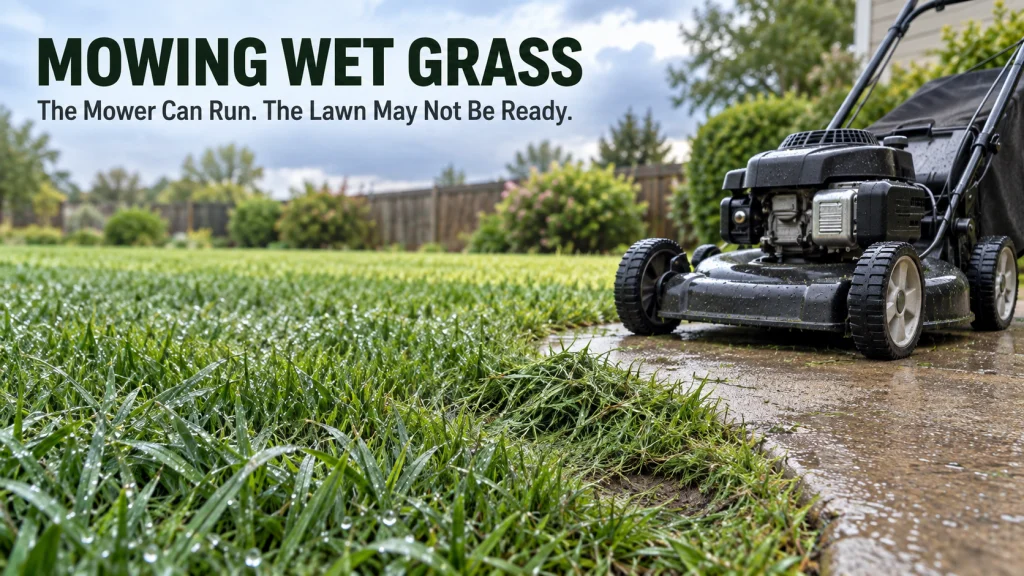
Mowing wet grass is usually a poor trade when the blades are wet enough to clump, the soil is soft enough to rut, or the surface is slick enough to reduce traction. The mower may run normally while the lawn itself is not ready for traffic or a clean cut. Instead of using a fixed waiting period after rain, check leaf wetness, soil firmness, clipping behavior, and footing. Once those conditions improve, resume at an appropriate mowing height rather than trying to compensate for the delay with a lower cut.
The machine starting does not make the lawn ready
Mowing wet grass can look like an equipment question because the first thing a homeowner notices is whether the mower will start and move through the yard. That is the wrong first test. A mower can operate while wet blades stick together, tires press into soft ground, and shoes lose grip on a damp slope. The practical decision is whether the turf and soil can handle the pass cleanly and safely.
Rain also creates several different conditions that can exist at the same time or separately. Leaf blades may still carry enough moisture to form heavy clipping clumps even when the soil underneath feels firm, while a lawn can look nearly dry on top but remain soft enough below the surface to show wheel marks. A shaded low spot may stay wetter than an open area only a few yards away. That is why mowing after rain is better judged by the lawn in front of you than by the fact that the rain has stopped.
| What you find | What it means | Practical response |
|---|---|---|
| Blades are wet, soil is firm | Clumping and an uneven cut are still likely | Wait for the leaf surface to dry further |
| Blades look drier, soil is soft | Wheel traffic can mark or compact the lawn | Delay until the soil firms up |
| Blades and soil are wet on a slope | Cut quality and footing are both poor | Do not mow until traction improves |
| Blades are dry enough to separate and soil is firm | The lawn is moving toward a normal mowing condition | Use the usual height and normal mowing judgment |
Before mowing, run a quick wet-lawn readiness checklist across the actual route rather than judging from the driest edge of the yard. Each check asks whether the lawn is likely to behave normally under traffic and cutting. A clear problem in any one category is enough reason to delay that area. The goal is not to prove that the lawn is perfectly dry, but to avoid conditions that predict a worse cut or avoidable damage.
- Leaf blades: Do the blades separate normally instead of sticking together in wet mats?
- Soil firmness: Can you walk the route without leaving deep footprints, surface movement, or obvious wheel marks?
- Traction: Do your shoes hold securely, especially on slopes, turns, and uneven ground?
- Clipping behavior: Does a small test pass disperse clippings instead of leaving heavy, sticky piles?
The useful distinction is not simply wet versus dry. It is whether moisture is changing the cut, the ground surface, or your footing enough to create a worse result. If any one of those conditions is still clearly unfavorable, waiting is usually the lower-burden choice. A short delay is easier to correct than ruts, flattened turf, or a lawn covered in wet clumps.

The AcuRite 00850A3 rain gauge measures up to 5 inches of rainfall with magnified white inch markings. Its weather-resistant acrylic body can be mounted by the integrated hang hole or staked into the ground. It records how much rain fell, while actual mowing readiness still depends on the blade, soil, and traction checks described in this section.
Check On AmazonIf you click this link and buy, we earn a commission at no additional cost to you.
Check whether the blades are wet enough to clump
Wet leaf blades do not move through a mower the same way dry blades do. Moist clippings can stick together and collect in heavier masses instead of dispersing through the turf, and mulching performance is especially sensitive to wet conditions. The result can be an uneven surface with visible piles even when the mower completed the entire route. Those piles are a lawn condition to correct, not proof that the mower needs to be run over the same wet area again.
A quick pre-mow check is more useful than guessing from the weather. Walk through several parts of the lawn, brush your hand across the grass, and look for blades that are sticking together or leaving obvious moisture on your shoes. Pay attention to shaded areas, dense turf, and low spots because they may lag behind the rest of the yard. If the grass is still matting into wet bunches before mowing, it is reasonable to expect the clippings to behave the same way after cutting.
- Check more than one area instead of judging from the driest edge near pavement.
- Look for blades that separate normally rather than lying in wet mats.
- Consider whether dense or shaded sections are still holding moisture.
- Delay if a test area immediately leaves heavy, sticky clipping piles.
This is also where the difference between cutting wet grass and cutting slightly damp grass becomes practical rather than semantic. A faint trace of moisture is less important than whether the leaf mass is behaving badly under the mower. If the first pass produces dense clumps, stop using the whole lawn as the test strip. Let conditions improve before turning a small quality problem into cleanup across the entire yard.

The True Temper 2914912 uses a 24-inch poly rake head designed to reduce leaf clogging. Its 48-inch hardwood handle includes a cushioned grip for routine yard cleanup. After a wet test pass leaves clumped material on the turf, this rake can help with targeted cleanup once conditions are dry enough to handle the clippings.
Check On AmazonIf you click this link and buy, we earn a commission at no additional cost to you.
Check whether the soil is soft enough to rut or compact
Leaf wetness is only the visible part of the decision. Wet soil is more vulnerable to compaction from traffic, and a mower adds repeated wheel pressure across the same root zone you are trying to maintain. If your steps leave deep impressions, the surface shifts underfoot, or mower tires begin marking the lawn, the ground is telling you that it is not ready. Continuing because the grass itself looks dry can trade one missed mowing for a longer soil and surface problem.
Soil texture, drainage, slope, thatch, shade, and rainfall pattern all affect how quickly a lawn firms up. A free-draining area may recover sooner than a low clay section that still feels spongy, so one property can have several readiness levels at once. Do not use the sidewalk edge as the only test point because it may dry faster than the center or lower portions of the lawn. Walk the actual mowing route and give the softest areas enough weight in the decision.
If only a small zone remains soft, there is no requirement to force the entire mowing pattern through it. Leave that patch for a later pass rather than making tight turns or repeated tracks over saturated soil. Home lawn care is easier when the task follows site conditions instead of a rigid schedule. For the broader relationship between mowing, watering, compaction, seasonal growth, and routine care, see the site’s guide to home lawn maintenance.

The XLUX meter gives an immediate soil-moisture reading on a 10-level Dry-Moist-Wet dial without batteries. Its slim single probe is designed for soil and can be used in gardens and lawns to compare moisture conditions. It measures moisture rather than soil firmness, so lawn readiness still requires the separate underfoot checks described in this section.
Check On AmazonIf you click this link and buy, we earn a commission at no additional cost to you.
Delay if traction or slope becomes unsafe
A wet lawn can become a safety issue before it becomes a turf-quality issue. University of Minnesota Extension advises delaying mowing when grass is wet and notes that footing is better on dry grass. That matters most where the route includes a slope, uneven ground, a ditch edge, or any place where a slip would put the operator in a poor position around powered equipment. A schedule is never a good reason to accept worse footing.
Do not treat a wet slope as a place to experiment with whether the mower can still climb, turn, or hold its line. If shoes slide, the surface feels slick, or the mower does not track predictably, stop and wait for better conditions. The exact safe operating limits also depend on the mower design, so the owner’s manual remains the authority for machine-specific precautions. This article stays with the homeowner lawn decision and does not replace equipment safety instructions.
The same caution applies after storms when the mowing path may contain more than water. Branches, stones, washed debris, or hidden objects can create separate hazards before the grass is even considered. Clear and inspect the route first, and use the broader yard cleanup after a storm guidance when the property needs debris triage before ordinary lawn work resumes. Mowing should be the next task only after the route itself is safe to use.

DEWALT DPG54-1C safety glasses use a clear polycarbonate lens and meet ANSI Z87.1+ high-impact requirements. The frame weighs under 1 ounce and uses flexible rubber temples for stability during outdoor work. They add basic eye protection to mowing preparation, while safe footing on wet slopes still requires the separate traction judgment described in this section.
Check On AmazonIf you click this link and buy, we earn a commission at no additional cost to you.
Wait for a cleaner cutting window instead of mowing lower later
One common response to a rain delay is to let the lawn grow, then lower the mower to make up for the missed cut. That solves the calendar problem by creating a plant-stress problem. Extension mowing guidance commonly uses the one-third principle, meaning a normal mowing should avoid removing more than about one-third of the leaf blade at one time. If the grass has grown beyond that point, the better adjustment is usually to mow higher first rather than scalp it back to the preferred height in one pass.
The target height itself depends on the dominant turfgrass and growing conditions. Cool-season and warm-season grasses do not all share the same mowing range, and heat, drought, shade, or slow growth can change how aggressively the lawn should be cut. That is why a wet-weather delay should not become an excuse to choose a universal low setting. Once the lawn is ready, use the appropriate height for the grass you actually have and return gradually if growth has gotten ahead of the normal schedule.
This approach also avoids turning a weather delay into an unnecessary mowing cycle. If the turf is only slightly above its normal trigger height, there is no benefit in repeatedly cutting simply because the lawn missed a preferred day. Let growth rate, turf type, and current condition set the cadence. The broader lawn mowing guidance covers height, frequency, and routine mowing decisions beyond this wet-lawn question.

This Westcott ruler is 12 inches long and includes both imperial and metric scales. The imperial scale is marked in 1/16-inch increments, making it practical for checking turf height before and after mowing. Its clear shatterproof plastic body bends without breaking during ordinary measurement and storage.
Check On AmazonIf you click this link and buy, we earn a commission at no additional cost to you.
Break up or redistribute heavy clumps if a wet cut already happened
If you already mowed while the lawn was wet, the most visible problem may be piles or ropes of clippings sitting on top of the turf. Grass clippings normally decompose quickly and can be left in place when mowing conditions and cutting frequency allow them to disperse well. Wet or excessively long clippings are different because they can mat together and cover the grass beneath them. Large clumps are worth dealing with rather than leaving them as dense blankets.
Wait until the clumps are easier to handle, then break them apart or redistribute them so they are not sitting in heavy masses. Penn State Extension notes that clumps left after prolonged wet weather can be removed after drying to make dispersal easier. The goal is not to strip every clipping from the lawn, since normal fine clippings are useful and do not need routine collection. Focus on the abnormal piles that are thick enough to smother the surface or leave obvious patches.
Do not immediately remow the entire wet lawn just to chop those clumps smaller. That adds more traffic to soft soil and may create another layer of wet material without fixing the original condition. A rake or other simple cleanup method can be enough once the clippings have dried, depending on the size of the affected area. The practical repair is targeted cleanup, followed by better timing on the next cut.

The Corona RK 45030 BigLOAD rake has a 30-inch poly head for gathering lawn debris. Its 60-inch aluminum handle includes an anti-slip vinyl grip, while 18-inch teeth provide reach across the turf surface. It fits the targeted cleanup in this section after wet clipping clumps have dried enough to rake apart or redistribute.
Check On AmazonIf you click this link and buy, we earn a commission at no additional cost to you.
Return to normal height once conditions dry
When the blades separate normally, the ground feels firm, and traction is reliable, the lawn can return to its usual mowing routine. Do not keep treating the grass as a special wet-weather case after the conditions that caused the delay are gone. Use the mowing height appropriate for the turfgrass, avoid removing too much leaf tissue at once, and let normal growth determine the next cut. That restores a predictable routine without overcorrecting for a few missed opportunities.
Seasonal growth still matters after the lawn dries. Cool-season turf can grow rapidly during favorable spring or fall conditions, while warm-season turf has a different active-growth pattern, so the same number of days between mowings will not work everywhere. If the lawn is growing quickly, inspect it more often rather than automatically cutting it shorter. For the larger seasonal picture, the site’s spring lawn care guidance can help connect mowing with the other tasks competing for attention during active growth.
The important point is that wet-weather decisions should be reversible. Waiting does not require a new permanent mowing height, a new schedule, or a more aggressive cut. It simply postpones traffic until the turf and soil can handle it better. Once that condition clears, return to ordinary mowing judgment.

The Westcott 10561 is a clear 6-inch acrylic ruler with both 1/16-inch and metric markings. Its transparent body and compact measuring length make it easy to place close to the turf surface when checking grass height. It provides a simple reference for returning to the normal mowing height after wet conditions have cleared.
Check On AmazonIf you click this link and buy, we earn a commission at no additional cost to you.
Keep mower cleaning and corrosion care separate from the lawn decision
Wet clippings can stick to mower surfaces, but equipment cleaning is a separate maintenance task from deciding whether the turf should be cut. Do not keep mowing a wet yard because you assume cleanup is the only downside. The lawn can still clump, rut, and become harder to cross safely even if the mower itself is capable of operating. Judge the lawn first, then deal with the machine according to its own maintenance requirements.
After use, follow the mower manufacturer’s instructions for cleaning, inspection, storage, and any steps involving the deck or blade area. Different mower designs have different procedures, and powered equipment should not be serviced by improvising around moving parts or safety controls. This article does not give internal repair instructions or model-specific maintenance steps because those belong to the equipment side of the job. The useful boundary is simple: wet-lawn readiness is a turf decision, while cleaning and corrosion prevention should follow the exact mower manual.

The MoJack deck scraper uses a 10.25-inch by 2-inch curved stainless-steel blade to remove compacted grass, dirt, and debris from mower decks. Its curved profile improves knuckle clearance while maintaining deck contact during scraping. The molded rubber non-slip grip adds control for manual cleanup performed only in the manner allowed by the mower manufacturer.
Check On AmazonIf you click this link and buy, we earn a commission at no additional cost to you.
Final Thoughts: let the lawn tell you when it is ready
Weather delays do not need a catch-up strategy. If mowing now would leave a worse lawn than mowing later, the better decision is to wait. That keeps a temporary rain event from turning into extra cleanup or surface damage. The missed day matters less than how the turf responds to the next pass.
Once the lawn behaves normally underfoot and through the mower, return to the usual height for your turfgrass. Avoid compensating with a lower cut, and address only the heavy clumps that still need cleanup. Keep equipment maintenance tied to the instructions for the exact mower you use. Then let normal growth, rather than the missed mowing day, determine what happens next.

Each 3-by-5-inch Rite in the Rain notebook contains 100 pages of all-weather paper with a durable Wire-O binding. The paper is designed to resist water, sweat, grease, and mud, and can be written on wet with a standard No. 2 pencil or an all-weather pen. It gives homeowners a weather-resistant place to record rain, mowing dates, and the lawn conditions that guided each decision.
Check On AmazonIf you click this link and buy, we earn a commission at no additional cost to you.
FAQs
🌧️ Can I mow the lawn right after rain stops?
Usually, wait until the blades are no longer clumping, the soil feels firm underfoot, and your footing is reliable. The rain stopping only tells you that no more water is falling, not that the turf and soil are ready for mower traffic.
💧 Is morning dew enough reason to delay mowing?
Judge what the moisture is doing rather than the label you give it. If the blades are sticking together, producing wet clumps, or making footing slick, wait; if the turf is separating normally and the ground is firm, the situation is closer to ordinary mowing.
👣 How can I tell whether the soil is too wet to mow?
Walk the actual mowing route and look for deep footprints, surface movement, sponginess, or wheel marks in a small test area. Soft low spots and shaded sections deserve extra attention because they can stay wet after other areas have firmed up.
🍃 Should I remove wet grass clumps after mowing?
Remove or redistribute the heavy, matted clumps that sit in dense piles over the turf. Normal fine clippings can remain on the lawn, so the goal is targeted cleanup rather than collecting every clipping.
📏 Should I mow lower if rain made me miss a cut?
No. If the grass has become too tall for the normal cut, use a higher setting first so you do not remove too much leaf tissue at once, then return toward the normal height as conditions and growth allow.
⛰️ Is mowing wet grass on a slope different from mowing a flat lawn?
Yes. Wet grass can reduce footing, so a slope adds a safety concern beyond clipping quality or rutting. Delay mowing if the surface is slick or the mower cannot be controlled predictably, and follow the exact safety instructions in the mower manual.
References and Sources
- University of Maryland Extension lawn maintenance guidance: Supports wet-soil compaction guidance, mowing only when the lawn is dry, appropriate mowing height, and the one-third mowing principle.
- Alabama Cooperative Extension home lawn maintenance: Supports turfgrass-specific mowing height and the role of mowing in routine home lawn maintenance.
- University of Minnesota Extension mowing safety guidance: Supports delaying mowing on wet grass because dry turf provides better footing and is less likely to plug a mower.
- Penn State Extension grass clipping guidance: Supports handling heavy clipping clumps after wet weather and leaving normal clippings when mowing conditions allow even distribution.