Lawn mowing height is not one universal number. The right finished height depends first on the turfgrass species, then on local growing conditions, active growth, and whether the lawn is under heat, drought, shade, or renovation stress. Use a land-grant or Extension range for the grass you actually have, measure the grass after mowing instead of trusting an unlabeled deck notch, and avoid making a large height change in one pass. That approach keeps the decision tied to turf biology rather than to how short the lawn happens to look after mowing.
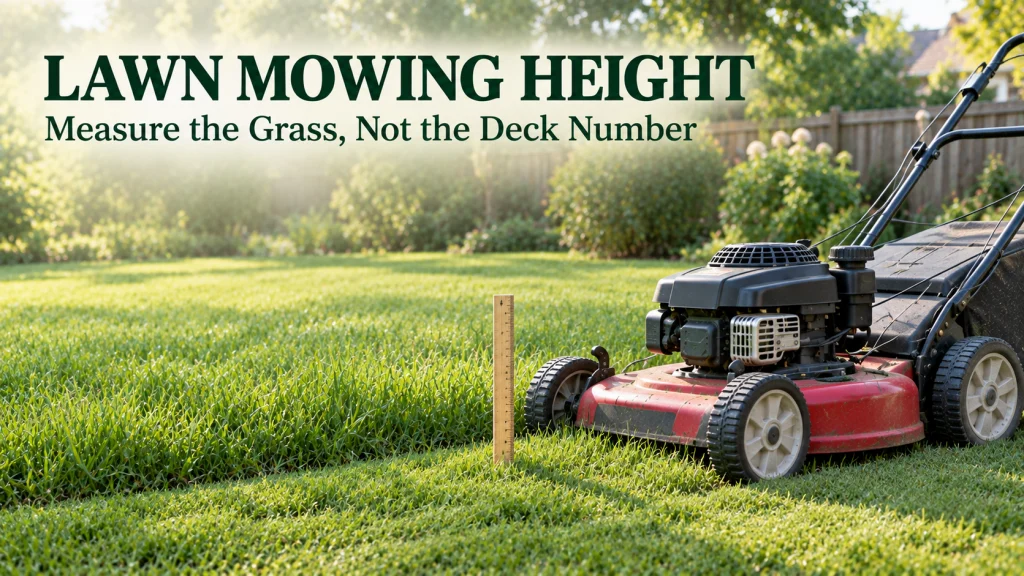
A mower setting means little until you know the grass
Lawn mowing height becomes useful only after the turf is identified. One mower notch can leave bermudagrass within a normal home-lawn range while cutting tall fescue far below the range commonly recommended for that species. That is why lowering the deck because the lawn looks tidier can create a problem even when the mower itself is working perfectly. The same visual idea of a short, neat lawn can therefore represent routine mowing for one turf and an unnecessarily severe cut for another. The starting question is not, “Which notch looks best?” It is, “What grass is this, and what finished height does that grass tolerate in this region?”
This height decision belongs inside a broader lawn mowing routine, because frequency, leaf removal, turf growth rate, and mowing height affect one another. It also has to fit the rest of a home lawn maintenance plan, especially when heat, drought, shade, overseeding, or recovery from damage changes how aggressively the turf should be cut. The mower number is only a control setting. The useful measurement is the height of the grass left standing after the pass.

This universal gauge is designed to check mower blade and deck level on riding and push mowers. It gives you a repeatable way to catch an uneven deck before you rely on the machine setting alone. Use it during mower setup or maintenance, then confirm the finished grass height in the yard.
Check On AmazonIf you click this link and buy, we earn a commission at no additional cost to you.
Identify the turf type before choosing a height
Start by separating cool-season turf from warm-season turf, then narrow the species when possible. Common cool-season home lawns include tall fescue, Kentucky bluegrass, perennial ryegrass, and fine fescue. Common warm-season lawns include bermudagrass, zoysiagrass, St. Augustinegrass, and centipedegrass. These groups grow most actively under different conditions, but the group name alone is still not precise enough to choose one mowing height for every lawn.
The most reliable clues often come from how the lawn was established rather than from leaf color alone. A seed bag, sod invoice, builder record, renovation note, or local Extension recommendation can be more useful than trying to identify a mixed lawn from one close-up photo. If the lawn contains obvious patches of different grasses, treat that as a mixed stand rather than forcing the whole yard into one species label. When identity remains uncertain, keep the mower on a conservative setting and get a local identification before making a severe cut.
- Check any seed, sod, or renovation records you still have.
- Compare the dominant turf with locally recommended lawn species, not with a national photo gallery alone.
- Notice whether distinct areas of the yard contain different grasses.
- Use local Extension guidance when regional adaptation makes a species more or less likely.
This is also where regional context matters. A warm-season species common in a southern lawn may be unusual in a cooler region, while a cool-season species can struggle under conditions where another turf is better adapted. Local adaptation narrows the list of likely grasses before you ever touch the mower lever. Identifying the turf first prevents a familiar beginner mistake: copying a neighbor’s mower setting even though the two lawns are not made of the same grass.

This 40X pocket loupe includes LED and UV illumination and is listed for close inspection of plants as well as coins and jewelry. It can help you look closely at blade texture, margins, and small turf features when comparing samples. Treat it as an observation aid, not a substitute for local turf identification guidance.
Check On AmazonIf you click this link and buy, we earn a commission at no additional cost to you.
Use a sourced mowing-height range for that turf
Extension recommendations are usually given as ranges because turf response changes with species, cultivar, region, shade, heat, moisture, and the type of mower being used. The table below is a practical starting matrix assembled from land-grant guidance for common home-lawn grasses. It is not a national override for local recommendations. If your state Extension gives a different range for the turf grown in your region, use the local guidance.
| Turfgrass | Useful starting range | What to keep in mind |
|---|---|---|
| Tall fescue | About 2.5 to 4 inches | Often kept toward the higher end where heat, drought, or shade increases stress. |
| Kentucky bluegrass | About 2 to 3.5 inches | Regional guidance varies, so use the local range rather than the shortest possible cut. |
| Perennial ryegrass | About 2 to 3.5 inches | Use the range as a starting point and adjust only with local turf guidance. |
| Fine fescue | About 2 to 4 inches | Some fine fescues are managed less frequently, especially under stressful summer conditions. |
| Bermudagrass | About 1 to 2 inches | Lower mowing can demand more precise equipment and more frequent mowing than a typical homeowner wants. |
| Zoysiagrass | About 1 to 2.5 inches | Local recommendations differ by region and management level. |
| St. Augustinegrass | About 2.5 to 4 inches | This warm-season grass is commonly maintained higher than bermudagrass or zoysiagrass. |
| Centipedegrass | About 1 to 2 inches | Use local guidance because adaptation and management expectations vary across its range. |
The overlap in the table is the point, not a flaw. Two species can share part of a height range while still responding differently to mowing frequency, shade, heat, thatch, and renovation. A homeowner does not need to chase the lowest number that appears in a chart. A better target is a height inside the local recommended range that the mower can hold consistently without scalping high spots or forcing an unrealistic mowing schedule.

These 3 x 5-inch top-spiral notebooks use weatherproof paper and come as a three-pack. They are useful for recording turf type, the local recommended mowing range, the mower setting that produced it, and seasonal notes at the yard. Keeping those observations together makes it easier to return to a known setting instead of guessing each time.
Check On AmazonIf you click this link and buy, we earn a commission at no additional cost to you.
Measure the finished grass instead of trusting the deck number
Mower height labels are not a reliable substitute for measuring the lawn. Some machines use numbered notches without stating the actual cutting height, and the same notch number does not mean the same height across different mowers. Tire condition, deck setup, and uneven ground can also change what the lawn looks like after a pass. Treat the control label as a repeatable reference only after you have connected it to an actual finished grass height.
A simple homeowner check is to mow a small, reasonably level test strip, stop the mower, and measure several standing grass blades from the soil surface to their cut tips. If the target is 3 inches and the test strip averages closer to 2 inches, raise the deck before mowing the rest of the lawn. Measure more than one spot because a single depression or mound can mislead you. Once you find the setting that repeatedly produces the intended height, mark or record that setting for your mower.
Key point: The deck number is a machine reference. The grass left standing is the horticultural measurement that matters.
This test also exposes terrain problems that a notch label cannot solve. A deck that leaves 3 inches on a flat test strip can still cut much lower over a mound, exposed root flare, rut, or abrupt grade change. Check several representative areas before deciding that the setting is correct for the whole yard. If the lawn has repeated high spots that are being shaved close, raising the deck is usually more sensible than forcing the whole yard to match the shortest area.

The stainless steel blade provides a 12-inch measuring edge, and the combination head adds 45- and 90-degree references. For lawn use, the straight blade can be placed at the soil surface to check several cut grass blades after a test pass. Repeating the same measurement at multiple spots helps separate a true height setting from one misleading low or high point.
Check On AmazonIf you click this link and buy, we earn a commission at no additional cost to you.
Avoid sudden height changes that remove too much leaf area
A correct target height does not justify removing a large amount of leaf tissue in one pass. If the lawn has grown well above the intended height, cutting straight back to the target can remove too much green leaf area at once. Extension guidance commonly uses the one-third rule as a practical limit, meaning a mowing event should remove no more than about one third of the standing leaf height. That keeps the target height connected to mowing frequency rather than turning it into permission for an occasional severe cut.
For example, a lawn maintained near 3 inches should be mowed before it becomes so tall that returning to 3 inches requires a major reduction. If growth gets ahead of you, raise the cutting height for the first pass and work down over later mowings instead of trying to correct everything at once. The detailed math and scheduling logic are covered in the one-third rule for mowing. The practical takeaway here is simple: choose a species-appropriate finished height, then mow often enough that reaching it does not require a shock cut.
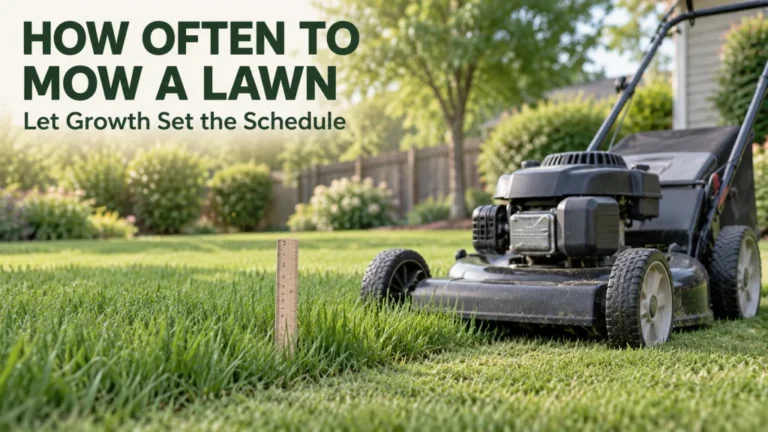
Growth rate changes with moisture, fertility, temperature, light, and species, so a fixed weekly schedule can be too slow during fast growth and unnecessary during slow growth. Let the grass tell you when the height threshold has been reached. That may mean shorter intervals during active growth and much longer intervals when growth slows. This approach is less tidy on the calendar, but it is much more consistent with how turf actually grows.

This clear acrylic ruler has a 12-inch scale with easy-to-read markings and raised beveled edges. It is a simple way to check standing grass before mowing and compare that height with the planned finished height. Measuring before the pass makes the one-third limit easier to apply than relying on a fixed weekly schedule.
Check On AmazonIf you click this link and buy, we earn a commission at no additional cost to you.
Adjust height only when growth conditions or renovation justify it
Season alone is not a reason to move the deck up and down repeatedly. The better trigger is a change in turf growth, stress, or a specific maintenance task supported by guidance for that species. During hot or dry stress, some cool-season lawns are better kept toward the upper end of their recommended range, while a dormant lawn may not need mowing at all. In shade, higher mowing can also be recommended because the turf has less light available to support growth.
Renovation is a different case because the mowing goal can temporarily change. A lawn being prepared for overseeding may be cut lower than its normal maintenance height to improve seed-to-soil contact, but that is a task-specific adjustment rather than a new everyday setting. New turf also needs its first mowing timed around establishment and target height rather than around impatience to make the yard look finished. When a special task ends, return to the normal maintenance range for that species and region instead of leaving the lawn at the temporary renovation height.
Note: A temporary lower cut for a documented renovation step is not evidence that the same low setting is appropriate for routine mowing.
This distinction matters because homeowners often copy a preparation cut from a seeding guide and accidentally turn it into a season-long habit. The mower has not changed, but the job has. A temporary step should end when the purpose for that step ends. Keep the routine height tied to turf health, and keep temporary height changes tied to the specific task that requires them.

This battery-free moisture meter uses a single 304 stainless steel probe and provides an instant analog reading. It can add site context when you are checking whether soil is relatively dry before changing lawn-care decisions around heat or drought stress. Use the reading as supporting information rather than as a stand-alone rule for mower height.
Check On AmazonIf you click this link and buy, we earn a commission at no additional cost to you.
Low mowing can weaken turf and expose more soil
Cutting below the recommended range reduces the leaf area the grass uses to support growth. Extension sources also associate overly low mowing with weaker roots, greater drought stress, and more opportunity for weeds where the turf canopy becomes thin. On uneven ground, the risk is even more obvious because the mower can scalp high spots and expose stems or soil. A lawn can therefore look sharply cut for a short period while becoming less competitive as a plant community.
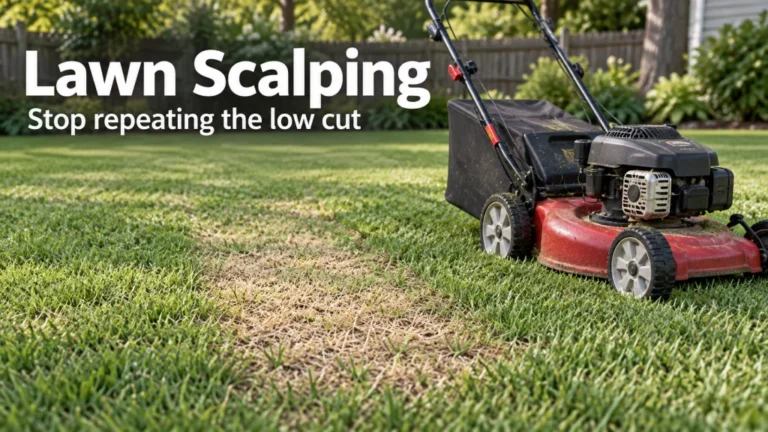
If short mowing has already created pale strips, exposed soil, or repeated shaved patches, do not assume fertilizer or extra water is the first fix. Check the mowing height, terrain, and amount of leaf removed before adding inputs. The separate guide to recognizing and correcting lawn scalping covers that damage pattern in more detail. The key decision here is to stop repeating the low cut while you identify whether the problem is a deck setting, uneven ground, excessive height reduction, or a combination of those factors.
Higher is not automatically better for every species either. Some warm-season grasses are normally managed lower than tall fescue, and mowing them far above their recommended range can create its own management issues. The goal is not to make every lawn tall. The goal is to keep each turf within a range supported for that species and local growing context.

This bow rake has a 63-inch stainless steel handle, a heat-treated manganese steel head, and 17 steel tines. It is built for soil loosening, yard leveling, lawn care, and thatch removal around homeowner landscapes. After the mowing problem is diagnosed, it can support surface preparation where thin or uneven areas actually need repair.
Check On AmazonIf you click this link and buy, we earn a commission at no additional cost to you.
Keep species-specific exceptions attached to local guidance
National charts are useful for orientation, but local Extension guidance should settle close calls. Tall fescue recommendations can differ slightly among states, and warm-season mowing ranges can shift with cultivar, region, mower type, and expected maintenance intensity. That does not mean the sources are unreliable. It means turf management is condition-specific, and a number taken out of its regional context can sound more universal than the source intended.
This is especially important when a recommendation pushes toward the edge of a species range. A very low bermudagrass height may be realistic under a management system built around frequent mowing and suitable equipment, but it may be a poor homeowner target if the mower cannot hold that height evenly across a bumpy yard. Likewise, a higher tall fescue setting can be reasonable under summer stress even if a lower number also appears in a general table. Choose the range first, then choose the point within that range that fits the site and the workload.
Mixed lawns require the same caution. If two grasses occupy separate areas, they can be maintained differently. If they are intermingled, the practical answer may be a compromise that favors the dominant turf rather than an impossible setting that is ideal for both species at once. When the lawn is valuable enough that the difference matters, local identification is more useful than guessing from a generic mowing chart.

This acrylic rain gauge has a 5-inch capacity and a magnifying design intended to make rainfall readings easier to see. It gives you a simple record of what actually fell at your property instead of relying only on a regional weather summary. That local rainfall context can help explain why the same turf height recommendation may need different handling under dry or wet conditions.
Check On AmazonIf you click this link and buy, we earn a commission at no additional cost to you.
Final thoughts: set the mower for the grass, not the number
The best lawn mowing height is a species and condition decision, not a cosmetic one. Identify the dominant turf, start with a locally supported height range, and verify the actual grass height after mowing instead of assuming a deck notch equals a certain number of inches. Keep major height changes gradual so routine mowing does not remove excessive leaf area. If a setting only works when the lawn is cut severely or the yard is scalped on high spots, it is not a practical maintenance setting for that site.
If the lawn is mixed, shaded, drought-stressed, uneven, newly established, or being renovated, let that condition shape the next adjustment. A shorter lawn is not automatically a healthier lawn, and a taller lawn is not automatically correct for every species. The useful setting is the one that leaves the turf within its supported range while remaining realistic for the site and the mowing schedule. When local guidance and a generic chart disagree, use the guidance written for your turf and region rather than forcing the lawn to fit the chart.
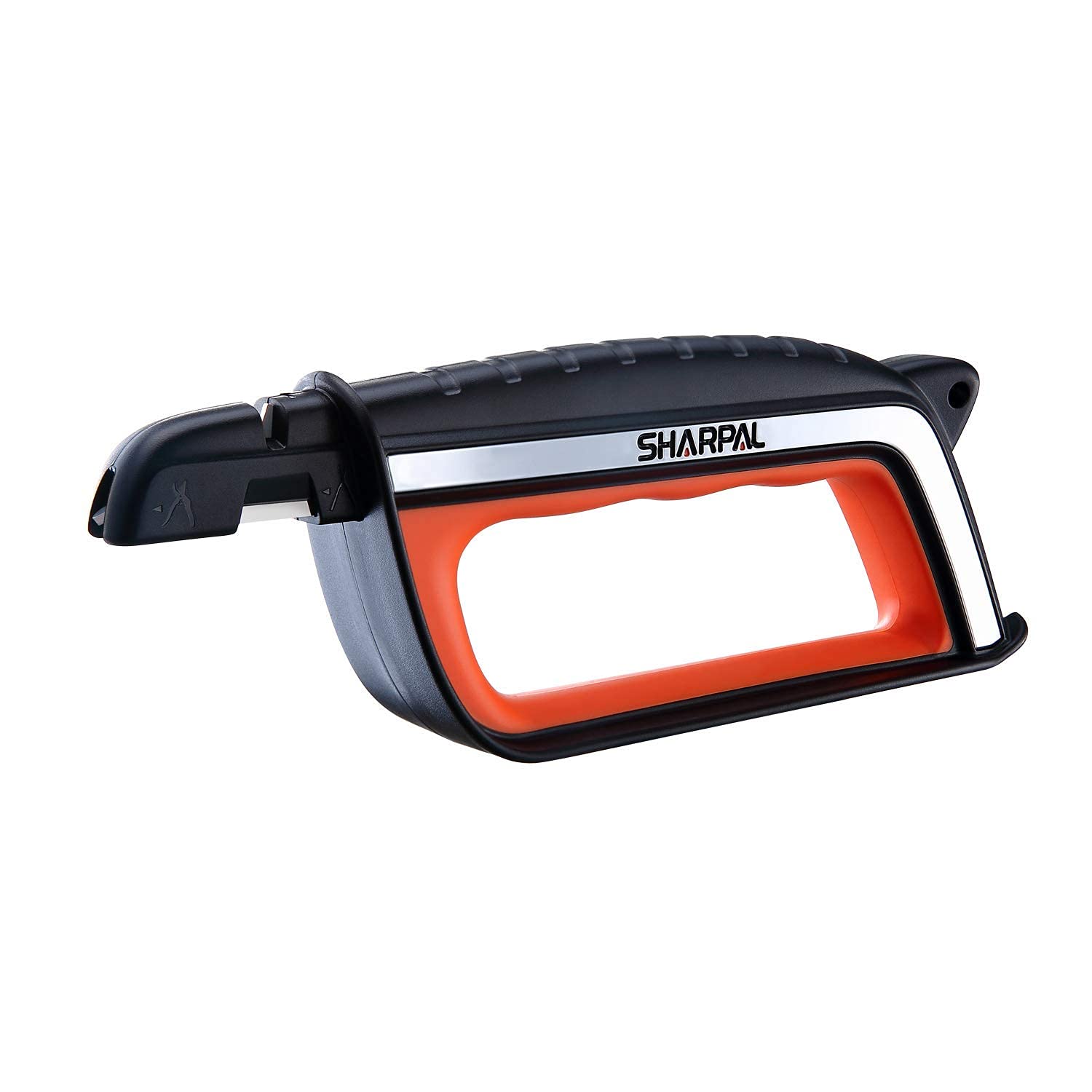
This all-in-one sharpener is designed for lawn mower blades and several common garden cutting tools. It gives homeowners a compact way to handle routine sharpening without turning the mowing-height decision into a full mower repair project. A correct deck setting still works best as part of basic mower maintenance and a consistent lawn-care routine.
Check On AmazonIf you click this link and buy, we earn a commission at no additional cost to you.
Frequently asked questions
🌱 What is the best lawn mowing height?
There is no single best height for every lawn. Identify the turfgrass species first, then use the mowing range recommended by your local Extension or land-grant source for that species and region.
📏 How do I know what height my mower is actually cutting?
Mow a small, level test strip and measure several grass blades from the soil surface to the cut tips. Once you know which notch produces the intended finished height, record or mark that setting for future use.
✂️ Is 2 inches too short for grass?
It depends on the species. Two inches can fall within the range for some warm-season grasses and some regional cool-season recommendations, but it can be too low for turf that is normally maintained closer to 3 or 4 inches.
☀️ Should I mow higher during hot, dry weather?
For some cool-season lawns, using the upper end of the recommended range during heat or drought stress is supported by Extension guidance. Do not keep mowing a lawn that has stopped active growth simply to maintain a calendar schedule.
🧩 What if my lawn has more than one grass type?
If the grasses occupy separate areas, manage each area for its dominant species. If they are intermingled, use local guidance to choose a practical compromise rather than assuming one species-specific height is ideal for the entire lawn.
🌿 Does cutting grass shorter help prevent weeds?
Not as a general rule. Cutting below the recommended height can thin and stress turf, expose more soil and light at the surface, and give weeds more opportunity to establish.
References and sources
- University of Maryland Extension lawn maintenance guidance: Supports species-specific mowing ranges, the one-third mowing limit, and the risks of cutting cool-season turf too short.
- Alabama Cooperative Extension home lawn maintenance: Supports mowing-height ranges for bermudagrass, centipedegrass, St. Augustinegrass, tall fescue, and zoysiagrass in southern home lawns.
- Purdue Extension turf mowing guidance: Supports species-based mowing height, the effect of low mowing on turf stress and weeds, and higher mowing in shaded conditions.