Lawn scalping is usually a mowing problem before it is a fertilizer, watering, or reseeding problem. A low deck setting, uneven ground, excessive thatch, or a mower that does not hold a consistent cutting height can expose pale stems, crowns, or soil. The practical fix is to stop repeating the damaging cut, return to a height supported by the grass type, and judge recovery from new growth and stand density. Water, fertilizer, and seed should enter the decision only when the lawn actually shows a need for them.
A lower cut can create the problem it is trying to tidy
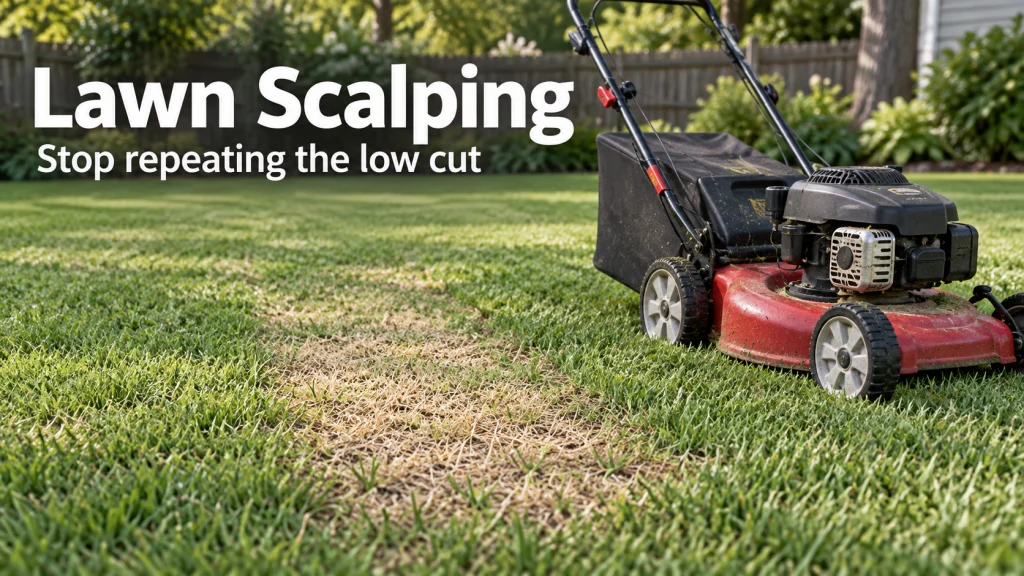
Lawn scalping can make a freshly mowed yard look as though it suddenly needs fertilizer or more water. Here, scalping means an accidental low cut during normal mowing, not a deliberate seasonal mowing practice. A pale stripe, brown patch, or shaved high spot often appears immediately after the mower passes, which makes the mowing event itself the first thing to investigate. If the same area is cut at the same low setting again, the lawn loses more useful leaf tissue before it has rebuilt what was removed. The first correction is therefore simple: stop chasing a greener appearance with another low pass.
I would treat the pattern of damage as the starting evidence, not the color by itself. A lawn can look tan after a severe cut because green leaf tissue has been removed and lighter stems or crowns are now visible. Heat stress, drought, disease, nutrient problems, and other issues can also change lawn color, so brown grass is not proof of scalping on its own. The goal is to connect the symptom to the mowing pattern, grass type, ground shape, and recent cutting height before adding another treatment.

This 12-inch clear acrylic ruler has easy-to-read markings for checking the grass height left after a mowing pass. Its straight edge makes it simple to compare a shaved patch with nearby turf. Use the measurement as a reference while matching the next cut to the grass type and local guidance.
Check On AmazonIf you click this link and buy, we earn a commission at no additional cost to you.
Confirm scalping before treating the lawn
Scalping is more convincing when the damage follows the mower rather than appearing randomly across the yard. Look for exposed crowns, pale or straw-colored stubble, short strips that match a mowing pass, or small shaved areas sitting on a rise. On uneven lawns, a mower can ride normally for most of the pass and then cut much lower when the deck crosses a mound or when a wheel drops into a depression. Those patterns point toward mechanical removal of too much leaf tissue rather than a problem that automatically calls for fertilizer or a lawn treatment.
Use the condition of the plants as a second check. If green leaves remain around or within the affected area and the crowns are not obviously destroyed, the stand may be stressed without being lost. If the area is truly bare, plants pull loose easily, or no living shoots remain after surrounding grass has resumed active growth, the decision can shift toward repair. That distinction matters because a lawn that only looks rough after mowing does not benefit from being treated as though the turf has disappeared.
- Check whether pale or brown areas appeared directly after mowing.
- Look for stripes, arcs, or shaved high spots that match mower travel.
- Compare the affected area with nearby grass that was cut at a higher effective height.
- Inspect for remaining green shoots and intact crowns before assuming the stand is dead.
- Note whether the same spot is scalped repeatedly, which suggests a persistent grade or setup issue.
A checklist is useful because no single visual clue should carry the whole diagnosis. When several clues line up with the mowing path and recent cut, correcting the mowing condition becomes the most direct next step. If the clues do not line up, keep investigating instead of forcing the scalping explanation onto a different lawn problem. That pause helps prevent unnecessary treatments and keeps the next action tied to evidence you can actually see.

These fluorescent orange marking flags come in a 50-pack with 15-inch steel wire staffs and writable PVC flags. They can mark shaved high spots, wheel paths, or repeat-damage locations while you compare the pattern after mowing. The visible markers make it easier to revisit the same physical spots without treating lawn color alone as the diagnosis.
Check On AmazonIf you click this link and buy, we earn a commission at no additional cost to you.
Check whether the deck is below the grass type’s supported range
A mower setting is only useful when it produces an appropriate actual cutting height for the grass in front of it. Different turfgrasses tolerate different mowing ranges, and the same numbered deck position does not mean the same height on every mower. For example, Extension guidance commonly keeps tall fescue higher than bermudagrass because their growth habits and mowing tolerances differ. Identify the turfgrass first, then use guidance for that grass and region instead of copying a neighbor’s deck position.
The amount removed in one mowing also matters even when the final height is normally acceptable. Removing a large share of the leaf surface at once can stress grass that was allowed to grow tall between cuts, so dropping directly from overgrown turf to the usual setting can produce a scalped appearance. Bring an overgrown lawn down gradually rather than forcing the whole correction into one pass. For the broader mowing routine, use a mowing approach built around grass type and actual growth instead of treating deck height as a fixed number for every lawn.
| What you know | Practical next check |
|---|---|
| Grass type is known | Compare the actual cut with a current local Extension mowing range for that turfgrass. |
| Grass type is uncertain | Identify it before making another large height change. |
| The lawn was overgrown | Reduce height over multiple mowings rather than removing too much leaf tissue at once. |
| Only high spots are shaved | Inspect grade and mower travel before lowering or raising the entire lawn based on one patch. |
The useful measurement is the grass left behind, not the label beside the mower lever. Once the actual cut and grass type agree, repeated scalping becomes less likely unless another site or equipment factor is changing the effective height. Recheck the result after the next normal mowing instead of assuming the setting is correct forever. Growth rate, surface conditions, and mower behavior can still change what the lawn experiences at the blade.

The Oregon 42-095 deck leveling gauge is made for checking mower blade and deck level on riding and push mowers. It provides a repeatable reference for comparing blade height instead of relying only on the deck lever number. That helps verify whether the mower is holding a consistent cutting setup before the next pass.
Check On AmazonIf you click this link and buy, we earn a commission at no additional cost to you.
Inspect uneven ground and mower setup before changing the whole lawn
A lawn can be scalped even when the deck setting looks reasonable on flat ground. Small mounds, settled wheel tracks, shallow depressions, exposed roots, or a thick spongy thatch layer can change the distance between the blade and the turf as the mower moves. A wide deck may bridge a dip and shave the center high spot, while a wheel dropping into a low area can lower one side of the deck relative to the grass. If damage repeats in the same physical location, the site deserves as much attention as the height control.
Basic mower condition also affects the cut, but this article stops at owner-level checks rather than internal repair. With the mower safely off according to its manual, confirm that the deck is not visibly tilted, the height controls are matched as designed, and the tires are properly inflated if the mower uses pneumatic tires. A dull blade can leave ragged tips, but it is not the same problem as a blade cutting far below the intended height. If the machine cannot hold a consistent deck position or has damaged components, follow the manual or use qualified service rather than improvising a repair.
- Walk the scalped route and look for mounds, dips, roots, ruts, or soft spots.
- Compare repeated damage with the mower wheel path and deck width.
- Check for a thick, springy thatch layer where the mower appears to sink.
- Confirm visible deck alignment and normal height control operation with the mower off.
- Correct the cause that changes effective cutting height before making the next pass.
Repeated scalping in one strip is a useful clue because it turns a vague lawn problem into a specific site check. Fixing the source of that height change prevents the lawn from being injured again after it starts to recover. Do not lower the rest of the yard just to make one shaved spot blend in. A consistent, supported cutting height matters more than making every patch look identical after a mowing mistake.

The JACO ElitePro is an analog tire pressure gauge with a 100 PSI range. It provides a direct way to check pneumatic mower tires against the pressure specified in the mower manual before evaluating deck behavior. Matching tire pressures can remove one setup variable when repeated scalping follows the same wheel path.
Check On AmazonIf you click this link and buy, we earn a commission at no additional cost to you.
Raise the mowing height and judge recovery from living turf
After an accidental low cut, the priority is to preserve the leaf area that remains. Raise the effective mowing height into the supported range for the grass type and avoid another pass until growth actually calls for mowing. The lawn does not become healthier because the brown stubble is made uniformly shorter. New leaf growth is a better sign of recovery than trying to make every patch look even immediately.
Recovery potential depends on how much living turf remains, the grass type, growing conditions, and whether the crowns or growing points were damaged. Creeping grasses can sometimes spread into small injured areas, while bunch-type grasses do not repair bare spaces in the same way. That is why a universal promise about how quickly every scalped lawn will turn green again is not useful. I would watch for new shoots, increasing green cover, and stable plant attachment before deciding that the stand needs seed.
| What the area shows | Better next move |
|---|---|
| Green shoots remain and the stand is still dense | Raise the cut, avoid repeated injury, and monitor regrowth. |
| Pale stems are visible but crowns remain alive | Give the turf time to rebuild leaf area before adding seed. |
| Small bare spots remain after surrounding turf is actively recovering | Evaluate whether the grass type can fill them or whether local seeding guidance is appropriate. |
| Large areas have no living turf | Treat the problem as stand repair and verify the right establishment window for the grass type and region. |
This sequence keeps a bad mowing event from becoming an unnecessary renovation project. It also leaves room for the lawn to show what survived before money and labor are committed to seed, soil work, or other inputs. If recovery is visible, continue protecting that growth rather than interrupting it with another aggressive cut. If recovery stalls and bare ground remains, the evidence for repair becomes much stronger.

This four-piece stainless steel ruler set includes 6-, 8-, 12-, and 14-inch lengths with imperial and metric measurements. The longer rulers can track the height of remaining grass and new growth without relying on color alone. Repeating the same measurement during recovery gives a simple reference before mowing again.
Check On AmazonIf you click this link and buy, we earn a commission at no additional cost to you.
Water from actual root zone need, not from the color of the cut
Scalped grass is stressed, but stress does not prove that the soil is dry. Check the root zone before turning irrigation into an automatic rescue step, especially if rainfall has already supplied moisture or the soil drains slowly. Watering saturated soil can create a second problem without restoring the leaf tissue that was removed. The lawn needs adequate moisture for growth, not a fixed extra watering schedule simply because the mower exposed pale tissue.
Signs of genuine water need should come from the turf and soil together. Depending on grass type and conditions, drought stress can include wilted or folded leaves, a duller color, or footprints that remain visible instead of springing back, but those signs still need context. If the soil below the surface is already moist, wait and reassess rather than watering by appearance alone. This is part of a broader home lawn maintenance routine based on actual site conditions, not a special irrigation rule created by scalping.

The XLUX soil moisture meter uses a probe and analog dial to provide an immediate soil moisture reading. It requires no batteries and is intended for outdoor soil, including grass lawns. Checking below the surface can help separate an actual moisture need from the pale color created by a low cut.
Check On AmazonIf you click this link and buy, we earn a commission at no additional cost to you.
Avoid rescue fertilizer unless there is a nutrient reason
A freshly scalped lawn can look yellow or brown because the mower removed green leaf tissue and exposed lower stems. That color change is not evidence of a nutrient deficiency by itself, so fertilizer should not be used as a cosmetic reaction to the cut. Nutrient decisions belong to the grass type, soil conditions, local recommendations, and an actual fertility reason. Adding fertilizer without that reason can increase growth pressure or create other management problems while the original mowing error remains uncorrected.
If the lawn already had a scheduled, evidence-based fertility plan, evaluate that plan separately from the scalping event. Do not increase the rate, add an extra application, or combine products simply to force a faster green response. Where soil testing is appropriate for the nutrient question, use it to investigate that question rather than interpreting post-mowing color as a diagnosis. The safer sequence is to correct cutting height first, maintain suitable moisture, observe recovery, and only then address a separate nutrient issue if evidence supports it.

The Luster Leaf Rapitest 1602 kit checks soil pH plus nitrogen, phosphorus, and potash with color comparators. It includes supplies for 20 tests, with five tests for each variable. That provides a separate nutrient check when a fertility question exists instead of treating post-mowing color as proof that the lawn needs fertilizer.
Check On AmazonIf you click this link and buy, we earn a commission at no additional cost to you.
Overseed only when the stand is genuinely thinned and timing fits
Seed is useful when living turf is actually missing, not when a low cut merely exposes stems for a while. Before overseeding, separate temporary discoloration from a true loss of plants by watching the affected area as nearby turf resumes growth. A patch that still contains living crowns and new shoots may recover without seed, while a persistent bare area may need establishment work. The grass type also matters because spreading grasses and bunch-type grasses fill space differently.
When reseeding is justified, use the establishment window and seed choice recommended for the turfgrass and region rather than seeding immediately after the mowing mistake. Soil contact, moisture, temperature, competition from existing turf, and seasonal growth pattern all affect whether seed has a reasonable chance to establish. Warm-season and cool-season lawns do not share one universal seeding schedule, so a generic calendar rule would be misleading. If the appropriate window is not open, protecting the remaining turf and correcting the mowing cause can be the better short-term move.

The Scotts Whirl is a hand-powered spreader designed for small areas and for distributing grass seed with smooth, even coverage. Its hopper holds enough Scotts product to cover up to 1,500 square feet, and the arm support is adjustable. For a genuinely thinned patch, it provides a controlled way to distribute seed once grass choice and timing have been established.
Check On AmazonIf you click this link and buy, we earn a commission at no additional cost to you.
Final Thoughts: stop repeating the low cut
A scalped lawn often looks dramatic because mowing removes the green tissue people expect to see. The most useful response is not to chase that color with another low pass, extra water, fertilizer, or seed all at once. Confirm the mowing pattern, identify the grass type, and find out whether the effective cutting height changed because of the deck, the grade, thatch, or mower setup. Then protect the living turf while it shows whether it can recover.
If green shoots return and the stand remains intact, keep the correction simple and avoid turning one mowing error into a larger renovation. If the area remains genuinely bare, move from recovery to repair using grass-specific and region-appropriate establishment guidance. Either way, the next mowing should be based on actual growth and a supported cutting height rather than a desire to make the damaged patch look uniform. That makes the fix repeatable and reduces the chance of shaving the same area again.

The Landzie lawn leveling rake uses a 36-inch-wide head and a long handle for smoothing soil across uneven lawn areas. It is designed for lawn leveling and can address localized bumps or low spots after the cause of repeated scalping has been identified. Correcting an uneven surface can reduce the chance of a mower shaving the same physical spot on later passes.
Check On AmazonIf you click this link and buy, we earn a commission at no additional cost to you.
FAQs
🌱 Will a scalped lawn grow back?
It can if enough living crowns and shoots remain and growing conditions support recovery. Severe damage that leaves persistent bare areas may require repair, and the grass type affects how well the lawn can fill space on its own.
✂️ Should I mow a scalped lawn again to make it look even?
Do not make another low pass just to even out the color. Wait for enough growth to justify mowing, then cut at a height supported by the grass type and avoid removing a large share of the leaf tissue at once.
💧 Should I water immediately after scalping?
Check soil moisture and turf drought signs first. If the root zone already has adequate moisture, extra irrigation is not a direct fix for leaf tissue that was removed by the mower.
🌿 Should I fertilize grass that was cut too short?
Not simply because the lawn looks pale after mowing. Fertilizer should address a real nutrient need and follow grass-specific, region-appropriate guidance rather than being used as a quick color correction.
📏 Why does my mower scalp only certain spots?
Repeated isolated scalping often points to mounds, dips, ruts, roots, thatch, or a deck that changes height as the mower crosses the area. Compare the damage with the mower path and correct the physical cause before the next pass.
References and Sources
- University of Maryland Extension, lawn problems not caused by pests or diseases: Supports the relationship between low mowing height, uneven ground, scalping, and stressed turf.
- University of Minnesota Extension, mowing practices for healthy lawns: Supports limiting excessive leaf removal, avoiding scalping, and using mowing height to reduce stress.
- University of California IPM, turf scalping: Supports scalping identification, uneven surface causes, mowing height correction, and the difference in recovery among turf growth habits.