Lawn mowing works better when the grass sets the schedule instead of the calendar. The right cutting height depends on turf type, while mowing frequency changes with growth rate, moisture, heat, drought stress, and the condition of the lawn. A practical routine is to identify the grass, choose a defensible height range, and mow often enough that each cut removes only a modest share of the leaf. That same decision process also tells you when to wait, when to leave clippings, and how to recover after a missed mow without turning one mistake into repeated stress.
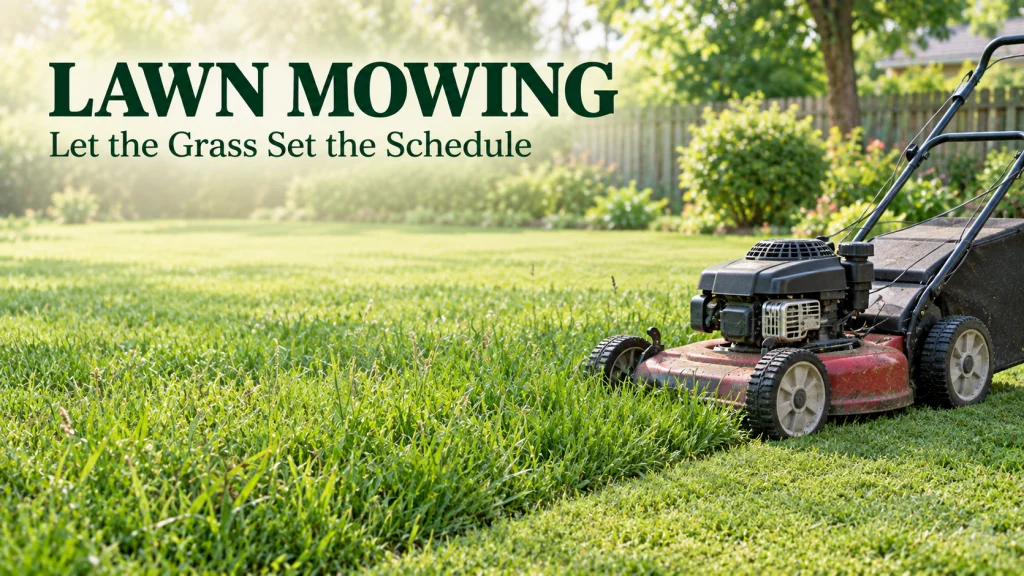
Mowing frequency is a growth decision, not a calendar habit
The calendar says the weekend is open, but the lawn may be telling you something different. Good lawn mowing starts with the turf in front of you: how tall it is, how quickly it is growing, whether the leaves are dry enough to cut cleanly, and whether the grass is actively growing or under stress. A fixed weekly routine can be too slow during fast growth and unnecessarily aggressive when heat or drought has slowed the lawn. The useful question is not, “Is it mowing day?” but, “Will this cut leave enough healthy leaf for the grass I have?”
That shift makes routine mowing easier to manage because it gives you a repeatable check instead of another calendar obligation. Identify the turf type first, then watch current height and growth, check surface moisture and stress, and only then decide whether to mow. If the grass has barely grown, leaving it alone may be the better maintenance decision. For a broader view of how mowing fits with watering, seasonal care, and other lawn tasks, use the home lawn maintenance guide as the larger framework.

This acrylic rain gauge measures up to 5 inches of rainfall. Magnified markings and white inch numbers are designed for quick reading. It can be mounted through the integrated hang hole or staked into the ground.
Check On AmazonIf you click this link and buy, we earn a commission at no additional cost to you.
Identify the turf type before choosing a mowing height
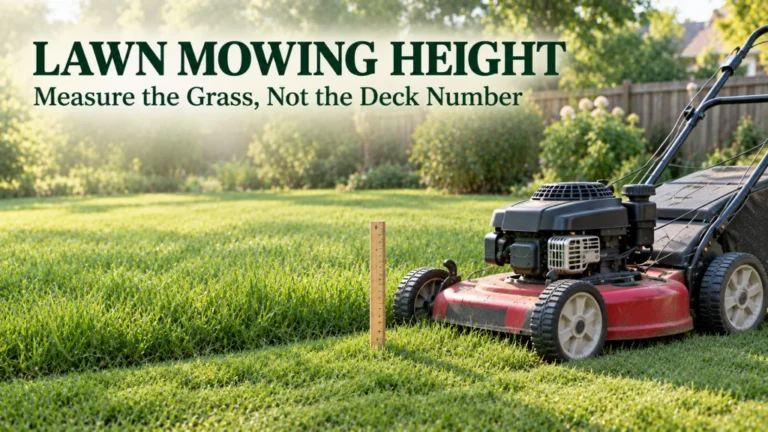
A single mowing height for every lawn is a bad shortcut because common turfgrasses are not maintained the same way. Tall fescue and St. Augustinegrass are usually kept substantially taller than bermudagrass, while zoysiagrass and centipedegrass sit in different ranges depending on region, cultivar, and maintenance level. That matters because cutting a naturally taller turf too low can repeatedly reduce leaf area, while allowing a lower-growing turf to become excessively tall can create a different mowing problem. If you do not know what grass you have, identification comes before fine-tuning the mower setting.
The table below is a homeowner starting point drawn from current university Extension guidance, not a universal prescription for every cultivar or climate. Regional recommendations differ, especially where warm-season and cool-season grasses overlap, so local Extension guidance should take priority when it gives a more specific range for your area. Use the range to choose a sensible starting height, then let turf response and local guidance refine it rather than chasing a golf-course look that does not fit your grass. The goal is a stable height the lawn can maintain without repeated scalping or unnecessary mowing pressure.
| Turf type | Common homeowner mowing range | What to keep in mind |
|---|---|---|
| Tall fescue | About 2.5 to 3.5 inches | A taller cut is commonly recommended, especially when heat or moisture stress is a concern. |
| Kentucky bluegrass | About 2 to 3 inches | Growth rate can change sharply with season and fertility, so frequency should follow actual growth. |
| Perennial ryegrass | About 2 to 3 inches | Use local guidance where it is grown in mixtures or under regional conditions that change the preferred range. |
| Common bermudagrass | About 1 to 2 inches | It tolerates a lower cut than many cool-season grasses, but the mowing setup still has to produce a clean, even cut. |
| Centipedegrass | About 1 to 2 inches | Avoid copying a taller-grass routine simply because neighboring lawns look different. |
| St. Augustinegrass | About 2.5 to 4 inches | It is commonly maintained taller than bermudagrass or centipedegrass. |
| Zoysiagrass | About 1 to 3 inches | Cultivar, region, and mower capability can narrow the useful range. |
Once you have a defensible target height, mowing frequency becomes much easier to judge. You are no longer trying to make the lawn fit a generic schedule; you are watching how long it takes your turf to grow enough that another cut is actually justified.

This 10X stand magnifier uses pre-focused dual lenses for close viewing. Its transparent acrylic base lets ambient light reach the subject. The LL-10 has a 1-inch lens diameter and does not include a measuring reticle.
Check On AmazonIf you click this link and buy, we earn a commission at no additional cost to you.
Use current growth to decide when to mow
Grass does not grow at one speed through the season. Temperature, rainfall, irrigation, fertility, shade, turf type, and recent stress can all change how quickly the canopy gains height, which is why a routine that worked recently may stop fitting the lawn. During vigorous growth, you may need to mow more often to keep each cut modest. When growth slows, forcing the same frequency can mean running the mower over grass that has little need to be cut.
A simple pre-mow check keeps the decision practical. Walk a few representative areas instead of judging from the driveway, because sunny edges, shaded sections, irrigated zones, and low spots may not grow at the same rate. Look for actual height, standing moisture, visible drought stress, flattened or lodged grass, and unusually heavy growth that could create clumps. If those checks point in different directions, choose the action that avoids the larger stress, such as waiting for the surface to dry or raising the cutting height rather than forcing the usual setting.
- Confirm that the turf has grown enough to justify a cut.
- Check more than one part of the lawn before deciding on height.
- Wait if the surface is wet enough to rut, smear, or produce heavy clumps.
- Reduce mowing pressure when growth has paused under drought or heat stress.
- Raise the cutting height temporarily if the lawn has become taller than your normal routine can handle cleanly.
| If you see this | Check next | Next mowing decision |
|---|---|---|
| Grass is near the normal target height | Is the surface dry enough for a clean pass, and is the turf actively growing? | Mow only if the cut can stay modest and the lawn is not under acute stress. |
| Grass has barely grown since the last cut | Has heat, drought, shade, or seasonal slowdown reduced growth? | Skip the cut and reassess after growth resumes instead of mowing for appearance alone. |
| Grass is ready to mow but the lawn is wet | Would mowing cause rutting, smearing, clumping, or an uneven cut? | Wait for better surface conditions, then reassess height before starting. |
| Grass is much taller than the normal range | Would returning to the usual setting remove too much leaf at once? | Start higher, manage the heavier clipping load, and step back toward the normal height over later mowings. |
| The lawn is dry, stressed, or partly dormant | Is active growth still occurring, or would the cut add stress without useful height control? | Reduce mowing pressure and wait unless there is enough active growth to justify a light cut. |
| The cut is needed but clippings will be heavy | Can the material settle into the canopy without forming wet or dense piles? | Use a higher first pass if needed, then spread, re-cut, or collect excess material instead of leaving thick clumps. |
Read the table from left to right, but stop as soon as a condition makes mowing a poor choice. The point is not to force every lawn through the same sequence; it is to identify which constraint controls the next action. Height matters only after turf type is known, and a suitable height still does not override wet soil, drought stress, or excessive leaf removal. That is also why cutting extra short rarely creates a useful shortcut between mowing sessions.

Each ruler is 6 inches long and includes imperial and metric graduations. The stainless steel construction uses etched markings for clear readings. The set includes three rulers with 1/64-inch, 1/32-inch, and millimeter markings.
Check On AmazonIf you click this link and buy, we earn a commission at no additional cost to you.
Keep each cut within a defensible amount of leaf removal
University turf guidance commonly uses the one-third rule as a practical mowing limit: avoid removing more than about one-third of the grass blade in a single mowing. It is a management guideline rather than a magic threshold, but it gives homeowners a useful way to connect target height with actual mowing timing. If the lawn is far above its normal height, dropping the mower straight back to the usual setting can remove a large share of green tissue at once. Repeating that pattern is more stressful than keeping the lawn near a stable height with smaller cuts.
The key is to use the rule as a decision aid, not as permission to ignore turf type or current stress. A grass maintained at a taller height can usually grow farther before the next cut while still keeping removal moderate, whereas a low mowing height leaves less room before the same proportion is removed. This helps explain why “cut it shorter so I can mow less” often works against the desired outcome. When the lawn is already stressed, the safer adjustment is usually to reduce the severity of the cut, not to chase the usual appearance in one pass.
Key point: Pick the correct height for the turf first. Then use current growth to decide when the lawn has reached the point where another modest cut makes sense.
For the deeper mechanics of choosing and checking a target height, the dedicated guide to lawn mowing height is the better next step. If your main problem is deciding how frequently the grass needs attention as growth changes, use the guide to how often to mow a lawn rather than forcing a weekly number onto every season.

This gauge is designed to check and correct uneven mower deck and blade height. It fits most standard riding and push lawn mowers according to the listing. The compact measuring tool supports repeatable deck-height checks before mowing.
Check On AmazonIf you click this link and buy, we earn a commission at no additional cost to you.
Delay mowing when the lawn is wet, dormant, or acutely drought-stressed
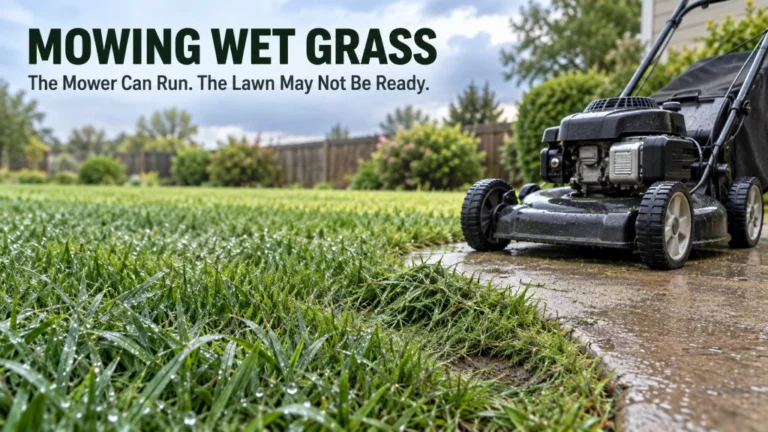
A lawn can be tall enough to cut and still be a poor mowing candidate. Wet grass is more likely to bend, clump, clog a mower deck, and leave an uneven finish, while saturated soil can be damaged by wheel traffic and turning. If rain has made the lawn too wet for a clean pass, waiting for better surface conditions is usually more useful than preserving a calendar habit. The important distinction is between grass that is merely tall and a site that is physically unsuitable for mowing at that moment.
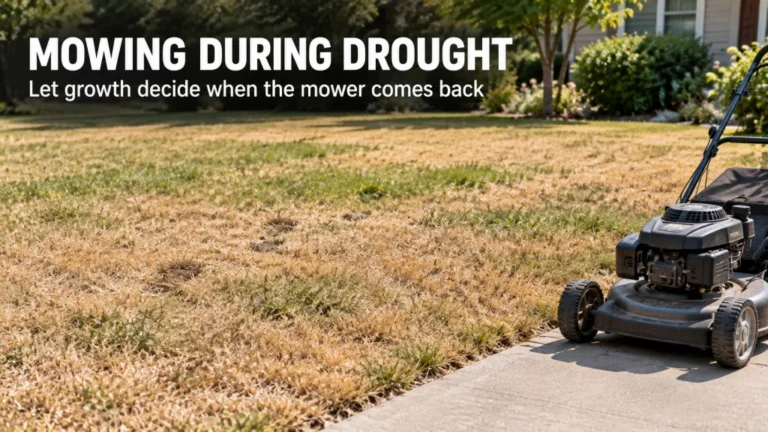
Drought stress creates the opposite problem: the lawn may be dry enough to drive over, but active growth may have slowed or stopped. Mowing dormant or acutely stressed turf simply because the usual interval has passed adds disturbance without much maintenance benefit. When growth resumes, return to the correct height gradually if the canopy has become uneven. The dedicated guides to mowing wet grass and mowing during drought cover those two decisions in more detail.
Note: Heat, rainfall, soil moisture, and turf type change the answer. Treat “mow every week” as a convenience pattern, not as a rule that overrides lawn condition.
If a wet period and rapid growth happen together, do not try to solve both problems by lowering the deck and making one severe cut as soon as the rain stops. Let the surface become mowable, start higher if needed, manage the clippings, and work back toward the normal target as the lawn allows.

This battery-free soil moisture meter gives an instant reading through a single probe. The probe is made from 304 stainless steel and is intended for indoor or outdoor soil checks. Its analog display is designed to be clear and easy to read.
Check On AmazonIf you click this link and buy, we earn a commission at no additional cost to you.
Choose mulching or bagging from clipping volume and lawn condition
Grass clippings are not automatically a waste product. When the lawn is cut regularly and the clippings are short enough to settle into the canopy, Extension guidance generally supports leaving them in place because they break down and return nutrients to the turf. That makes mulching or ordinary clipping return a sensible default for many routine cuts. Bagging every mowing adds handling work and removes material that often could have stayed on the lawn without causing a problem.
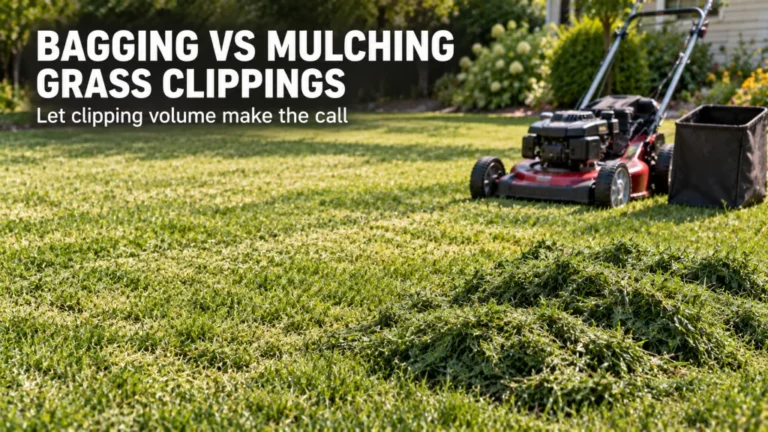
The decision changes when clipping volume is heavy, wet, matted, or concentrated in piles that shade the grass below. After delayed mowing or a stretch of fast growth, the better job may be to spread, re-cut, or collect excess clippings rather than leave thick windrows sitting on the surface. The practical test is not whether clippings exist, but whether they can disappear into the canopy without forming a dense layer. The comparison between bagging and mulching grass clippings goes deeper into that trade-off.
A missed mow is where this distinction becomes especially useful. If you return to a lawn that is noticeably overgrown, raise the mower, make a less aggressive first cut, and judge the clipping load before deciding whether to leave everything behind. That approach solves the immediate height problem without automatically turning the whole job into bagging, raking, and hauling.

This 24-inch leaf rake is made for leaves, grass clippings, twigs, pine needles, acorns, and other yard debris. It uses a hardwood and steel handle. The wide rake head is suited to spreading or collecting heavy clipping piles after mowing.
Check On AmazonIf you click this link and buy, we earn a commission at no additional cost to you.
Recover from scalping or an overgrown lawn gradually
An overgrown lawn and a scalped lawn look like opposite problems, but both are easier to manage when you stop chasing an instant visual reset. If the grass has grown well above its normal height, start with a higher cut and bring it down over successive mowings rather than removing a large share of leaf in one pass. If you have already scalped part of the lawn, avoid repeating the same low setting just to make the rest match. Give the turf a chance to resume growth at an appropriate height before deciding whether any bare or discolored area needs separate diagnosis.
Consider a common missed-mow situation: rain or travel keeps you from mowing, and the lawn returns much taller than usual. The tempting move is to set the deck to the old height and clear everything at once, but a higher first pass usually creates a smaller physiological and clipping burden. After the lawn has had time to continue active growth, the height can be stepped back toward the normal range. If the problem is specifically damage from cutting too low, the guide to lawn scalping covers recovery decisions and the signs that the issue may be more than a simple mowing mistake.
For homeowners trying to understand why that gradual approach matters, the one-third rule for mowing provides the underlying leaf-removal logic. It is most useful as a guardrail for routine care and recovery, not as an excuse to ignore wet soil, drought stress, or an incorrect target height.

This grass whip uses double-edged serrated steel blades for cutting tall grass and overgrown weeds. Its 38-inch hardwood handle provides reach during manual clearing. A hole in the handle allows hanging storage.
Check On AmazonIf you click this link and buy, we earn a commission at no additional cost to you.
Edge only as far as the site and tool can do cleanly
Edging is a boundary-finishing task, not a reason to scalp the lawn next to every hard surface. The cleanest result comes from following the actual edge of a sidewalk, driveway, bed, or curb without cutting a wide trench into the turf. Uneven grade, exposed roots, tight corners, and fragile irrigation components can all change how much of that edge can be handled cleanly in one pass. If the site does not give the tool a stable path, forcing a perfectly straight line can create more repair work than visual improvement.
Keep the mowing decision separate from the edging decision. Mow the lawn at the correct height first, then deal with the boundary using a controlled pass that fits the site rather than lowering nearby turf to imitate a sharper edge. Where the ground drops away or the border is irregular, a slightly less aggressive finish is often the better homeowner choice. The full lawn edging guide covers how to handle those boundaries without turning routine maintenance into unnecessary turf damage.

This manual half-moon edger uses a saw-tooth blade and a T-grip handle. Its 38-inch length is sized for stand-up edging along lawn boundaries. The tool is intended for defining edges beside walkways and garden borders.
Check On AmazonIf you click this link and buy, we earn a commission at no additional cost to you.
Keep mower hardware and blade maintenance separate from the mowing routine
Mowing technique cannot compensate for equipment that is unable to make a clean, consistent cut. Ragged leaf tips, an uneven cutting plane, repeated clogging, vibration, or a deck that will not hold the intended height can point to an equipment issue rather than a turf-care decision. At that point, the task has moved beyond choosing when and how high to mow. Treat the mower as equipment that needs its own inspection, maintenance, and manufacturer-specific guidance.
This article does not cover mower selection, blade sharpening procedure, powered-equipment repair, or internal mechanical troubleshooting. Those jobs belong with garden tool and equipment guidance, and the exact mower manual should govern model-specific adjustment, service, and safety steps. For the lawn itself, the useful boundary is simple: confirm that the machine can make the intended cut, then return to turf type, current growth, surface condition, and clipping load. If the mower cannot do that reliably, fix the equipment decision before changing the lawn-care rule.
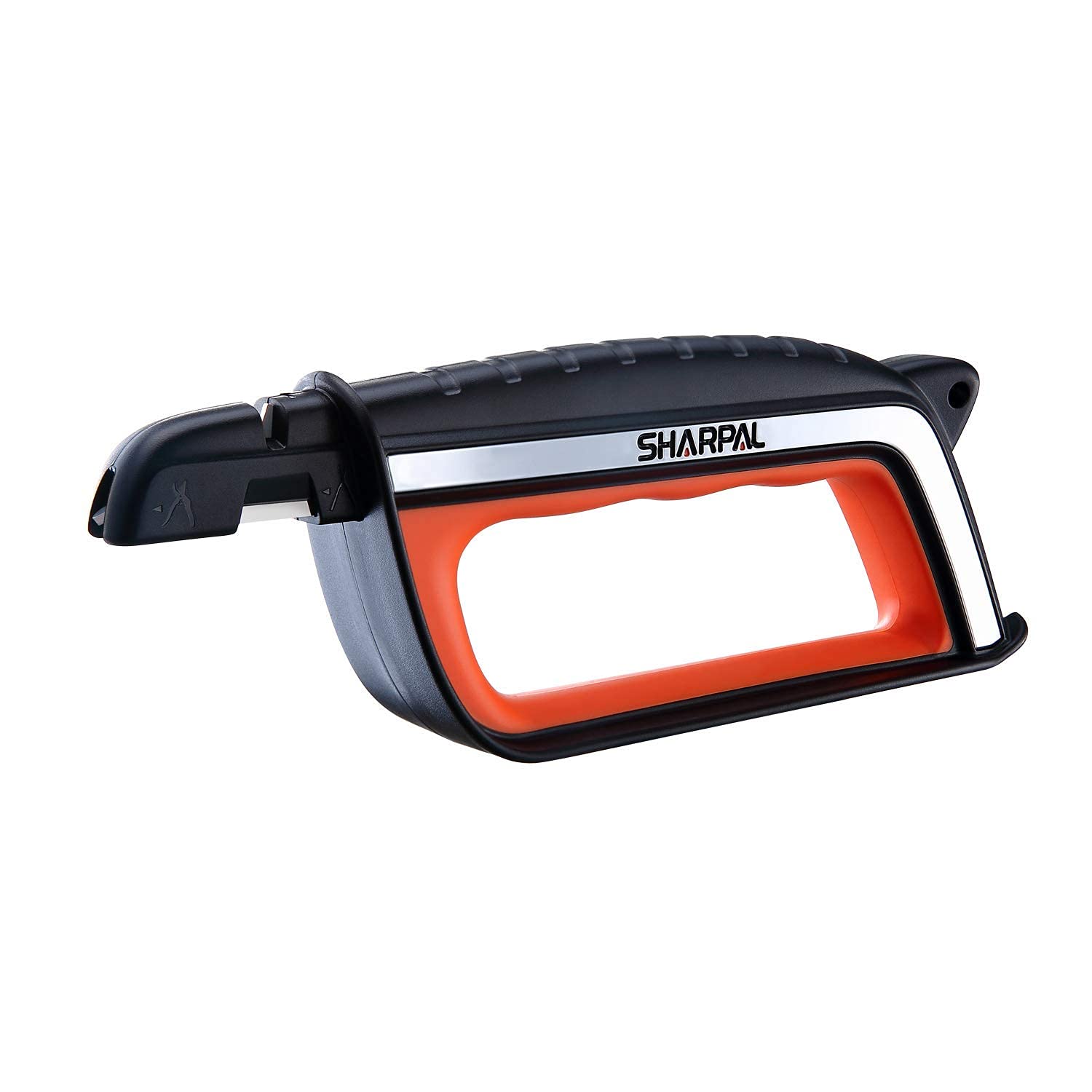
This manual sharpener is designed for mower blades and several other single- and double-bevel garden tools. It combines preset-angle slots with a tungsten carbide bar and a ceramic bar. Model 103N is a single handheld sharpening tool.
Check On AmazonIf you click this link and buy, we earn a commission at no additional cost to you.
Final thoughts: let the lawn set the next mowing decision
A durable mowing routine works best when each pass has a reason. Know the turf, keep a suitable target height in mind, and check whether current growth actually calls for another cut. Surface moisture, drought stress, clipping volume, and the amount of leaf that would be removed can all change the answer. That sequence is more useful than treating mowing as a task that must happen just because the usual day has arrived.
When conditions are ordinary, the routine can stay simple: make a modest cut and let manageable clippings return to the canopy. When the lawn is wet, stressed, overgrown, or already scalped, change the next step instead of forcing the normal setting. A higher first pass, a delay for better conditions, or a gradual return to the target height can prevent one disruption from becoming several. The practical goal is not a perfectly timed schedule, but a lawn that can stay within a stable mowing range without repeated correction.

This pack contains 40 unscented lawn and leaf bags, each with a 39-gallon capacity. The black plastic bags are designed to resist tearing. Red drawstrings provide a closure for tying and carrying filled bags.
Check On AmazonIf you click this link and buy, we earn a commission at no additional cost to you.
Explore the next lawn mowing decisions
Use the topic that matches the problem in front of you instead of stretching one general mowing rule to cover every condition. Height, frequency, wet weather, drought, clipping load, scalping, leaf removal, and edging each become separate decisions once one of them is the limiting factor. The table below keeps those routes together without forcing every question into this overview. Choose the row that matches what you are trying to solve next.
| Topic | What you’ll find |
|---|---|
| Lawn mowing height | How to choose a cutting height that fits the turf instead of copying a neighbor or mower setting. |
| How often to mow a lawn | How growth rate, season, moisture, and target height change mowing frequency. |
| Mowing wet grass | How to judge whether wet conditions make mowing a poor choice and what to do when growth keeps advancing. |
| Mowing during drought | How to reduce mowing stress when the lawn is dry, slow-growing, or moving toward dormancy. |
| Bagging vs mulching grass clippings | When clippings can stay on the lawn and when volume or condition makes collection more sensible. |
| Lawn scalping | How to recognize a too-low cut and make recovery decisions without repeating the same stress. |
| The one-third rule for mowing | How leaf-removal proportion connects mowing height with timing and gradual recovery. |
| Lawn edging | How to finish lawn boundaries without turning a clean edge into a strip of scalped turf. |
For decisions beyond mowing, return to the home lawn maintenance guide and follow the care issue that matches the condition you are seeing. That broader guide is the better route when mowing is only one part of a watering, seasonal care, seeding, or renovation question. Staying with the specific problem also helps prevent a mowing adjustment from being used to solve something the mower cannot correct. Once the limiting condition is clear, move to the focused guide instead of adding more rules to the routine.

This WG163 tool converts between a string trimmer and lawn edger. The selected variant includes two 20V 2.0Ah PowerShare batteries and a charger. Its Command Feed system advances line through a push-button feed.
Check On AmazonIf you click this link and buy, we earn a commission at no additional cost to you.
FAQs
🌱 How often should I mow my lawn?
Use the turf’s target height and actual canopy growth to judge the next cut instead of relying on a fixed weekly interval. Weather, moisture, fertility, and seasonal stress can all change how quickly another mowing becomes useful.
📏 What height should I mow my grass?
Start with the recommended range for your turf type and region. Tall fescue and St. Augustinegrass are commonly maintained taller than bermudagrass, so one mower setting does not fit every lawn.
✂️ What is the one-third rule for mowing?
It is a guideline to avoid removing more than about one-third of the grass blade in one mowing. Use it with the correct turf-specific height and current lawn condition rather than treating it as the only mowing rule.
💧 Should I mow grass when it is wet?
Waiting is usually better when the grass or soil is wet enough to cause clumping, tearing, rutting, or an uneven cut. If repeated rain has made the lawn overgrown, let the surface become mowable and start with a higher cut rather than forcing the usual height immediately.
🍂 Should I bag grass clippings every time?
No. Short, dry clippings can usually be returned to the lawn, while thick, wet, or matted clippings may need to be spread, re-cut, or collected so they do not sit in dense piles.
🌤️ Should I mow during drought?
Reduce mowing pressure when the lawn is acutely drought-stressed or has stopped active growth. When mowing is needed, follow the height guidance for your turf and avoid an unusually severe cut.
References and Sources
- University of Maryland Extension: Supports growth-based mowing frequency, avoiding mowing wet or dormant turf, and limiting leaf removal in routine mowing.
- Alabama Cooperative Extension System: Supports turf-specific mowing heights, growth-based frequency, gradual recovery after an overgrown interval, and clipping return.
- NC State Extension: Supports common homeowner mowing-height ranges and returning manageable grass clippings to the lawn.
- Illinois Extension: Supports turf-specific height differences, the one-third guideline, wet-grass caution, and leaving routine clippings in place.