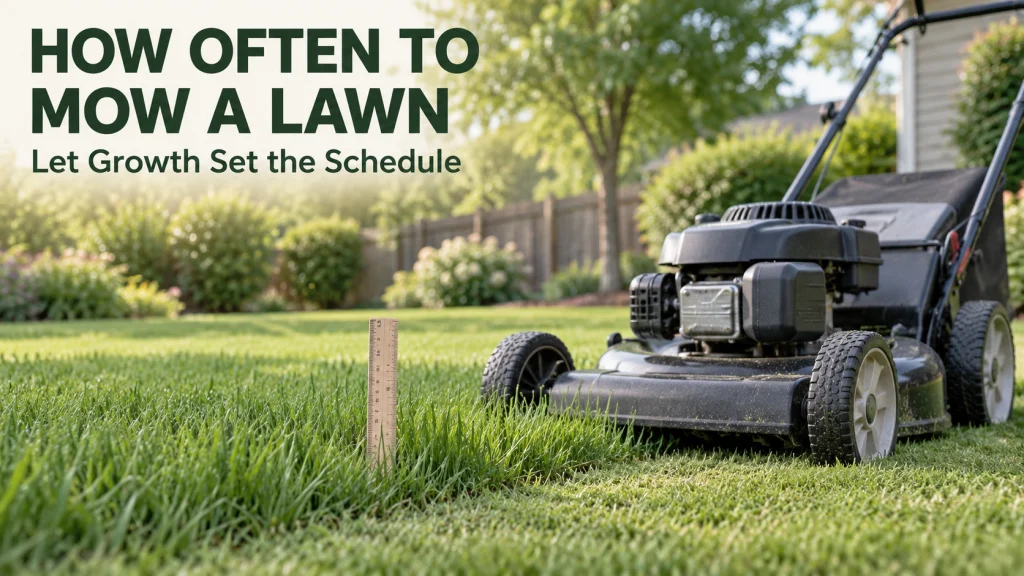
How often a lawn needs mowing is determined by how quickly the grass is growing toward its target height, not by a fixed weekly schedule. The useful trigger is the amount of leaf growth since the last cut, with the one-third rule setting an upper limit on how much to remove at once. Grass type, weather, soil moisture, fertility, and seasonal stress can all change the interval between cuts. A practical mowing routine therefore starts with height, watches current growth, and slows down or stops when the lawn is not actively growing.
Mowing frequency should follow growth
How often to mow a lawn can change sharply even when your calendar does not. During a fast spring growth period, the grass may reach its mowing trigger twice within what you normally think of as one weekly cycle. During a drought week, that same lawn may add so little height that there is nothing useful to cut at all. The difference comes from growth, not from the number of days since the last mowing.
The practical job is to keep the turf near an appropriate mowing height without removing too much green leaf tissue in one pass. That means you first need a target height for the grass you actually have, then you watch how quickly it grows above that target. This same decision framework fits into a broader set of lawn mowing decisions for home lawns, where height, moisture, grass type, and mowing conditions matter more than convenience alone. If you are trying to coordinate mowing with watering, seasonal care, and other routine tasks, the broader home lawn maintenance approach helps keep those choices in context.

This 12-inch stainless steel ruler has a non-slip cork backing and etched 1/16-inch and metric markings. It gives you a simple way to check grass height at the same representative spots between mowings. Repeating those checks helps show whether growth is accelerating, slowing, or holding near the mowing trigger.
Check On AmazonIf you click this link and buy, we earn a commission at no additional cost to you.
Start with the target mowing height
A mowing interval only makes sense after you know the height you are trying to maintain. Different turfgrasses have different recommended ranges, and local climate, season, shade, and stress can shift which end of that range makes sense. University Extension guidance commonly treats mowing height as species specific rather than universal, which is why one generic number should not be applied to every lawn. If you do not know your grass type, identifying the dominant turf is a better first step than copying a neighbor’s mower setting.
Once the target is known, height becomes a practical trigger you can inspect directly. The one-third rule says not to remove more than about one-third of the current leaf height in one mowing, so the maximum trigger height is roughly one and one-half times the intended post-mow height. You do not have to wait until the grass reaches that upper limit, and mowing a little earlier is often easier on the lawn and mower. The table below shows the math only, not a recommendation for which target height your turf should use.
| Chosen target height | Approximate upper trigger height | Maximum amount removed |
|---|---|---|
| 2 inches | 3 inches | 1 inch |
| 2.5 inches | 3.75 inches | 1.25 inches |
| 3 inches | 4.5 inches | 1.5 inches |
| 3.5 inches | 5.25 inches | 1.75 inches |
Use this table only after choosing a target that fits your turfgrass and local conditions. A tall fescue lawn, a bermudagrass lawn, and a zoysiagrass lawn should not be forced into the same cutting height simply because one mower setting is convenient. Local Extension guidance is the better place to confirm the suitable range for the grass in your region. With that target established, the next question becomes how quickly the lawn is moving toward the trigger.

This gauge measures mower blade height from the ground or another flat surface and helps level the deck across its width. It gives you a machine-side check when setting the mower to an intended cutting height. That makes it easier to connect the chosen turf target with what the mower is actually set to leave behind.
Check On AmazonIf you click this link and buy, we earn a commission at no additional cost to you.
Estimate the next cut from current growth
The easiest way to estimate mowing frequency is to observe how much height the lawn gains between checks. You do not need a complicated calculation, but measuring a few representative areas can be more reliable than judging the entire lawn from the porch. Growth often differs between sunny and shaded areas, irrigated and dry areas, or spots with different fertility. Use the fastest healthy section as your early warning so one vigorous patch does not become badly overgrown while the rest still looks manageable.
Several conditions can speed or slow growth, so treat the current rate as temporary rather than as a permanent schedule. Rain or irrigation, suitable temperatures, available nitrogen, grass type, and season can all change how quickly the turf reaches its next cut. The most useful observations are simple and repeatable. They tell you whether the lawn is approaching the trigger, holding steady, or barely growing at all.
- Check actual grass height in a few representative areas rather than relying only on appearance.
- Notice whether recent moisture has produced a clear flush of new leaf growth.
- Watch for areas that are growing much faster than the rest of the lawn.
- Distinguish slow growth from stress or dormancy before deciding that the lawn simply needs a longer interval.
- Recheck after a major weather shift instead of assuming the previous mowing rhythm still applies.
After a few checks, you will usually see a pattern without needing to assign the lawn a fixed frequency. During a vigorous period, the trigger may arrive quickly enough that two cuts are appropriate within what would normally be one weekly cycle. During slower growth, the same lawn may not need a cut when the reminder appears. The point is not to create a more complicated calendar, but to replace automatic mowing with a quick condition check.

This acrylic rain gauge collects and measures up to 5 inches of rain and magnifies the scale for easier reading. Tracking recent rainfall gives you one concrete moisture input that can change how quickly turf grows. Pair that observation with actual grass-height checks instead of assuming the previous mowing interval will repeat.
Check On AmazonIf you click this link and buy, we earn a commission at no additional cost to you.
Use the one-third limit as the practical trigger
The one-third rule is useful because it connects mowing frequency to the amount of living leaf tissue being removed. If you repeatedly wait until the turf is far above its target and then cut it straight back down, each mowing becomes a larger stress event. Keeping removal to roughly one-third or less allows you to maintain height without turning every session into a major reset. The rule is an upper limit, not a requirement to remove exactly one-third every time.
A simple way to use it is to compare the current height with your target before starting the mower. If the lawn is below the upper trigger, you can mow if there is a practical reason, but you are not forced to. If the lawn is near the trigger, mowing soon helps avoid taking too much at once. For a deeper explanation of the calculation and its limits, see the guide to the one-third mowing rule.
Key point: The trigger is based on the height you are maintaining, not on the number of days since the last cut.
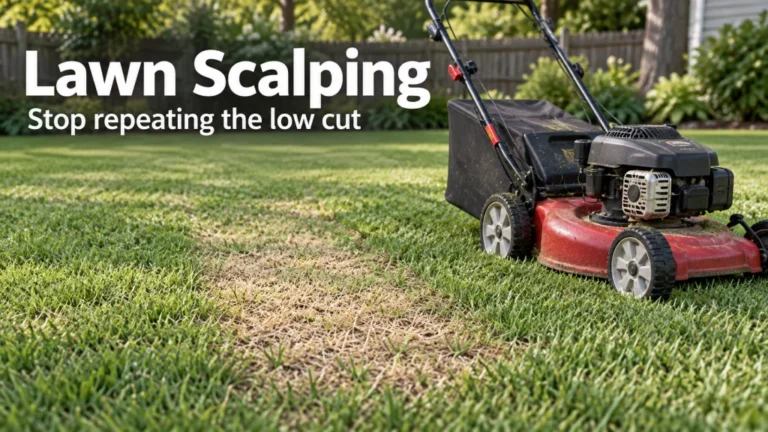
Real lawns are not perfectly level, and mower cutting height can vary with tire position, thatch, terrain, and the machine’s actual setup. That is another reason not to treat the formula as a reason to wait until the exact mathematical maximum. A little margin makes the rule easier to follow when the lawn has uneven growth. What matters most is avoiding a repeated pattern of letting grass get very tall and then scalping it back to the normal setting.

This clear acrylic ruler is 12 inches long and uses 1/16-inch graduations for precise measurements. It is a simple tool for comparing current grass height with the target and the calculated one-third upper trigger. Measuring before mowing keeps the decision tied to leaf height rather than the number of days on the calendar.
Check On AmazonIf you click this link and buy, we earn a commission at no additional cost to you.
Increase frequency during rapid growth instead of cutting lower
When grass is growing quickly, the right response is usually to shorten the interval between mowings rather than lower the cutting height. Cutting lower may make the lawn look as if you have bought more time, but it also removes more leaf area and can push the turf below its appropriate height range. Fast growth is common when temperature and moisture favor the species and when fertility is high enough to support active leaf production. In those conditions, the lawn may simply need more frequent attention for a while.
This is where fixed weekly advice breaks down most clearly. A cool-season lawn can surge during favorable spring or fall conditions, while a warm-season lawn may grow most aggressively in hot weather when moisture is available. The same property can therefore need very different mowing intervals at different points in the growing season. Keep the target height steady unless local guidance or stress conditions give you a reason to change it.
| Condition | Fast-growth period | Drought or severe slowdown |
|---|---|---|
| Height change | Grass can move toward the mowing trigger quickly | Grass may gain very little height or stop active growth |
| Calendar result | Two cuts can be appropriate within a period that normally gets one | A usual mowing day can arrive with no useful reason to cut |
| What to protect | Target height and the one-third removal limit | Remaining leaf area and turf that is already under stress |
| Practical response | Mow more often if the height trigger arrives sooner | Reduce or stop mowing until growth and conditions justify another cut |
The contrast shows why mowing frequency cannot be assigned once and left unchanged for the season. Rapid growth calls for shorter intervals without lowering the target height, while drought or severe stress can stretch the interval until active growth returns. The decision in both cases still begins with the lawn’s condition rather than the calendar. That makes the same framework useful at opposite ends of the growth cycle.

This handheld mower blade sharpener uses a preset carbide blade, an oversized handle, and a large safety guard. A wire cleaning brush is built into the tool for blade cleanup before sharpening. During periods of frequent mowing, maintaining the cutting edge supports cleaner cuts without changing the mower height just to stretch the interval.
Check On AmazonIf you click this link and buy, we earn a commission at no additional cost to you.
Reduce or stop mowing during dormancy and severe stress
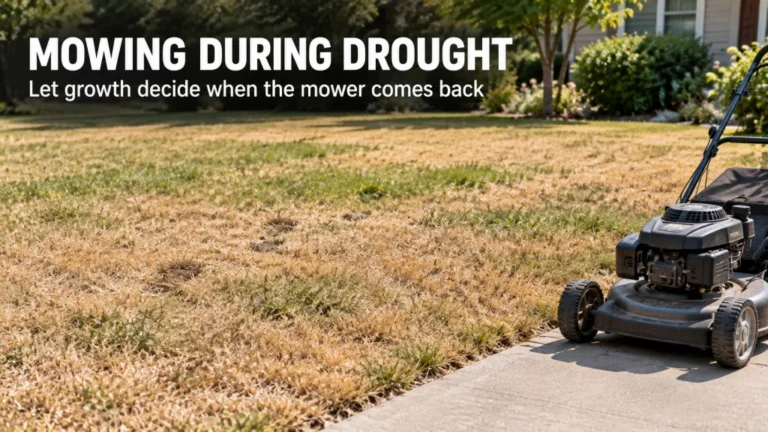
A lawn that has stopped growing does not need to be cut simply because the usual mowing day has arrived. Cool-season grasses can slow sharply or go dormant in hot, dry conditions, while warm-season grasses naturally slow or become dormant in colder conditions. Drought stress can also reduce growth before the turf is fully dormant. In those periods, continuing to mow by habit can add traffic and leaf removal when the grass has little growth to replace what was cut.
Look for a combination of slowed height gain and stress cues rather than assuming brown color alone proves dormancy. Dull color, folded or rolled leaves, and footprints that remain visible longer can be signs that turf is short of water, but those symptoms should be interpreted with soil moisture, recent weather, and grass type. University Extension guidance commonly advises against mowing drought-dormant turf until growth resumes. For the specific decision around dry weather, use the more focused guidance on mowing a lawn during drought.
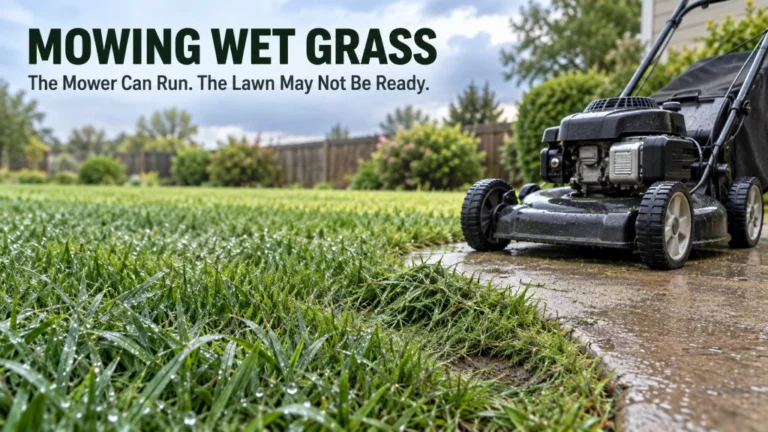
When the lawn is stressed but still growing, it can also make sense to stay toward the higher end of the recommended mowing range for that grass and region. Higher leaf area can improve the plant’s ability to tolerate stressful conditions, but the exact adjustment should follow local turf guidance rather than a universal number. Avoid mowing wet soil simply because rain restarted growth, since mower traffic can rut soft ground and wet grass cuts poorly. Wait until both the turf and the mowing surface are in suitable condition.
The important distinction is between a lawn that is merely growing slowly and one that is actively stressed or dormant. Slow healthy growth may only require a longer interval. Dormancy can require stopping until growth returns. Severe stress calls for reducing additional pressure and checking the underlying condition before deciding that mowing should continue.

This battery-free soil moisture meter uses a single stainless steel probe and provides an instant analog reading. It can add a direct soil-moisture check when turf color and slow growth alone do not tell the whole story. Use the reading alongside weather, grass type, and visible stress cues before deciding whether mowing should continue.
Check On AmazonIf you click this link and buy, we earn a commission at no additional cost to you.
Reset gradually after vacation or missed mowing
If the grass becomes much taller than its normal target, forcing it back to the usual height in one pass can violate the one-third limit. The better reset is to raise the mower for the first cut so that you remove a smaller share of the leaf blade. On later mowings, lower the cutting height in steps until you are back within the appropriate range for the turf. This approach protects more green leaf area while restoring a manageable height.
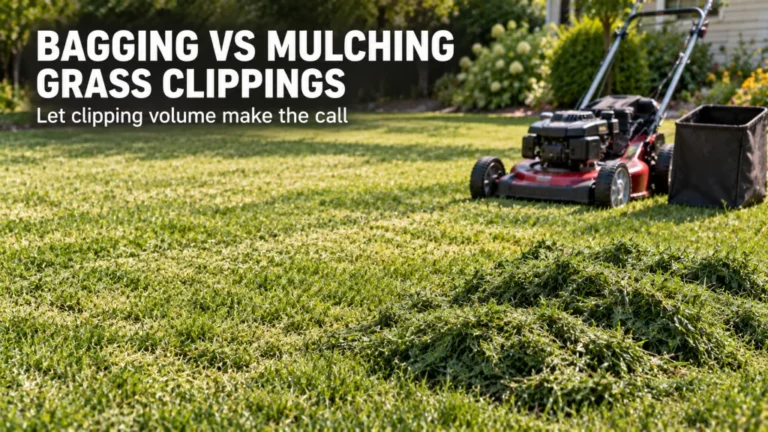
Do not confuse a gradual reset with leaving the lawn excessively high for the rest of the season. The goal is to return to the normal target without one aggressive cut. If the lawn is extremely overgrown, thick clippings may need to be managed so they do not sit in heavy piles that block light and air from the turf beneath them. A normal quantity of small clippings can usually be left to decompose when mowing is frequent enough and the material disperses evenly.
Note: If the mower cannot handle the current height safely or the lawn contains hidden debris, branches, rocks, or other obstacles, clear the area and use a safer staged approach rather than forcing one difficult pass.
After the reset, measure the resulting height instead of assuming the mower’s numbered lever position equals an exact cutting height. Mower settings are not standardized across machines, and actual height can vary with terrain and setup. Once you know what the mower is really leaving behind, the height-trigger method becomes much easier to repeat. The next mowing should then be based on new growth from that restored target.

This steel leaf rake has a 24-inch head and a 54-inch wood handle for routine lawn cleanup. Its flexible steel tines are intended for clearing leaves, straw, hay, grass, and light thatch. After an overgrown lawn is cut in stages, it can help disperse or remove heavy clipping piles that would otherwise sit on the turf.
Check On AmazonIf you click this link and buy, we earn a commission at no additional cost to you.
Use calendar reminders as inspection prompts
A calendar still has value, but its best job is to remind you to inspect rather than to authorize mowing automatically. When the reminder appears, check the current height, look for active growth, and make sure the turf and soil surface are suitable for mower traffic. If the lawn is approaching its trigger, mow. If it has barely changed since the last check, the reminder has done its job even though the mower stays put.
This keeps a household routine without pretending grass grows on a household schedule. You can reserve a regular window for lawn care, then use that window to decide whether mowing, cleanup, or no action is appropriate. The habit is especially useful when weather shifts quickly because the inspection stays consistent even while the mowing interval changes. It also removes the temptation to lower the deck just to make one cut last longer.
A useful inspection can stay very short: compare the current height with the target, confirm that the grass is actually growing, and check whether the surface is dry and firm enough to mow cleanly. Those observations are also more informative than recording the number of days between cuts because they show why the interval changed. If one area repeatedly reaches the trigger first, use that pattern to check for differences in moisture, shade, or fertility rather than forcing the entire lawn into a tighter schedule. The calendar becomes a consistent observation tool instead of a fixed mowing rule.
Once that habit is established, you do not need to rework the schedule every time conditions change. The same inspection works during vigorous growth, ordinary growth, recovery after a missed cut, and seasonal slowdown. Local turf guidance still determines the suitable height range, while the lawn’s present condition determines whether today is a mowing day. That is a simpler routine than trying to predict one correct interval for the entire season.

This 3 x 5-inch top-spiral notebook uses all-weather paper and a compact yellow cover for field notes. It gives you one place to record height checks, rain events, and whether a scheduled lawn inspection led to mowing or no action. Keeping those observations together can turn a calendar reminder into a repeatable condition-check routine.
Check On AmazonIf you click this link and buy, we earn a commission at no additional cost to you.
Final Thoughts: let the lawn set the mowing interval
A useful mowing schedule begins with an appropriate target height and changes as growth changes. During rapid growth, mow more often rather than cutting lower. During slow growth, stretch the interval, and when the turf is dormant or severely stressed, stop treating the calendar as a command. The one-third rule gives you a practical upper limit that ties all of those situations together.
The next time a mowing reminder appears, inspect the lawn before starting the mower. Check whether the grass has actually grown enough to justify a cut, whether the surface is suitable, and whether stress is changing the decision. That simple habit is more adaptable than a universal once-a-week rule. It also keeps the mowing decision tied to the condition of the turf instead of to convenience alone.

This over-the-head hearing protector has a 24 dB Noise Reduction Rating and Bluetooth connectivity. It combines hearing protection with wireless audio in one earmuff-style unit for noisy tasks such as lawn mowing. It is a practical safety accessory for the mowing routine once the lawn condition says it is actually time to cut.
Check On AmazonIf you click this link and buy, we earn a commission at no additional cost to you.
FAQs
🌱 Is mowing once a week enough?
Sometimes, but not as a universal rule. If the grass reaches its height trigger sooner, mow sooner; if growth is slow, a week may pass without any need to cut. Grass type, moisture, temperature, fertility, and season all affect the interval.
📏 How tall should grass be before mowing?
Start with the recommended mowing height for your turfgrass and local conditions. A common one-third rule uses an upper trigger of about one and one-half times the intended post-mow height, but mowing a little earlier is fine. Verify the target height with local Extension guidance.
🌧️ Should I mow right after rain?
Wait until the grass and soil are suitable for mowing. Wet grass can cut unevenly and clump, while soft soil can rut under mower traffic. A growth flush after rain may mean the lawn needs mowing sooner once conditions dry enough.
☀️ Should I mow a drought-stressed lawn?
If growth has stopped because the turf is drought stressed or dormant, delay mowing until active growth resumes. If the lawn is still growing, use the appropriate height for the turf and local conditions rather than cutting lower to stretch the interval. Check soil moisture and grass condition before deciding.
🏡 What if my grass is too tall after I miss a mowing?
Raise the mower for the first cut so you do not remove too much leaf tissue at once. Then lower the height gradually on later mowings until the lawn returns to its normal target. Avoid one aggressive cut back to the lowest setting.
🧭 Does grass type change how frequently I should mow?
Yes. Turf species differ in growth habit, preferred mowing height, and seasonal growth pattern, so two lawns in the same neighborhood can need different mowing intervals. Use local guidance for the dominant grass type and then let current growth determine the next cut.
References and Sources
- University of Maryland Extension, Maintaining an Established Lawn: Supports growth-based mowing frequency, species-specific mowing heights, the one-third limit, and guidance for dormant or drought-stressed turf.
- Alabama Cooperative Extension System, Home Lawn Maintenance: Supports mowing frequency based on turf growth rate, the one-third rule, and gradual height reduction after grass becomes too tall.
- New Mexico State University, Mowing Your Lawn: Supports the height-trigger calculation that links desired mowing height to the maximum height before mowing.