Choosing between thinning and heading is not just a vocabulary choice. A thinning cut removes a branch at its point of origin, while a heading cut shortens a stem and usually concentrates new growth near the cut. For most crowding and form problems, thinning is the cleaner choice because it removes selected growth without asking the plant to replace that tip with a group of shoots. Heading has a place when denser or redirected growth is actually the goal, but the right choice still depends on the plant, its growth stage, and why you are pruning.
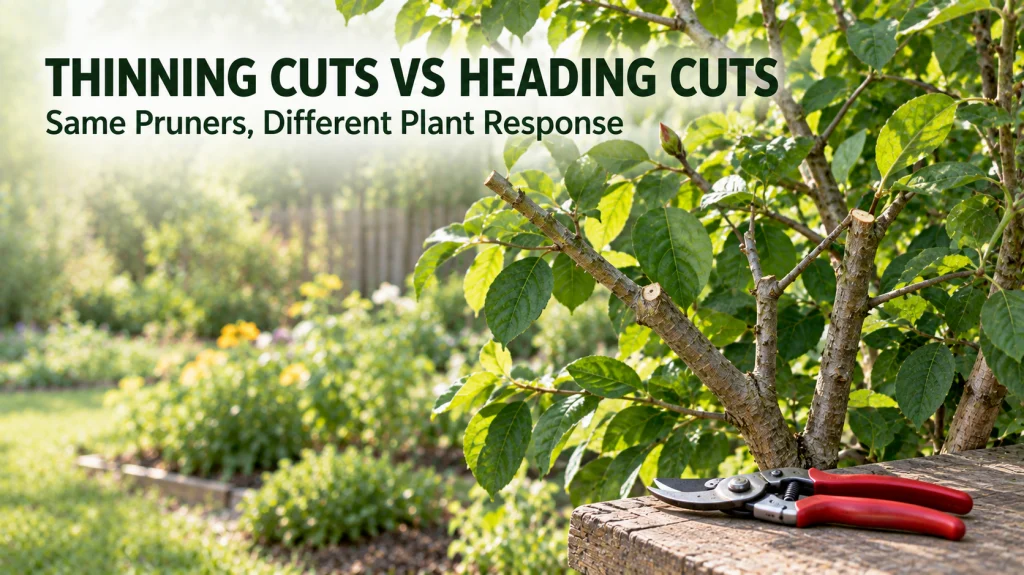
Same tool, different biological message
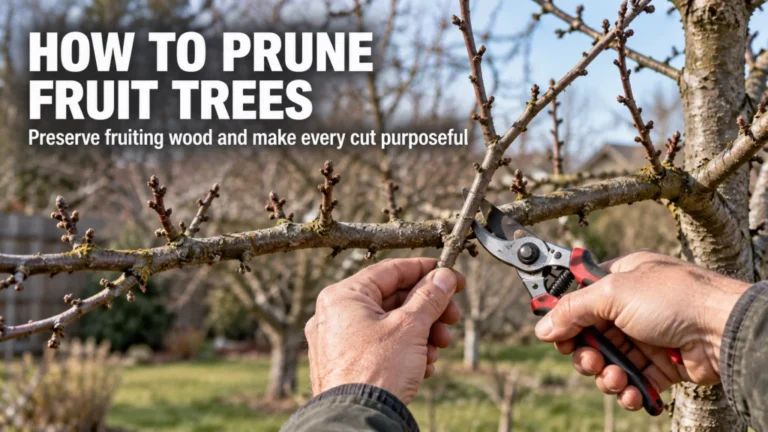
You can remove roughly the same length of growth with the same hand pruners and still give a plant two very different instructions. In practical pruning work around the garden, the important question is not simply how much wood comes off, but where the cut ends the branch. Cut the branch away at its origin and you have made a thinning cut. Shorten that branch partway, usually to a bud or smaller side shoot, and you have made a heading cut.
That placement changes what happens next because the plant is left with a different set of buds and growing points. Thinning usually removes the selected branch without creating the same concentrated flush near the cut, while heading commonly stimulates buds just below the shortened tip. The distinction matters in broader garden care because pruning is not only subtraction, it is also a growth-direction decision. Before cutting, decide whether you want a branch gone or whether you actually want that branch to branch more.

Felco F2 pruning shears are 9.25 inches long and use a precision bypass blade. The aluminum body is paired with replaceable parts for ongoing tool service. This hand-pruner format fits small, reachable pruning where cut placement determines whether a branch is removed or shortened.
Check On AmazonIf you click this link and buy, we earn a commission at no additional cost to you.
Define a thinning cut by where the branch is removed
In common homeowner shrub pruning, a thinning cut removes a shoot, stem, or branch back to the place where it joins a larger branch, the trunk, or in some shrubs, the base of the plant. The useful part of that definition is the destination of the cut, not the tool used to make it. Tree-care terminology can be more specific, with some references separating removal cuts at a parent stem from reduction cuts made back to a suitable lateral. On a multi-stem shrub, thinning may mean taking an older stem all the way back to its origin instead of repeatedly shortening its top.
This is why thinning is often the better match for crowding, crossing growth, unwanted interior stems, and branches that simply do not belong in the finished structure. Removing the branch at its origin reduces the number of growing points in that location and tends to preserve more of the plant’s natural outline. It can also open space and light pathways without building a dense shell of short, repeatedly headed shoots. The practical test is simple: if your goal is to remove that branch rather than make it branch more, think thinning first.

Corona BP 3180D is a forged bypass pruner with a 1-inch cutting capacity. Its hand-pruner format is intended for controlled pruning of stems and branches. It is a practical match for selective thinning cuts on small, safely reachable shrub growth.
Check On AmazonIf you click this link and buy, we earn a commission at no additional cost to you.
Define a heading cut by where the branch is shortened
A heading cut removes the terminal portion of a stem or branch while leaving part of that same stem in place. On young, manageable growth, the cut is typically made in relation to a bud or suitable small lateral so the remaining section has a clear place from which to continue growing. Removing the terminal growing point reduces its control over buds below it, so several nearby buds may begin to grow. That response is exactly why heading can make a shoot or shrub denser.
Heading is therefore not automatically a mistake, but it should have a purpose that matches the regrowth it is likely to create. It can be useful when training young growth, encouraging branching, or directing a small shoot toward a selected bud where species-specific guidance supports that approach. It is a poor default for reducing the size of a mature landscape tree because repeated tip shortening can create vigorous shoots and awkward structure instead of lasting size control. If you do not want more growth near the cut, heading is usually sending the wrong message.

Felco F5 pruning shears are 8.9 inches long and use a precision bypass blade. The listing specifies a forged aluminum body and replaceable parts. The compact hand-pruner format suits deliberate shortening of manageable young growth when a heading cut is appropriate.
Check On AmazonIf you click this link and buy, we earn a commission at no additional cost to you.
Compare the likely regrowth pattern after each cut
The clearest way to choose between heading and thinning cuts is to picture the next flush of growth, not just the plant immediately after pruning. A thinning cut removes one branch and usually shifts growth to the remaining structure more broadly, so the plant often keeps a more open outline. A heading cut leaves the shortened branch in place and commonly activates buds close to the cut, which can produce several shoots in a small area. That concentrated response can be useful for branching, but it can also create congestion when the original problem was already too much density.
The table below turns that biological difference into a homeowner decision. It does not replace plant-specific pruning guidance, because fruiting wood, flowering habit, evergreen growth, and training systems can all change which cut is appropriate. It does give you a reliable first question before the blades close: do you want this branch removed, or do you want this branch to produce more nearby growth? Once that answer is clear, the cut type becomes much easier to choose.
| What you want to change | Cut that usually fits | Likely response to expect |
|---|---|---|
| Remove a crowded or unwanted branch | Thinning cut | The selected branch is gone, with less concentrated regrowth at that point |
| Open a shrub while keeping a natural outline | Thinning cut | More space between remaining stems and less outer-shell density |
| Encourage branching on young growth | Heading cut | More shoots may develop from buds below the cut |
| Redirect a manageable shoot toward a suitable bud | Heading cut | New growth tends to be concentrated near the selected bud and nearby nodes |
| Reduce a mature tree without creating a flush of shoots | Usually not random heading | Use plant-appropriate removal or reduction decisions, and leave large or hazardous work to a qualified arborist |
A common beginner mistake is to keep clipping every long branch back to roughly the same outline because the plant looks smaller for the moment. The immediate result can look tidy, but the next response may be a ring or shell of vigorous shoots around those cut points. Thinning solves a different problem by choosing which branch stays and which branch goes. That distinction is more useful than treating both cuts as interchangeable ways to make a plant shorter.
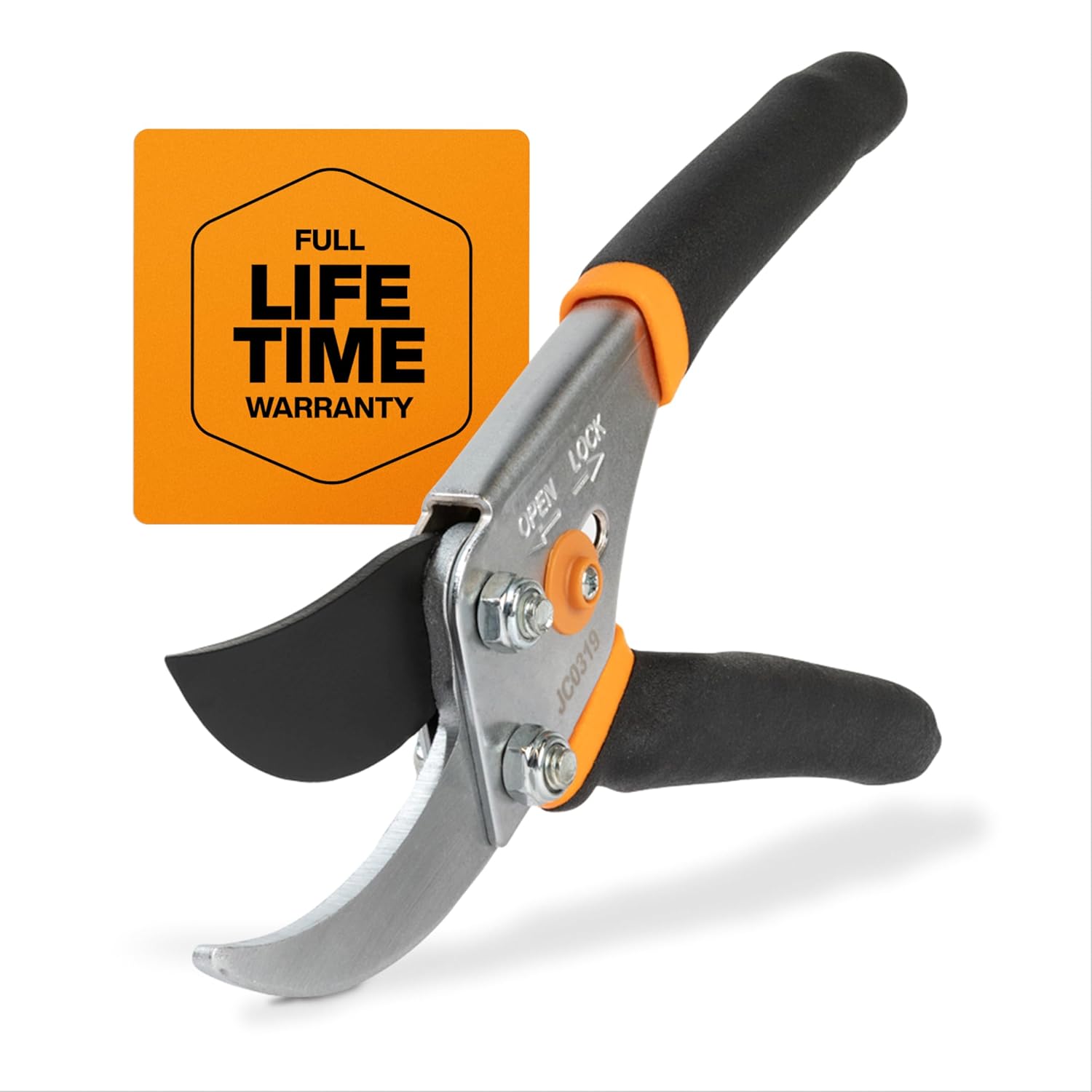
Fiskars bypass pruning shears have a 5/8-inch cut capacity for stems and branches. The steel blades use a low-friction coating, and the tool includes a self-cleaning sap groove and non-slip grip. A standard bypass pruner lets the gardener focus on whether the planned cut should remove a branch or shorten it.
Check On AmazonIf you click this link and buy, we earn a commission at no additional cost to you.
Use thinning to reduce crowding without creating a wall of new tips
When a shrub is crowded, the tempting move is to shorten everything that sticks out. That can make the surface look compact, but it leaves many cut stems around the outside where new shoots can develop close together. Selective thinning works differently because entire stems or branches are removed from their origins, creating real space rather than just trimming the shell. University of Maryland Extension describes this approach as a way to open shrubs without stimulating the same excessive outer growth associated with repeated heading or shearing.
Use that logic when the problem is too many stems competing for the same space, branches rubbing through the center, or an exterior that has become so dense that the interior is shaded. Do not remove wood simply to hit a percentage or create symmetry from every viewing angle, because species, plant vigor, and the amount of live foliage remaining all matter. Work branch by branch and stop when the reason for pruning has been solved rather than continuing because the pruners are already in your hand. A less dramatic cut that fixes the actual crowding problem is often easier for both the plant and the person who has to manage the next flush.

Haus & Garten ClassicPRO is an 8.5-inch handheld bypass pruning shear. The bypass cutting format is designed for garden pruning rather than shearing an entire outer surface at once. That makes this tool type well suited to selective stem-by-stem thinning on shrubs that remain safely reachable from the ground.
Check On AmazonIf you click this link and buy, we earn a commission at no additional cost to you.
Use heading only where denser or redirected growth is actually wanted
Heading becomes useful when the desired result includes more branching near a chosen point. On young shoots, a properly placed cut near a suitable bud can redirect growth and encourage lateral development, which is useful in some training and shaping situations. That is very different from shortening mature branches indiscriminately just because the plant feels too large. The same cut that helps a young shoot branch can create unwanted density, upright regrowth, or repeated maintenance when used for the wrong purpose.
Before making a heading cut, identify what will remain below it and whether you actually want those buds to grow. If the answer is yes, choose a bud or small lateral whose direction makes sense for the plant’s form, then follow species-specific guidance for exact placement and timing. If the answer is no, reconsider whether the branch should be thinned out instead. The useful question is not whether heading is good or bad, but whether the expected shoot response helps the plant you are managing.

Felco F322 pruning snips are 9.84 inches long with a curved carbon-steel blade and rounded tip. The blade includes a sap groove for routine plant clipping. The narrow snip format is a practical match for controlled cuts on small young growth where bud direction matters.
Check On AmazonIf you click this link and buy, we earn a commission at no additional cost to you.
Avoid random midpoint cuts that create weak or awkward regrowth
A branch that is simply cut off halfway between useful growing points has no clear structural destination. On woody plants, leaving a stub can delay closure and create a poor transition between live tissue and the dead portion beyond the nearest active growth point. On larger branches, severe heading can also provoke groups of vigorous upright shoots near the cut, especially when the plant tries to replace lost terminal growth. That is one reason random midpoint cuts are a poor way to manage the size of established trees.
If a branch needs to disappear, remove it correctly at its point of origin while preserving the branch collar. If a young shoot needs to be shortened for a valid training reason, make the cut in relation to an appropriate bud or lateral instead of choosing a convenient point in open stem. If what you are really trying to do is reduce the height or spread of a mature tree, that is no longer a simple choice between two cuts made wherever you can reach. Large limbs, elevated work, unstable branches, split trunks, or anything near electrical lines belongs with a qualified arborist rather than a homeowner improvising a midpoint cut.

gonicc GPPS-1003 is an 8-inch handheld bypass pruning shear for garden clipping and pruning. Its bypass configuration is intended for controlled cuts on stems and small branches. Used on appropriately sized, reachable growth, this tool type supports deliberate cuts at a bud, lateral, or branch origin instead of arbitrary midpoint clipping.
Check On AmazonIf you click this link and buy, we earn a commission at no additional cost to you.
Read branch collars, buds and laterals before placing the cut
The plant usually tells you where the useful decision points are if you slow down before cutting. At a branch union, look for the swollen or ridged tissue associated with the branch collar and avoid cutting flush into the trunk or parent stem. Along a young shoot, identify buds and side branches rather than treating the stem as an empty stick that can be shortened anywhere. Those landmarks separate a deliberate pruning cut from a cut that merely removes length.
A quick inspection also helps you decide whether the branch should be removed, redirected, or left alone. Branches that cross, rub, crowd the center, or grow from an unwanted origin may point toward thinning, while a young shoot that genuinely needs controlled branching may justify heading. Use the cut only after you can identify the growth point or branch union that will remain. Before cutting, check the following points rather than deciding from distance alone.
- Where does this branch or shoot originate?
- Is there a visible branch collar that should be preserved?
- Which buds or laterals will remain after the cut?
- Do I want growth concentrated near this point, or do I want the branch gone?
- Is the work small, stable, and safely reachable from the ground?
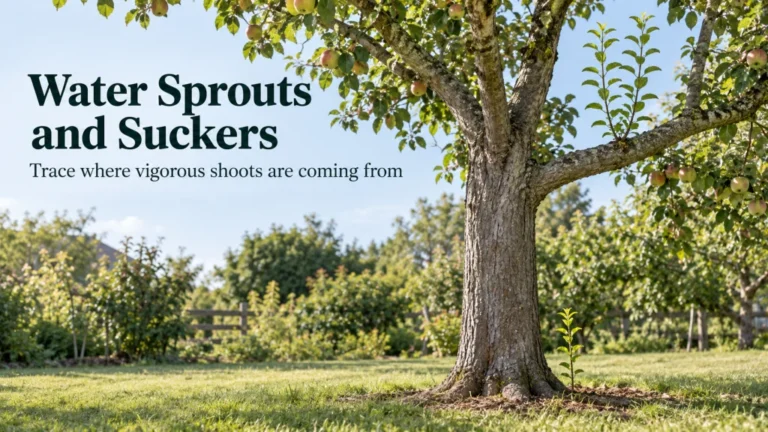
If the branch keeps producing vigorous upright shoots after previous pruning, do not automatically cut every new shoot back halfway again. First identify whether they are water sprouts or suckers and why they are appearing, because repeating the same heading pattern can keep the cycle going. The location of the next cut should solve the underlying branch-selection problem rather than create another set of cut tips. Reading the structure first is slower than clipping by outline, but it usually leads to less corrective pruning later.

Fiskars 6-inch Micro-Tip pruning scissors are made for flower stems, herbs, buds, and other small plants. The tool uses stainless steel blades, an Easy Action spring, and a SoftGrip handle. The fine-tip format is useful when the pruning decision depends on seeing a small bud or lateral clearly before cutting.
Check On AmazonIf you click this link and buy, we earn a commission at no additional cost to you.
Apply the distinction to shrubs and fruiting wood without overriding species guidance
The thinning versus heading distinction transfers across many woody plants, but the exact pruning plan does not. A deciduous shrub grown for a loose natural form may respond well to removal of selected older or crowded stems, while a trained fruit tree may use both thinning and heading for specific structural or fruiting goals. Flowering habit matters too, because cutting at the wrong stage can remove flower buds even when the cut itself is technically well placed. That is why cut type answers one question, while species and timing answer another.
Before pruning a fruiting or flowering plant, verify whether flowers or fruit are produced on current growth, older wood, spurs, or another species-specific structure. Then use the thinning or heading decision only inside that larger care plan rather than letting the terminology override plant biology. The same caution applies to evergreens, because some species do not reliably regrow from old bare wood after severe shortening. For seasonal timing, use plant-specific guidance and the broader framework for when to prune trees and shrubs instead of applying one national calendar to every plant.

VELCRO Brand ONE-WRAP Garden Ties come as a 50-foot by 1/2-inch cut-to-length roll. The reusable adjustable ties are designed for staking, supporting, training, and organizing plants. They are useful alongside species-specific pruning when young fruiting or flowering growth also needs gentle positioning and support.
Check On AmazonIf you click this link and buy, we earn a commission at no additional cost to you.
Final thoughts: choose the cut by the response you want
At the branch, the useful pause is not which cut is better, but what you want that specific growth point to do next. A crowded stem that should no longer occupy space points toward removal at its origin, while a shoot being trained may call for controlled shortening. That decision should still sit inside plant-specific guidance, especially for flowering shrubs, fruiting wood, and established trees. If the likely regrowth would create a new maintenance problem, the cut is probably solving the wrong problem.
Before each cut, trace the branch back to its origin and identify the buds, laterals, or collar that will remain. On established trees, pruning terminology may distinguish removal and reduction cuts more specifically than the broad thinning-versus-heading shorthand used for many shrubs, so use plant-specific guidance rather than forcing every tree cut into two labels. If the reason for the cut is still vague, leave it alone until the decision is clearer. Keep homeowner pruning to small, stable, safely reachable work, and use a qualified arborist when large limbs, climbing, unstable wood, or electrical hazards enter the job.

DECERK pruning shears use an 8.5-inch handheld bypass format for garden pruning. The listing specifies a cutting capacity of up to 3/4 inch for branches. This size keeps the product aligned with small, ground-level pruning where the branch structure and intended regrowth have already been considered.
Check On AmazonIf you click this link and buy, we earn a commission at no additional cost to you.
Frequently asked questions
The questions below focus on placement mistakes and boundary cases rather than repeating the main comparison. They are most useful when a cut looks simple but plant age, crop type, branch size, or growth habit changes the answer. Use them as a check before making the cut, then return to species-specific guidance when the plant has a specialized flowering, fruiting, or training requirement. Safe access remains a separate decision from cut type.
One recurring mistake is choosing a cut from the plant’s current silhouette instead of the branch structure that will remain. Trace the stem to its origin, identify the next viable bud or lateral, and decide what response would actually help. That approach is slower than clipping every long shoot to one outline, but it reduces the chance of creating another round of corrective pruning. If the work moves beyond small, stable, ground-level pruning, the safer next step is professional help.
🌿 Which cut makes a shrub bushier?
A heading cut usually encourages more shoots from buds near the cut, so it can make growth denser. Whether that is useful depends on the shrub and the form you want, because repeated heading can also create a crowded outer shell.
✂️ Can a thinning cut reduce the size of a plant?
Yes, when selected branches are removed back to their origin, thinning can reduce bulk while preserving more of the plant’s natural structure. It is not a license to remove large amounts of canopy at once, so keep the amount and timing appropriate for the species and plant condition.
🌱 Where should a heading cut be made?
On small, appropriate growth, place a heading cut in relation to a viable bud or suitable lateral rather than in an arbitrary stretch of stem. Exact placement can vary by plant type, so species-specific pruning guidance should take priority over a generic distance rule.
🌳 Is heading the same as topping a tree?
Topping is a severe form of indiscriminate heading used to reduce tree size without proper branch-selection logic. A deliberate heading cut on young, manageable growth is not automatically the same thing, but random heading of mature tree branches can create many of the same structural problems.
🍎 Should fruit trees use only thinning cuts?
No. Fruit-tree training systems can use both thinning and heading, but the purpose, age of the wood, crop, and training method matter. Follow crop-specific guidance instead of applying a landscape-shrub rule to fruiting wood.
🪵 What should I do if a branch is too large to prune safely?
Do not turn a large or hazardous limb into a homeowner experiment with a heading cut. If the work involves climbing, unstable wood, large suspended weight, split trunks, or power lines, use a qualified arborist.
References and sources
Pruning advice becomes unreliable when every woody plant and every cut is treated as if it responds the same way. The Extension references below agree on the core distinction between removing a branch at its origin and shortening a branch to stimulate or redirect growth. They also support preserving the branch collar and avoiding indiscriminate heading on established landscape trees. Species-specific guidance should still take priority when flowering, fruiting, evergreen growth, or training systems change the decision.
These sources are limited to the points that directly support the homeowner decisions in this article. They are not being used to create a universal pruning calendar or a single rule for every shrub and tree. Large, elevated, unstable, or electrical work remains outside ordinary homeowner pruning even when the cut terminology is understood. For routine pruning, the useful takeaway is to match cut placement to the biological response you actually want.
- University of Maryland Extension, pruning tree and shrub basics: Supports homeowner pruning objectives, removal of unwanted growth, and the need for professional help around power lines.
- University of Maryland Extension, pruning shrubs and hedges in the home garden: Supports the response difference between thinning and heading cuts in shrubs and the effect of repeated shearing on plant density.
- Colorado State University Extension, pruning cuts: Supports branch-collar placement and the growth response that follows heading cuts.
- University of New Hampshire Extension, basics of pruning trees and shrubs: Supports the distinction among heading, thinning, reduction, and removal terminology and reinforces choosing cuts by the growth response they create.