The best time to water a garden is usually early morning, especially when sprinklers or a hose will wet leaves. Cooler conditions can reduce evaporation, and foliage that gets wet has a better chance to dry instead of staying damp through the night. Evening can still be practical when water is delivered directly to the root zone, while a genuinely dry root zone may need water sooner rather than waiting for a preferred window. The useful rule is to match timing to soil moisture, weather, and the way the water reaches the plants.
The clock is only one input
At 2 p.m., a garden bed can have a dry root zone even though the standard advice says to wait until tomorrow morning. Timing matters because temperature, wind, and leaf wetness can change how efficiently water is used, but the clock does not tell you whether roots already need moisture. Waiting for the preferred window can be the worse choice when the root zone is genuinely dry, especially around vulnerable or recently planted plants. Before deciding, check below the soil surface and, if you are still working out how often your garden needs water, let that moisture check come before any fixed schedule.
Once the need for water is confirmed, time of day becomes a trade-off rather than a command. Early morning remains a strong default when watering may wet leaves, while a drip line or careful base watering reduces the importance of leaf-drying time. Wind, heat, planting stage, and the amount of soil available to roots can all make one window more practical than another. Local watering restrictions still take priority where they apply, but within those limits the useful question is whether the chosen time and method will get water into the root zone with acceptable losses.

This battery-free meter uses a single 304 stainless steel probe to give an instant soil-moisture reading. Its clear analog display is designed for indoor and outdoor plant checks. Use it below the surface to compare actual root-zone moisture with a fixed watering schedule.
Check On AmazonIf you click this link and buy, we earn a commission at no additional cost to you.
Use early morning as a default when overhead watering may wet leaves
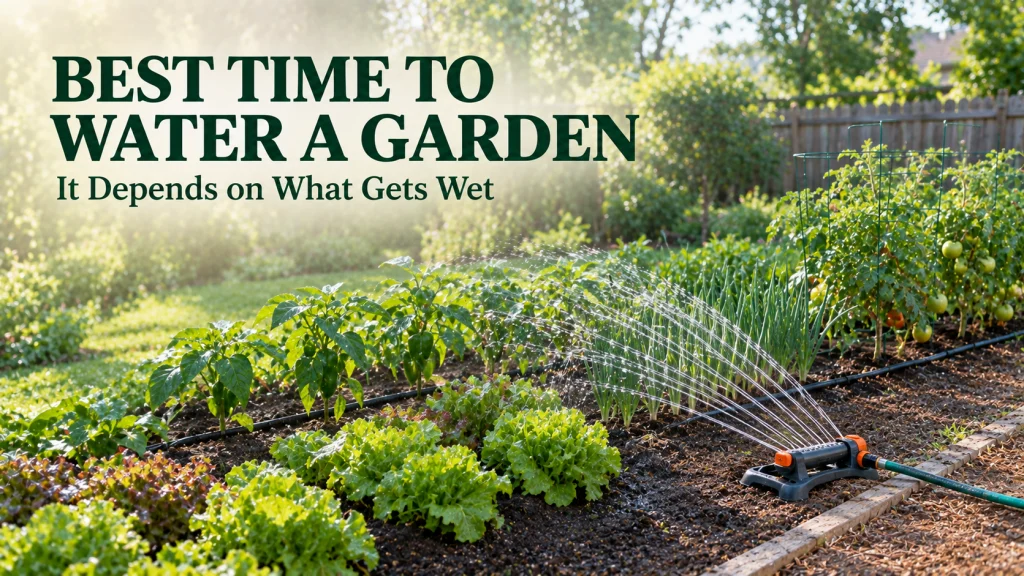
If a sprinkler, watering wand, or hose spray is going to wet foliage, early morning is the most useful default for a general home garden. Air and soil surfaces are usually cooler than later in the day, so less applied water is lost immediately to evaporation. More important for leaf wetness, plants have daylight and moving air ahead of them, which gives wet foliage a better chance to dry. That combination is why extension guidance commonly favors morning watering when overhead irrigation is used.
The disease point needs a boundary, because wet leaves do not mean a plant will automatically develop a disease. Disease depends on the plant, the pathogen, the environment, and how long favorable conditions persist. Still, repeatedly extending leaf wetness is a controllable risk factor, so it makes sense not to create a longer wet period when you can avoid it. Morning watering is therefore a practical risk-reduction habit, not a guarantee of healthy plants and not a substitute for correct watering depth or frequency.

This 16-inch garden-hose wand provides eight spray patterns for different watering jobs. A front trigger, flow-control knob, and trigger lock let you control the application from the handle. Its 3/4-inch GHT connection fits the hose-end role described in this section.
Check On AmazonIf you click this link and buy, we earn a commission at no additional cost to you.
Treat evening differently when foliage will stay wet overnight
Evening watering gets a bad reputation because two different situations are often treated as the same thing. A sprinkler that leaves leaves wet as the garden heads into a long cool period can extend leaf wetness, which may favor some disease problems. A drip line or soaker hose that wets the soil while keeping foliage mostly dry does not create that same leaf-wetness pattern. This is the useful distinction in morning versus evening watering: wet soil and wet foliage are not the same exposure. The method matters enough that an evening root-zone watering can be reasonable when morning does not fit your routine.
That distinction is especially useful for gardeners who are home only later in the day. If evening is your realistic watering window, aim water at the soil, avoid spraying foliage unnecessarily, and stop before the bed becomes saturated or runoff begins. Do not compensate for an inconvenient schedule by giving shallow splashes every day, because the root zone still needs an effective watering rather than a damp-looking surface. A workable routine that reaches the roots is more useful than an ideal time that you cannot consistently use.

This 25-foot flat weeper hose is made for watering garden beds and planted areas. Its flexible hose layout lets water reach vegetable and flower beds without relying on overhead spray. That makes it a direct fit for evening root-zone watering when reducing unnecessary foliage wetting matters.
Check On AmazonIf you click this link and buy, we earn a commission at no additional cost to you.
Do not delay urgently needed root-zone water just to obey a clock rule
A preferred watering window should not become a reason to leave a genuinely dry root zone dry for many more hours. Newly planted vegetables, flowers, shrubs, and container plants can have limited access to stored soil moisture, so a missed watering can matter more to them than it does to an established planting with a larger root system. Check the soil where active roots are likely to be, and consider recent heat, wind, rainfall, and planting stage before deciding to wait. If the root zone is clearly dry and the plant is vulnerable, getting water into the soil can take priority over waiting for the next ideal window.
At the same time, visible wilting during a hot part of the day is not proof that irrigation is required. Some plants wilt temporarily even when the soil still contains usable moisture, and overwatered plants can also wilt when roots are stressed. Use the plant as a signal to investigate, then confirm moisture in the root zone before turning on the water. That extra check prevents a timing article from turning into an overwatering rule.
Emergency exception: If the root zone is clearly dry around a vulnerable plant, water the soil when it is needed rather than withholding water only because the timing is not ideal. Keep the application focused on the root zone and reduce unnecessary leaf wetting. Apply water slowly enough that it can soak in instead of simply running away from the plant. Reassess moisture afterward instead of automatically adding another watering.

This 2-gallon watering can is designed for indoor and outdoor plants. Its removable nozzle and drip-free head provide better control over water flow. That control is useful when a vulnerable plant needs water placed at the root zone instead of waiting for the next preferred watering window.
Check On AmazonIf you click this link and buy, we earn a commission at no additional cost to you.
Let wind and heat change evaporation losses
Hot, dry air increases water loss from soil and plants, while wind can make overhead watering less uniform by carrying droplets away from the intended area. That does not mean water applied later in the day suddenly becomes useless, but it can make a sprinkler less efficient and less predictable. If spray is drifting onto a path, fence, or neighboring bed, changing the watering time may help, but changing the delivery method can help even more. The goal is not to win an argument about the clock; it is to get enough water into the root zone without wasting much of it.
- Move overhead watering toward a cooler, calmer window when heat or wind is causing obvious spray loss.
- Keep root-zone methods focused on the soil rather than extending watering just because evaporation is lower.
- Recheck exposed beds and containers more often during hot, windy weather instead of assuming yesterday’s moisture level still applies.
Heat also changes how you interpret what you see. A bed that was adequately moist earlier may dry faster under high temperatures, especially if plants are newly established, the soil is sandy, or the planting is exposed to wind. Containers can lose moisture faster than in-ground beds because their root volume is limited and their sides are exposed to warm air. Check actual moisture more often under those conditions, then use timing to improve efficiency rather than as a substitute for observation.

This single-outlet hose timer is battery powered and uses an LCD screen for programming. It includes a built-in rain-delay function and a water-resistant housing. A programmable hose timer can shift watering toward cooler or calmer periods without requiring you to be at the faucet.
Check On AmazonIf you click this link and buy, we earn a commission at no additional cost to you.
Pair time of day with the actual delivery method
The best watering window changes in importance depending on what your equipment gets wet. Overhead methods put timing and leaf drying near the center of the decision because foliage, flowers, and surrounding surfaces may all receive water. Root-zone methods reduce that concern and let you focus more on soil moisture, runoff, and whether water is reaching the full root area. If you need a broader method framework, how to water a garden effectively starts with where the water needs to go rather than with a clock rule.
| Watering situation | Useful default | What can change the decision |
|---|---|---|
| Sprinkler or overhead hose spray | Favor early morning | Wind, evaporation, and how long foliage is likely to stay wet |
| Drip irrigation or soaker hose | Morning is still convenient, but evening can also work | Soil moisture, runoff, and whether the system actually wets the root zone |
| Hand watering at the base of individual plants | Use a cooler part of the day when practical | Urgent dryness, planting stage, container size, and how precisely water can be placed |
| Clearly dry root zone around a vulnerable plant | Water when needed | Confirm soil moisture first and keep unnecessary leaf wetting low |
Use the matrix as a starting point, then check what happened after you water. If water runs off before soaking in, pools around roots, or leaves a large part of the root zone dry, changing the hour will not fix the application problem. A slower application, a different placement, or a shorter cycle followed by time for water to soak in may be more useful. Timing works best when the delivery method is already matched to the bed, container, or planting.

This landscape and garden kit includes 1 GPH and 2 GPH drippers, adjustable micro bubblers, and adjustable micro sprays. It also includes distribution tubing, a faucet connection, a pressure regulator, and fittings. The components let you route different delivery methods close to planted areas instead of depending on one overhead pattern.
Check On AmazonIf you click this link and buy, we earn a commission at no additional cost to you.
Final thoughts: use the best default window, but do not delay water when the garden clearly needs it
Early morning is a useful default, especially when irrigation will wet foliage, because it usually offers a better combination of lower evaporation and drying time. That default becomes less decisive when water goes directly to the soil, and it should not override a confirmed need for water in a vulnerable root zone. The practical advantage comes from using timing to improve an already sound watering method, not from treating one part of the day as universally correct. A schedule is useful only while it still matches the conditions in the bed or container.
Before watering, verify moisture where the roots are rather than judging only the surface or a temporarily wilted leaf. Then account for wind, heat, planting stage, and what the chosen method will actually wet. Those checks tell you whether to keep the normal morning routine, use a careful evening application, or water sooner because waiting would add unnecessary stress. The best routine is the one that gets needed water into the root zone with the fewest avoidable losses and complications.

This acrylic rain gauge has a 5-inch rainfall capacity and a magnifying design for easier reading. It gives you a simple local record of recent rainfall between watering checks. Pair that rainfall total with soil-moisture observations before deciding whether a routine watering window still matches garden conditions.
Check On AmazonIf you click this link and buy, we earn a commission at no additional cost to you.
Frequently asked questions
🌅 Is morning or evening better for watering a garden?
Morning is the stronger default when your method wets leaves because evaporation is generally lower than later in the day and foliage has time to dry. Evening can still work well when drip irrigation, a soaker hose, or careful hand watering keeps most foliage dry.
🌙 Is it okay to water a garden in the evening?
Yes, especially when you can put water directly into the root zone without soaking leaves. If you use overhead watering, avoid creating a routine that leaves foliage wet for a long period overnight.
☀️ Should I avoid watering during a hot part of the day?
A cooler period is usually more efficient because less water is lost to evaporation, especially with overhead watering. However, if the root zone is clearly dry around a vulnerable plant, water the soil rather than delaying only to follow a preferred schedule.
🍃 Does watering leaves cause plant disease?
Wet foliage alone does not guarantee disease, but longer leaf-wetness periods can favor some plant diseases when a susceptible plant and suitable pathogen are also present. Keeping irrigation focused on the root zone reduces unnecessary leaf wetness.
💧 Does drip irrigation have to run in the morning?
No. Morning is still a useful routine, but drip irrigation changes the timing trade-off because it can keep foliage dry while delivering water to the soil. Soil moisture, runoff, and the plant’s actual need should still guide the decision.
🪴 Do containers need a different watering time?
Containers can dry faster than in-ground beds, so moisture checks may need to be more frequent during hot, windy weather. Use a cooler part of the day when practical, but do not leave a clearly dry container waiting solely for an ideal watering window.
References and sources
- Iowa State University Extension watering tips: Supports root-zone watering, morning timing, evaporation considerations, and avoiding unnecessary foliage wetting.
- Iowa State University Extension garden watering timing: Supports the distinction between overhead watering and root-zone methods when comparing morning and evening watering.
- Purdue Extension garden watering guidance: Supports deep watering, checking soil conditions, and using morning timing when overhead irrigation wets foliage.
- Iowa State University Extension container watering guidance: Supports the caution that wilting alone does not prove a plant needs more water and that saturated roots can also be stressed.