Watering time only becomes useful after you know how much water the garden needs and how quickly your setup delivers it. A hose that runs for the same number of minutes can deliver a very different volume after changes in pressure, nozzle setting, hose length, or outlet restriction. Measure flow with the setup you actually use, convert the target water volume into an initial runtime, then check whether that water reached the intended root zone without excessive runoff. Sprinklers, soaker hoses, and drip systems need their own output checks because source flow alone does not show how evenly water reaches the soil.
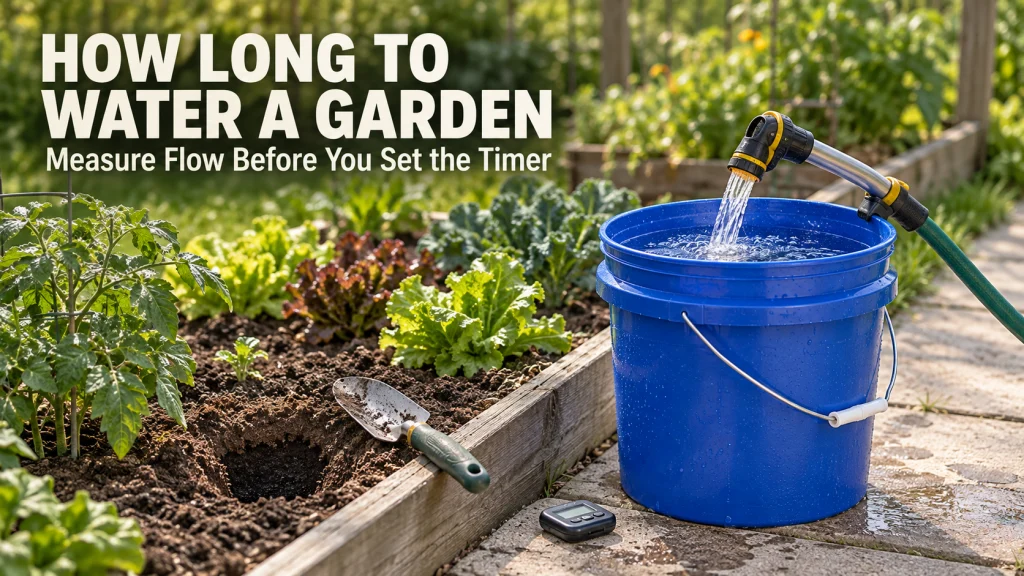
Minutes are not a water dose until flow is known
How long to water a garden sounds like a timer question, but the timer is only the last part of the calculation. Put two hoses beside the same bed and test them before the same 30-minute run: one might fill a 5-gallon bucket in 1 minute while the other takes 2.5 minutes. At those measured rates, the first setup would move about 150 gallons in 30 minutes and the second about 60 gallons, even though the timer shows the same number. Time by itself tells you how long the faucet was open, not how much water reached the root zone.
The practical sequence is volume first, flow second, runtime third, and soil verification last. The target volume should come from the actual garden situation, including recent rain, plant stage, soil, weather, and the area being watered, rather than from a universal weekly timer setting. Once you know the gallons you intend to apply, the arithmetic is simple enough for a homeowner to repeat whenever the setup changes. The final check is physical: water should move into the intended soil depth without simply running off, pooling, or soaking only one small patch.

The P3 P0550 two-pack fits a standard garden hose and measures watering use in gallons or liters. Its LCD meter tracks both single-use and accumulated water volume. That gives a direct volume check for a timed watering session instead of relying on minutes alone.
Check On AmazonIf you click this link and buy, we earn a commission at no additional cost to you.
Measure hose or outlet flow with a bucket test
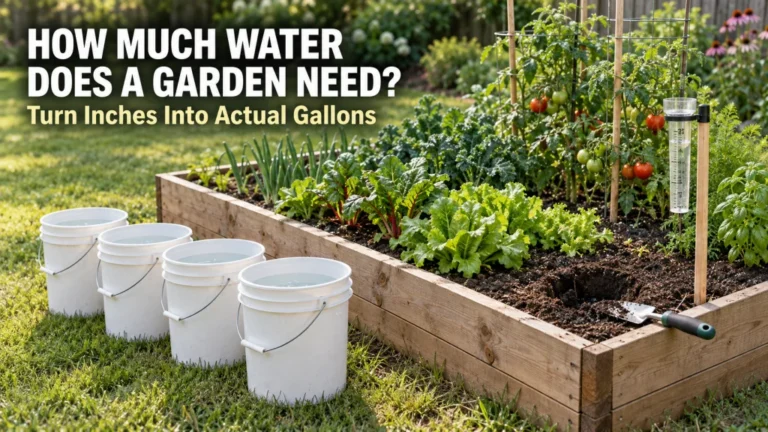
A bucket test is the cleanest way to measure a hose because it captures the combined effect of the faucet, hose, fittings, nozzle, and pressure setting you actually plan to use. Use a container with a known volume, keep the hose configured exactly as it will be during watering, and time how long it takes to fill the container. If you normally water through a wand or nozzle, leave that attachment in place and use the normal setting rather than testing a wide-open hose end. Changing the attachment or pressure after the test changes the flow rate, so the old number may no longer describe the setup.
Convert the fill time to minutes, then divide the bucket volume by that time to get gallons per minute. For example, if a 5-gallon bucket fills in 2.5 minutes, the measured flow is 2 gallons per minute. If the same bucket fills in 1 minute, the flow is 5 gallons per minute, so the same 30-minute session would move far more water. Repeating the test when the setup changes is more reliable than assuming a typical garden hose output from a chart.
| Bucket-test step | What to record | Your number | Calculation |
|---|---|---|---|
| Container volume | Known capacity of the bucket or container | _____ gallons | Use this as the measured volume. |
| Fill time | Time required to reach that known volume with the normal watering setup | _____ minutes | Convert seconds to a fraction of a minute if needed. |
| Measured flow | Bucket volume divided by fill time | _____ gallons per minute | _____ gallons ÷ _____ minutes = _____ gallons per minute |
| Target volume | Gallons you intend to apply to the target area | _____ gallons | Choose this from the garden’s actual water need before setting runtime. |
| Initial runtime | Target gallons divided by measured flow | _____ minutes | _____ gallons ÷ _____ gallons per minute = _____ minutes |
Keep the result with the hose setup rather than treating it as a permanent property of the faucet. A different nozzle pattern, kinked hose, added splitter, partially closed valve, or changed supply condition can alter the number. If the measured flow seems inconsistent from one test to the next, solve that inconsistency before building a watering routine around it. A repeatable measurement is more useful than a precise-looking number from an unstable setup.

The Leaktite 5GLSKD is a 5-gallon white plastic pail made from heavy-duty polyethylene. It has a reinforced lip and solvent-resistant construction for repeated utility use. Its known 5-gallon capacity provides a fixed volume for timing a hose bucket test.
Check On AmazonIf you click this link and buy, we earn a commission at no additional cost to you.
Translate the target gallons into an initial runtime
Once you have a target volume, divide the gallons needed by the measured gallons per minute. Iowa State Extension notes that applying 1 inch of water over 1 square foot requires about 0.623 gallon, which makes area-based examples easy to calculate without pretending that every garden needs the same inch target. A 4-by-8-foot bed has 32 square feet of surface area, so 1 inch over that area is about 19.9 gallons, while one-half inch is about 10 gallons. Those are volume conversions, not instructions that every 4-by-8 bed should receive those amounts on a fixed schedule.
If you are still deciding whether the bed needs water, how much recent rain counts, or how soil and plant stage affect frequency, start with how often to water a garden under changing conditions before calculating minutes. Runtime becomes useful only after the water target is sensible for that specific situation. A newly transplanted crop, an established perennial bed, sandy soil, and moisture-retentive soil can all require different decisions even when the measured hose flow is identical. The calculation converts a chosen volume into time, but it does not choose the correct volume for you.
| Example target | Measured flow | Initial runtime |
|---|---|---|
| 10 gallons | 2 gallons per minute | 5 minutes |
| 10 gallons | 4 gallons per minute | 2.5 minutes |
| 20 gallons | 2 gallons per minute | 10 minutes |
| 20 gallons | 5 gallons per minute | 4 minutes |
The examples show why garden watering time cannot be separated from flow. Two gardeners can aim for the same 10-gallon dose and end up with runtimes that differ by a factor of two simply because one setup delivers twice the flow. Round the result to a practical starting point, then let infiltration and soil checks refine it rather than chasing seconds of arithmetic precision. The math gives you a controlled first attempt, not permission to ignore what the water does after it leaves the hose.

The Orbit 62061 is a single-outlet, battery-powered hose watering timer with an LCD screen. It supports adjustable watering duration and includes a built-in rain delay for outdoor use. Once target gallons and measured flow are converted into minutes, the timer can repeat that chosen runtime consistently.
Check On AmazonIf you click this link and buy, we earn a commission at no additional cost to you.
Account for multiple passes or uneven hand watering
Hand watering introduces a second problem after flow is measured: distribution depends on where you point the water and how quickly you move. A calculated 8-minute runtime does not help if six minutes are spent around one end of the bed and the remaining two minutes are swept across everything else. Divide the bed into repeatable zones, or make several passes so each part receives a similar share of the total runtime. On sloped, crusted, compacted, or very dry soil, slower repeated passes can also give water more time to infiltrate before the next application.
This is where a high-flow hose can become harder to manage even though it shortens the theoretical runtime. If water starts moving across the surface, splashing soil, or pooling before it can soak in, reduce the application rate or pause and return after the first pass has infiltrated. The objective is not to finish the calculated minutes as quickly as possible, but to deliver the intended volume into the root zone with limited runoff. A lower-flow setting can take longer while still producing the better watering result.
Keep the math attached to the whole area, not to one favored plant or one easy-to-reach edge. If you divide a 12-minute session into three passes, that can mean roughly four minutes per pass across the entire target area, not four minutes on each plant unless that was how the target volume was calculated. Consistency matters more than a perfectly equal sweep, especially in an irregular bed. The next step is to check whether that distribution actually produced the moisture depth you intended.

The Dramm 14805 One Touch Rain Wand is a 30-inch aluminum watering wand with thumb-operated flow control. Its design allows water flow to be started, stopped, and adjusted without continuously squeezing a trigger. That control is useful when making slower or repeated passes across a garden bed to limit runoff.
Check On AmazonIf you click this link and buy, we earn a commission at no additional cost to you.
Verify the result below the soil surface
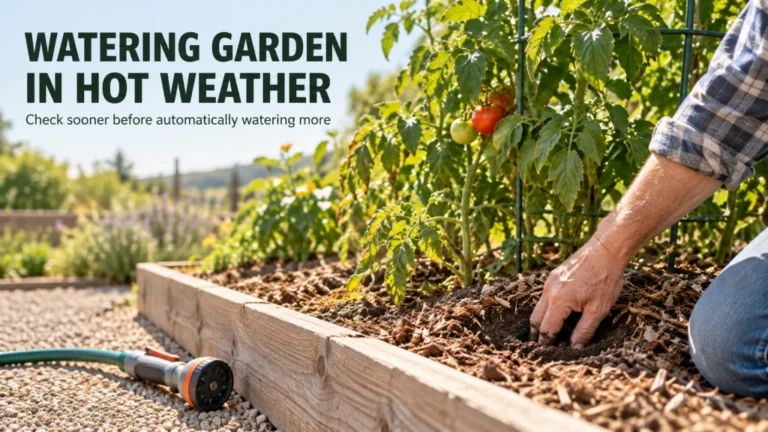
A dark soil surface can look thoroughly watered while the layer below is still dry, especially after a quick pass with a strong spray. Extension guidance commonly emphasizes wetting the root zone rather than repeatedly dampening only the surface, and Iowa State suggests checking whether moisture has reached roughly 5 to 6 inches for general garden watering. That depth is a useful verification point for many established garden situations, not a universal rooting depth for every crop or every planting stage. Seedlings, shallow containers, newly set plants, and species with different root patterns need a check that fits their actual root zone.
After the initial runtime, wait long enough for the applied water to move into the soil, then use a trowel, narrow hole, or direct soil feel to see how far the moist zone extends. If only the upper layer is wet, the answer may be more total volume, slower application, or another pass after infiltration rather than simply adding an arbitrary number of minutes. If the target zone is already wet and water is moving below it, shorten the next application or reassess whether irrigation was needed. Soil texture, compaction, organic matter, slope, mulch, and prior dryness can all change how the same gallon amount moves through the profile.
- Check whether the target root zone is moist, not just whether the surface is dark.
- Look for runoff, puddling, or water leaving the bed before counting the application as successful.
- Compare the result across more than one spot if the bed is large or the soil is variable.
- Adjust the next runtime only after deciding whether the problem was total volume, flow rate, or uneven distribution.
- Recheck after major changes in weather, plant size, mulch, or watering equipment.
The verification step is what turns a formula into a garden-specific routine. Once the measured flow, calculated volume, and observed wetting depth agree, you have a defensible starting runtime for that setup. If they do not agree, do not hide the mismatch by keeping the timer number unchanged. Change the variable that caused the miss, then verify again.

The XLUX T10 is a battery-free soil moisture meter for indoor and outdoor plants. Its single probe provides an instant dial reading without digging a large hole in the root area. It can help compare moisture below the surface at several representative spots after watering.
Check On AmazonIf you click this link and buy, we earn a commission at no additional cost to you.
Use delivery-system guidance when output is uneven or emitter-based
The bucket test works well for a hose or outlet because you can collect the full output in one container, but that does not mean the same gallons-per-minute number describes what a sprinkler deposits across a bed. A sprinkler spreads water over an area, and its useful measurement is the application captured at multiple points in that area. Place several straight-sided containers within the pattern and compare their collected depths to see both the average application and obvious dry or wet spots. If the containers differ sharply, extending the runtime may deepen the wettest areas without fixing poor coverage elsewhere.
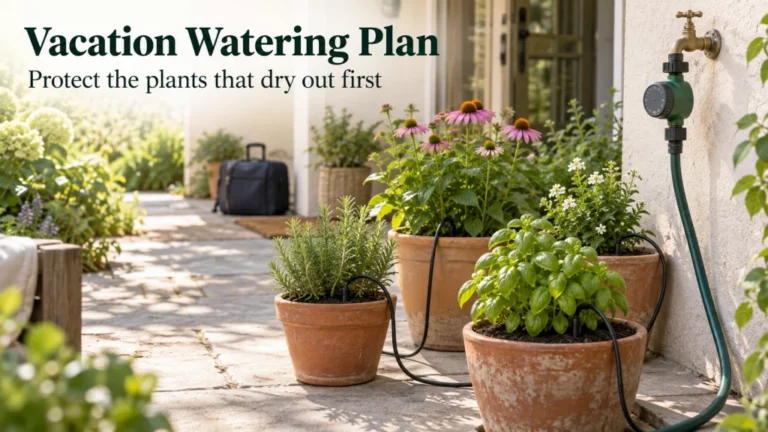
Soaker hoses and drip systems are also emitter-based or distributed systems, so source flow and soil delivery are not interchangeable. Their output may be stated in gallons per hour for an emitter, a length of line, or a product configuration, and actual distribution can still be affected by pressure, layout, clogging, or uneven line performance. Use the system’s documented output method and check the soil at representative locations rather than converting an open-faucet bucket test directly into a drip or soaker runtime. For a broader look at matching watering method to garden conditions, see how to water a garden without relying on one delivery method.
System-specific measurement prevents a common mistake: using a correct source-flow number for the wrong question. The faucet may supply plenty of water while a distant emitter delivers poorly, or a sprinkler may have adequate total flow while missing the edge of the bed. In those cases, adding minutes increases total water use without necessarily correcting distribution. Fix coverage or output consistency first, then calculate or calibrate runtime from the delivery pattern that actually reaches the soil.

The GARDENA Master Unit 1000 reduces incoming water pressure to 1.5 bar for a Micro-Drip-System and includes an integrated filter. The unit is rated for a water flow of 1000 liters per hour. It connects to 4.6 mm supply pipe and 13 mm connecting pipe, making pressure and compatibility explicit before setting drip runtime.
Check On AmazonIf you click this link and buy, we earn a commission at no additional cost to you.
Final thoughts: runtime only means something after flow and penetration are measured
A useful watering runtime is not a universal number pulled from a schedule. Measure the output of the setup you actually use, choose a water volume that fits the garden conditions, and divide volume by flow to get an initial runtime. Then check the soil below the surface and watch for runoff or uneven coverage before repeating the same setting. If the soil result disagrees with the calculation, adjust the application rather than defending the timer.
Once that process is calibrated, the timer becomes convenient because it represents a known application rather than a guess. Recheck whenever the hose setup, delivery system, weather, plant stage, or soil condition changes enough to affect the result. A short bucket test or soil check is usually less work than correcting a routine that has been delivering the wrong amount for weeks. The simplest reliable approach is the one you can measure, verify, and adjust without pretending that identical minutes mean identical watering.

The Fiskars Ergo Garden Trowel has a cast-aluminum head with rust resistance and an ergonomic handle for control. Its compact hand-tool format is suited to digging small inspection holes in garden beds or containers. It can expose the soil profile when checking how far irrigation moisture has moved below the surface.
Check On AmazonIf you click this link and buy, we earn a commission at no additional cost to you.
FAQs
💧 How many minutes should I water my garden with a hose?
There is no reliable universal minute count because hose flow and the target water volume both vary. Measure gallons per minute with a bucket test, divide the gallons you intend to apply by that flow rate, then verify the wetting depth in the soil.
🪣 How do I calculate gallons per minute from a bucket test?
Divide the known bucket volume by the number of minutes it takes to fill. A 5-gallon bucket that fills in 2.5 minutes indicates a flow of 2 gallons per minute, provided you tested the same hose, attachment, and pressure setting you will use for watering.
🌱 Is one inch of water always the right target?
No. An inch can be a useful reference for established garden areas, but actual need changes with rainfall, plant type and stage, soil, weather, rooting depth, and growing setup. Use the volume conversion only after deciding what water target makes sense for the current garden conditions.
🚿 Can I use the faucet flow rate to set a sprinkler runtime?
Not by itself. A sprinkler’s useful result depends on how water is distributed over the target area, so use several catch containers to measure application depth and uniformity across the pattern.
🧤 What should I do if water runs off before the calculated time is finished?
Slow the application or divide the runtime into multiple passes with infiltration time between them. Runoff means the soil is not accepting water as quickly as you are applying it, so simply finishing the timer can waste water without improving root-zone moisture.
🌦️ Do I need to recalculate runtime after rain?
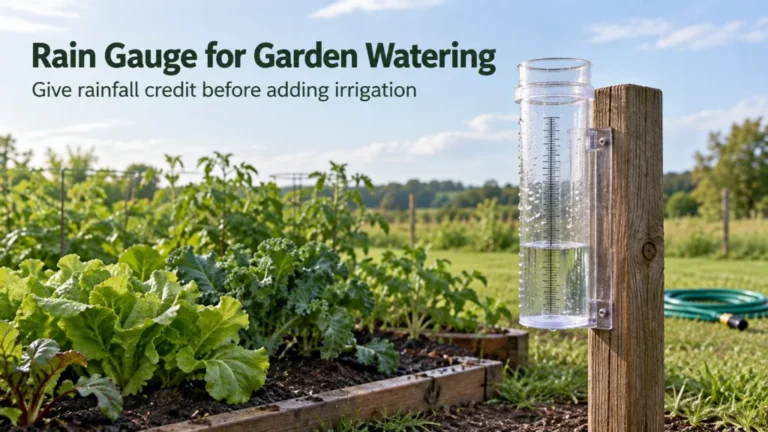
You usually do not need to remeasure hose flow just because it rained, but you may need a smaller irrigation volume or no irrigation at all. Check recent rainfall and soil moisture first, then calculate runtime from the remaining water target if supplemental watering is still needed.
References and sources
- Iowa State University Extension bucket-test and watering-volume guidance: Supports the gallons-per-square-foot conversion, hose bucket test, gallons-per-minute calculation, and runtime formula.
- Iowa State University Extension watering tips: Supports checking soil moisture, watering the root zone, and verifying that water has moved several inches into the soil.
- Purdue Extension garden watering guidance: Supports deep watering, avoiding repeated shallow applications, and adjusting watering for newly established plants and changing conditions.