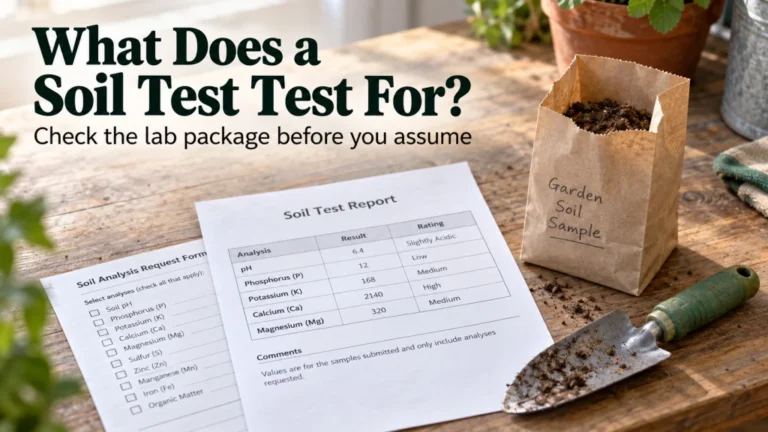
A soil test report is useful only when its numbers stay attached to the laboratory method, rating scale, units, crop or planting type, and recommendation framework that produced them. A practical reading order is to identify those report details first, read soil pH before amendment guidance, interpret nutrient ratings on the laboratory’s own scale, and convert any recommendation only after the area basis is clear. Raw values such as ppm are measurements, not automatic instructions to add fertilizer or lime. When a report uses unfamiliar methods, units, or recommendation language, the safest next step is to clarify that item with the laboratory or local Extension office before acting.
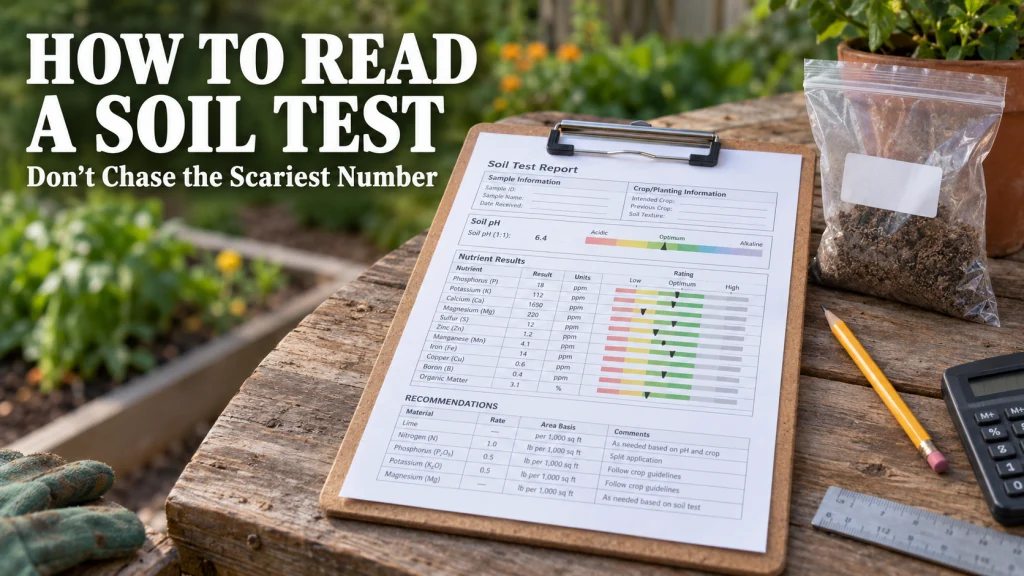
A soil test report is not a scoreboard
If you are learning how to read a soil test, resist the urge to scan for the lowest number and treat it as the biggest problem. Two nutrient values can look dramatically different on the page while using different units, different laboratory methods, or different rating scales. A number marked low matters because the laboratory has interpreted it against a calibrated range, not because low numbers are automatically bad. The useful question is not “Which number looks scariest?” but “What does this laboratory say this result means for this planting?”
That distinction keeps a soil report from turning into a shopping list. The report usually contains measured results, interpretation ratings, and recommendations, and those three things do different jobs. This article stays with the reading procedure so you can tell them apart and know what needs clarification. If you still need to decide what kind of sample to take or when testing makes sense, start with the broader soil testing process for a home garden before using the workflow below.
This mail-in soil test uses professional laboratory analysis to measure pH and 13 plant-available nutrient levels. The kit is intended for lawns, gardens, flowers, trees, shrubs, and other common growing areas. Results include laboratory data and recommendations tailored to the submitted soil and plant needs.
Check On AmazonIf you click this link and buy, we earn a commission at no additional cost to you.
Identify the laboratory method and report sections first
Begin at the top, legend, notes, or interpretation page instead of jumping straight to phosphorus or potassium. Confirm the sample identification, the crop or planting type entered on the submission, the analytical method when it is shown, and the units used for each result. Laboratories can use different extraction procedures and different calibration ranges, so the raw value is meaningful only inside the system that produced it. This is why comparing a phosphorus ppm number from one laboratory with a number from another laboratory can be misleading even when both reports appear to be measuring the same nutrient.
Next, divide the report into functional parts. Most reports have some version of sample information, measured soil values, interpretation words or graphics, amendment or nutrient recommendations, and laboratory notes. The exact layout can change, but the reading task does not: keep the result beside its method, unit, rating, and recommendation rather than treating each number as a standalone fact. If the report does not state a method or you cannot find the legend that defines its ratings, mark that item for clarification instead of borrowing a scale from another lab.
| Read in this order | What to confirm | Why it matters |
|---|---|---|
| Sample and planting information | Correct bed, lawn, crop, or planting type | Recommendations may depend on what the laboratory was told you intend to grow. |
| Method and units | Extraction method, ppm, mg/kg, pounds per area, percent, or other units | Raw values and conversions are not interchangeable without context. |
| Measured results | pH and nutrient values actually reported | These describe the sample, not automatically what to apply. |
| Rating scale | Low, optimum, high, excessive, or the lab’s equivalent terms | The category connects the measurement to the laboratory’s calibration. |
| Recommendations and notes | Planting basis, material, rate, area basis, and special instructions | This is where the laboratory turns test interpretation into an action framework. |
That order is more useful than memorizing one universal range for every nutrient. It also makes later decisions easier because you can see whether a recommendation came from the measured value, the intended planting, the laboratory calibration, or a combination of those factors. For a broader soil improvement decision after you understand the report, use the site’s guide to improving garden soil based on the condition you actually have. Here, the job is narrower: read the report correctly before deciding what to change.

This 12-inch soil probe is made from stainless steel and uses a T-handle for sampling. The kit includes two reusable sample bags for collected soil. The listing identifies it for plant care, gardens, lawns, and farm soil sampling.
Check On AmazonIf you click this link and buy, we earn a commission at no additional cost to you.
Read pH before interpreting amendment recommendations
Soil pH is a measured condition that affects how the rest of the report is interpreted, but it is not a verdict by itself. A value below 7 is acidic, 7 is neutral, and a value above 7 is alkaline, yet the desired range depends on the plant or planting type. A vegetable bed, turf area, blueberry planting, and ornamental bed do not necessarily share the same target. That is why the report’s stated crop or use needs to stay beside the pH result.
Some reports also include buffer pH, reserve acidity, lime requirement, or another laboratory measure used to estimate how much material would be needed to change soil pH. Do not confuse that supporting measurement with the target pH you are trying to reach. Two soils can have the same measured pH and still receive different lime recommendations because their resistance to pH change differs. The laboratory recommendation is therefore more useful than trying to invent a lime rate from the pH number alone.
Separate the measured pH from a plant-specific target
Write the measured pH on one line and the laboratory’s target or preferred range for the named planting on another. If the report does not state a target, use the interpretation supplied by that laboratory or regional Extension guidance for the plant rather than a generic internet range. This matters most when a plant has a narrower preference than the rest of the garden. A pH that is acceptable for one bed can still be a poor fit for a different planting a few yards away.
Read lime or acidification guidance in the laboratory’s own framework
If the report recommends lime, sulfur, or another pH adjustment, read the recommendation as a complete statement. Keep the named material, rate, area basis, crop target, and any laboratory notes together. Do not turn a general statement that lime raises pH or sulfur can lower pH into a homemade application rate. The actual amount can depend on the soil, the laboratory’s buffer or lime requirement method, the target, and the material being used.
This article stops before application because that is a separate decision. Once you know what the report recommends, the next step is to verify the current product label and any regional application guidance that applies to the material and planting. If the report gives no adjustment recommendation even though the pH looks unusual to you, do not fill the gap with a rate copied from another report. Mark it for clarification and keep reading the rest of the report in context.

This soil pH kit includes 100 test strips calibrated for soil testing across a pH range of 3.5 to 9. The kit includes a full-color testing handbook and an AI reader template for its web-based strip reader. It is intended for soil pH testing in lawns, gardens, compost, and planted areas.
Check On AmazonIf you click this link and buy, we earn a commission at no additional cost to you.
Interpret nutrient ratings using the laboratory’s scale
After pH, read the nutrient categories before you stare at the raw numbers. A laboratory may use words such as below optimum, optimum, above optimum, low, medium, high, very high, or excessive. Those words summarize how the laboratory interprets its own measurement for a crop or use, and another laboratory may place the same raw number into a different category because its method or calibration differs. The rating is therefore the practical bridge between the analytical value and the recommendation.
More is not automatically better. A value above the laboratory’s optimum range can mean additional application is unlikely to help the named planting, and a high number should not be treated as a prize to increase further. At the other end, a low rating tells you to look closely at the recommendation, not to guess a fertilizer product or rate. The report’s own scale should control the first interpretation step.
Separate nutrient status from the application recommendation
A measured nutrient value describes what the laboratory found in the sample under its test method. The rating interprets that value, while the recommendation answers a different question about what the named planting may need. Those lines can look contradictory if you assume they are duplicates. For example, a nutrient can be rated optimum while the report still includes a maintenance recommendation intended to support the crop during the growing period.
The reverse can also happen: a report can show a high nutrient status and recommend no additional application. That does not mean the test failed or the nutrient disappeared from the recommendation section. It means the laboratory has separated existing soil status from what it expects an added application to accomplish. If your next question is how to translate that recommendation into a fertilizer decision, keep that task separate and use the guide to reading soil test fertilizer recommendations.
Keep units and area basis attached to every number
Circle or note the unit beside each result before doing any arithmetic. A concentration such as ppm or mg/kg is not the same thing as an application rate stated in pounds per 100 square feet, pounds per 1,000 square feet, or pounds per acre. Even when a report provides a mathematical conversion, that does not erase differences in sampling depth, bulk density assumptions, extraction method, or the laboratory’s calibration. Units tell you what kind of number you are looking at before you decide whether conversion is even appropriate.
Use the same five checks for each line you may act on, especially when one report covers several beds or planting types. The point is not to create extra paperwork; it is to stop a rating from being detached from its unit or a recommendation from being detached from its area basis. If a field is missing, leave it unresolved instead of filling it with an example from another laboratory. That one pause can prevent a valid measurement from becoming an invalid application decision.
| Checklist item | What to write beside the result | Stop and clarify when |
|---|---|---|
| Result | The exact measured value or reported condition | You cannot tell which sample or planting the value belongs to. |
| Unit | ppm, mg/kg, percent, pounds per area, or the exact unit shown | The unit is missing or appears to change between report sections. |
| Rating | Low, optimum, high, or the laboratory’s own category | The legend does not define what the category means. |
| Recommendation | The separate action or amount the laboratory provides | You cannot tell whether the number is a nutrient amount, amendment amount, or product amount. |
| Area basis | The stated reference area, such as per 100 or per 1,000 square feet | The area basis is absent or does not match the space you intend to treat. |
Once those five items stay together, the next step is easier to judge. A measured concentration remains a measurement, while a rate tied to a treatment area can be handled as a recommendation. That separation matters before any scaling or product choice enters the picture. It also gives you a clean list of questions if the report is incomplete.

This 3-pound water-soluble plant food has a 24-8-16 NPK analysis. The listing identifies it for indoor and outdoor plants including roses, flowers, vegetables, houseplants, trees, and shrubs. It is mixed with water for application rather than used as a dry granular fertilizer.
Check On AmazonIf you click this link and buy, we earn a commission at no additional cost to you.
Convert a recommendation only after the units are clear
Home gardeners often need to scale a laboratory recommendation from a large reference area to the actual square footage of a bed or lawn. Before doing that, confirm that the number you are scaling is truly an application recommendation rather than a measured soil concentration. Also confirm whether it is expressed as a nutrient amount, a specific amendment amount, or another laboratory convention. The arithmetic is the easy part once those labels are clear.
Suppose a report lists a nutrient status as a concentration in ppm and, elsewhere, gives a recommendation as pounds per 1,000 square feet. The ppm value should stay in the interpretation section, while the pounds per 1,000 square feet value is the one that can be scaled to the garden area if the report intends it for that planting. Mixing the two can produce an application amount that has no valid relationship to the laboratory recommendation. This is the practical difference between reading a number and using a recommendation.
| Report item | What it represents | What to do with it |
|---|---|---|
| Phosphorus: 42 ppm | Example measured concentration | Read it with the laboratory method and rating. Do not spread 42 pounds of anything. |
| Phosphorus: optimum | Example interpretation category | Use the laboratory’s definition of optimum, then check the separate recommendation. |
| Recommendation: amount per 1,000 square feet | Example application basis | Scale only after confirming the material or nutrient basis and your actual treatment area. |
Measure the area you actually intend to treat rather than automatically using the size of the whole property. A 120 square foot vegetable bed and a 1,200 square foot lawn section require different scaling even if they came from the same laboratory system. Keep the recommendation basis visible while you calculate so a zero or unit change does not slip in unnoticed. If the format is unfamiliar, stop before scaling it.

This open-reel measuring tape extends 100 feet and includes inch and metric scales. Its 1/2-inch vinyl-coated fiberglass tape is housed in an impact-resistant shell. The tape also has a versatile end hook and a shock-absorbing handle for long-distance measuring.
Check On AmazonIf you click this link and buy, we earn a commission at no additional cost to you.
Mark results that need clarification from the laboratory or Extension
A soil report does not have to be fully decoded in one sitting. Mark any line where the extraction method is unclear, the units seem inconsistent, the crop or use is wrong, the rating legend is missing, or the recommendation does not state an understandable area basis. Also flag results that appear to rely on a test you did not request or a section that the laboratory labels as supplemental. These are interpretation questions, not reasons to guess at an amendment.
Plant symptoms also need a boundary. A soil test can show pH and nutrient status, but a yellow leaf, weak growth, or poor flowering can also involve moisture, root problems, temperature, pests, disease, or other conditions that a routine fertility report does not diagnose. Do not turn one low laboratory value into a certain diagnosis just because it resembles a symptom chart. Use the report to narrow the question, then investigate the plant problem separately if symptoms remain.
- Ask what analytical method produced an unfamiliar nutrient value.
- Ask what the laboratory’s rating words mean for the crop or planting type on your report.
- Ask whether a recommendation is stated as nutrient amount, amendment amount, or product amount.
- Ask what area basis the recommendation uses before scaling it to a bed or lawn.
- Ask whether an unusual result needs confirmation or a new sample before you make a major correction.
These questions are especially useful when a report looks precise but leaves out the context needed to act on it. The goal is not to eliminate every unfamiliar number; it is to separate what the report actually establishes from what still needs explanation. Once that boundary is clear, the report becomes a decision tool instead of a page of competing numbers. Any later soil amendment or fertilizer choice can then start from a defined need rather than a guess.

This three-pack contains 3 x 5-inch top-spiral notebooks with yellow covers and a universal page pattern. The notebooks use weatherproof paper and a Polydura cover designed for outdoor conditions. The Wire-O binding is designed to keep open pages aligned and intact.
Check On AmazonIf you click this link and buy, we earn a commission at no additional cost to you.
Final thoughts: read the laboratory’s scale first and the recommendation second
The cleanest way to read a soil test is to follow the report from context to action. Confirm the sample and planting, read pH, use the laboratory’s nutrient ratings, and only then move to recommendations. That sequence prevents a raw number from becoming an automatic amendment decision. It also exposes the places where the report does not yet give you enough information to act.
Keep measured status, interpretation, and recommendation as separate layers. Convert a rate only after you know what it represents and what area it covers, and leave uncertain lines unresolved until their meaning is clear. A good reading of the report does not produce the longest amendment list; it produces a short set of decisions you can actually justify. That is the point where the report has done its job.

This digital scale weighs up to 11 pounds or 5 kilograms in 1-gram increments. It supports five measurement units and includes a tare function for zeroing a container before weighing material. The weighing surface is made from 304 stainless steel and the scale includes two AAA batteries.
Check On AmazonIf you click this link and buy, we earn a commission at no additional cost to you.
FAQs
🧪 What is the first thing I should look at on a soil test report?
Confirm the sample identification, planting or crop type, laboratory method when listed, and reporting units before interpreting individual nutrients. Then read pH and the laboratory’s rating scale before moving to recommendations.
🌱 Does a low nutrient number always mean I should add fertilizer?
No. Read the laboratory’s rating and crop-specific recommendation rather than acting on the raw number alone. A low-looking value may use a method or scale that is not comparable with another laboratory’s report.
📏 What does ppm mean on a soil test?
Parts per million is a concentration unit commonly used for measured nutrient levels. It is not automatically an application rate, so do not convert it into pounds of fertilizer unless the laboratory specifically provides and explains that conversion.
🪨 Is buffer pH the pH I should try to reach?
No. When a laboratory reports buffer pH, it is generally used to help estimate the soil’s resistance to pH change and the amount of lime that may be needed. Use the plant-specific target and the laboratory recommendation rather than treating buffer pH as your target.
📋 Why can a report recommend nutrients when the rating says optimum?
Status and recommendation are different parts of the report. A laboratory may rate the current soil level as optimum while still recommending an amount intended to support the named crop or maintain that range.
☎️ When should I call the soil testing laboratory?
Ask for clarification when the method, units, rating legend, crop basis, or recommendation format is unclear. It is also worth checking when the report appears to use the wrong planting type or when a major correction depends on a line you cannot interpret confidently.
References and Sources
- University of Maryland Extension soil test report guide: Supports interpretation of pH, buffer pH, nutrient results, and laboratory amendment recommendations for home gardens and lawns.
- Penn State Extension soil test report guide: Supports separating nutrient status categories from the recommendation section and reading the report by functional sections.
- University of Missouri Extension soil report guide: Supports checking analytical methods and reporting units before comparing raw values or converting recommendations.