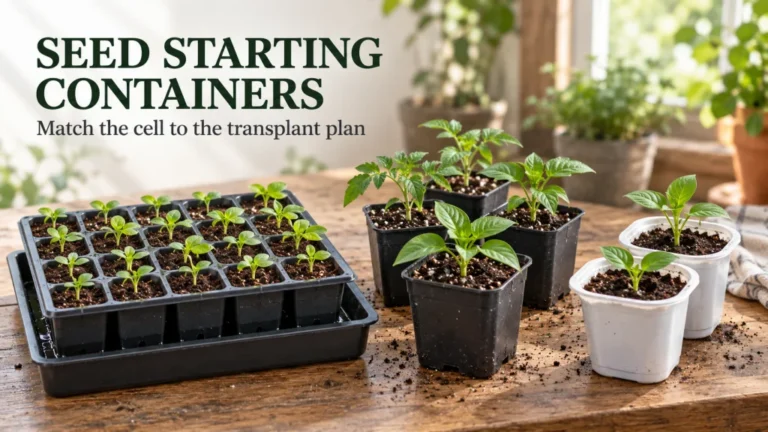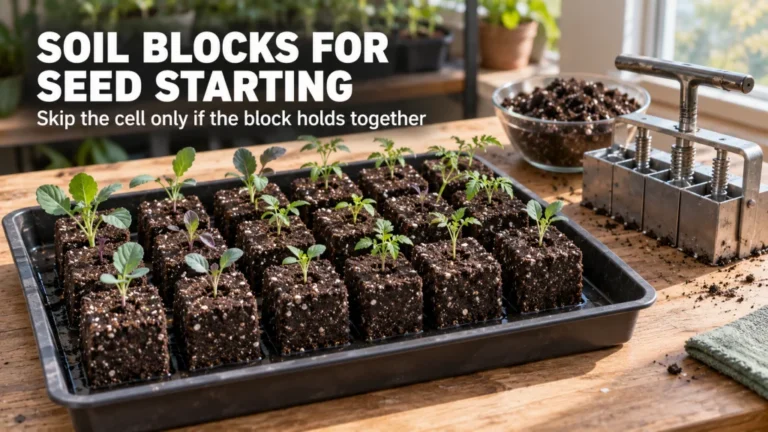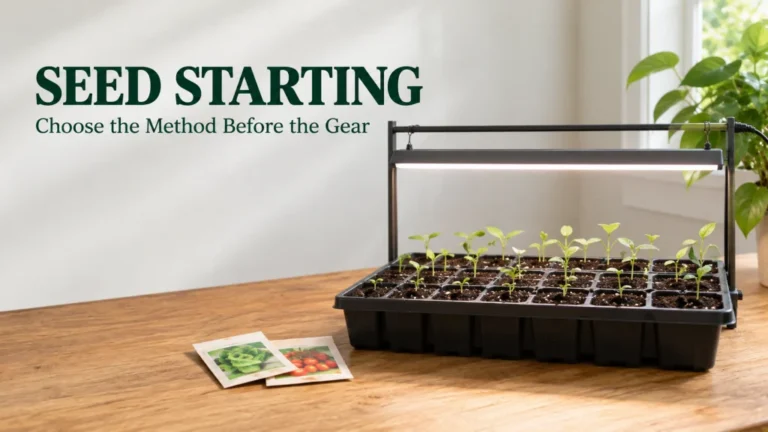
A useful seed starting mix is chosen for the work it has to do in a tray or cell: hold enough moisture for germination, drain excess water, preserve air space around new roots, and stay physically consistent enough for small seeds. Garden soil is usually a poor fit for that job in small containers because it can become dense and lose useful pore space, while some general potting mixes can work if their texture and drainage suit the seed and container. A finer specialty mix can be helpful for very small seed, but the label alone does not make one mix universally better. Choose by particle size, drainage, moisture retention, cleanliness, and how long the seedling will remain in that container before moving on.
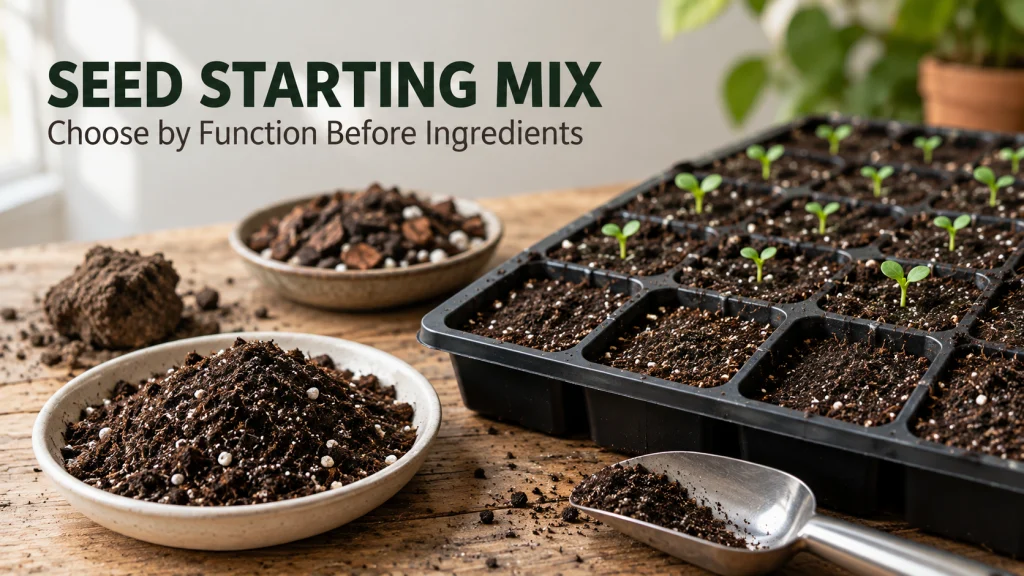
Start with the jobs the medium must do
A seed does not need a miniature garden bed in the cell, and that is the useful way to think about seed starting mix. The first job is physical: keep the seed in reliable contact with moisture without turning the cell into a saturated lump. The second job is to leave enough pore space for air and early root growth while allowing extra water to move out of the container. Ingredients matter, but they matter because of the behavior they create, not because a particular ingredient list is automatically superior.
That distinction keeps a simple purchase from turning into a search for the most elaborate recipe on the shelf. A coarse mix that works well for an established container plant may be awkward around tiny seed, while an extremely fine mix can become difficult to manage if it is packed tightly or kept too wet. The right choice also depends on how long the seedlings will stay in the original cells before they are transplanted or potted up. Start with the physical job, then read the bag or formulation in that context.
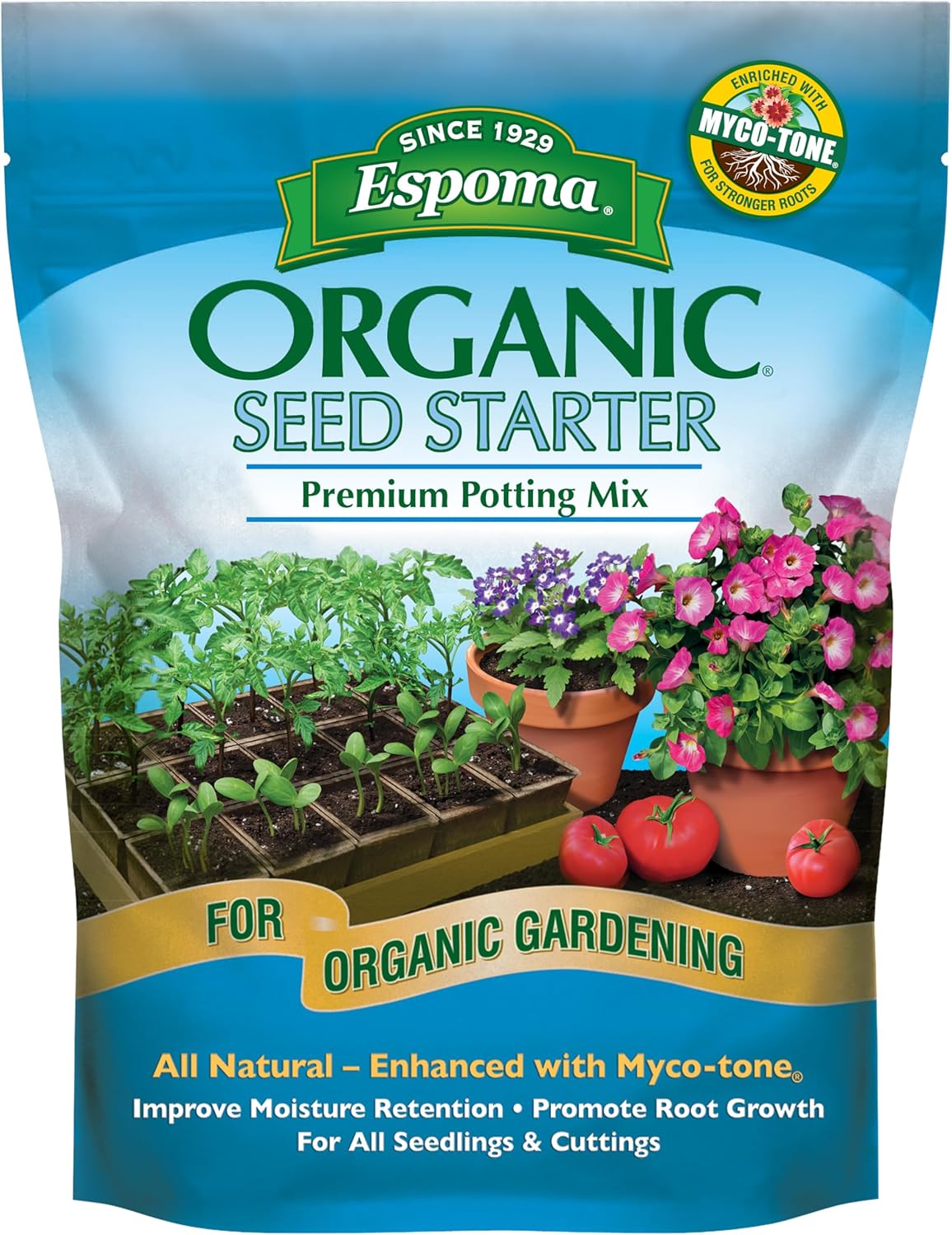
Espoma Organic Seed Starter is an 8-quart seed-starting potting mix. The listing identifies it as an organic mix with mycorrhizae for seed starting. It fits this section as a purpose-built medium to compare against the functional requirements of moisture, drainage, and air space.
Check On AmazonIf you click this link and buy, we earn a commission at no additional cost to you.
Separate seed starting mix from garden soil and long-term potting mix
The names on bags are not always as tidy as the gardening aisle makes them look. Some products sold as potting mix are lightweight, porous soilless media that can be suitable for germination, while other potting mixes are coarse or formulated more for longer container growth. Garden soil is different because it contains mineral soil particles and behaves differently once confined in a shallow tray or small cell. That is why the better question is not simply whether a bag says seed starter, but whether its structure suits germination in the container you are using.
University of Maryland Extension notes that an all-purpose soilless transplanting mix can be suitable for seed starting and that a special finer seedling mix is especially useful for extremely small seed. That matters because it prevents an unnecessary rule that every seed must be started in a specialty bag. At the same time, ordinary garden soil should not be treated as equivalent to a purpose-built container medium just because seeds can germinate outdoors. In a small cell, drainage, aeration, and consistency become much more restrictive than they are in an open garden bed.
| Medium | Useful fit for seed starting | Main reason to pause |
|---|---|---|
| Seed starting mix | Usually designed around fine texture, moisture control, and early root growth | Some formulas are intended only for the short germination stage and may not match a long stay in the same cell |
| General soilless potting mix | Can work when it is light, porous, well drained, and not excessively coarse for the seed | Large bark pieces or an uneven texture can make small cells and tiny seed harder to manage |
| Garden soil | Better left in the garden rather than used alone in small seed starting cells | It can compact, drain poorly in containers, and may bring weed seed or plant pathogens with it |
The practical takeaway is to judge the medium by what happens after it is confined in your tray. A familiar material can behave very differently in a shallow cell than it does in the ground. That is the distinction to keep in mind before comparing ingredient lists or prices. If the tray setup makes drainage or aeration difficult, changing the label on the bag will not solve the physical mismatch.
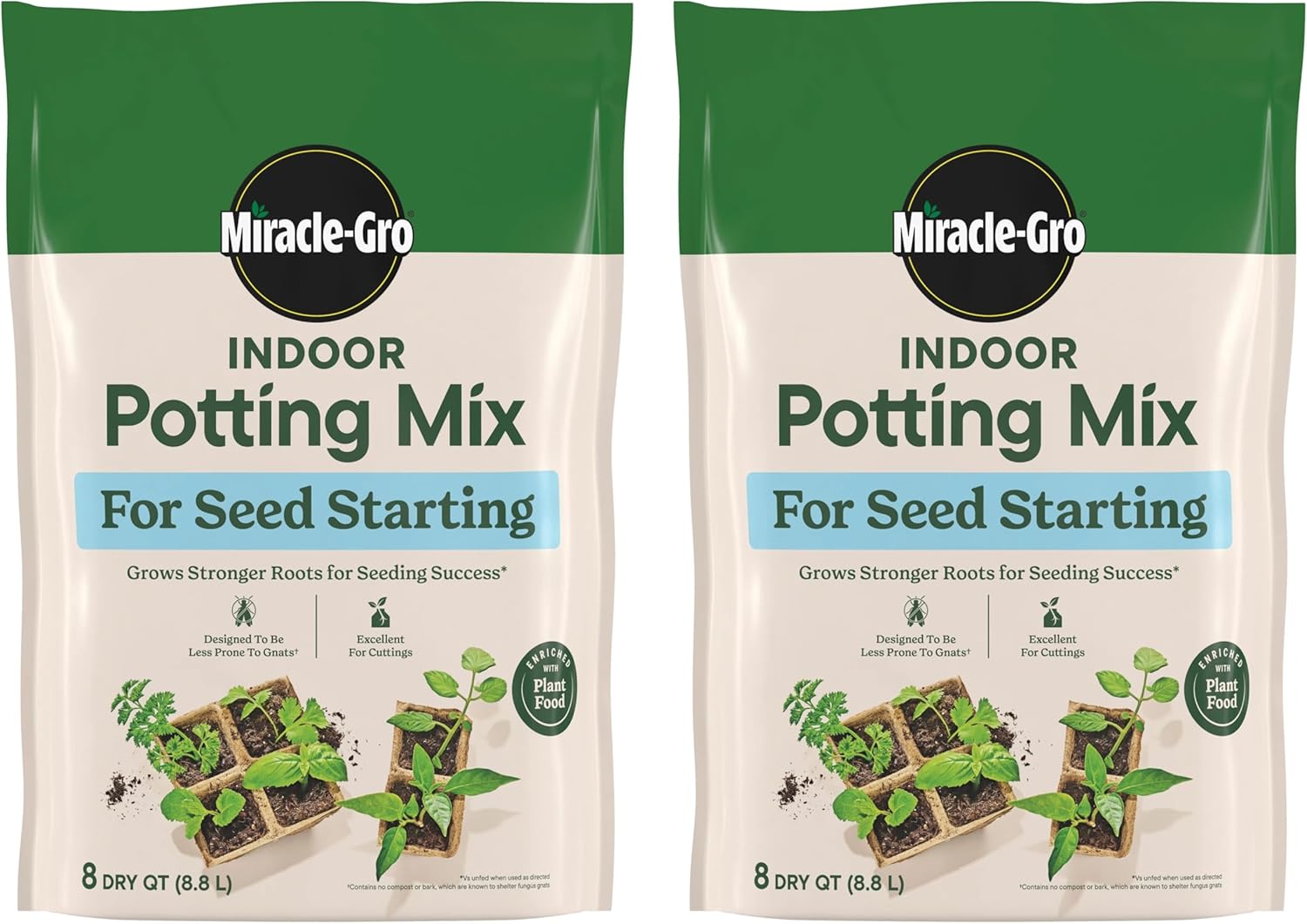
Miracle-Gro Indoor Potting Mix for Seed Starting comes as two 8-quart bags. The listing identifies it for starting vegetable, flower, and herb seeds indoors and for cuttings. It fits this section because it is explicitly a potting mix formulated for seed starting, which helps illustrate why bag category alone is not enough to judge suitability.
Check On AmazonIf you click this link and buy, we earn a commission at no additional cost to you.
Prioritize fine texture with drainage and aeration
Fine texture is most useful when it improves seed contact without closing off the air spaces roots need. Very small seed can sit awkwardly among large bark pieces or coarse chunks, and uneven media can leave some cells holding more water than others. At the same time, fine does not mean paste-like, muddy, or packed hard. The target is a relatively uniform medium that can stay moist while still releasing excess water and preserving useful pore space.
This is where a function check is more useful than memorizing a recipe. Peat, coir, perlite, vermiculite, bark, compost, and other components can change water holding, structure, and aeration, but their effect also depends on particle size and processing. Two bags that list similar materials may therefore handle differently in a tray. Read the formulation, look at the actual texture when possible, and favor the mix whose physical behavior matches the seed size and container.
| Function to check | What you want to see | What can create trouble |
|---|---|---|
| Particle size | Uniform enough for the seed and cell size | Large chunks around tiny seed or very uneven material |
| Moisture retention | Enough moisture to support germination without constant drying | A mix that stays waterlogged or becomes difficult to rewet after drying |
| Drainage | Excess water can leave the cell rather than pooling around roots | Dense media combined with a container that drains poorly |
| Aeration | Useful pore space remains after the tray is filled and watered | Overpacking, compaction, or keeping the medium saturated |
| Cleanliness | A medium and container suited to delicate early growth | Assuming any bagged mix eliminates every possible disease risk |
No single row in this table should be treated as a guarantee of germination. Seed viability, temperature, moisture management, light requirements, and species-specific sowing directions still matter. The table is useful because it narrows the medium decision to traits you can actually inspect and manage. If a seed has unusual germination requirements, follow the seed packet or a species-specific horticultural source rather than forcing the general table to fit.

Perfect Plants Organic Perlite is an 8-quart soil amendment. Amazon lists it for improving soil drainage and aeration. It fits this section as a component that can change pore space and water movement rather than as a complete seed-starting medium.
Check On AmazonIf you click this link and buy, we earn a commission at no additional cost to you.
Avoid compaction in small cells
A good mix can lose part of its advantage if it is pressed firmly into a small cell. Iowa State University Extension explains that handling can compact potting media and reduce air-filled pores, which is why filling evenly without unnecessary pressing is a useful habit. Small cells magnify that issue because there is little volume available to buffer uneven filling or poor drainage. Fill the tray consistently, level the excess, and resist the urge to make every cell feel solid before sowing.
Watering then has to match the structure you preserved. If the medium is repeatedly saturated, the air space around new roots can shrink even when the original mix was porous. If it dries too far, some peat- or coir-based media can become harder to rewet evenly, creating dry pockets next to overly wet ones. The goal is not a permanently wet tray, but a medium that stays appropriately moist for the seed while still draining and breathing.

Gardzen's kit includes five seed-starting tray sets with vented humidity domes and bases. The listing specifies 200 cells total. The small-cell format directly matches this section's focus on filling cells evenly without unnecessary compaction.
Check On AmazonIf you click this link and buy, we earn a commission at no additional cost to you.
Decide whether a commercial soilless mix solves consistency needs
A commercial soilless mix can be the simplest choice when you want predictable texture without blending several components yourself. That convenience is most valuable when you are filling many small cells, sowing tiny seed, or trying to make watering behavior more consistent from tray to tray. It is not necessary because a bag is expensive or heavily marketed for seedlings. It is useful when its structure removes a real source of variation from your setup.
Before buying, check the bag for the job it is meant to do and look beyond the front label. A mix intended for germination or transplant production should make sense for your cell size and planned seedling duration, while a coarse long-term container mix may require more judgment. You also do not need to assume that a product described as clean or soilless removes every risk of damping off or other seedling problems. Air movement, moisture, container sanitation, temperature, and seedling care still remain part of the system.
- Check whether the medium is intended for germination, transplanting, or longer container growth.
- Check whether the texture is fine enough for the seed and cell size you plan to use.
- Check that the container itself has a real drainage path before blaming the mix for standing water.
- Check whether the formulation includes fertilizer if seedlings may remain in the same container beyond early germination.
- Skip a specialty purchase when a suitable lightweight, porous soilless mix you already have clearly meets the same physical requirements.
That last point matters for budget as much as horticulture. A second bag does not improve germination simply because its label is more specific. Buy the more specialized medium when it solves a texture, consistency, or workflow problem you actually have. If the mix already on hand meets those physical requirements, using it can be the simpler choice.

Back to the Roots Organic Seed Starting comes as a compressed block that expands to 12 quarts. The listing identifies it for herbs, vegetables, and flowers. It fits this section as a preformulated commercial medium that removes the need to blend several loose components.
Check On AmazonIf you click this link and buy, we earn a commission at no additional cost to you.
Treat homemade recipes as source-tied formulations
Homemade seed starting recipes are useful only when the ingredients, particle sizes, and intended use are clear. A ratio copied from a forum or social post can look precise while hiding important differences in coir grade, peat processing, compost maturity, perlite size, or the container system it was designed for. That is why I would not treat one recipe as the universal best seed starting mix for every crop and tray. The formulation should come from a horticultural source or a clearly documented method whose conditions resemble your own setup.
If you do mix your own, evaluate the result by the same functions used for a commercial medium. It should be uniform enough for the seed, able to hold useful moisture, porous enough to drain and aerate, and clean enough for propagation work. Do not fix a dense mix by adding random ingredients until the tray becomes a chemistry experiment. If the question turns into general compost ratios, amendments, liming, or long-term soil fertility, it has moved beyond the seed starting decision this page is meant to solve.

Back to the Roots Organic Coir is a 51-quart expanding coir product. Amazon identifies it for seeds and potting. It fits this section as a defined coir ingredient that should be used within a documented formulation rather than treated as a universal seed-starting recipe.
Check On AmazonIf you click this link and buy, we earn a commission at no additional cost to you.
Match nutrient expectations to seedling duration
Germination and extended seedling growth are not the same stage, so nutrient expectations should not be treated as a single rule. A seed carries stored reserves that support the start of germination, while a growing seedling eventually depends on roots, leaves, light, water, and an appropriate nutrient supply. That does not mean every starting mix must be rich in fertilizer from day one. It means you need to know how long the plant is expected to remain in that medium before you choose a low nutrient starter or a mix designed to support a longer stay.
A short germination phase followed by prompt potting up creates a different requirement from a seedling that will occupy the same cell for an extended period. Read the media label so you know whether fertilizer is included, and follow species-specific seedling guidance rather than guessing from the color or speed of growth alone. More fertility is not automatically better for young plants, and a low nutrient mix is not automatically defective. The relevant question is whether the medium and the next care step match the duration of that seedling stage.

Espoma Organic Grow is a 16-ounce liquid concentrate plant food for indoor and outdoor plants. The listing identifies it as an all-purpose fertilizer for organic gardening. It fits this section as a separate nutrient product to consider only when seedling duration and label directions call for feeding.
Check On AmazonIf you click this link and buy, we earn a commission at no additional cost to you.
Keep fertilizer and amendment questions in the right lane
Once the main question becomes how much compost, fertilizer, lime, or another amendment to add for ongoing plant growth, the decision is no longer mainly about choosing a propagation medium. That broader soil and fertility work belongs with garden soil and fertility guidance, where nutrient management can be handled with the right plant, soil, and product context. This separation prevents a seed starting article from turning one simple tray decision into a full-season soil recipe. It also keeps application rates and amendment advice tied to the source or product label that actually governs them.
The same boundary helps with propagation methods. If you are sowing seed, use the physical needs of germination and early roots as the starting point; if you are rooting stems instead, the medium is supporting a different biological task, which is why propagation media for cuttings deserves its own decision process. For the larger indoor sowing workflow, continue with the seed starting guide. For the broader methods that include seeds and other ways of making new plants, use the plant propagation guide.
MySoil is a soil test kit for nutrient and pH analysis. The listing describes recommendations tailored to soil and plant needs. It fits this section because broader fertilizer and amendment decisions are better tied to soil information than folded into the seed-starting mix itself.
Check On AmazonIf you click this link and buy, we earn a commission at no additional cost to you.
Final Thoughts: choose by function before ingredients
The most useful starting medium is not the one with the longest ingredient list. Choose a medium whose particle size fits the seed and container, whose structure balances moisture with drainage and air, and whose consistency matches how long the seedling will remain there. A suitable lightweight soilless potting mix may be enough for many seeds, while a finer specialty mix can make sense for very small seed or a workflow that benefits from tighter consistency. Garden soil is a different material and is generally a poor default for small seed starting cells.
Before sowing, check the actual medium, the drainage holes, the seed packet, and your plan for what happens after germination. Avoid packing the cells hard, and do not treat a clean commercial medium as protection from every disease or watering mistake. If seedlings will stay in the container longer, include that duration when you think about nutrition and the next potting step. That keeps the decision simple: choose the medium for the stage you are actually managing, then move broader fertility questions to the guidance built for them.

The BN-LINK seedling heat mat measures 10 by 20.75 inches and is designed for seed starting and germination. The listing presents it as a plant germination heat mat. It fits the final section as an example of a separate seed-starting condition to manage after the medium itself has been chosen.
Check On AmazonIf you click this link and buy, we earn a commission at no additional cost to you.
FAQs
🌱 Can I use potting mix instead of seed starting mix?
Yes, some lightweight, porous soilless potting mixes can work well for starting seeds. Check texture and drainage first, especially for tiny seed or very small cells, because a coarse or dense mix may be harder to manage.
🪴 Why is garden soil a poor choice for seed trays?
Garden soil can lose useful pore space and compact when confined in a small container, which can make drainage and aeration harder to manage. It can also carry weed seeds or plant pathogens, so a purpose-suited soilless medium is usually the more predictable choice indoors.
💧 Should seed starting mix stay wet all the time?
No. Germinating seed needs reliable moisture, but keeping the medium saturated can reduce oxygen around roots and increase problems associated with overly wet conditions. Keep the moisture appropriate for the species and make sure the container can drain.
🔎 Does a seed starting mix have to be sterile?
Do not use the word sterile as a guarantee that seedlings cannot develop disease. A commercially prepared propagation medium can reduce some sources of contamination, but sanitation, airflow, moisture, temperature, and seedling care still matter.
🌿 When should seedlings move to a different potting mix?
That depends on the crop, cell size, growth rate, and whether the starting medium is intended only for germination or for continued seedling growth. Follow species-specific transplanting guidance and use the planned time in the container, not a universal calendar date, to decide when the next medium is needed.
References and Sources
- University of Maryland Extension on seed starting media: Supports the distinction between lightweight soilless media, fine seedling mixes, and garden soil used in small containers.
- Iowa State University Extension on potting media components and handling: Supports the roles of particle size, water holding, aeration, compaction, and container handling in growing media.