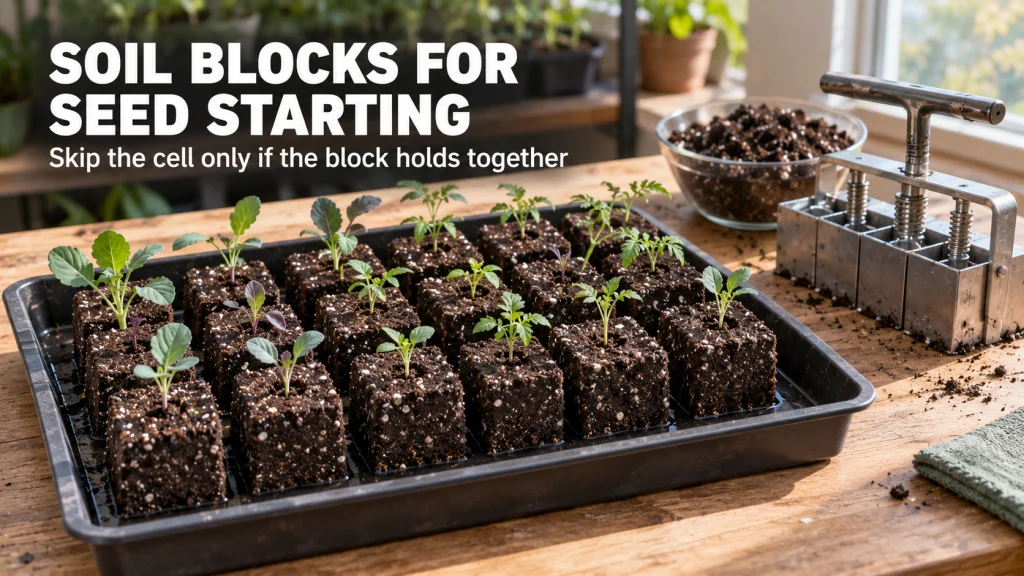
Soil blocks replace individual seedling cells with compressed growing medium, but they do not remove the need for a stable mix, a rigid tray, careful watering, and a realistic transplant schedule. They fit best when reducing disposable cells or avoiding root circling matters enough to justify a different workflow. The useful question is not whether blocks are better in general, but whether your batch size, growing medium, watering habits, and indoor holding period make the system easier or harder to manage. A reusable cell tray may still be the simpler choice when you want more forgiving handling and less sensitivity to moisture changes.
Name the problem soil blocks should solve
Soil blocks for seed starting remove the pot, not the need for structure. If the mix crumbles, the plastic saved does not simplify the job because every later step becomes more delicate. The method makes the most sense when you have a clear reason to change your current setup, such as reducing disposable inserts, keeping roots from circling inside a cell, or making only the number of starts you actually need. I would begin with that problem rather than with the blocker itself, because the tool only helps when the rest of the workflow supports the blocks it makes.
The trade is simple to miss: a container wall gives a seedling medium physical support, while a soil block has to hold itself together through mixing, moisture, compression, and careful handling. That shifts attention toward the medium, tray, watering method, and the length of time seedlings will stay indoors. If your current seed-starting workflow is already predictable with reusable cells, switching methods may add work without solving a meaningful problem. If plastic reduction or root management is important to you, blocks can be worth considering, but the decision should start with the job they need to do.

Ladbrooke's 4-Pc Basics Set includes the Mini 4, Micro 20, cubic inserts, and 3/8-Inch seed pins. The Mini 4 presses four 2-inch blocks, while the Micro 20 presses twenty 3/4-inch starter blocks. Cubic inserts let the smaller starter blocks nest into the larger blocks, supporting a two-stage soil-block workflow without individual cell pots.
Check On AmazonIf you click this link and buy, we earn a commission at no additional cost to you.
Use a mix able to form a stable block
A blocking mix has two jobs at once: it must stay open enough for roots and air while also binding well enough to stand without a pot. Ordinary seed-starting media can vary widely in particle size, fiber content, and how they behave when wet, so a mix that performs well in a cell is not automatically a good blocking mix. The practical test is whether a freshly pressed block releases cleanly and keeps defined sides when moved on a flat tray. If it slumps, sticks in the blocker, or sheds material immediately, fix the mix or moisture before sowing rather than hoping roots will rescue a weak block later.
Do not treat one recipe as universal because the best texture depends on the ingredients, the blocker, the crop, and how long the block must remain intact. Fine, fibrous material can help bind a block, while excessively coarse pieces can interrupt the compressed structure and make clean edges harder to form. Moisture also matters because a dry mix may not knit together, while an overly wet mix can smear, stick, or lose shape. For the broader question of how growing media behave around seeds and young roots, keep the block decision separate from your plant propagation basics rather than turning this method into a universal seedling recipe.
- Check whether the mix forms clean edges before you sow into a full tray.
- Break up coarse lumps that prevent even compression.
- Adjust moisture gradually instead of flooding a dry mix all at once.
- Reject blocks that slump or crack badly before planting seeds in them.
- Keep the tray flat while blocks are being formed and moved.
A short test batch is useful because it exposes structural problems before seed, labels, and tray space are committed. Press several blocks, move the tray a short distance, and check whether the edges remain intact before scaling up. If they fail during this dry run, adjust the mix or handling method while the correction is still cheap and simple. Once the blocks consistently release and hold their shape, the next decision is how much medium each seedling actually needs.

Back to The Roots Organic Coir is a 51-quart expanding growing medium made from coconut coir. The selected Amazon variant is the 51-quart Expanding Soil option intended for seeds and potting. Its fine fibrous medium gives you a practical material to evaluate for moisture, compression, and edge stability when dialing in a soil-block mix.
Check On AmazonIf you click this link and buy, we earn a commission at no additional cost to you.
Match block size to seed and indoor duration
Block size is not just about whether a seed physically fits in the planting depression. It determines how much growing medium surrounds the seedling, how quickly that medium can dry, and how long the root system can remain supported before the plant needs more room. A very small block can save space early, but that advantage shrinks if the seedling must stay indoors long enough to require another move. A larger block uses more mix and tray area, yet it can be the simpler choice when the transplant window is still far away or the crop develops quickly.
I would match the starting block to the expected indoor duration rather than buying into a fixed size rule for every crop. Seed size, root growth, transplant sensitivity, and the planned move outdoors all change the fit, so the same block can be efficient for one seedling and cramped for another. If you expect to step a seedling into a larger block, count that as a real handling step with more mix, more tray space, and another chance to damage a weak block. The useful goal is to avoid unnecessary moves while still giving the seedling enough medium to remain manageable until its next stage.

The Ladbrooke Micro 20 presses twenty 3/4-inch soil blocks at a time. Its small block format is intended for fine seeds and high-volume starts, and the blocks can nest into compatible Mini 4 blocks. That defined 3/4-inch size makes it directly useful when matching starting volume to seed size and expected indoor duration.
Check On AmazonIf you click this link and buy, we earn a commission at no additional cost to you.
Provide a rigid tray
Soil blocks may be containerless, but they are not trayless. A full tray has to support the blocks while you carry them to lights, a watering area, a hardening location, or the garden, and even a small amount of flex can push blocks into one another or crack their edges. A flat, rigid surface also makes blocking easier because the fresh cubes can be released onto a stable base instead of a tray that bends under pressure. I would judge a tray first by stiffness, flatness, and how well it works with the intended watering method, not by whether it looks like a dedicated seed-starting accessory.
The tray also controls how easily water reaches the blocks and how easily excess water can leave. An impermeable tray can hold a shallow layer for bottom watering, while a permeable support tray can be lowered into a separate water-holding tray and then removed to drain. Either approach can work if the blocks stay supported and are not left standing in excess water. Before filling a large batch, carry the empty tray with one hand under each end, flex it gently, and picture doing the same move when every open space is occupied by a damp block.

Yield Lab black propagation trays measure 10 by 20 inches and come as a 10-pack with no drain holes. The resilient plastic construction is designed for repeated growing use, while the solid bottom contains water instead of draining through. That makes the tray useful as a stable support surface for grouped soil blocks and bottom-watering setups.
Check On AmazonIf you click this link and buy, we earn a commission at no additional cost to you.
Water without eroding blocks
Watering is where a workable soil-block system can become frustrating. The exposed sides lose moisture differently from a cell surrounded by plastic, and a forceful stream from above can cut channels into a weak block or scatter material around a newly sown seed. Bottom watering avoids that direct impact by letting moisture move upward through the block from the tray. The target is an evenly moist block that keeps its shape, not a tray that remains flooded or a cube that is repeatedly allowed to become extremely dry.
A fixed watering schedule is less useful than checking the blocks themselves because room temperature, airflow, block size, seedling size, and tray position all change drying rate. Edge blocks may dry differently from blocks sheltered in the middle, so scan the whole tray rather than judging moisture from one convenient corner. Add water gently, give the medium time to absorb it, and remove or drain excess water instead of leaving the blocks soaking. If watering repeatedly damages the blocks, treat that as a system problem involving mix structure, tray setup, or water delivery rather than as a reason to press the next batch harder without diagnosis.

The Fiskars Indoor Watering Can holds 40 ounces and uses a long-reach spout with an anti-drip nozzle. Its narrow spout is designed for precise water placement around indoor plants, flowers, and garden starts. That control is useful for adding water gently to a bottom-watering tray without directing a broad stream across exposed soil blocks.
Check On AmazonIf you click this link and buy, we earn a commission at no additional cost to you.
Plan how blocks will be moved and transplanted
The easiest soil block to grow is not necessarily the easiest one to move. Seedlings may travel from the blocking area to lights, from lights to a sheltered hardening space, and finally to the planting site, so the tray and block must survive several ordinary handling steps. Roots that reach an exposed block edge tend to stop extending into open air instead of circling around a container wall, but neighboring blocks placed tightly together can still allow roots to bridge between them. A little separation helps preserve the reason for using a freestanding block and makes individual seedlings easier to lift later.
At transplanting, the goal is to move the block as a unit and support it from below rather than squeeze the sides or tug on the stem. A stable block can place the root mass into the planting hole with relatively little disturbance, but that does not make hardening, weather, planting depth, or crop-specific handling irrelevant. If the block breaks apart during routine lifting, the problem began earlier with structure, moisture, or support. Plan the route before the tray is full, especially when stairs, narrow doors, uneven paths, or a distant growing area make repeated carrying part of the workflow.
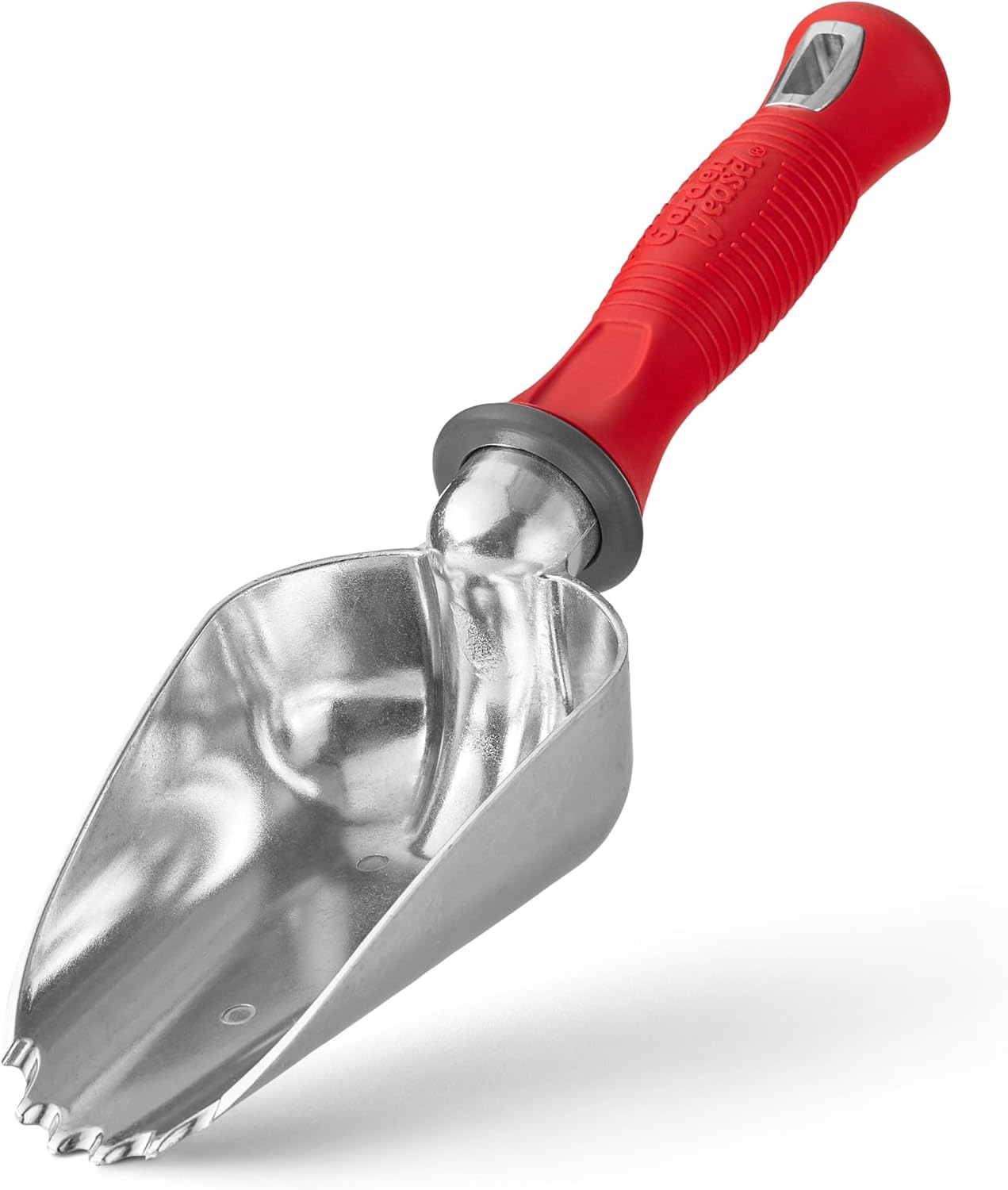
The Garden Weasel Oversized Potting Scoop uses a heavy-duty steel scoop for transplanting and moving soil or potting mix. Its tall sides carry material with less spillage, and the mini-shovel profile works in garden beds and containers. The broad scoop is useful for preparing planting holes and supporting careful soil handling during a block-to-garden transplant workflow.
Check On AmazonIf you click this link and buy, we earn a commission at no additional cost to you.
Compare cleanup, storage, and plastic use with reusable cells
Reducing plastic is a reasonable reason to consider soil blocks, but the comparison changes when the alternative is a durable cell tray that is cleaned and reused. Blocks remove the individual cell wall, while cells provide built-in support and usually make each seedling easier to move independently. Soil blocking also introduces a specialized forming step and leaves you with wet mix to manage during setup. Reusable cells keep a familiar filling process but add washing, drying, and storage between seed-starting rounds.
| Decision point | Soil blocks | Reusable cells |
|---|---|---|
| Physical support | The mix must hold its own shape. | The cell wall supports the medium. |
| Watering | Gentle bottom watering is especially useful. | Watering is often more forgiving because the medium is contained. |
| Moving seedlings | The tray carries the blocks as a group. | Individual cells can be easier to separate and handle. |
| Cleanup and storage | No individual cells to wash or store. | Trays and inserts need cleaning, drying, and storage for reuse. |
| Plastic use | Can reduce the need for disposable cell inserts. | Repeated reuse can spread the plastic cost over many seed-starting rounds. |
Neither column wins automatically because the better workflow depends on what currently causes trouble in your setup. If storage is tight and you routinely discard fragile inserts, soil blocks may solve a real burden. If you already own sturdy reusable cells and value easy handling, changing systems may create more mixing and watering work than it removes. Compare the whole annual routine, not just the moment when a seed is sown.
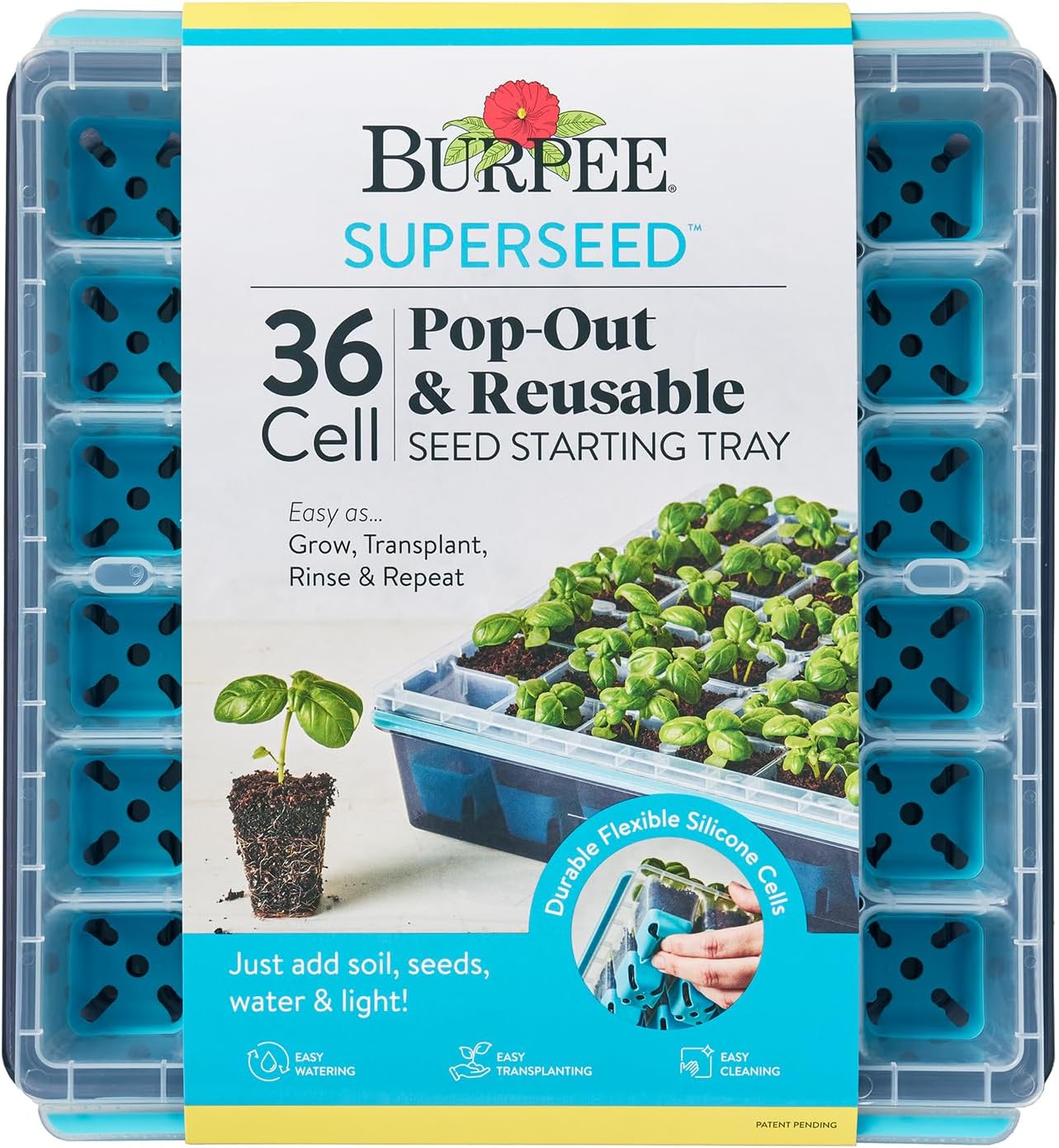
The Burpee SuperSeed tray has 36 reusable flexible pop-out cells for indoor seed starting. Soft food-grade silicone cells release seedlings by flexing, while molded corner slots improve drainage and soil aeration. It provides a durable cell-based alternative for comparing handling, cleanup, storage, and plastic reuse against a soil-block workflow.
Check On AmazonIf you click this link and buy, we earn a commission at no additional cost to you.
Decide whether batch size justifies the blocker
Batch size changes the economics of attention even when you are not comparing exact product prices. Making a few blocks requires gathering mix, adjusting moisture, pressing the blocker, arranging the tray, cleaning the work area, and then caring for an exposed-sided system. For a small number of seedlings, that setup can feel disproportionate if reusable containers are already on hand. For repeated batches, the same setup routine may become easier to justify because you can form the number of blocks needed without filling many separate cells.
I would also count how often you start seeds, not just how many seedlings you want at one moment. A gardener who starts several rounds of vegetables and flowers may value a repeatable blocking station more than someone who raises one modest batch each season. Watering attention matters just as much because more exposed blocks mean more surfaces to monitor, especially in warm or moving air. Buy into the method only after the mix, tray, watering space, and transplant route make sense together, because the blocker cannot compensate for a workflow that is awkward everywhere else.

Ladbrooke's 5-Pc Essentials Set includes the Mini 4, Micro 20, cubic inserts, 3/8-Inch seed pins, and 7/8-Inch dowel pins. The Mini 4 presses four 2-inch blocks and the Micro 20 presses twenty 3/4-inch starter blocks. The combined tools cover two block sizes in one nesting system, making the setup relevant when repeated seed-starting batches justify a dedicated blocking station.
Check On AmazonIf you click this link and buy, we earn a commission at no additional cost to you.
Final Thoughts: Decide whether the workflow fits before buying a blocker
Soil blocks can reduce reliance on disposable cells and avoid roots circling against container walls, but those gains come with a different kind of management. The mix has to hold, the tray has to stay rigid, watering has to be gentle, and the block size has to match how long the seedling will remain indoors. If those pieces already fit the way you start seeds, the method can be clean and logical. If they do not, reusable cells are not a failure or a lesser method; they may simply match your routine better.
Before buying anything, make a short checklist of the problem you want to solve, the batch size you expect, the growing medium you can prepare consistently, and the place where trays will be watered and carried. That check keeps the decision tied to the real work instead of to claims that soil blocks are automatically superior. The best fit is the setup you can keep stable from sowing through transplanting without unnecessary handling or emergency corrections. Choose the method that makes that sequence easier to repeat in your own home garden.

The Fiskars Planting Soil Scoop and Brush Set combines a narrow rigid scoop, a flexible dustpan end, and soft cleanup bristles. The scoop is designed for indoor potting and transplanting, while the brush sweeps spilled dirt and potting mix from work surfaces. It supports a more contained prep-and-cleanup routine around mixing medium, filling trays, and resetting a seed-starting station.
Check On AmazonIf you click this link and buy, we earn a commission at no additional cost to you.
FAQs
🌱 Are soil blocks better than seedling cells?
Not automatically. Soil blocks can reduce disposable plastic and prevent roots from circling against a cell wall, while reusable cells provide more physical support and can be easier to handle. Choose based on the problem you need to solve and the workflow you can manage consistently.
💧 How should I water soil blocks without breaking them?
Bottom watering is usually the safest approach because it avoids striking exposed block surfaces with a stream from above. Let the blocks absorb moisture, then drain or remove excess water rather than leaving them standing in it. Check moisture across the tray because edge and center blocks may dry at different rates.
🧱 Why do my soil blocks crumble after I make them?
Crumbling usually points back to block structure, which can be affected by mix texture, moisture, compression, or handling. Test the mix before sowing a full tray and make sure fresh blocks release with clean edges and remain stable on a flat surface. Fix the cause before planting seeds into blocks that are already failing.
🪴 Do soil blocks still need trays?
Yes. The tray provides the rigid support needed to form, water, carry, and transplant a group of freestanding blocks. It also needs to work with your bottom-watering method and allow excess water to be removed.
✋ Can seedlings stay in the same soil block until transplanting?
Sometimes, but it depends on block size, crop growth, and how long the seedling must remain indoors. A block that is efficient for a short indoor period may become too small when transplanting is delayed. Plan the starting size around the expected growing period so an extra move is not added unnecessarily.
References and Sources
- Iowa State University Extension and Outreach: Supports soil-block mix structure, tray requirements, bottom watering, spacing, root behavior, and transplant handling.
- University of Minnesota Extension: Supports the comparison with reusable seed-starting containers and general indoor seedling handling.