Soil does not need to be retested simply because another gardening season has arrived. A useful retest schedule starts with the last reliable result, then changes according to soil texture, management intensity, major amendments, and whether a fresh number would change what you do next. Extension guidance gives reasonable baseline intervals, but those ranges are starting points rather than a ritual for every bed. Stable areas can often wait longer than intensively managed or recently corrected soil.

The same calendar point can call for two different retest decisions
If you are asking how often you should test your soil, start with what has happened since the last reliable report, not the calendar alone. Picture two garden beds at the same point in the season: one has been managed steadily with no major correction, while the other received a substantial pH adjustment or a new fertility program. Giving both beds the same retest date ignores the reason testing is useful in the first place. The question is whether the soil conditions or the decisions based on them have changed enough to make new data valuable.
A recent, representative test can remain useful when the bed, crop pattern, and amendment routine have stayed fairly stable. A changed bed may need a new baseline sooner because the old report describes conditions that no longer match current management. I would treat the calendar as a reminder to review the record, not as an automatic order to buy another test. For the broader role of testing in homeowner soil decisions, the soil testing process provides the larger context without turning retesting into an annual habit.

This single-use mail-in kit is designed for lawn and garden soil and provides laboratory nutrient and pH analysis. The kit includes sampling materials, instructions, and a prepaid mailing envelope addressed to the testing lab. It fits a retest decision when changed conditions justify establishing a fresh soil baseline.
Check On AmazonIf you click this link and buy, we earn a commission at no additional cost to you.
Start with the last test and what has changed since then
The first useful question is whether the previous result still describes the area you are managing now. Check how old the report is, whether it came from the same bed or lawn area, and whether the major inputs have stayed similar since sampling. A number from a different area, or from soil that has since been heavily amended, is a weak baseline even if the report itself is recent. The reliability of the old test matters as much as the number of seasons that have passed.
Then look for management changes that could make the previous baseline less useful. Major pH correction, a large shift in fertilizer or compost inputs, conversion to more intensive vegetable production, or a newly established growing area can all change the value of retesting. The point is not that every change demands an immediate sample, because some amendments need time to react and local guidance may set the appropriate follow-up window. The point is that a changed system deserves a different soil testing frequency from a bed that has been managed the same way for years.
- Was the last sample representative of the same area you are making decisions about now?
- Have you made a major pH correction or substantially changed amendment inputs?
- Has the area shifted from low-intensity ornamental use to more intensive food production?
- Would a new result change a fertilizer, lime, amendment, or management decision?
- Are you trying to compare a trend, and can you sample under comparable conditions?
Retest trigger timeline: Begin with the last reliable result as the working baseline, then watch for changes that could make that baseline less representative. A stable area stays on the normal local review cycle while management remains consistent and no new decision depends on fresh data. A major correction or a shift to more intensive management starts a new review point, but the next sample should wait until the change has had enough time to matter under the relevant guidance. Once a follow-up result has answered the management question, the area can return to a normal review cycle unless another meaningful change creates a new trigger.
| Point in the retest cycle | Trigger to review | What to do next |
|---|---|---|
| Reliable baseline established | No major management change | Keep the report as the working baseline and follow the normal local interval |
| Management changes | Major pH correction, substantially different inputs, or a move to more intensive production | Mark the area for follow-up rather than testing again immediately |
| Follow-up window becomes meaningful | The correction has had time to react and a new result could change the next decision | Retest the changed area using the applicable laboratory or Extension guidance |
| New baseline is useful | The follow-up result now represents current management | Use it for future comparisons and return to the normal review cycle unless conditions change again |
If most answers point to continuity, retesting may be less urgent. If several answers point to changed management, the older report is more likely to be describing a garden that no longer exists in the same form. That is the practical dividing line to carry into the interval guidance. The next step is to match that history to a realistic baseline rather than defaulting to the shortest interval you can find.

This at-home kit tests soil pH, nitrogen, phosphorus, and potash with a capsule and color-comparator system. It includes enough components for 20 tests, with five tests for each measurement. Multiple tests make it practical for checking several garden spots when you are deciding whether an older result still represents the area.
Check On AmazonIf you click this link and buy, we earn a commission at no additional cost to you.
Use Extension intervals as a baseline, not a ritual
Extension recommendations do not all give the same interval, which is useful evidence that one universal schedule would be misleading. Penn State, for example, gives different retest ranges for sandy and clay soils, while University of Georgia guidance shortens the interval for intensively cultivated vegetable soil and allows a longer interval for established lawns and ornamental areas. Michigan State also advises established plantings to be retested on a multiyear cycle or after major changes. Those differences reflect management and soil behavior, not disagreement that can be solved by picking the shortest number.
If you are deciding how often to soil test a garden, use the interval that best matches your local Extension guidance and your actual management intensity. A sandy bed with frequent harvest and nutrient inputs should not automatically inherit the same schedule as a stable ornamental border on heavier soil. I would use the local interval as the default checkpoint, then move sooner only when a meaningful change or decision justifies it. That keeps testing connected to improving garden soil rather than turning the test itself into the goal.
| Garden situation | How to use the interval | Why the schedule may change |
|---|---|---|
| Stable bed with a recent reliable baseline | Use local Extension guidance as the normal checkpoint | Few management changes mean the existing report may still support current decisions |
| Intensively managed vegetable soil | Expect a shorter interval where local guidance supports it | Frequent harvest and nutrient inputs can make management more dynamic |
| Recently corrected or substantially amended area | Plan a follow-up based on amendment response time and local guidance | The old baseline may no longer represent current conditions |
| Unchanged area with no decision tied to a new result | Do not retest merely to satisfy the calendar | A new number has little practical value if it will not change management |
This table is a decision frame, not a replacement for state or laboratory instructions. Local soil type, crop use, and the recommendation system behind a report can change the appropriate interval. Use the range to decide when to review the need for retesting, then let current conditions decide whether the sample is actually worthwhile. A useful baseline narrows the decision, but it should never erase the management history of the bed in front of you.

These soil pH strips cover a 3.5 to 9 range and come in a 100-count kit. The test uses a soil-and-water mixture followed by comparison with the included color chart. The large strip count suits periodic pH checkpoints when a simple repeat measurement is useful between broader soil tests.
Check On AmazonIf you click this link and buy, we earn a commission at no additional cost to you.
Retest sooner after major correction or intensive management when guidance supports it
A major correction changes the retest question because you are no longer asking only whether routine fertility has drifted. You may be asking whether a deliberate management change has moved the soil toward the condition the original recommendation was meant to create. Michigan State specifically points to major changes such as adding lime or sulfur as reasons to retest outside the ordinary multiyear cycle, while other Extension guidance gives its own follow-up timing for pH work. That is why an amendment label, laboratory recommendation, or local Extension instruction should control the follow-up window instead of a generic online countdown.
Intensive management can also justify more frequent testing, but intensity needs a real meaning. A vegetable bed that is harvested heavily, fertilized regularly, and amended often is a different management system from a perennial border that receives modest inputs and has stable fertility. University of Georgia guidance reflects that distinction by recommending annual testing for intensely cultivated soils while using a longer interval for established lawns and ornamental areas. More frequent testing is useful when it tracks a faster-changing system, not when it simply produces another report to file away.
Key point: A major change can justify an earlier retest, but earlier does not mean immediately. Give the management change enough time to affect the soil. Follow the timing recommended for that specific correction. If the amendment has not had time to react, another sample may tell you very little.
Think of a recently amended bed as a follow-up case rather than a routine case. The old report established the problem or baseline, the amendment changed the management, and the next test should answer whether a new management decision is needed. That sequence keeps retesting tied to an action instead of to anxiety about whether the soil number moved quickly enough. It also gives the next report a defined job before you collect another sample.
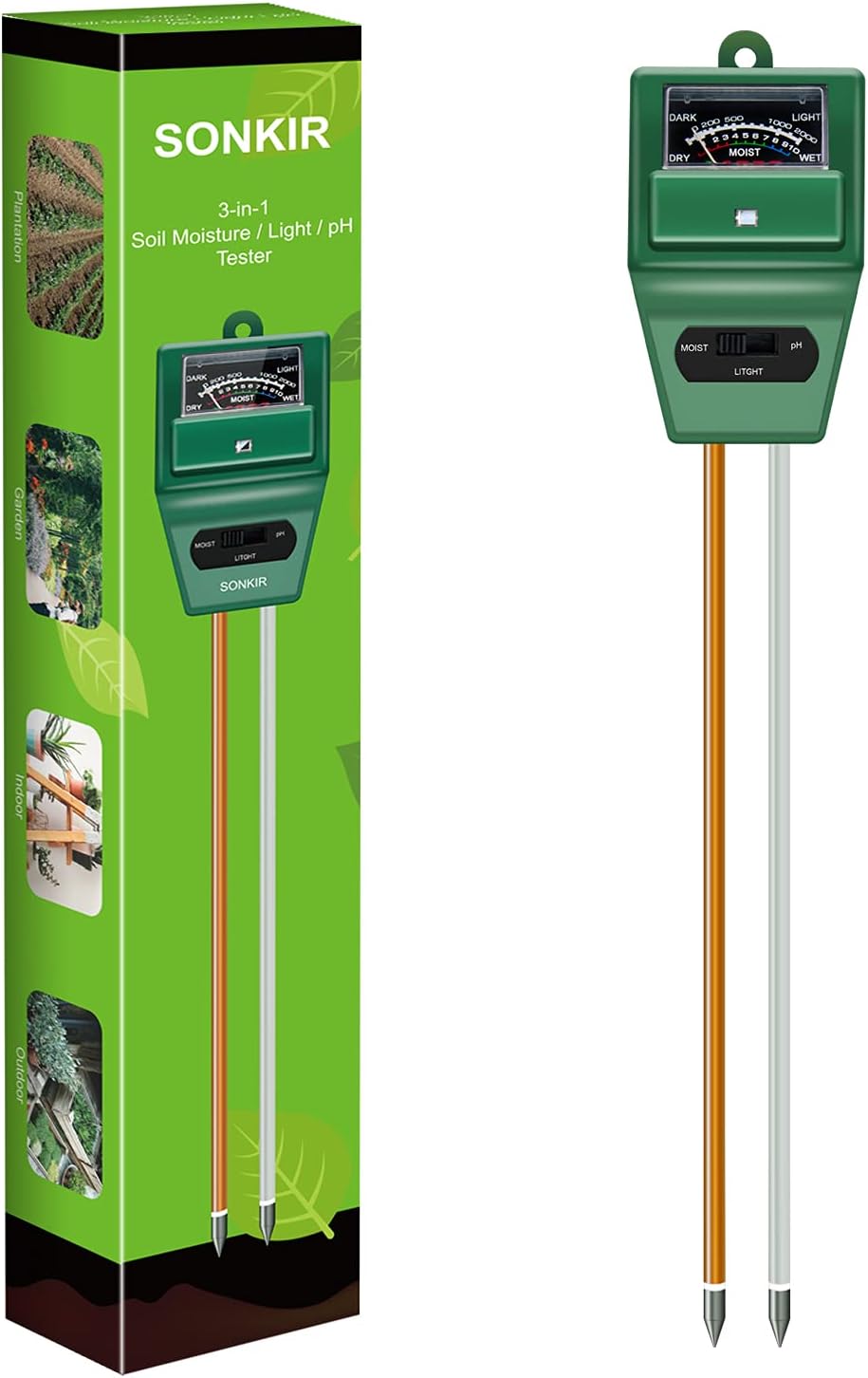
This battery-free meter checks soil pH, moisture, and light through a three-position selector. The probe is inserted directly into soil and the readings appear on the analog dial. It is useful for quick spot checks after management changes while laboratory or Extension guidance still determines the proper retest timing.
Check On AmazonIf you click this link and buy, we earn a commission at no additional cost to you.
Keep timing comparable when you are tracking a trend
Retesting is most useful when the new result can be compared fairly with the old one. Michigan State notes that sampling at the same time of year makes year-to-year nutrient comparisons easier because measured nutrient levels and pH can shift with seasonal conditions. If one sample was taken under one seasonal context and the next under a very different one, part of the apparent change may reflect timing rather than management. For trend tracking, consistency in the sampling window is part of the measurement, not a minor detail.
Keep stable and recently changed areas separate as well. Oregon State advises gardeners who are problem solving or fine tuning to collect individual samples from different garden areas rather than blending everything into one average. If one raised bed received a major amendment and the neighboring bed did not, combining them can blur the very difference you are trying to measure. A stable bed can remain on its normal schedule while the changed bed follows a more specific retest plan.
| Area | What happened since the last test | Better retest approach |
|---|---|---|
| Stable perennial bed | No major amendment or management shift | Stay near the normal local interval and sample under comparable conditions |
| Recently amended vegetable bed | Major correction or much more intensive input pattern | Treat it as a separate area and use guidance tied to that change |
The practical lesson is simple: do not let one changed corner force the entire property onto the same retest schedule. Separate areas when their management history is meaningfully different, then compare each area to its own prior baseline. That makes the next report easier to interpret and reduces the chance of reacting to an average that hides what actually changed. It also prevents a recently amended bed from making a stable area look as though it needs the same level of follow-up.

This 12-inch stainless steel T-handle probe is made for collecting soil samples and includes two sample bags. The narrow probe helps take repeatable cores from selected garden areas without blending unlike beds together. It fits trend tracking where consistent sampling location and separate handling of changed areas matter.
Check On AmazonIf you click this link and buy, we earn a commission at no additional cost to you.
Skip retesting when no decision depends on a new number
Testing has a cost in money, time, and attention, so a new report should answer a question that matters. If the last reliable test is still reasonably current under local guidance, the area has been managed consistently, and you are not considering a change that depends on fresh soil data, another test may add little value. The same is true when a gardener already knows the next step from the existing report and the management change has not had enough time to work. Retesting too soon can create noise without creating a better decision.
Before sending another sample, finish the sentence, “I will change this if the result shows that.” If you cannot name the decision, the test is probably habitual rather than informative. That does not mean ignoring a new garden problem, but a soil test should not be treated as a universal diagnosis for every symptom. Use retesting when current soil data can guide a real management choice, and use the appropriate plant or problem investigation when the question lies elsewhere.
Note: A soil test can support a soil management decision, but it cannot by itself prove the cause of a plant symptom. Keep the retest focused on the question the laboratory result can actually answer. A normal result does not rule out every nonsoil cause. An unusual result still needs to be interpreted in the context of the plants and management history.
A good retest schedule therefore has a stop condition as well as a trigger. Stable management plus a usable recent baseline can justify waiting, while a major change plus a pending decision can justify checking sooner. That is a more useful rule than testing every year simply because the season changed. The value comes from a better decision, not from accumulating more laboratory reports.

This battery-free single-probe meter gives an instant soil moisture reading on a clear analog dial. Its 304 stainless steel probe is intended for indoor and outdoor plant soil. It can help check whether a plant problem is simply related to moisture before you order another soil test that may not answer the real question.
Check On AmazonIf you click this link and buy, we earn a commission at no additional cost to you.
Final thoughts: Retest when management changes make a new baseline useful
The most useful retest interval is the one that matches how quickly your management can make the old baseline less useful. Start with local Extension guidance, then adjust for soil type, intensity of cultivation, major amendments, and whether the next report will change an action. Keep trend samples comparable and separate areas that have different management histories. That approach gives you fewer meaningless tests and more useful comparisons.
I would not treat annual testing as a badge of careful gardening, and I would not treat a multiyear interval as permission to ignore a major change. Review the last report, note what has changed, and decide what question the next sample needs to answer. If there is no decision waiting on a new number, waiting can be the more disciplined choice. If management has changed enough that the old report no longer represents the bed, a fresh baseline becomes much more valuable.

This digital 4-in-1 meter measures soil moisture, pH, temperature, and sunlight and shows readings on a backlit LCD. It uses four AAA batteries and is designed for garden, farm, and potted-plant soil checks. Its broader snapshot can help document changing conditions while you decide whether a full retest would actually change a management decision.
Check On AmazonIf you click this link and buy, we earn a commission at no additional cost to you.
Frequently asked questions
🌱 Do I need to test my garden soil every year?
Not for every garden. Annual testing can make sense for intensively cultivated soil when local Extension guidance recommends it, while stable areas may use a longer interval. Base the decision on management intensity and whether new results will change what you do.
🧪 How often should established garden soil be retested?
Use your state or laboratory guidance as the starting interval because recommendations vary with soil and management. Extension examples commonly use multiyear intervals for stable areas. Move sooner only when a major change or a current decision makes fresh data useful.
🥕 Should a vegetable garden be tested more often than an ornamental bed?
It can be, especially when the vegetable bed is intensively cropped, harvested, fertilized, and amended. Some Extension programs recommend annual testing for intensively cultivated vegetable soil while allowing longer intervals for established ornamental areas. Follow the guidance that matches your region and management level.
🪨 Should I retest after adding lime or sulfur?
A major pH correction can justify a follow-up test, but the correct waiting period depends on the amendment, soil conditions, and local guidance. Do not retest immediately just to see whether the number moved. Follow the laboratory or Extension timing for the correction you made.
📊 Does it matter if I retest at a different time of year?
It can matter when you are tracking changes over time. Sampling in a comparable seasonal window makes repeated results easier to compare because some measured values can shift with season and soil conditions. Consistency is especially useful when your goal is trend tracking.
🌿 Can one soil sample represent every bed in my yard?
Only when the areas have similar soil and management histories. Beds that received different amendments, support different plant groups, or are being investigated for different questions are better treated separately. Combining unlike areas can hide useful differences.
References and sources
- Penn State Extension soil testing: Supports different routine retest intervals for sandy and clay soils and the use of testing when problems occur.
- Michigan State University Extension soil testing instructions: Supports multiyear retesting for established plantings, retesting after major changes, and sampling at the same time of year for better comparisons.
- University of Georgia Extension soil testing guidance: Supports more frequent testing for intensely cultivated vegetable soils and longer intervals for established lawns and ornamental areas.
- Oregon State University Extension garden soil testing: Supports treating separate garden areas individually when fine tuning or problem solving rather than blending unlike areas into one sample.