Soil testing is most useful when it answers a decision you actually need to make, not when it is treated as a routine box to check. A gardener deciding whether to add an amendment needs a different kind of answer from someone who already has a laboratory report in hand. The useful path is to identify the question first, then choose the sampling method, test type, timing, and interpretation that fit that question. This keeps a soil test from becoming a pile of numbers that does not change what you do in the garden.
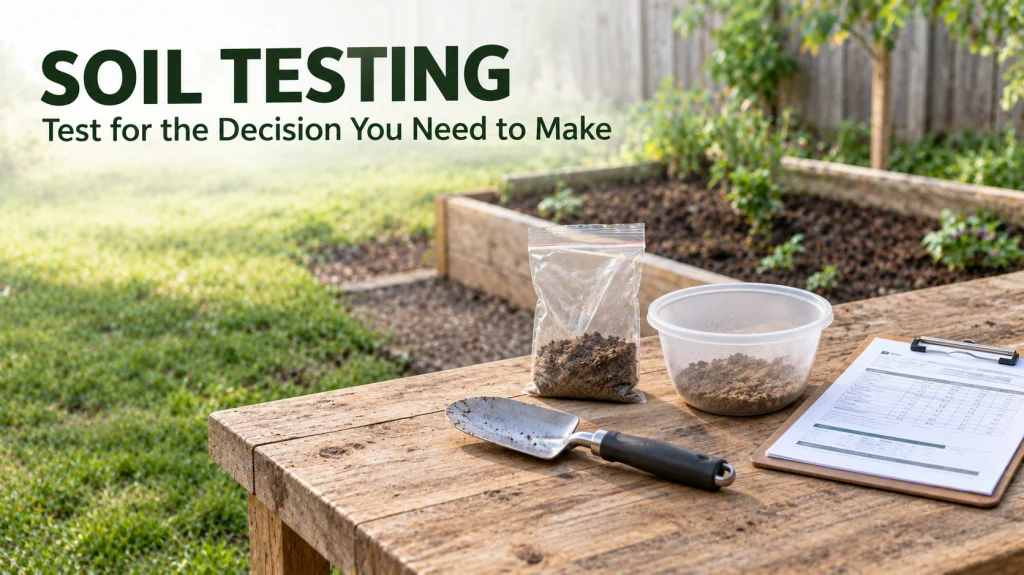
Two gardeners can need completely different soil tests
Soil testing can mean very different things depending on where you are in the decision. One gardener may be staring at several bags of fertilizer and wondering whether the bed needs any of them. Another may already have a laboratory report showing pH, phosphorus, potassium, and organic matter, but still not know what the numbers mean for the plants going into that bed. Treating both people as if they need the same generic testing checklist is where useful information starts to blur.
The first gardener needs to know whether testing can prevent an unnecessary amendment or point to a more appropriate one. The second needs help interpreting the report in the context of the crop, the laboratory method, and the recommendation that came with the test. A third gardener may not be ready for either step because the real question is how to collect a representative sample. Once the current job is clear, the rest of the process becomes much easier to route without turning every soil question into the same answer.
Use this soil-testing routing tree to choose the next step:
- Considering an amendment: decide whether testing could change that decision.
- Ready to collect soil: follow the protocol for taking a representative sample.
- Already have a report: move to interpreting the soil test report.
- Choosing a method: compare a home kit with laboratory testing.
- Choosing timing: separate when to sample from how often to retest.
- Choosing a package: verify what the test actually measures.
These branches solve different problems, so follow the one that matches the decision in front of you. Resolve that question before moving to another testing job. This keeps testing focused on information that can change the next garden decision. It also shows when the real problem belongs outside soil testing.

YAMRON 4-in-1 Soil Meter measures soil moisture, pH, temperature, and sunlight intensity. The digital meter uses a backlit LCD for displaying readings. It is designed for gardening, farming, and outdoor plants.
Check On AmazonIf you click this link and buy, we earn a commission at no additional cost to you.
Identify the soil testing question before choosing the method
Start by naming the decision that is blocked. If you are about to change pH, add fertilizer, or apply a major amendment, the useful question is whether a test can change that decision. If you have already decided to test, the question may be how to divide the garden into sampling areas or how to collect soil that actually represents each area. If you already have results, the next step is not another sample but a careful reading of the laboratory’s terms, ratings, and recommendations.
This matters because the same garden can produce several valid testing jobs at once. A vegetable bed, a lawn area, and an acid-loving shrub planting may have different management histories and different plant requirements, so combining them into one decision can hide useful differences. A struggling patch may also need a separate sample rather than being mixed into the average for an otherwise healthy area. Use the table below to keep the testing job tied to the action it is supposed to support.
| Current question | What the test needs to support | What not to do yet |
|---|---|---|
| Should I amend this soil? | Confirm whether pH or nutrient information can change the amendment choice. | Do not buy or apply a large corrective input just because the soil looks poor. |
| How should I take the sample? | Collect soil that represents one reasonably uniform management area. | Do not mix unusual trouble spots into a sample meant to represent the whole bed. |
| What does this report mean? | Translate the laboratory’s values and recommendations into a garden decision. | Do not compare numbers from different laboratories as if every extraction method and rating scale were identical. |
| Is a home kit enough? | Decide how much accuracy and interpretation the consequence of the decision requires. | Do not treat a coarse low, medium, or high reading as a precise fertilizer prescription. |
The goal is not to test more often or collect more numbers. It is to make sure the information is capable of changing a real garden decision. If the decision is broader than testing, such as how to improve structure, organic matter, fertility, or drainage together, use the broader guide to improving garden soil to frame the problem before ordering a test. That keeps soil testing in its proper role as one source of evidence rather than a complete diagnosis of the bed.

KINGLAKE includes 100 plastic T-type garden labels. Each label measures 6 x 10 cm. The markers are intended for nursery and garden labeling, making it easier to keep sampling areas or beds identified.
Check On AmazonIf you click this link and buy, we earn a commission at no additional cost to you.
Test when the result can change an amendment decision
A soil test earns its keep when the result can stop you from making a bad correction or confirm that a change is justified. If a bed has received compost, manure, fertilizer, or lime for years, more input is not automatically an improvement. Some soils already contain ample levels of certain nutrients, and a laboratory report can reveal that adding more would be unnecessary. This is especially useful before making a large pH or fertility adjustment that would be difficult to reverse quickly.
Testing is less useful when the question is actually outside the test’s scope. A standard fertility test does not by itself explain compaction, drainage, root damage, insect injury, disease, watering problems, or every reason a plant may look weak. If a plant symptom is the starting point, use the test as one piece of evidence rather than treating it as a diagnosis. Keep looking at the plant, site, and recent management when the test does not measure the suspected cause. The practical question is not “Can I get a number?” but “Would this number change what I am about to add, stop, or investigate?”
- Test before a major fertilizer or pH correction when the result could prevent an unnecessary application.
- Test a new growing area when its fertility history is unknown and you are planning amendments.
- Consider a separate sample for a distinct problem area instead of blending it into an average sample.
- Do not expect a routine fertility test to explain every plant symptom or physical soil problem.
If the answer is that the result would not change anything you plan to do, testing may not be the next useful step. If the answer is yes, the quality of the sample becomes the next limiting factor. A precise laboratory result from a poor sample can still lead you toward the wrong management decision. The sample therefore deserves its own protocol rather than a few rushed scoops from one convenient corner.

Rapitest Soil Test Kit checks soil pH, nitrogen, phosphorus, and potash. The kit includes 20 total tests, with five tests for each parameter. Its color comparator system is used to match test colors against the supplied scales.
Check On AmazonIf you click this link and buy, we earn a commission at no additional cost to you.
Keep sample collection as its own protocol
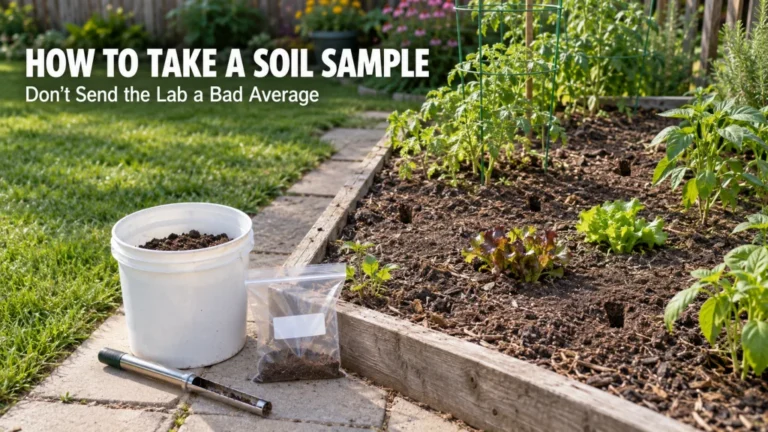
The laboratory only sees the soil you send, so the sample has to represent the area you want the result to describe. Extension guidance commonly recommends combining multiple small subsamples from a reasonably uniform garden area rather than relying on one spot. Areas that have been managed differently, planted differently, or that show a distinct problem are often better handled as separate samples. The exact depth, number of subsamples, container, drying instructions, and amount to submit should follow the laboratory or Extension instructions you are using.
That last point is important because sampling directions are not perfectly interchangeable. A vegetable bed, lawn, orchard area, or no-till system may call for a different sampling depth or approach, and laboratories may have their own submission requirements. Avoid obvious contamination such as fertilizer granules, fresh compost piles, mulch, roots, or soil from a recently treated spot unless that is specifically the condition you are trying to evaluate. When the sample is meant to represent an average growing area, unusual spots should not quietly dominate the result.
Think of sampling as a mapping problem before it becomes a laboratory problem. Mark the beds or zones that are managed similarly, decide which ones need separate results, and label every sample so the report can be matched back to the correct location. If a poor performing corner is important, sample it separately and compare it with a healthier area rather than blending the two. For the step-by-step procedure, use the dedicated guide on how to take a soil sample instead of improvising a collection method.

This soil sampler uses a 12-inch stainless steel probe with a T-handle. The listing includes two sample bags with the probe. It is designed for collecting soil samples from lawns and garden areas.
Check On AmazonIf you click this link and buy, we earn a commission at no additional cost to you.
Treat report interpretation as a separate decision from sampling
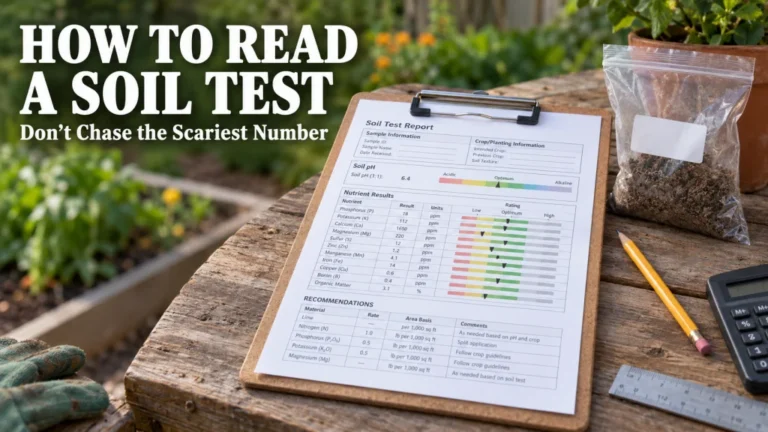
A clean sample and a good laboratory analysis still do not tell you what to do until the report is interpreted in context. Reports may include pH, nutrient values, organic matter, soluble salts, or other measurements, but the exact package varies by laboratory. The ratings attached to those values can also depend on the laboratory’s analytical method, regional calibration, crop information, and recommendation system. That is why a number copied from one report should not automatically be judged by a chart from an unrelated laboratory.
Read the report in the order that supports a decision. First confirm what was measured, then identify the units and rating scale, then read any crop or amendment recommendation provided by the laboratory. If a value is marked low, adequate, high, or excessive, find out what that label means in that laboratory’s system before acting on it. The useful outcome is not memorizing the report but knowing which recommendation is supported, which input may be unnecessary, and which questions still remain outside the test.
Soil pH is a good example of why context matters. The same pH is not equally suitable for every plant, and the amount of material needed to change pH can depend on soil properties and the laboratory’s recommendation method. A report may also distinguish between the measured soil pH and other values used to calculate lime needs, which should not be treated as interchangeable. When you have the report in front of you, the dedicated guide to reading a soil test report is the right place to work through those details.
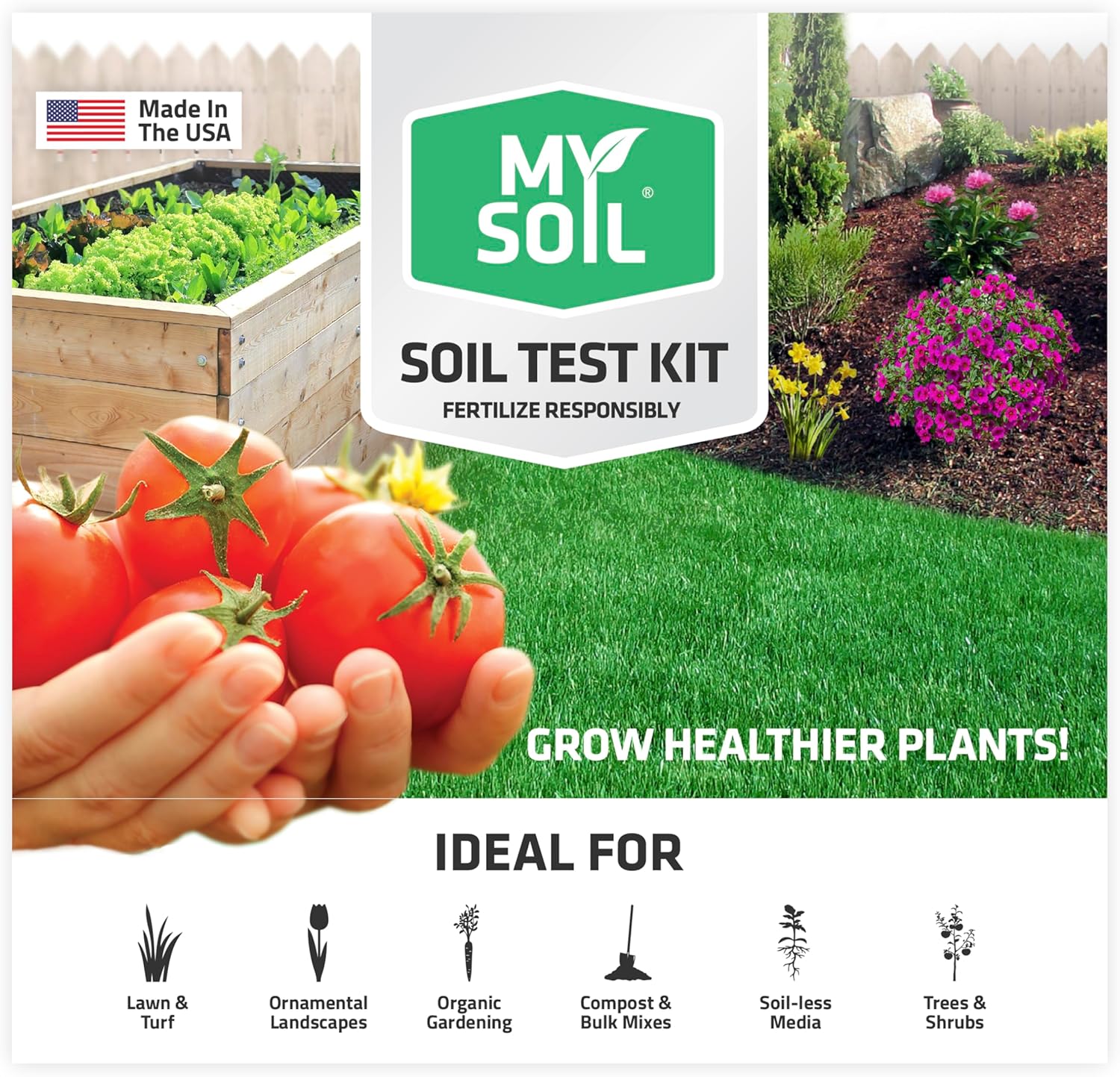
MySoil is a mail-in soil test kit that provides nutrient and pH analysis. The service returns soil results with recommendations tailored to the submitted soil and plant needs. The kit is designed for lawn and garden testing.
Check On AmazonIf you click this link and buy, we earn a commission at no additional cost to you.
Choose a home kit or laboratory by the consequence of being wrong
A home kit can be appealing because it is fast, inexpensive, and available without mailing a sample, but convenience is not the same as decision quality. Many basic kits report a small set of measurements and may reduce nutrient results to broad categories or color comparisons. Extension sources caution that these tools are generally less accurate than laboratory testing for detailed nutrient decisions, and some test methods may not match the regional calibration used for fertilizer recommendations. The more expensive or difficult the correction would be, the more valuable a well matched laboratory analysis becomes.
That does not mean every garden question requires the broadest laboratory package available. A simple pH question may need less information than a fertility plan for a new vegetable garden, while suspected contamination or soluble salt concerns may require a specific add-on test rather than a standard package. The right comparison is therefore not home kit versus laboratory in the abstract. It is whether the method provides enough accuracy, scope, and interpretation for the consequence of the decision you are about to make.
A useful rule is to spend more on evidence when being wrong would lead to a larger correction, repeated applications, or a difficult recovery. If you only want a rough screening result and you understand the limitations, a home method may still answer a narrow question. If the result will determine fertilizer, liming, or another substantial amendment, a laboratory result tied to regional guidance is usually the stronger foundation. The detailed tradeoffs belong in the separate comparison of soil test kits versus laboratory testing.
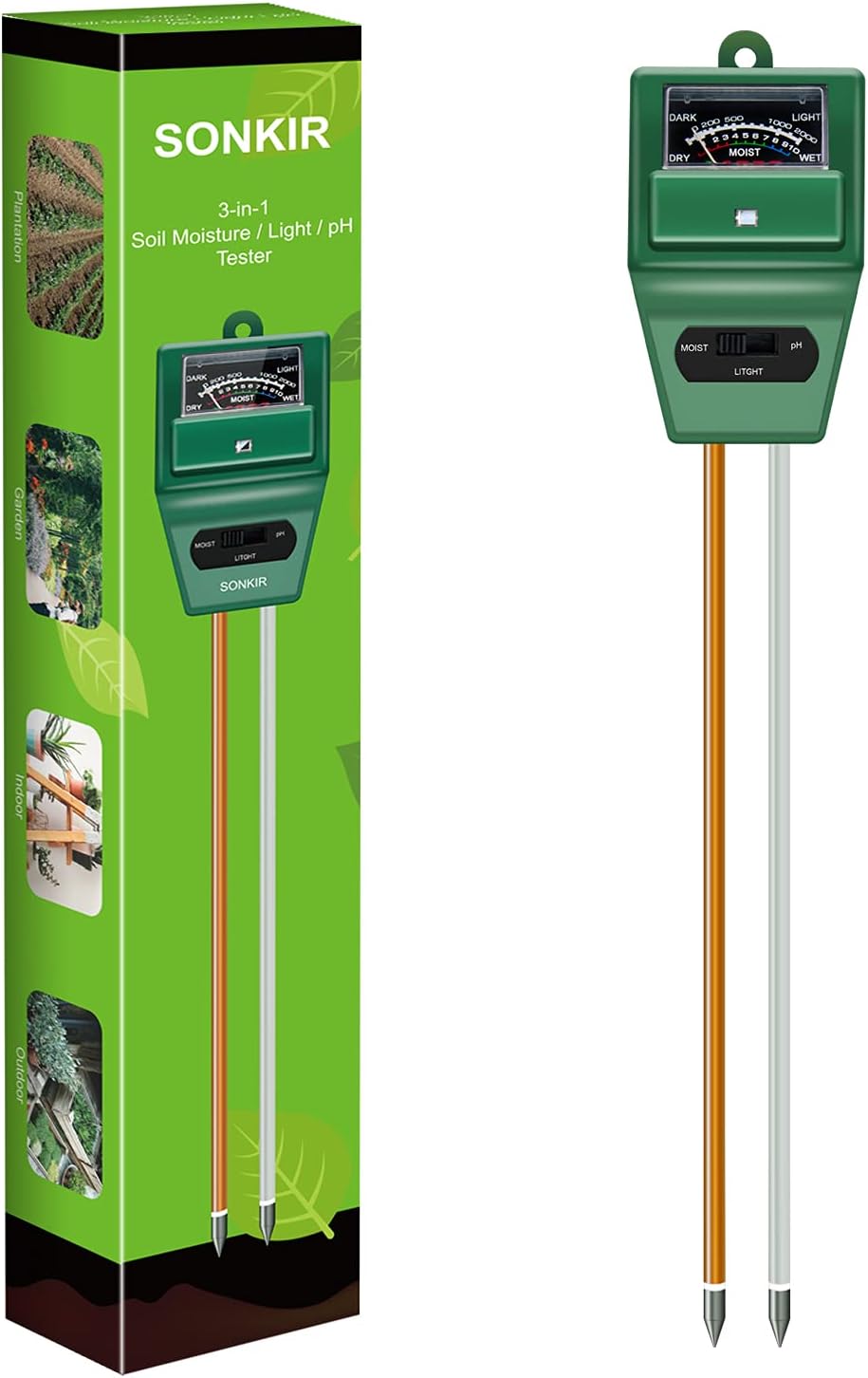
SONKIR MS02 is a 3-in-1 soil meter for moisture, light, and pH checks. The tester is intended for garden, lawn, indoor, and outdoor plant care. This listing is the green MS02 variant.
Check On AmazonIf you click this link and buy, we earn a commission at no additional cost to you.
Separate seasonal timing from how often you retest
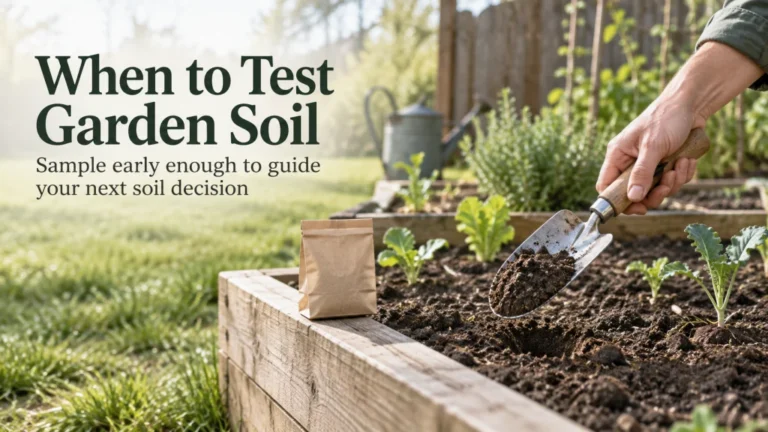
When to take a sample and how often to repeat testing are related questions, but they are not the same question. Sampling is often easiest when soil is workable and not excessively wet, and many gardeners prefer a point in the season that leaves enough time to review results before making major amendments. Consistency also helps when you are comparing one test with another because wildly different sampling conditions can make trend reading harder. The laboratory’s instructions should still take priority when they specify preparation or timing requirements.
Retest frequency should be driven by how quickly the management question can reasonably change. A newly established garden, a bed receiving significant amendments, or an area being corrected for pH may justify a different interval from a stable garden with a known history. Extension recommendations vary, which is a good reason not to turn one interval into a universal rule for every garden. The useful habit is to retest when the result can confirm a meaningful change, not simply because the calendar says another test is due.
Keep those two decisions separate so the advice stays practical. Use when to test garden soil for the seasonal sampling question, and use how often to retest soil for the longer term monitoring question. One helps you choose an appropriate sampling window, while the other helps you decide when another result is likely to add useful information. That distinction prevents routine testing from replacing actual garden observation and management.

Legend Garden Journal is a 5-year gardening planner and log book. The Cypress hardcover includes a planting calendar and plant logs. It is designed for tracking seasons, plants, progress, and detailed garden notes over time.
Check On AmazonIf you click this link and buy, we earn a commission at no additional cost to you.
Verify what the selected test package actually measures
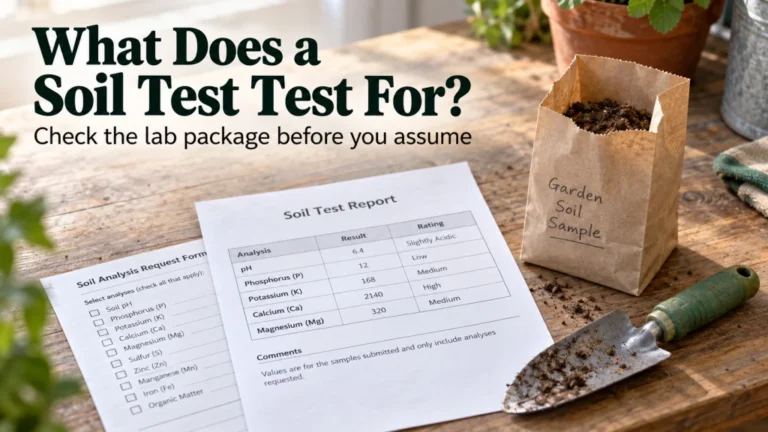
Do not assume that every package called a garden soil test measures the same things. A basic package may include pH, phosphorus, potassium, and organic matter, while other laboratories may include or offer soluble salts, calcium, magnesium, micronutrients, nitrate, texture, lead, or other analyses. Even when two packages list similar nutrients, the analytical method and the way recommendations are generated can differ. The package name is less important than the actual measurements, units, interpretation, and recommendation format you will receive.
Start with the question and work backward. If you need to know whether a routine fertility amendment is justified, a standard garden fertility package may be enough. If the concern involves lead, soluble salts, a specialized crop, or another issue not included in the standard package, choose a test that explicitly addresses that need rather than assuming the laboratory will cover it automatically. If you are unsure, review a sample report or ask the laboratory what the package measures and whether it provides homeowner recommendations.
More measurements are not automatically more useful. Extra data can add cost and confusion when it does not change the decision you need to make. The right package is the narrowest one that can answer the current question with enough confidence for the action that follows. For a field by field look at common test components and their limits, use the guide to what a soil test measures.

This soil test kit includes 100 pH test strips. The strips cover a pH range of 3.5 to 9 for garden, lawn, and indoor plant soil. It is an at-home pH-only testing product, so its scope is narrower than a multi-nutrient kit.
Check On AmazonIf you click this link and buy, we earn a commission at no additional cost to you.
Final thoughts: match the test to the soil decision
Good soil testing starts before the sample goes into a bag. Decide what action the result needs to support, separate areas that should not be averaged together, follow the correct sampling protocol, and choose a test package that measures what the decision actually requires. Then read the report using the laboratory’s own methods and recommendations instead of forcing every result into a generic chart. That sequence keeps the test tied to a practical soil management decision instead of turning it into a routine collection of numbers.
If the result would not change what you plan to add, stop, or investigate, another test may not be the most useful next step. If the result could change the decision, put as much care into the sample and test package as you do into reading the report. Keep physical soil problems and plant symptoms in their own troubleshooting lanes when a fertility test cannot answer them. The best next step is the one that reduces uncertainty enough to support a more careful garden decision.

Fiskars Ergo Garden Trowel is an aluminum hand tool for digging and planting. The listing specifies an ergonomic grip and a 12.25-inch overall length. Its polished aluminum head is described as rust resistant.
Check On AmazonIf you click this link and buy, we earn a commission at no additional cost to you.
Explore the soil testing decision in more detail
Once you know which part of the process is blocking the next garden decision, use the matching guide below. Each page takes one testing job farther without making you repeat the entire workflow. That keeps sampling instructions out of report interpretation and keeps test choice separate from retest timing. Start with the question you need answered now rather than reading every topic as if it were one long procedure.
| Topic | What you’ll find |
|---|---|
| Why test garden soil before amending | How to decide whether a test can prevent an unnecessary or poorly targeted soil amendment. |
| How to take a soil sample | How to divide the garden into sampling areas and collect a representative composite sample. |
| How to read a soil test report | How to interpret the laboratory’s values, ratings, units, and recommendations without mixing methods. |
| Soil test kit versus laboratory testing | How to compare convenience, accuracy, scope, and the consequence of acting on an uncertain result. |
| How often to test garden soil | How to choose a retest interval based on management changes rather than a fixed rule for every garden. |
| When to test garden soil | How seasonal conditions and amendment planning affect the most useful sampling window. |
| What a soil test measures | How to check what a test package includes before paying for data that may not answer your question. |
Choose the page that matches the decision you are making now. Follow that procedure or interpretation far enough to resolve the current uncertainty before moving to another topic. If the result changes your soil management plan, make the change according to the relevant recommendation rather than adding unrelated inputs at the same time. Return to the broader soil management plan after the test has given you information you can actually use.

Luster Leaf 1601 Rapitest Soil Test Kit checks pH, nitrogen, phosphorus, and potash. Model 1601 provides 40 tests, with 10 tests for each parameter. The kit uses color comparators to read the four soil measurements.
Check On AmazonIf you click this link and buy, we earn a commission at no additional cost to you.
FAQs
🧪 Is soil testing worth it for a home garden?
It is most useful when the result can change an amendment, fertilizer, or pH decision. Testing can also establish a useful baseline when you are starting a new growing area with an unknown fertility history. If you are not facing a decision that the test can answer, collecting more numbers may not improve the garden plan. Start with the action you are considering and ask whether the result could realistically change it.
🌱 Can a soil test tell me why a plant is struggling?
Not by itself. A routine fertility test can reveal useful soil information, but symptoms can also come from drainage, compaction, watering, roots, pests, disease, weather, or other conditions. Use the report to confirm or rule out soil factors that the selected test actually measures. Keep investigating the plant and site when the symptom could have another cause.
🏠 Are home soil test kits accurate enough?
They can be useful for a narrow screening question, but many kits provide less precise or less complete information than a laboratory test. Some also rely on broad color categories that are difficult to translate into a precise amendment decision. Use a laboratory when the result will drive a substantial fertilizer, liming, or other corrective change. Match the method to the consequence of being wrong rather than choosing on convenience alone.
🪣 Should I mix soil from the whole yard into one sample?
Usually not if the areas have different plants, management histories, soil conditions, or visible problems. A lawn, vegetable bed, and separately amended border can deserve separate samples because they represent different management areas. Combine subsamples only within an area that is reasonably uniform for the decision you want the result to represent. Keep unusual trouble spots separate when you want to compare them with healthier soil.
📄 What should I look for on a soil test report first?
Confirm what was measured, the units, the laboratory’s rating scale, and any crop or amendment recommendation provided. Then check whether the recommendation matches the plants or use you listed for the sample. Do not judge a value using an unrelated chart unless you know the analytical method and interpretation are compatible. If a report term is unclear, use the laboratory’s own interpretation guide before changing the soil.
⏳ How often should garden soil be retested?
The interval depends on the garden’s history, the changes you are making, and what you need to verify. A stable bed may need testing less often than a new area or a bed undergoing a significant fertility or pH adjustment. Retest when a new result is likely to confirm a meaningful management change rather than simply repeating a routine. When comparing results over time, use a consistent sampling area and follow the same laboratory guidance where practical.
References and Sources
- Oregon State University Extension: Supports the testing decision, laboratory versus home kit distinction, representative sampling, and report interpretation boundaries.
- University of Maryland Extension: Supports interpretation of common report components, pH, nutrient ratings, organic matter, and laboratory recommendation context.
- Montana State University Extension: Supports the differences between home kits and laboratory analysis, including method, accuracy, scope, and interpretation limits.
- Cornell Cooperative Extension: Supports representative sampling, separating unusual areas, and following a consistent sampling protocol.