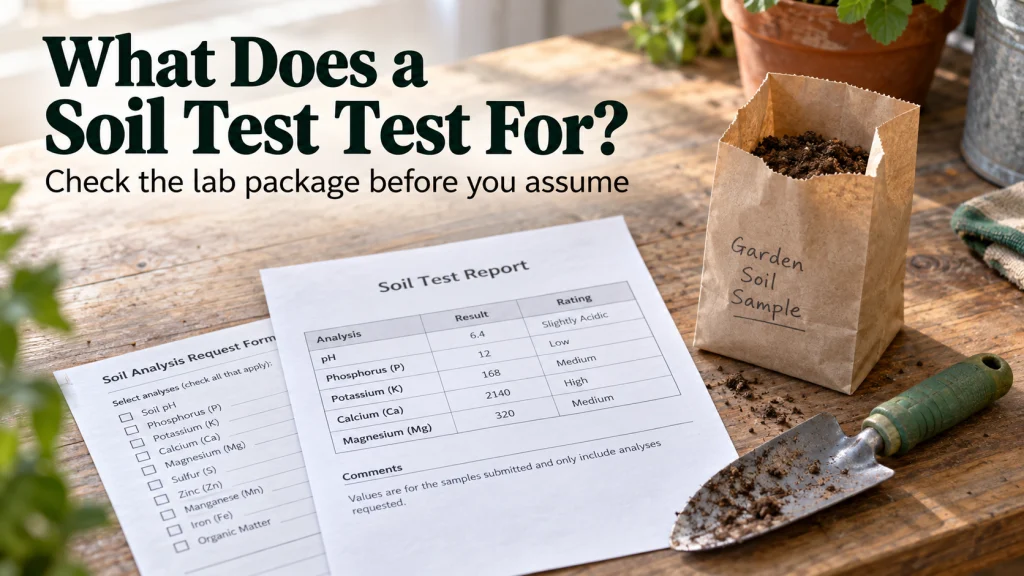
A garden soil test does not automatically measure every property of the soil. Routine packages commonly focus on pH and selected plant-available nutrients, while organic matter, soluble salts, texture, lead, other contaminants, or biological questions may require different options. The exact menu varies by laboratory, so the package description matters more than the generic label “soil test.” Before ordering, match the measurements to the garden decision you actually need to make.
Start with what the term tells you and what it does not
What a soil test measures depends on the laboratory package you order. A routine garden test may report pH and several plant-available nutrients, but that does not mean the same sample is being checked for soil texture, heavy metals, disease organisms, pesticide residues, or the full soil biological community. The phrase “soil test” names a testing process, not one universal panel. That distinction matters before you pay for a service or make a fertilizer, lime, or amendment decision from the result.
I would begin with the lab request form and ask one simple question: which reported field will change what I do in the garden? If you are still deciding why to test or where the test fits in your broader decision process, the soil testing process for a home garden gives that larger context. This article stays narrower and focuses on choosing the measurements, not collecting the sample or interpreting a finished report. Once the scope is clear, it becomes much easier to separate routine fertility testing from questions that need a different analysis.

This kit includes 100 soil pH test strips with a 3.5 to 9 pH range. The test procedure uses a soil-and-water mixture followed by comparison with the included color chart. It measures pH only, making it a clear example of why the exact field measured matters.
Check On AmazonIf you click this link and buy, we earn a commission at no additional cost to you.
Separate routine fertility testing from specialty analyses
Routine fertility testing is designed mainly to support soil fertility and pH decisions. Depending on the lab and region, the package may include pH, phosphorus, potassium, calcium, magnesium, selected micronutrients, a lime requirement or buffer measurement, and fertilizer recommendations tied to the crop or garden use you identify. Those fields are useful because they connect to practical choices such as whether lime is needed or whether adding more of a particular nutrient is justified. They should not be treated as a complete health screening for everything that can affect a garden.
Specialty analyses answer different questions and may use different methods, sample handling, or request forms. A homeowner concerned about lead, another heavy metal, pesticide residues, a suspected plant pathogen, or a specific biological measurement should not assume a routine fertility package covers that concern. Even when one laboratory offers both routine and specialty services, the tests can be separate line items rather than one bundled analysis. The safe reading rule is simple: if the measurement is not named on the package, treat it as unconfirmed until the laboratory says otherwise.
| Testing question | What a routine package may cover | What still needs verification |
|---|---|---|
| Soil reaction and fertility | pH plus selected plant-available nutrients | Which nutrients, which extraction method, and whether recommendations are included |
| Organic matter and salts | Sometimes included | Whether organic matter or soluble salts are standard fields or add-on tests |
| Texture | Sometimes estimated or omitted | Whether the lab provides an actual texture analysis and how it is measured |
| Lead and other contaminants | Usually not safe to assume | Which element or compound is being analyzed and whether a specialty service is required |
| Pathogens or soil biology | Not a routine fertility assumption | Which organism or biological question is being tested and what sample type the service requires |
Use the table as a comparison framework, not as a promise that every laboratory organizes services the same way. Regional labs choose methods and reported fields that fit local soils, crops, and interpretation systems. That is why two reputable university labs can both offer useful garden testing while reporting different standard fields. Before sending a sample, make sure the service names the measurement that matters to your decision.

The Luster Leaf 1663 kit provides 20 tests each for soil pH, nitrogen, phosphorus, and potassium. It includes a sturdy case, detailed instructions, and a plant pH preference list. Its defined four-measurement scope makes it a practical routine-fertility example without implying coverage of specialty contaminants or pathogens.
Check On AmazonIf you click this link and buy, we earn a commission at no additional cost to you.
Verify pH and nutrient fields on the exact lab package
pH is one of the most common measurements in garden soil testing because it describes how acidic or alkaline the tested soil is and helps frame nutrient availability and lime decisions. Nutrient testing is more variable than the casual shorthand “NPK test” suggests. Many laboratory programs report phosphorus and potassium, while calcium, magnesium, sulfur, nitrate nitrogen, and micronutrients depend on the package and regional testing program. Nitrogen deserves extra caution because forms such as nitrate can change quickly with moisture, temperature, organic matter breakdown, plant uptake, and leaching.
Do not infer an unlisted nutrient from a fertilizer recommendation or from a colorful chart on a report. Read the request form for the exact analytes, then check whether the lab describes the values as plant-available, extractable, total, or something else. Those terms are not interchangeable, and the number only becomes useful when it is interpreted with the laboratory’s own method and regional guidance. If your decision depends on a particular nutrient, verify that nutrient by name before ordering rather than assuming it is hidden inside a general fertility panel.
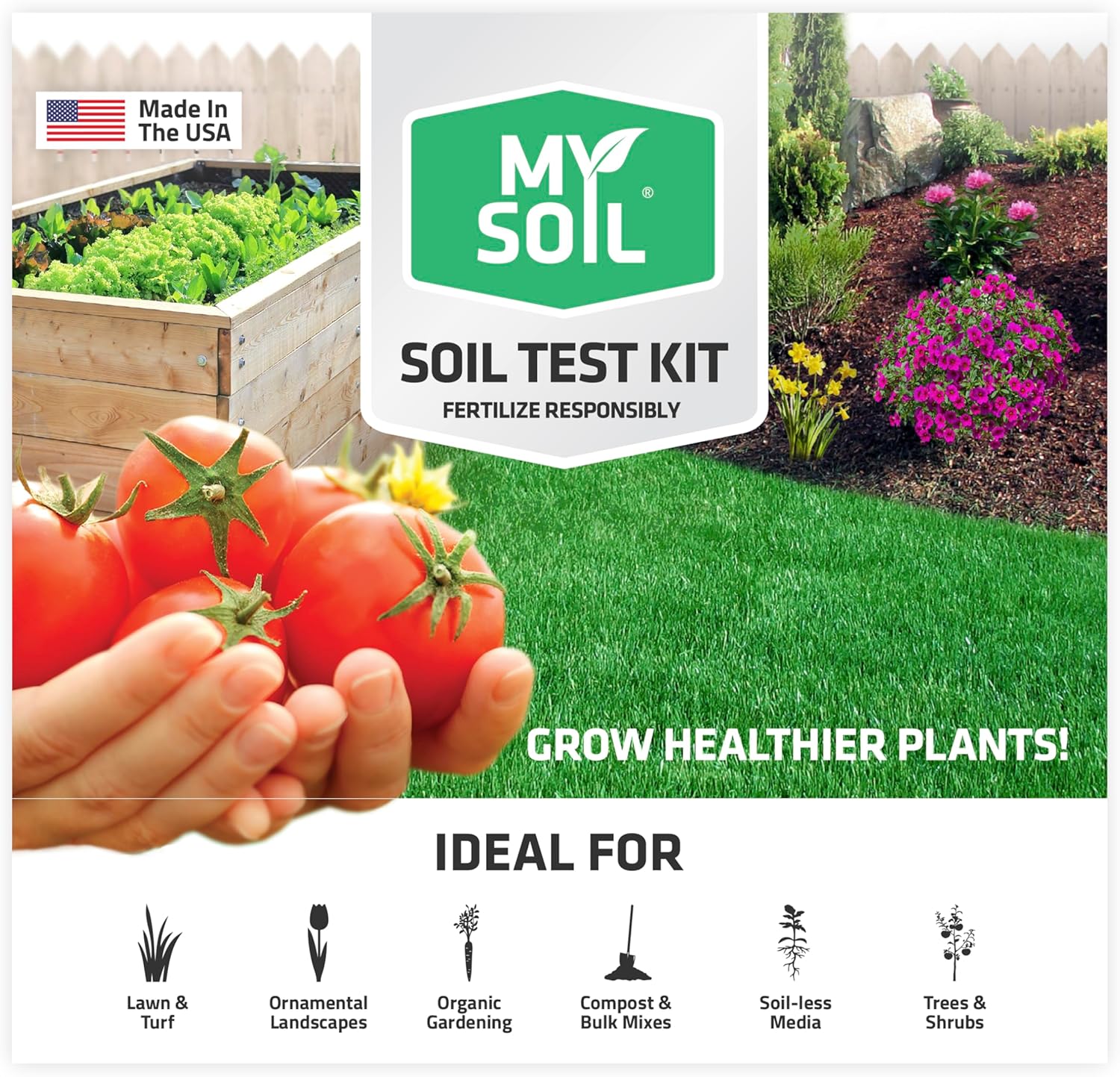
This mail-in laboratory kit measures pH plus 13 plant-available nutrients. It includes prepaid return shipping and provides online results with soil-specific fertilizer recommendations. The named analytes make it easier to verify exactly what the package measures before ordering.
Check On AmazonIf you click this link and buy, we earn a commission at no additional cost to you.
Check whether organic matter or soluble salts are optional
Organic matter is a good example of a field that may be routine at one lab and optional at another. It can help describe an important part of the soil, but the number does not by itself tell you how much compost to add or whether every plant problem comes from low organic matter. Soluble salts are similar: they can be highly relevant where salts are a concern, yet they are not automatically part of every homeowner fertility package. If either measurement matters to your decision, look for it explicitly on the current submission form.
A comparison of university lab menus shows why the package name is not enough. Penn State’s routine description emphasizes pH, lime requirement, phosphorus, potassium, magnesium, and calcium, while the University of Minnesota describes a regular lawn and garden test that also includes estimated texture and organic matter, with several additional tests available separately. University of Georgia programs list routine fertility fields separately from organic matter, texture, and other analyses. The lesson is not that one menu is better, but that the word “routine” changes with the laboratory.
| Lab menu example | Fields highlighted in the regular or basic service | Examples of separately listed measurements |
|---|---|---|
| Penn State | pH, lime requirement, phosphorus, potassium, magnesium, calcium | Organic matter, soluble salts, and additional micronutrient or harmful-element testing may be separate |
| University of Minnesota | Estimated texture, pH, organic matter, phosphorus, potassium | Soluble salts, lead, and several trace elements are listed as extra tests |
| University of Georgia | pH, lime requirement, phosphorus, potassium, calcium, magnesium, zinc, manganese | Organic matter, texture, and broader elemental analyses are listed separately |
These examples show why there is no single national definition of a basic garden test. A local laboratory may organize the same kinds of measurements differently or use methods tailored to regional soils. If organic matter or salt level will change what you add to the bed, include that measurement deliberately rather than assuming it comes with the base service. Otherwise, leave it out rather than paying for a number that will not change a decision.

This 3-in-1 meter reads soil electrical conductivity, moisture, and temperature directly in soil. The listing positions it for houseplants, gardens, composting, and nursery use. Its EC reading is relevant when soluble salts are the measurement you actually need to investigate.
Check On AmazonIf you click this link and buy, we earn a commission at no additional cost to you.
Treat texture, contaminants, and pathogens as separate questions unless listed
Soil texture describes the relative proportions of sand, silt, and clay, but a fertility report does not automatically include a laboratory texture analysis. Some programs provide an estimate, some offer a hydrometer or other texture test separately, and some leave texture outside the standard package. That matters because a gardener asking whether soil is sandy, loamy, or clayey is asking a physical soil question rather than only a fertility question. If exact texture is important to the decision, look for a named texture method instead of assuming the nutrient panel answers it.
Contaminants require even more specificity because “test for toxins” is not a single analysis. Lead or other metals may be available through a separate elemental or heavy-metal service, while pesticide residues and other organic contaminants can require different analytical work and special handling. A routine fertility test also should not be treated as a plant disease or pathogen screen, and a general soil biology question may require a specialized service that defines exactly what is being measured. If the concern involves a possible exposure risk or a disease organism, contact the appropriate laboratory or Extension service and ask which test and sample type address that exact question.

This combo kit includes 10 DIY lead swabs plus an optional sample-submission kit for testing at an EPA-certified laboratory. It is designed for lead screening on solid materials and gives a dedicated path for a specific contaminant question. That narrow purpose fits cases where a routine fertility test does not answer a lead concern.
Check On AmazonIf you click this link and buy, we earn a commission at no additional cost to you.
Order only measurements that can change a garden decision
More measurements are not automatically more useful. A long report can create the illusion of precision while still failing to answer the question that started the test. I would work backward from the decision: whether to lime, whether to add a nutrient, whether salt may be part of a problem, whether a contamination concern needs a specialty screen, or whether the physical soil texture needs separate measurement. That approach keeps the order focused and makes the eventual report easier to use.
The same logic applies when the bigger goal is improving garden soil based on actual constraints. A test is useful when it changes a choice, not when it simply produces more numbers. Write the question in ordinary language, such as whether lime, a nutrient amendment, or a salt check would change your next step, and choose measurements that answer it. If the available service does not address that question, ask the laboratory which analysis does.
- Write the garden decision first, such as whether lime or a particular nutrient amendment is justified.
- Confirm that pH and every nutrient you care about are named on the selected package.
- Check whether organic matter and soluble salts are included, optional, or unavailable.
- Look for a specific texture analysis if sand, silt, and clay proportions matter to the question.
- Use a named specialty analysis for lead, other contaminants, pathogens, or a defined biological question.
- Ask whether the report includes recommendations or only laboratory values if that affects how you plan to use the result.
After the checklist, remove any measurement that has no clear decision attached to it. That does not mean the measurement is unimportant in general; it means it may not be necessary for this order. A focused package is often easier to interpret because each field has a reason to be there. The goal is not to buy the largest test menu, but to order the service that answers the question you actually have.

The GroStar GS2 measures pH and temperature directly in soil and other growing media. It uses a replaceable spear-style pH probe and includes calibration and maintenance supplies. A dedicated pH tool fits a decision where pH is the specific measurement that will change the next garden action.
Check On AmazonIf you click this link and buy, we earn a commission at no additional cost to you.
Final Thoughts: Order the test package that measures your actual question
A soil test is most useful when its measurements match the decision you need to make. Routine fertility testing can answer important questions about pH and selected nutrients without also serving as a texture, contamination, pathogen, or soil biology screen. Optional measurements such as organic matter or soluble salts can be valuable when they address a specific concern. Specialty questions need a service designed for that question rather than a broader assumption about what the words “soil test” include.
Before ordering, write down what you plan to decide from the result and identify the measurement that would support that choice. Confirm that the selected service reports that field, and treat unlisted measurements as outside the scope of the order. Skip extra analyses that will not change what you do in the garden. A focused test gives you a clearer path from laboratory result to practical soil decision.

This 12-inch stainless steel T-handle probe is designed for collecting soil cores for testing. The kit includes two sample bags for holding collected soil. It is a practical sampling tool to use after you have chosen the laboratory package and measurements you actually need.
Check On AmazonIf you click this link and buy, we earn a commission at no additional cost to you.
FAQs
🌱 Does a basic soil test include nitrogen?
Not always. Nitrogen forms can change quickly in soil, so verify whether nitrate, ammonium, or another nitrogen measurement is actually listed on the package you are ordering.
🧪 Will a routine soil test tell me the organic matter percentage?
Some labs include organic matter in a regular garden package, while others list it as a separate test. Check the exact submission form rather than assuming it is included.
🪨 Can a soil test tell whether I have clay soil?
Only if the service includes a texture estimate or a specific texture analysis. A routine fertility panel can report useful chemical measurements without measuring the proportions of sand, silt, and clay.
⚠️ Does a garden soil test check for lead?
Do not assume it does. Lead is often handled as an additional or specialty analysis, so choose a service that explicitly lists lead if that is the concern.
🦠 Can one soil test detect pathogens and soil microbes?
A routine fertility test should not be treated as a pathogen or soil biology screen. If that is the question, ask a diagnostic or specialty laboratory which organism or biological measurement it can test and what sample it requires.
References and Sources
- Oregon State University Extension: Explains pH testing, full nutrient analysis, and why gardeners should verify what a lab package includes.
- Penn State Extension: Documents the measurements included in its routine soil analysis and how those results support fertility and lime recommendations.
- University of Minnesota Extension: Shows how a regular garden test can differ from optional testing for salts, lead, and trace elements.
- Colorado State University Extension: Distinguishes typical soil-test fields from special analyses such as lead and other heavy metals.
- University of Nevada, Reno Extension: Describes what basic soil testing does not measure, including several physical, contamination, disease, and soil biology questions.