A rain gauge for garden watering is useful only when it measures rain that can realistically reach the growing area and when that number is checked against actual soil moisture. A gauge under a tree, beside a roof edge, or inside sprinkler spray can give a misleading reading even when the scale itself is easy to read. The practical goal is not to chase a perfect rainfall number, but to give natural rain proper credit before adding irrigation. Placement, consistent reading, soil condition, plant needs, and storm variability all affect the final watering decision.
Measure rain where the garden can actually receive it
A weather app can report a solid storm while a gauge tucked under a tree stays nearly empty. That does not automatically mean the app was wrong, because leaves and branches may have sheltered the gauge from part of the rainfall. For a rain gauge for garden watering to help, it needs to represent the open exposure of the bed or planting area rather than the convenience of the nearest fence or porch. I would treat the gauge as a local decision tool, not as a tiny weather station that settles every question by itself.
The gauge becomes useful only when you interpret it in context. Soil texture, mulch, plant type, root depth, recent heat, wind, and prior soil moisture can all change how long measured rain remains useful to plants. The broader question of how often a garden actually needs water therefore cannot be answered by the gauge alone. That larger watering context matters, while this page stays focused on what the local rainfall reading should change in the next irrigation decision.

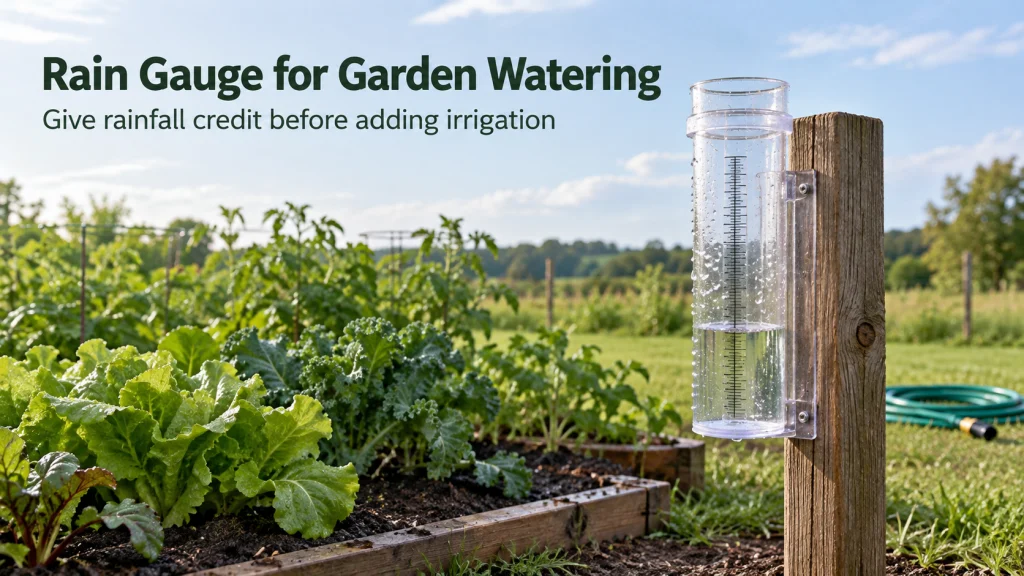
This acrylic rain gauge measures up to 5 inches of rainfall and uses magnified markings for easier reading. Its weather-resistant body supports outdoor use in a garden or yard. An integrated hang hole and ground-stake design give you two simple mounting options for a representative rainfall location.
Check On AmazonIf you click this link and buy, we earn a commission at no additional cost to you.
Place the gauge away from obvious shelter and splash
A garden rain gauge should sit in an open spot that is not directly shielded by a tree, roof, tall wall, or dense structure. It also should not be so close to a hard surface that bouncing water can splash into the opening and inflate the reading. Weather guidance for manual gauges emphasizes keeping the opening level and reducing interference from obstacles, strong wind, and artificial water sources. In a small residential yard, perfect exposure may be impossible, so the practical goal is to choose the most representative spot you can reach and read consistently.
Do not solve one placement problem by creating another. A gauge moved out from under a canopy can still mislead you if a sprinkler sprays into it, a downspout adds roof runoff, or a nearby deck edge sends splash toward the opening. The mounting point should also be stable enough that the gauge does not lean after wind, pets, garden work, or routine maintenance. Before trusting the first reading, look around the gauge from several directions and ask what could block rain, add extra water, or make the opening sit out of level.
- Keep the opening clear of overhead leaves, roof edges, and other obvious shelter.
- Keep sprinkler spray, hose spray, and runoff away from the gauge.
- Avoid placing the opening beside surfaces that can splash water upward.
- Use a stable mounting point and keep the gauge opening level.
If the best available spot is imperfect, keep that limitation in mind rather than pretending the reading is exact for every bed. Consistency still has value because repeated readings from the same reasonable location can show whether a storm contributed little, some, or substantial water to your yard. What matters most is that the gauge is not predictably biased by an avoidable placement mistake. Once the location is credible, the next job is reading it the same way each time.

This acrylic rain gauge has a 5-inch capacity and a magnified scale for easier reading. It can hang from a nail or screw or work as a garden stake. Its 12.25-inch overall height gives the gauge a visible profile while keeping the collector simple and manual.
Check On AmazonIf you click this link and buy, we earn a commission at no additional cost to you.
Read accumulated rainfall on a consistent cadence
Measuring rainfall for the garden works better when you use the same reading routine instead of checking only when plants look dry. Read the scale at eye level when possible, follow the instructions for the type of gauge you own, and empty it after recording the amount so the next accumulation starts from a known point. On a simple clear gauge, the water surface may curve slightly, so the instrument instructions should tell you where on that curve to read. If the gauge has an overflow design or another special measuring method, use the exact procedure for that instrument rather than improvising a conversion.
The useful record is not just the number in the tube. Note whether the rain came as a short hard burst, a longer soaking event, or several smaller showers, because the same measured total can behave differently on sloped, crusted, compacted, sandy, or mulched soil. Also note whether the gauge was exposed normally or whether something unusual happened, such as sprinkler overspray or a fallen branch. A small notebook or garden log is enough to connect rainfall with what you later find in the soil, which turns the gauge from a novelty into a repeatable decision aid.

This three-pack contains 3 x 5-inch top-spiral notebooks with all-weather paper and a universal page pattern. Each notebook has 100 pages across 50 sheets and a rust-resistant Wire-O binding. The pocket-size format is practical for recording rainfall totals, storm notes, and soil observations beside the garden.
Check On AmazonIf you click this link and buy, we earn a commission at no additional cost to you.
Combine the gauge with soil moisture checks
A rainfall total tells you how much water entered the gauge, not how much usable moisture remains around roots. After rain, check the soil in the area you are deciding whether to irrigate, especially when the surface looks dry but the layer below may still be moist. Extension guidance commonly recommends checking below the immediate surface rather than watering from appearance alone. I would give the soil check more weight than a watering habit based on the calendar, because plant demand and water storage change with weather and soil conditions.
Texture and drainage explain why two gardens can react differently to the same gauge reading. Sandy soil may drain quickly and hold less water between rains, while heavier soil may stay moist longer but can also take water slowly when rainfall is intense. Mulch can reduce surface evaporation, and established plants with deeper roots may use a larger soil volume than small transplants. The gauge provides the input number, but the soil tells you whether that input actually carried the root zone far enough toward the next irrigation decision.

This analog soil moisture meter provides an instant moisture reading without batteries. Its single 304 stainless steel probe is designed for indoor and outdoor soil checks. The clear 10-level dial helps compare a rainfall total with the moisture actually present in the soil.
Check On AmazonIf you click this link and buy, we earn a commission at no additional cost to you.
Use the measurement to reduce or skip irrigation
The easiest mistake is to treat scheduled watering as automatic and rainfall as extra. Instead, let measured rain replace part or all of the irrigation you would otherwise have added when the soil still shows adequate moisture. This is where a gauge can save work without pretending every plant has the same water requirement. For the broader method behind depth, timing, and application choices, use the site guidance on watering a garden effectively and then apply the local rainfall reading to the plants and soil in front of you.
A useful decision table should not turn one rainfall amount into a universal command. Newly planted vegetables, established ornamentals, containers, raised beds, and in-ground beds can respond differently even after the same storm. Use the gauge reading as a credit against expected water need, then confirm with the soil before deciding whether to skip, reduce, or proceed with irrigation. If the soil is still adequately moist where roots are active, adding water simply because the usual watering day arrived defeats the reason for measuring rain in the first place.
| What the gauge shows | What to check next | Practical watering response |
|---|---|---|
| Little or no measured rain | Check root-zone moisture and recent drying conditions | Irrigate if the soil and plant needs indicate a real deficit |
| Some measured rain | Check whether moisture reached below the immediate surface | Reduce or delay irrigation if the root zone still has adequate moisture |
| Substantial measured rain | Check drainage, soil moisture, and whether the event soaked the target area | Skip irrigation while the root zone remains adequately moist |
The table is deliberately conditional because rain does not arrive as perfectly uniform irrigation. A hard storm can produce runoff before some soils absorb much water, while a gentler event may soak more effectively even with a similar total. Containers can also dry faster than nearby beds, so a gauge in the yard should not overrule a direct moisture check in a pot. Use the measured amount to challenge unnecessary watering, not to replace observation.

This single-outlet digital hose timer programs watering from a hose faucet and uses a battery-powered LCD interface. Its built-in rain-delay function can postpone programmed watering for 24, 48, or 72 hours. The delay then lets the normal program resume after the selected rain-delay period.
Check On AmazonIf you click this link and buy, we earn a commission at no additional cost to you.
Know when highly localized storms make one gauge insufficient
Rainfall can vary sharply across a surprisingly short distance, especially with localized showers and thunderstorms. That is one reason a nearby weather station or app total may not match what landed in your yard, and it is also why one backyard gauge cannot describe an entire large or divided property perfectly. If the vegetable bed, side yard, and front planting area sit under very different exposure or storm patterns, one number may need to be treated as a reference rather than a complete map. The larger and more varied the property, the more important it becomes to verify conditions where the watering decision will actually be made.
You do not need to fill a normal home garden with instruments just because rainfall varies. Start with one well-sited gauge near the area whose watering matters most, then compare its reading with soil conditions in other beds after several storms. If one part of the property repeatedly appears much wetter or drier, a second simple gauge can help confirm whether rainfall distribution is part of the difference. If the readings usually track closely enough for your decisions, one gauge plus direct soil checks is often the simpler setup.

This outdoor rain gauge uses a tall stake design with adjustable height for placement in a yard or garden. A red floating buoy rises with collected water to make the reading easier to see. A second gauge like this can be placed in another part of a divided property when you need to compare localized rainfall.
Check On AmazonIf you click this link and buy, we earn a commission at no additional cost to you.
Final Thoughts: Count useful rainfall before adding irrigation
A rain gauge earns its place when it changes a watering decision, not when it simply collects a number. Good placement and a consistent reading routine make that number credible enough to use. From there, the soil and the plants determine whether rainfall actually covered the current need. That keeps natural rainfall in the calculation without turning the gauge into an automatic watering command.
Use the reading as credit, not as a verdict. Meaningful rain can justify delaying or skipping irrigation when moisture remains available in the root zone, while a dry bed or fast-drying container may still need water after the same storm. Uneven exposure and localized rain are reasons to check the area, not reasons to ignore the gauge. The best outcome is fewer automatic watering sessions and more decisions tied to what actually happened in the garden.

This manual outdoor rain gauge collects rainfall without batteries or electronic setup. Model 705-109 is a single-unit plastic gauge intended for outdoor rainfall measurement. It provides a straightforward local rain total to check before deciding whether routine irrigation is still necessary.
Check On AmazonIf you click this link and buy, we earn a commission at no additional cost to you.
Frequently asked questions
🌧️ Where should I put a rain gauge in my garden?
Use an open, stable location away from obvious overhead shelter, splash, runoff, and sprinkler spray. Keep the opening level and choose a spot that reasonably represents the area whose watering you are trying to judge.
🌱 Should I water if the rain gauge collected some rain?
Not automatically. Check moisture below the immediate soil surface and consider the plant, soil texture, drainage, mulch, and recent drying conditions before deciding whether to irrigate.
🪴 Can one rain gauge represent containers and in-ground beds?
It can represent the rainfall that reached that part of the yard, but containers may dry much faster than in-ground soil. Use the gauge as rainfall evidence, then check container moisture directly before skipping water.
💧 Why does my rain gauge disagree with a weather app?
Rainfall can vary over short distances, and app totals may come from stations, radar estimates, or broader location data rather than your exact garden. First confirm that your gauge is well placed, then use the local reading as one piece of the watering decision.
🌦️ Do I need more than one rain gauge?
Usually not for a small, fairly uniform yard. A second gauge becomes more useful when different parts of the property repeatedly receive noticeably different rain or have very different exposure.
References and Sources
- Iowa State University Extension watering tips: Supports checking soil moisture before watering and using a rain gauge to account for natural rainfall.
- CoCoRaHS rain gauge installation guidance: Supports placing a manual gauge away from obstacles, splash, and artificial water while keeping the opening level.
- CoCoRaHS rain measurement guidance: Supports consistent reading of manual rain gauges and following the instrument’s measuring procedure.