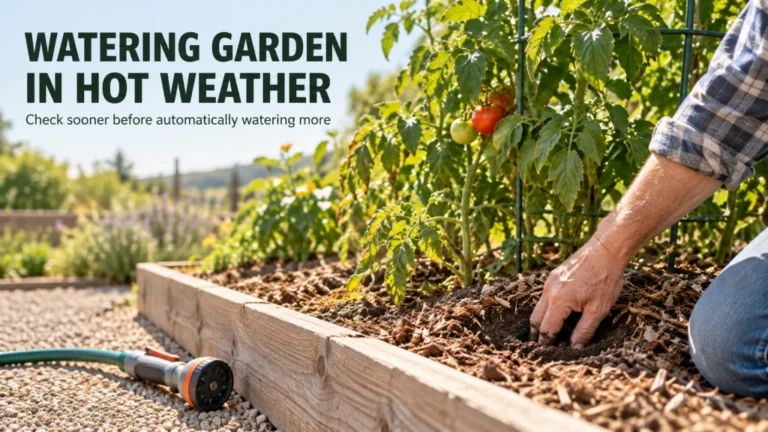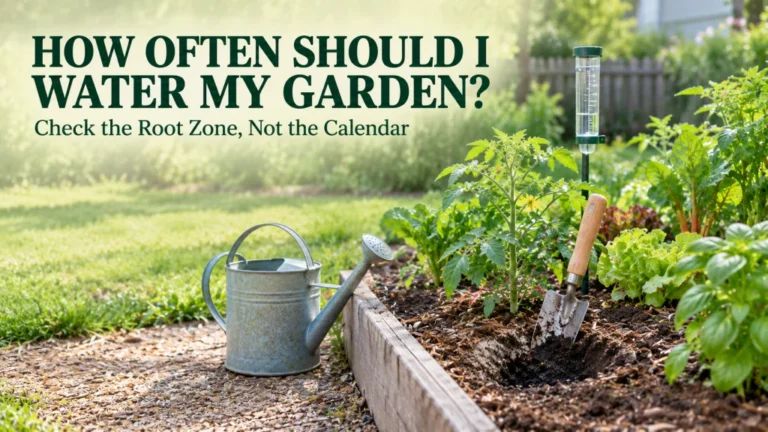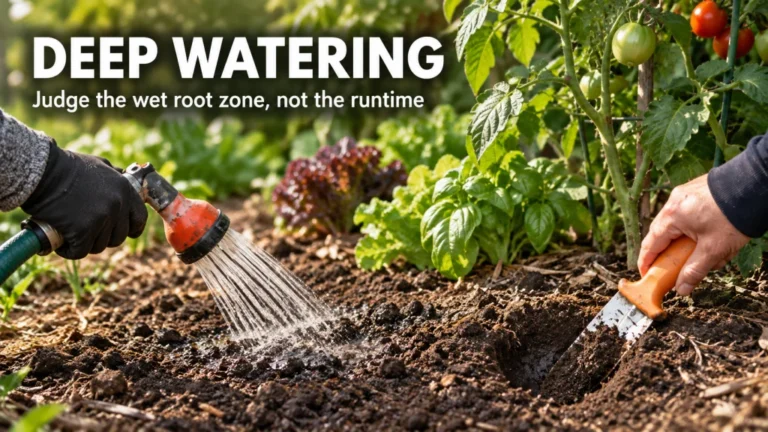
A garden water target stated in inches describes depth across an area, not a fixed number of gallons. A useful starting calculation is garden area in square feet multiplied by target water depth in inches multiplied by 0.623 gallons. Rainfall can reduce that irrigation amount, but only when enough of it reaches and moistens the root zone instead of running off or barely wetting the surface. The final check is always the soil itself, because texture, rooting depth, weather, and plant stage can change how that starting water budget should be applied.
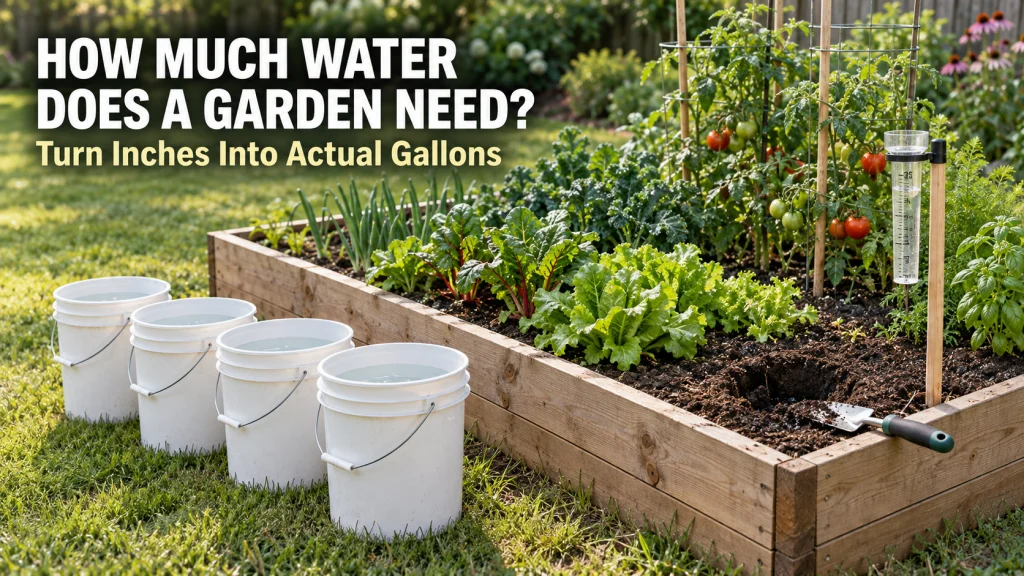
One inch of water is a depth, not a fixed number of gallons
A familiar answer to how much water a garden needs is about one inch, but that can sound more precise than it really is. One inch over a small raised bed is a modest volume, while the same one inch over a larger in-ground plot takes many more gallons. The depth stays the same because it describes a layer of water spread over the surface, but the volume rises directly with area. That distinction is the first step toward turning a general watering rule into something you can actually measure.
For example, one inch over a 2 by 8 foot bed is about 10 gallons, while one inch over a 5 by 10 foot bed is about 31 gallons. The point is not that either bed should automatically receive that amount on a fixed schedule, but that the same depth becomes a different volume as the watered area changes. The next step is to calculate that relationship for your own bed or plot instead of borrowing a gallon number from someone else’s garden. Rainfall, soil, roots, weather, and plant demand can then be used to adjust the starting budget.
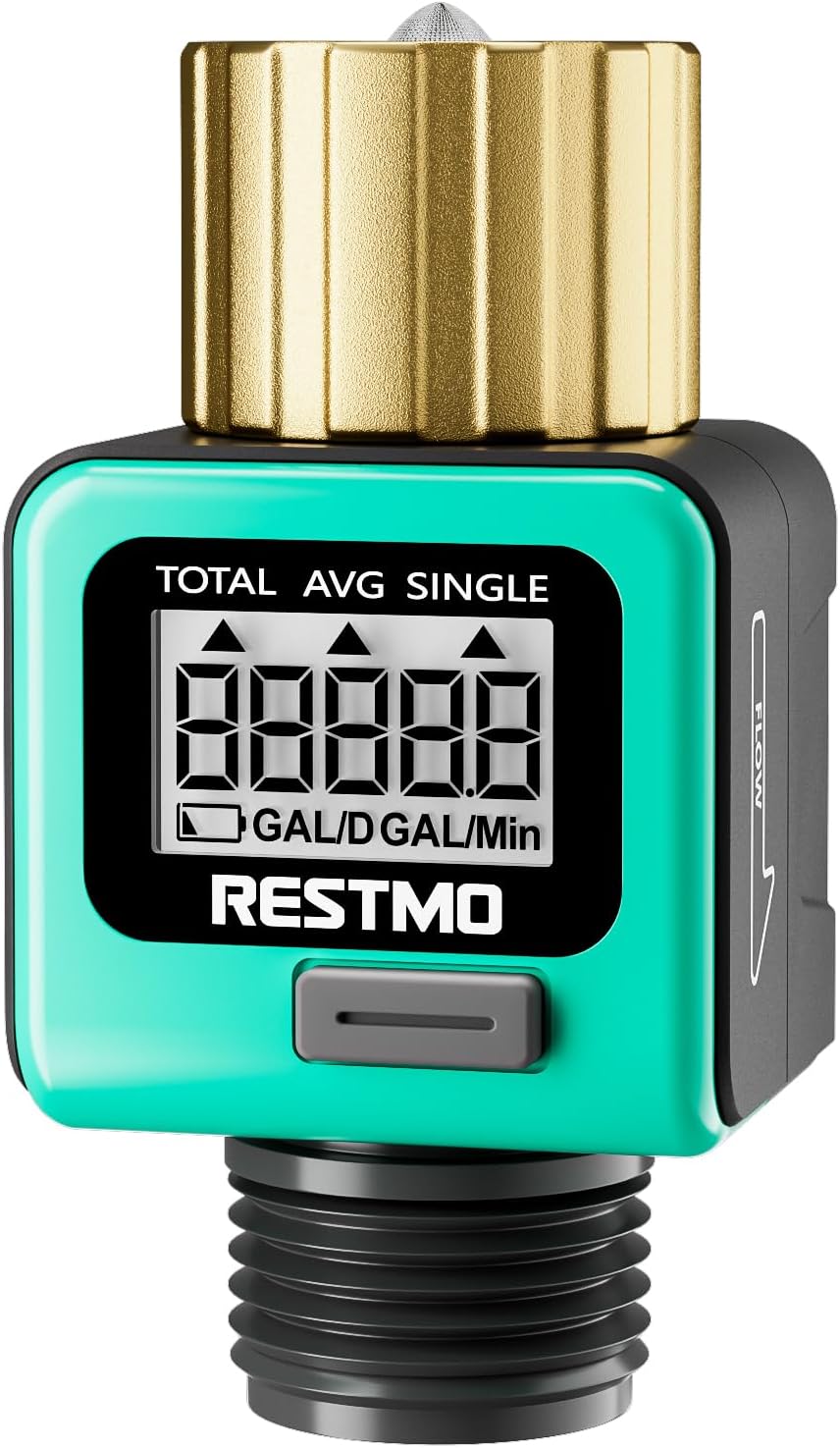
This inline meter tracks total water consumption in gallons or liters and shows flow rate for outdoor hose use. Its brass inlet is designed for garden watering connections. Use it to compare a calculated gallon target with the amount actually delivered through the hose.
Check On AmazonIf you click this link and buy, we earn a commission at no additional cost to you.
Convert garden area and target depth into a starting water volume
The basic conversion is straightforward: square feet of watered area multiplied by inches of water multiplied by 0.623 gives gallons. Iowa State University Extension uses 0.623 gallons as the amount needed to cover one square foot with one inch of water. Start by measuring only the area you actually intend to irrigate, not the entire yard around it. If a bed is rectangular, multiply length by width; if several beds are watered together, calculate each area and add them before converting the total.
Think of this as water per square foot in a garden, not as a plant prescription. The table below shows what several water depths equal over common garden areas, so you can see how quickly gallons change as either area or depth increases. A half inch over 100 square feet is about 31 gallons, while one inch over the same area is about 62 gallons. After the table, bring the number back to your own bed size rather than choosing a row simply because it looks familiar.
| Garden area | 0.5 inch | 1 inch | 1.5 inches |
|---|---|---|---|
| 16 sq ft | 5.0 gal | 10.0 gal | 15.0 gal |
| 32 sq ft | 10.0 gal | 19.9 gal | 29.9 gal |
| 50 sq ft | 15.6 gal | 31.2 gal | 46.7 gal |
| 100 sq ft | 31.2 gal | 62.3 gal | 93.5 gal |
| 200 sq ft | 62.3 gal | 124.6 gal | 186.9 gal |
A 4 by 8 foot bed provides a useful worked example because its area is 32 square feet. For a one inch starting target, 32 multiplied by 1 multiplied by 0.623 equals 19.936 gallons, which is practical to round to about 20 gallons. A 10 by 10 foot area needs about 62 gallons for the same one inch depth, and a 10 by 20 foot plot needs about 125 gallons. Rounding to a sensible whole number is usually more useful than pretending a garden can be watered to hundredths of a gallon.
Key point: The formula converts depth into volume. It does not decide the correct depth for every garden, every plant, or every set of weather conditions. Use it to translate a chosen depth into a measurable amount before you account for rainfall and soil response. Then verify that the chosen depth makes sense for the plants and conditions in front of you.

This 25-foot tape measure has fraction markings and a retractable self-locking blade. Use it to measure bed length and width before calculating square footage. The 25-foot length is practical for many raised beds and residential garden plots.
Check On AmazonIf you click this link and buy, we earn a commission at no additional cost to you.
Subtract rainfall only when it actually reached the root zone
Rain belongs in the same water budget because rainfall depth and irrigation depth describe the same kind of measurement. If your working target is one inch and a rain gauge records 0.4 inch that soaked into the bed, the remaining depth to consider is 0.6 inch rather than the full inch. For an 80 square foot garden, 80 multiplied by 0.6 multiplied by 0.623 is about 30 gallons of remaining irrigation. This is the useful part of rainfall subtraction: it prevents you from adding a full irrigation amount on top of water the soil already received.
The catch is that gauge depth does not automatically equal useful root zone water. A hard downpour can run off compacted or sloped soil, and a brief shower can leave only the surface damp while deeper soil stays dry. Penn State Extension specifically warns that rain can be deceptive because runoff may leave soil drier than the visible puddles suggest. Treat the gauge as the first number, then verify moisture in the bed before deciding how much of that rainfall deserves to be subtracted.
| Worksheet step | Example | What to verify |
|---|---|---|
| Starting depth target | 1.0 inch | Use only as an appropriate starting point for the plants and conditions. |
| Measured rainfall | 0.4 inch | Check whether rain fell on the actual garden area. |
| Useful rainfall | 0.4 inch | Confirm the water infiltrated rather than mostly running off. |
| Remaining depth | 0.6 inch | Subtract useful rain from the starting target. |
| Remaining volume for 80 sq ft | About 30 gal | Verify the resulting irrigation by checking the soil after application. |
A worksheet like this is most useful when you keep each assumption visible. Do not quietly turn recorded rainfall into useful rainfall when the bed shows obvious runoff, crusting, or dry soil below the surface. If only part of the rain appears to have infiltrated, the exact usable fraction may be uncertain, so a soil check is more defensible than invented precision. The goal is a reasonable water budget that you can verify, not a spreadsheet that claims the weather behaved more neatly than it did.

This acrylic rain gauge measures up to 5 inches of rainfall and uses magnified, easy-to-read markings. Place it where it can collect rain for the garden area you are tracking. Use the recorded depth as the starting rainfall number, then verify infiltration in the soil before subtracting it from irrigation.
Check On AmazonIf you click this link and buy, we earn a commission at no additional cost to you.
Use soil texture and rooting depth as adjustment checks
Two gardens can receive the same calculated gallons and still behave differently because water movement depends strongly on soil. Iowa State Extension notes that sandy soils generally need more frequent watering than heavier clay-based soils because they hold less water. A fast-draining bed may therefore benefit from dividing a needed volume into smaller applications, while a slower soil may need more time for water to move downward without puddling or running off. The total math can be identical even when the practical watering pattern is not.
Rooting depth matters for the same reason: the useful question is not whether the surface looks wet, but whether moisture reached the active root zone. Established vegetables often need moisture several inches below the surface, while very young plants with small root systems use a shallower portion of the profile. If your main uncertainty is cadence rather than volume, the separate guide on how often your garden actually needs water explains why soil, weather, and plant stage can change the interval. Use the gallons calculation here to size a starting application, then use the condition of the soil and roots to decide whether that application pattern makes sense.
- Sandy soil usually drains faster and may call for more frequent moisture checks.
- Heavier soil can hold water longer, so adding another full application before checking may overshoot the need.
- Shallow-rooted or newly established plants can respond differently from deeply rooted established plants in the same bed.
- Mulch, shade, wind, heat, and plant size can change how quickly stored soil moisture is used.
These checks are why a single gallons figure should never be treated as the final answer by itself. The math tells you how much water corresponds to a chosen depth over a chosen area, while the garden tells you whether that depth is appropriate and whether the water stayed available where roots can use it. If the soil is already moist at useful depth, adding the calculated amount again simply because a new week has started is not careful watering. Measure first, adjust second, and keep the conversion as a tool rather than a rule.

This battery-free soil moisture meter uses a single stainless-steel probe and provides an instant moisture reading. Insert the probe into the soil near the root zone, then remove it after checking. Use readings from several spots to decide whether the bed is still moist before applying more water.
Check On AmazonIf you click this link and buy, we earn a commission at no additional cost to you.
Measure wetting depth after the first application
The simplest reality check is to look below the surface after watering. Iowa State Extension recommends watering deeply enough to moisten the soil roughly 6 to 12 inches for many vegetable gardens, then checking how far the moisture actually moved. A trowel or narrow soil opening can show a clear change between darker moist soil and lighter dry soil, especially when you compare more than one spot. This turns the first calculated application into a calibration step instead of assuming the delivered gallons spread evenly and infiltrated perfectly.
If the soil is wet only near the surface, the issue may be that the application was too small, too brief, or delivered faster than the soil could absorb it. If water moved deeper than the active roots and the bed stays saturated, the application may be larger or more concentrated than the garden can use efficiently. Uneven wetting across the bed can also reveal poor sprinkler coverage, emitter spacing issues, or hand watering that favored the easiest areas to reach. Before changing the weekly target, first separate a delivery problem from a true change in garden water needs.
- Check more than one location instead of digging only beside the wettest plant.
- Look for how deep the soil is moist, not just whether the top looks dark.
- Notice runoff, puddling, or dry pockets that suggest uneven delivery.
- Adjust application size or frequency only after comparing the moisture pattern with the root zone you are trying to serve.
Once you know what a measured amount does in your soil, future watering becomes less guessy. The volume calculation gives you a repeatable starting point, and the wetting depth tells you whether that amount is reaching the place that matters. Different irrigation methods deliver water at different rates and patterns, so this article stops at the volume and soil response rather than assigning a universal runtime. For broader method choices, see how to water a garden efficiently and deeply and then calibrate the method you actually use.

This hand trowel has a cast-aluminum head and ergonomic grip for digging in garden beds and pots. Use it to open a narrow soil check after watering and inspect how far moisture moved below the surface. Comparing several small openings can reveal whether the wetting depth is consistent across the bed.
Check On AmazonIf you click this link and buy, we earn a commission at no additional cost to you.
Avoid turning a seasonal rule of thumb into a daily prescription
The common one inch guideline is useful because it gives gardeners a shared starting depth, but it is not a command to deliver exactly one seventh of that amount every day. Weather, plant size, rooting depth, soil texture, mulch, and recent rainfall can all shift how quickly moisture leaves the root zone. Frequent shallow watering can keep only the surface wet, while a deeper application can make more water available below that surface when the soil can absorb it. The better question is whether the root zone is approaching dryness and how much water is needed to restore it without creating runoff or prolonged saturation.
That also means the weekly total should not be increased mechanically whenever the weather feels hot or reduced mechanically whenever rain appears in the forecast. Start with the depth-based budget, subtract rain that actually soaked in, and inspect the soil before making another application. Crop-specific needs can differ, especially during establishment, flowering, fruiting, or other sensitive growth stages, so a mixed garden may contain plants that do not fit one universal schedule. When those differences become important, use plant-specific guidance rather than forcing every bed into the same number.
The distinction protects you from false precision. A calculation such as 62.3 gallons per 100 square feet is exact as geometry, but the garden’s actual need is still conditional. If the bed already received useful rain or remains moist at root depth, the irrigation requirement can be lower; if plants are using water rapidly in dry conditions, the soil check may support a different pattern. The arithmetic should make your decisions clearer, not make the living system look more predictable than it is.

This mechanical hose timer uses a battery-free clockwork shutoff and an oversized dial. It lets you set a watering duration from 15 to 120 minutes and also supports manual watering. Use it only after deciding that the soil needs water, so the timer controls duration rather than turning a weekly guideline into an automatic daily prescription.
Check On AmazonIf you click this link and buy, we earn a commission at no additional cost to you.
Final Thoughts: Turn depth guidance into a measured water budget, then verify it in the soil
Start with the area you are actually watering, choose an appropriate depth target, and multiply square feet by inches by 0.623 to convert that depth into gallons. Then subtract rainfall only to the extent that it genuinely contributed moisture to the root zone. This gives you a practical starting budget instead of a vague instruction to apply an inch of water. It also makes clear why a small bed and a large garden can follow the same depth guidance while needing very different volumes.
The last step matters more than another decimal place: check where the water went. Soil texture, roots, weather, mulch, and plant stage can all change how a calculated amount behaves after it leaves the hose, sprinkler, or watering can. If the root zone is adequately moist, stop treating the weekly rule as a quota that must be filled. If it is too dry or wet, adjust the next application based on what you observed rather than on the calendar alone.

This 2-gallon watering can is made from recycled plastic and has a removable nozzle with a drip-free sprinkler head. The 2-gallon capacity provides a fixed container size for manual applications. Use it when you want direct control over where part of a calculated water budget is applied.
Check On AmazonIf you click this link and buy, we earn a commission at no additional cost to you.
FAQs
💧 How many gallons is one inch of water over 100 square feet?
One inch over 100 square feet is about 62.3 gallons. That is a geometric conversion, not a guarantee that every 100 square foot garden needs exactly that amount in every set of conditions.
🌧️ Does one inch of rain mean I can skip irrigation?
Often it can, but first check whether the rain soaked into the root zone. Runoff, compacted soil, slope, or a very intense storm can make recorded rainfall less useful than the gauge reading suggests.
📐 How much water is one inch for a 4 by 8 foot raised bed?
A 4 by 8 foot bed has 32 square feet of surface area. Multiplying 32 by 0.623 gives about 20 gallons for a one inch depth.
🏖️ Should sandy soil get the whole calculated amount at once?
Not necessarily. Sandy soil drains faster, so a garden may need the needed volume divided into more frequent applications, with soil moisture checked between them.
🌱 Should I water exactly one inch every week?
No. One inch is a common starting guideline for many garden situations, but rainfall, soil texture, plant type, growth stage, weather, and existing soil moisture can change the actual need.
References and Sources
- Iowa State University Extension, determining garden water volume: Supports the 0.623 gallon conversion for one inch of water over one square foot.
- Iowa State University Extension, watering the home vegetable garden: Supports using rainfall and irrigation together, checking wetting depth, and adjusting frequency for sandy soil.
- Penn State Extension, garden watering guidance: Supports checking soil after rainfall because runoff and shallow wetting can make rain less useful than it appears.