A garden soil test is most useful when its result can change a decision you are about to make, especially whether to add lime, fertilizer, or another fertility amendment. A routine test can provide useful information about soil pH and selected nutrients, but the exact analyses and recommendations depend on the laboratory and package you choose. It does not automatically answer questions about drainage, texture, contamination, pathogens, or every possible plant problem. The practical rule is to test before an amendment when the result could change what you buy, how much you apply, or whether you apply anything at all.
Start with the soil change you are considering
If you are wondering whether to test your garden soil when a bag of lime or fertilizer is already in the cart, the best reason is that the result may cancel or redirect that purchase. Start with the action, not with the test. Are you planning to raise pH, add phosphorus, correct a suspected potassium shortage, or spread a general fertilizer because the bed looks tired? Once the proposed change is clear, you can ask whether a routine soil test is capable of supplying evidence that would materially change that decision.
This matters because the same visual problem can have several causes, and a soil amendment only helps when it addresses the actual limiting condition. Pale growth, poor vigor, or disappointing production can coexist with unsuitable light, root damage, water stress, compaction, or other problems that a routine fertility test does not diagnose by itself. A dark, crumbly bed can also contain enough of a nutrient already, so appearance is not a reliable inventory of soil fertility. The test earns its place when it changes the next step rather than simply producing numbers.
That decision-first approach also preserves a valid no-purchase outcome. If the laboratory result shows that the nutrient you were about to add is already sufficient for the crop, the useful recommendation may be to leave that input on the shelf. If pH is already in a suitable range for the plants you intend to grow, lime may have no role in the immediate plan. The broader soil testing overview can help place this decision within the rest of the testing process without turning every garden question into a laboratory question.
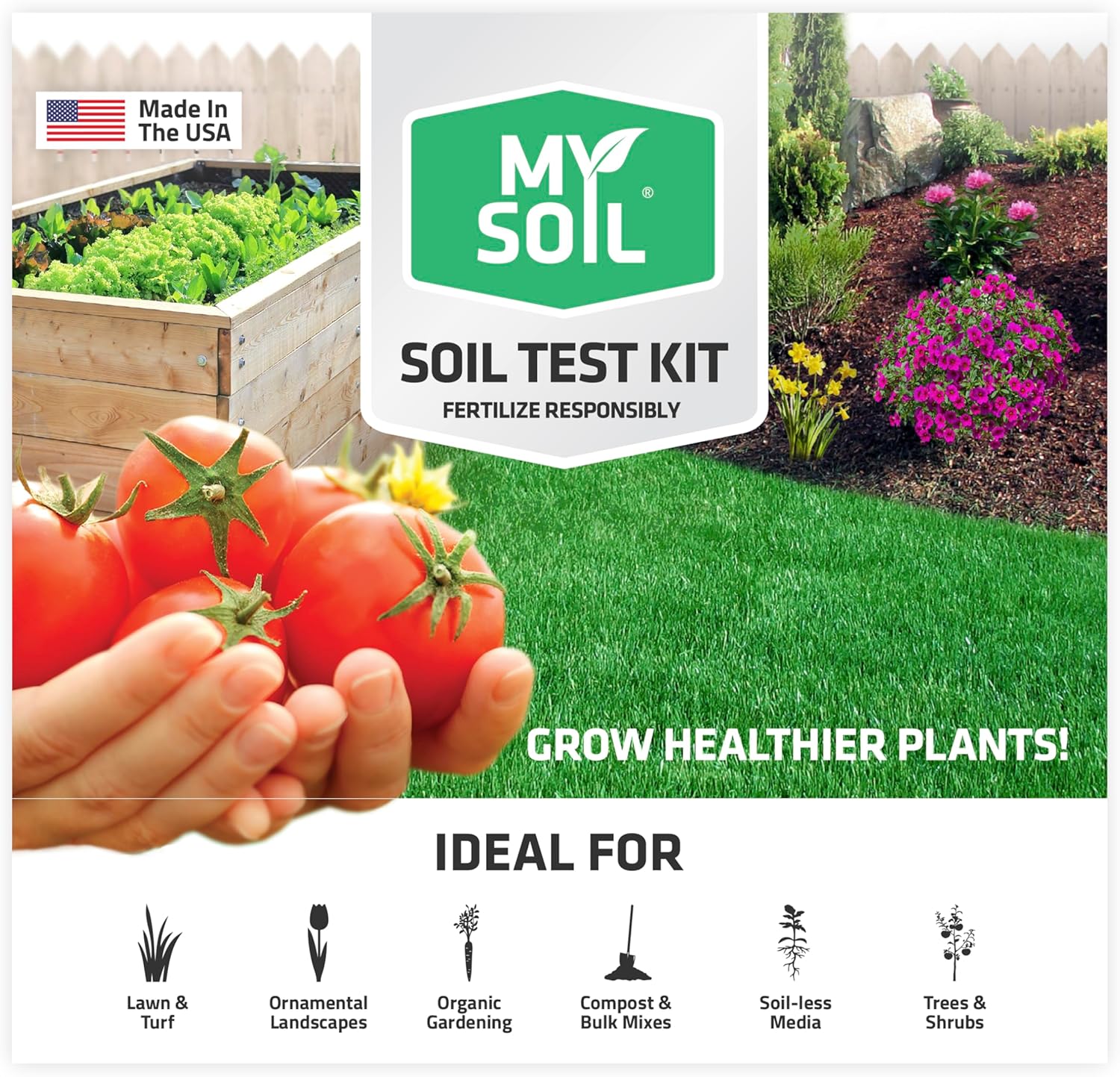
MySoil uses a mail-in laboratory analysis to measure 13 plant-available nutrient levels, including nitrogen and pH. The kit provides fertilizer recommendations based on the submitted soil results and plant needs. It fits a pre-amendment decision because the report can help determine what to apply, how much to apply, or whether an input is unnecessary.
Check On AmazonIf you click this link and buy, we earn a commission at no additional cost to you.
Ask whether a routine soil test can change that decision
A routine fertility test is valuable when the management choice depends on soil chemistry that the selected laboratory actually measures or interprets. Common examples include deciding whether soil pH needs adjustment or whether certain plant nutrients are already present at levels that make additional application unnecessary. Oregon State University Extension notes that soil testing can support informed fertilizer and soil amendment choices, while also advising gardeners to check what a laboratory package includes and whether interpretation or recommendations are part of the service. That is a better frame than assuming every test returns the same measurements or the same kind of recommendation.
The useful question is not simply, “Can soil be tested?” It is, “Will the selected test return information that changes this specific action?” A pH result can be relevant to a planned liming decision, while nutrient results may help separate a targeted fertilizer need from a habit of applying a balanced product every time a bed is prepared. If the answer could be “apply less,” “use a different nutrient balance,” or “apply nothing,” testing has clear decision value. If the result would not alter what you intend to do, the immediate value of testing is lower.
| Action under consideration | Can a routine test help? | What should wait |
|---|---|---|
| Adding lime to raise soil pH | Often, if the laboratory measures pH and provides an appropriate lime recommendation for the crop or use | The lime purchase and rate decision |
| Adding phosphorus or potassium fertilizer | Often, if those nutrients are included in the laboratory package and interpreted for the intended plants | The nutrient choice and application amount |
| Fixing persistent puddling after irrigation | Usually not by routine fertility testing alone | A fertility purchase that does not address the physical water problem |
| Checking possible lead or other contamination | Only if the laboratory offers the specific contaminant analysis required | Assuming a standard fertility package answers the safety question |
The table is a gate, not a promise that one laboratory package covers every row. Before paying for a test, check the laboratory’s current list of analyses and what kind of recommendation accompanies the results. Before paying for an amendment, check whether that result is one of the facts that should control the application. That sequence keeps testing tied to a real garden decision.

Rapitest provides 20 home soil tests, with five tests each for pH, nitrogen, phosphorus, and potash. The kit uses a color comparator system for reading the test results. It supports quick checks of the basic chemistry discussed in this section before a gardener commits to a lime or fertilizer change.
Check On AmazonIf you click this link and buy, we earn a commission at no additional cost to you.
Separate pH and fertility questions from texture, contamination and specialty testing
The phrase “soil test” sounds broader than many routine packages really are. A laboratory may offer a basic garden or fertility package that reports pH and selected nutrients, then offer organic matter, soluble salts, micronutrients, heavy metals, or other analyses separately. Oregon State Extension specifically advises gardeners to review the available test types and ask what a garden package contains. That makes the laboratory menu part of the decision, because a result is only useful if the requested analysis matches the question.
Texture is a good example of a question that should not be quietly folded into routine fertility testing. Whether a soil feels sandy, silty, or clayey affects water movement and handling, but a routine nutrient package does not automatically provide a laboratory particle-size analysis. The same boundary applies to contamination concerns, which require the appropriate specialty analysis rather than an assumption that a basic garden panel screens for hazards. If the concern comes from site history, imported fill, old painted structures, industrial use, or another credible contamination risk, choose testing around that concern rather than treating a routine fertility report as a safety clearance.
This distinction also prevents a common troubleshooting mistake: using chemistry results to explain a problem that is mainly physical. A bed that stays saturated because of drainage restrictions may need a site and water-management assessment even when its pH and nutrient numbers look ordinary. A compacted area may restrict roots without producing a clear routine fertility signal. For a broader look at soil improvement choices after the real constraint is identified, use the guide to improving garden soil rather than adding amendments simply because a soil problem is suspected.

Dewilde Trading Co includes 100 soil pH test strips with a stated pH range of 3.5 to 9. The strips are intended specifically for soil testing. Because this product measures pH rather than a full nutrient or contaminant panel, it is a clear fit for separating a narrow pH question from broader specialty testing.
Check On AmazonIf you click this link and buy, we earn a commission at no additional cost to you.
Decide what broad information the laboratory needs to return
Once you know the decision, look for a laboratory package that returns enough information to support it without buying unrelated analyses by default. For a basic pre-amendment fertility decision, pH and the nutrients relevant to the proposed fertilizer are often the most important categories to verify. Some laboratories add organic matter, soluble salts, calcium, magnesium, or other measures, but the exact list varies. The report may also include plant-specific or use-specific recommendations, and that interpretation can be more actionable than a column of raw values with no management context.
Do not assume that a nutrient name on a package means every gardening question about that nutrient is settled. Laboratories use specific extraction methods, regional calibration, reporting categories, and recommendation systems, so results are meant to be interpreted within that laboratory’s framework. Nitrogen is a useful caution because laboratories may handle it differently from phosphorus or potassium, and some services provide a nitrogen recommendation rather than treating one snapshot measurement as a stable inventory. The practical move is to read the package description before ordering and confirm that its output matches the decision you need to make. A short pre-order checklist keeps this simple without turning a targeted decision into a request for every analysis the laboratory offers.
- Identify the crop or garden use the recommendation should address.
- Confirm that the package includes the pH or nutrient information relevant to the planned amendment.
- Check whether the laboratory provides interpretation or application recommendations, or only analytical values.
- Choose a separate specialty analysis if the actual question concerns contamination or another item outside the routine package.
- Skip extra analyses that will not change a current garden decision unless you have another clear reason to collect them.
The goal is not to order the longest report. It is to obtain the minimum useful evidence for the action under consideration, then use that evidence within its limits. If you want a deeper explanation of the possible measurements, the guide to what a soil test can measure separates common analyses from tests that require a different request. That keeps this article focused on whether testing is worth doing before you amend.

MySoil Starter Pack includes one single-use soil sample kit, an 8-inch soil probe, instructions, and a prepaid mailing envelope to the testing lab. The mail-in analysis measures 13 plant-available nutrient levels, including nitrogen and pH. The service returns custom amendment recommendations, giving the gardener both broad laboratory information and a sampling tool in one package.
Check On AmazonIf you click this link and buy, we earn a commission at no additional cost to you.
Put lime and fertilizer changes on hold when the result controls the rate
If the test result is supposed to determine whether an amendment is needed or how much to apply, buying or spreading that amendment first defeats much of the purpose. Lime is the clearest example. Soil pH alone is important, but laboratories may use additional information and crop context to develop a lime recommendation, so the correct amount should come from the relevant recommendation rather than from a generic bag label or a guess based on plant appearance. Applying first can create a new correction problem instead of solving the original one.
The same logic applies to phosphorus and potassium when the planned application depends on existing soil levels. A gardener may reach for a familiar balanced fertilizer because it seems harmless, even though one or more nutrients are already adequate for the intended crop. Penn State Extension notes that soil testing can support proper lime and fertilizer recommendations and may reveal that adequate nutrient quantities are already present. That no-purchase result is not a failed test; it is one of the most useful outcomes because it prevents an unnecessary input.
Consider a simple vegetable-bed example. The gardener plans to buy lime and a complete fertilizer because growth was uneven in the previous crop, but the routine laboratory report shows pH already suitable for the planned vegetables and no need for additional phosphorus. The amendment plan now changes before anything is spread: lime is dropped, a phosphorus-containing product is no longer the default, and the gardener can investigate the remaining crop, watering, root-zone, or nutrient questions separately. The test did not “fix” the bed, but it prevented two guesses from becoming soil changes.

Luster Leaf 1605 is a digital soil testing kit for pH, nitrogen, phosphorus, and potash. Each test uses the supplied test tube with the reader optical chamber to produce a result. The included booklet explains pH adjustment and fertilizer recommendations, making the kit relevant when lime or fertilizer choices are being held until testing is complete.
Check On AmazonIf you click this link and buy, we earn a commission at no additional cost to you.
Know when testing adds little value to the immediate decision
Testing is not automatically the next step every time a plant looks unhappy or a bed seems imperfect. If the immediate question is whether a hose is reaching the root zone, whether a container has a blocked drainage hole, whether a plant is receiving enough light, or whether visible compaction is preventing infiltration, a routine fertility panel may add little to that first decision. Correct the clearly observable management problem or verify the missing condition first. A laboratory result should not become a detour around evidence you can already see.
Testing can also be low value when there is no pending soil-management decision and no useful question for the report to answer. A gardener with a productive established bed may not need to test merely because testing exists, especially if no amendment is being considered and there is no unexplained pattern that points back to fertility or pH. That does not mean testing is never useful in an established garden. It means the reason to test should be tied to a management decision, a baseline need, or a problem that the chosen analysis can actually inform.
There is another boundary around symptoms. Yellow leaves, slow growth, or weak flowering can be consistent with nutrient problems, but they do not prove a particular deficiency on sight. If the same symptom could result from roots, water, temperature, pests, disease, or light, a soil test is only one piece of the investigation. Treat the report as evidence about the soil factors it measures, not as a universal diagnosis of the plant.

XLUX measures soil moisture with a single probe and requires no batteries. Its dial uses 10 scales across dry, moist, and wet ranges for immediate readings. It is useful when the first troubleshooting question is watering or root-zone moisture rather than soil fertility.
Check On AmazonIf you click this link and buy, we earn a commission at no additional cost to you.
Keep sampling, report reading, test-method choice and retest timing as separate follow-up tasks
Deciding that a test is worth doing is only the first gate. The quality of the result still depends on collecting a representative sample, following the laboratory’s instructions, and keeping unlike areas separate when they should not be combined. Those procedures deserve their own attention because a carefully chosen test cannot rescue a poor sample. When you are ready for that step, use the separate guide on how to take a soil sample rather than compressing the entire sampling procedure into the pre-amendment decision.
The same separation helps after the report arrives. A laboratory value, category, or recommendation can be misunderstood if it is pulled away from the crop, units, method, or explanatory notes supplied with the report. The guide on how to read a soil test handles that interpretation step, while the comparison of a soil test kit vs lab addresses method choice. Keeping those decisions separate makes it easier to tell whether the problem is the need for testing, the way the sample was collected, the test selected, or the way the result was interpreted.
Timing is another distinct question. The best testing window can depend on what you are trying to change, recent amendments, the laboratory’s instructions, and the management cycle of the bed. Use the guide on when to test garden soil for that decision, and the separate guide on how often to test your soil when the question is about repeat testing. This article stops one step earlier: test before an amendment when the result is capable of changing the amendment decision.

ForoGore uses a 12-inch stainless steel sampling probe with a T-style handle for inserting and extracting soil samples. The package includes one probe and two sample bags. It directly supports the follow-up sampling step after the gardener has decided that a soil test is worth doing.
Check On AmazonIf you click this link and buy, we earn a commission at no additional cost to you.
Final thoughts: test before an amendment when the result can change what you apply
A soil test is worth doing when it can answer a question that changes garden management. Put the proposed action first, then choose a test that measures the relevant factor, and hold the amendment until the evidence arrives when that evidence should control the choice or rate. The result may point toward lime, a targeted fertilizer change, a different next step, or no amendment at all. Each of those outcomes is useful if it prevents guesswork from becoming a lasting soil change.
Keep the boundary just as clear. Routine fertility testing does not automatically answer questions about texture, drainage, contamination, pathogens, or every cause of weak plant growth, and different laboratories package their analyses differently. Verify what the laboratory will return, use the report within that scope, and move to the appropriate follow-up task when the question changes. The simplest rule is also the one most likely to save unnecessary inputs: measure first when the measurement can genuinely change what you were about to spread.

MySoil 2 Pack includes two single-use soil sample kits with instructions and two prepaid mailing envelopes. The mail-in analysis measures 13 plant-available nutrient levels, including nitrogen and pH. The service provides custom recommendations on what to apply, how much to apply, and when to apply it, matching the article's final measure-before-amending rule.
Check On AmazonIf you click this link and buy, we earn a commission at no additional cost to you.
Frequently asked questions
🌱 Should I test my garden soil before adding fertilizer?
Test first when the result can change the fertilizer choice or amount. A routine laboratory test can help show whether selected nutrients are already sufficient, but the exact measurements and recommendations depend on the laboratory package.
🧪 Do I need a soil test for my garden if plants look healthy?
Not automatically. Testing has the most immediate value when you need a baseline, are considering a soil amendment, or have a question that the chosen analysis can answer.
🪨 Should I add lime before the soil test comes back?
If the test is being used to decide whether lime is needed or how much to use, wait for the result and recommendation before applying it. Once the sample has already been collected, adding lime will not change that submitted sample, but it can still commit you to an unnecessary pH adjustment before you know whether lime is needed or what rate the laboratory recommends.
🌿 Does a routine soil test check for lead or other contaminants?
Do not assume it does. Contaminant testing is often a separate laboratory service, so choose an analysis that specifically includes the substance of concern and follow appropriate local guidance for a credible site-history risk.
💧 Will a soil test tell me why my garden drains poorly?
A routine fertility test usually does not diagnose the physical cause of poor drainage by itself. Standing water, compaction, grading, soil layering, and irrigation patterns may need to be assessed separately from pH and nutrient status.
🧾 Is every garden soil test package the same?
No. Laboratories differ in which analyses are standard, which are optional, and whether the report includes crop-specific interpretation or amendment recommendations, so confirm the package before submitting a sample.
References and sources
- Oregon State University Extension garden soil testing guidance: Supports the use of soil testing for fertilizer and amendment decisions and explains why gardeners should verify what a laboratory package includes.
- Penn State Extension soil testing guidance: Supports laboratory soil testing as a basis for garden soil management and provides context for soil-test procedures and recommendations.