Dormant pruning can make the structure of deciduous trees and shrubs easier to judge because leaves are out of the way, but visibility alone does not make every winter cut a good cut. The useful decision is to separate branches that clearly need attention from plants whose flowering cycle, regional disease risk, cold conditions, or current stress makes waiting the better choice. For ordinary homeowner work, dormancy is often a practical window for structural inspection and selective pruning, not permission for severe reshaping. Large limbs, unstable trees, climbing work, hanging branches, and anything near electrical lines belong with a qualified arborist or the utility responsible for the lines.
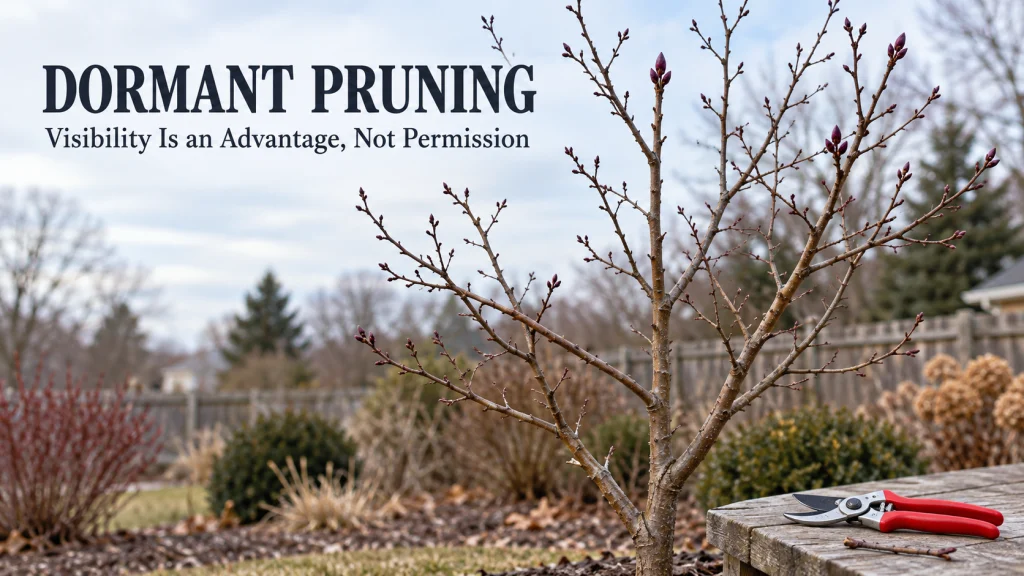
Visibility is an advantage, not permission
A leafless crown can make dormant pruning look almost too easy. Crossing limbs stand out, crowded branch unions are easier to trace, and the basic framework of a deciduous shrub is no longer hidden behind foliage. That clearer view is useful because pruning is partly a decision about structure, not just a reaction to how full a plant looks in summer. It still does not answer the second question, which is whether this particular plant should be cut during dormancy.
Before making a cut, identify the plant, the reason for pruning, and whether flowers form on old wood or new growth. Then check whether your region has a disease or pest restriction that changes the safest pruning window for that species. A healthy lilac and a nonflowering deciduous shrub may both be leafless, yet the same winter timing can have very different consequences for their next season of growth and bloom. That is why a broader plant pruning decision should start with the job and the plant, while seasonal garden care provides the wider context for damage, cleanup, and ongoing maintenance.
Key point: Treat bare structure as better information, not automatic permission to cut.

Covers more than 540 North American tree species with nearly 2,500 full-color photographs. Images show bark, fruit, flowers, leaf shape, and seasonal color, alongside range maps and physical descriptions. The guide is useful for confirming tree identity before applying species-specific pruning guidance.
Check On AmazonIf you click this link and buy, we earn a commission at no additional cost to you.
What dormancy changes in the plant and in what you can see
For many deciduous woody plants, dormancy changes both the plant’s activity and the information available to the gardener. Shoot extension has paused, stored reserves remain in woody and root tissues, and the branch framework can be examined without foliage masking attachments and branch direction. That makes it easier to trace scaffold relationships, compare competing stems, and distinguish a structural conflict from simple summer fullness. The practical benefit is a cleaner view of branch architecture before growth resumes, not a blanket signal that every visible defect needs removal.
The exposed framework also shows relationships that foliage can hide, including branch unions, competing leaders, narrow spacing, and repeated growth into the same part of the crown. Those observations are useful because they help separate a branch-position problem from a temporary density problem that disappears once leaves are gone. Dormancy itself does not correct weak structure or make stressed wood more tolerant of heavy removal, so the amount of live tissue removed still matters. The best use of this window is to improve diagnosis of structure first, then let species, plant condition, and local timing guidance determine whether action should follow.
- Confirm the plant identity before using a general winter rule.
- Name the pruning objective, such as removing damage, reducing rubbing, or improving young branch structure.
- Check whether flowering depends on buds already present on older wood.
- Check local Extension guidance for disease or pest timing that applies to that species.
- Reduce the scope if the plant is young, recently planted, stressed, or already damaged.
This checklist is intentionally short. If one of those checks is uncertain, the uncertainty is a reason to pause the cut rather than compensate with more pruning.
Use bare structure to identify crossing, rubbing, and poorly placed branches
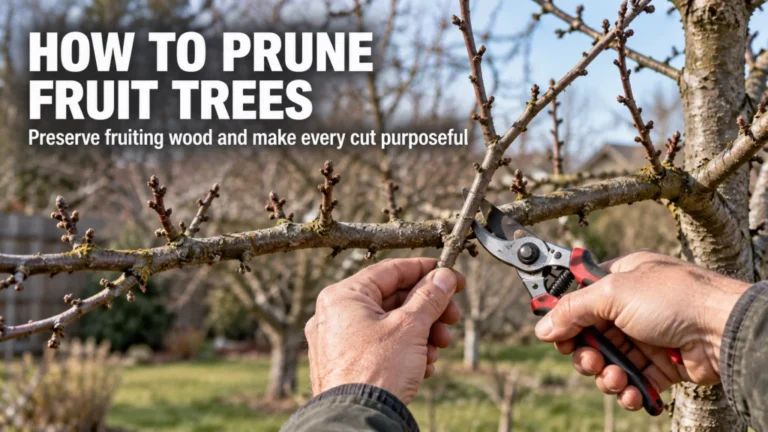
A good winter inspection begins with defects you can actually trace, not with a goal such as making the crown look thinner. Look for dead or broken wood, then follow crossing or rubbing branches back to their points of origin so you can compare which branch has the better position and attachment. On a young tree, competing leaders or branches that crowd the same part of the trunk can also be easier to recognize before leaves emerge. The advantage is precision: you are choosing a specific branch for a specific reason.
That is different from stripping out interior growth simply because you can see it. Excessive thinning can remove useful live foliage, shift weight toward branch ends, and create a plant that has been altered more than the original problem required. For a small tree or shrub that can be worked safely from the ground, favor selective removal over a general haircut. Step back after each meaningful cut, because the bare framework makes it possible to reassess before one correction turns into five.
The plant is leafless, so remove every inward, upright, or imperfect branch until the center looks empty.
Start with dead, broken, rubbing, crossing, or clearly competing growth, then stop when the stated structural problem has been addressed.
Winter visibility is most useful when it makes the pruning decision narrower. If it is encouraging a large redesign of an otherwise healthy plant, the plan needs another check before more wood comes off.

These bypass pruning shears are rated for green stems and small branches up to 5/8 inch. Precision-ground steel blades use a low-friction coating, while a sap groove helps reduce sticking from buildup. The non-slip grip and easy-open safety lock support controlled everyday pruning.
Check On AmazonIf you click this link and buy, we earn a commission at no additional cost to you.
Keep spring flowering wood out of a generic winter rule
Many spring flowering shrubs carry their next flowers on growth produced in the previous season. If you prune healthy lilacs, forsythias, and similar old wood bloomers during dormancy, you can remove flower buds that are already in place even though the stems look inactive. That does not necessarily mean the pruning cut is harmful to the whole plant, but it can reduce the display the gardener was trying to preserve. For routine shaping or light renewal, timing after flowering is often the more useful choice.
The exception is not a reason to ignore broken, dead, or clearly hazardous material, and an overgrown shrub may require a separate renovation decision where flowering is temporarily a lower priority. The important point is to know what you are trading away before you cut. A summer flowering shrub that blooms on current-season growth can fit a dormant pruning window much better than a healthy spring bloomer that is carrying old wood buds. Flower timing therefore belongs in the decision before branch visibility does.
| What you see in dormancy | What to verify before cutting | Likely homeowner decision |
|---|---|---|
| Healthy spring flowering shrub with visible older stems | Whether flower buds are carried on old wood | Delay routine pruning until after flowering if preserving bloom matters |
| Summer flowering shrub that blooms on new growth | Species specific pruning response and current condition | Dormant pruning may fit if the plant is otherwise suitable |
| Broken or dead branch | Safety, disease context, and a safe cutting position | Remove when appropriate, but do not extend the job into unnecessary reshaping |
| Large overgrown shrub | Whether renovation will sacrifice bloom and how the species responds | Use a separate renewal plan rather than a generic winter trim |
The table is an exception screen, not a calendar. The same bare branch can be a good candidate for pruning on one plant and a reason to wait on another.

These 6-Inch pruning scissors use stainless steel micro-tip blades that cut to the tip for small, precise plant work. An Easy Action spring is designed to reduce hand fatigue, and the SoftGrip handle supports control. A sheath is included for protected storage.
Check On AmazonIf you click this link and buy, we earn a commission at no additional cost to you.
Check regional disease and pest timing restrictions
Some pruning windows are shaped by more than dormancy. Fresh wounds can interact with disease cycles or insect activity, and those cycles are not identical across the United States. Oak wilt is a clear example of why a national winter rule is too blunt: Extension recommendations use local risk periods and regional disease presence to determine when pruning should be avoided or shifted. Similar caution applies whenever a species has a known disease-related pruning restriction in your area.
Use your state or regional Extension guidance for the plant in front of you rather than borrowing a calendar from another climate. If disease is suspected, identification comes before sanitation or treatment advice, because a discolored branch does not identify the cause by itself. Tool sanitation can be appropriate for certain disease situations, but the method should follow authoritative guidance for the problem instead of becoming an automatic ritual after every cut. When the local recommendation conflicts with a generic dormant pruning article, the local plant and disease guidance should control the timing.
Warning: Do not use a pesticide, wound treatment, or disinfectant simply because a branch looks diseased. Identify the problem and follow the current label or authoritative guidance for that specific use.
Avoid severe cold events and frozen, brittle working conditions
Winter pruning does not mean the coldest available day is the best day to work. Extension guidance commonly places routine dormant pruning toward the later dormant period, in part to avoid severe cold and to shorten the interval before active growth resumes. A calm period with workable footing, visible branches, and tools that can make clean cuts is more useful than forcing the job during extreme conditions. Frozen ground, ice, snow loading, and stiff or brittle branches can also make an otherwise simple task harder to judge and less safe to perform.
Cold injury can complicate the picture because damaged tissue is not always easy to assess immediately. If a plant has recently been exposed to a damaging freeze, avoid turning uncertainty about live wood into aggressive pruning. The same applies to evergreen browning, where winter injury can be mistaken for a reason to reshape the plant. Use the separate guidance on assessing frost damage to plants and recognizing winter burn on evergreens before assuming dormant pruning is the corrective step.
Waiting for clearer conditions is not neglect. It is often the simplest way to separate a structural pruning job from a cold damage assessment that has not finished revealing itself.

These Large gloves use grain goatskin leather with 3M Thinsulate insulation and a fleece lining. A reinforced palm and thumb saddle support grip, while an adjustable neoprene wrist helps secure the fit. The water-resistant leather construction is designed for cold-weather outdoor work.
Check On AmazonIf you click this link and buy, we earn a commission at no additional cost to you.
Keep the pruning dose gradual on young or stressed woody plants
Young trees benefit from early structural attention, but early does not mean everything needs correction in one session. A small competing branch can often be dealt with before it becomes a large future defect, while useful lower branches and healthy foliage still contribute to the young plant’s growth. The goal is to guide structure without creating a large sudden loss of live crown. That is especially important when the plant is newly established or already coping with drought, root disturbance, cold injury, or other stress.
For stressed woody plants, start with dead, broken, or clearly problematic growth and be conservative about optional shaping. If several defects are present, prioritize the one with the clearest long-term structural consequence and leave cosmetic changes for another evaluation. Severe renewal pruning can be appropriate for certain established shrubs, but that is a species-specific technique, not the default response to a plant that looks old or untidy in winter. Gradual pruning keeps each cut tied to a reason and reduces the chance that winter visibility becomes an excuse for overcorrection.
Pro Tips: Before cutting a second healthy branch, state what problem that cut solves. If the answer is only that the plant would look cleaner, compare that benefit with the live wood and future growth you are removing.

These 28-Inch bypass loppers are rated for branches up to 1.5 inches in diameter. Low-friction steel blades are designed for smooth cuts and reduced gumming, while SoftGrip handles improve control. Shock-absorbing bumpers add comfort during repeated cutting.
Check On AmazonIf you click this link and buy, we earn a commission at no additional cost to you.
Know when a dormant inspection should end with an arborist call instead of a cut
Dormant inspection is valuable even when the correct homeowner action is to stop. A split trunk, hanging limb, large dead branch over a target, unstable lean, storm-loaded branch, or work that requires climbing changes the problem from ordinary garden pruning to tree risk and professional tree work. The same boundary applies when a branch is close enough to electrical conductors that a person, tool, or falling limb could enter the hazard area. Bare branches may make the defect easier to see, but they do not make the work safer.
For utility conflicts, contact the utility or the responsible local service rather than trying to create clearance yourself. For large, elevated, unstable, or structurally uncertain tree work, use a qualified arborist who can assess the tree and perform the work with the appropriate equipment and safety practices. Homeowner pruning is best kept to small, stable plants and branches that can be reached safely from the ground with ordinary hand tools. If you cannot control the branch, your footing, and the fall path at the same time, the dormant season has already given you the most useful information: this is not a routine cut.
- Stop for branches near electrical or utility lines.
- Stop for hanging, split, cracked, or storm-loaded limbs.
- Stop when climbing or elevated cutting is required.
- Stop when the branch is too large to control safely from the ground.
- Stop when the tree’s stability or failure risk is uncertain.
The homeowner goal is not to finish every pruning job personally. It is to recognize which jobs remain ordinary garden maintenance and which ones have crossed into a different risk category.
Final Thoughts: use winter visibility to make fewer, better cuts
Dormant pruning is most useful when the bare plant helps you see a real structural problem and the plant’s biology supports acting during that window. Start with identification, flowering habit, local disease guidance, plant condition, and the specific branch problem you are trying to solve. Then keep the cut selective rather than treating winter as a chance to redesign every tree and shrub in the yard. A good dormant inspection should often produce a short list of cuts, not a pile of wood.
If flowering, cold injury, disease timing, or stress makes the decision uncertain, waiting for better evidence is a valid maintenance choice. If the work involves large limbs, climbing, instability, hanging branches, or electrical lines, the inspection should end without a homeowner cut. The simplest useful rule is that visibility improves judgment, but it does not replace plant-specific timing or safety limits. Use dormancy to see more clearly, then let that clearer view narrow the job.

GardenSharp uses diamond-honed tungsten carbide blades to sharpen pruning shears, loppers, hoes, shovels, and other single-edged garden tools. Its reversible sharpening blades extend service life, and the full-length guard helps protect fingers during use. The sharpener can be cleaned with soap and water or in a dishwasher.
Check On AmazonIf you click this link and buy, we earn a commission at no additional cost to you.
FAQs
🌿 Is dormant pruning good for every tree and shrub?
No. Many deciduous woody plants fit a dormant pruning window, but spring flowering plants, species with disease-related timing restrictions, some evergreens, and stressed plants can require a different decision. Identify the plant and check regional guidance before using a general winter rule.
🌸 Will winter pruning remove spring flowers?
It can when a shrub flowers on buds formed on the previous season’s wood. Healthy spring bloomers such as lilac and forsythia are commonly pruned after flowering when preserving the bloom display is a priority.
✂️ What branches should I look for first on a leafless plant?
Start with dead, broken, rubbing, crossing, or clearly competing branches. Trace each candidate branch back to its attachment and remove only what solves a defined structural or maintenance problem.
🧊 Should I prune immediately after severe cold or frost damage?
Not automatically. Cold injury can make the amount of live wood uncertain, so it can be better to wait until damage is easier to distinguish unless there is an immediate safety issue. Separate cold damage assessment from routine dormant pruning.
⚡ When should I call an arborist instead of pruning the tree myself?
Call for qualified help when work involves large or elevated limbs, climbing, unstable or split trees, hanging branches, or uncertain tree risk. Never attempt pruning near electrical lines; contact the utility or responsible local service for line clearance concerns.
References and sources
- Wisconsin Horticulture dormant tree pruning guidelines: Supports using leafless structure to identify branch problems, selective pruning of young trees, correct branch removal principles, and the boundary for larger tree work.
- Iowa State University Extension pruning timing guidance: Supports differences among deciduous trees, spring flowering shrubs, summer flowering shrubs, evergreens, and regional disease-related timing.
- University of Minnesota Extension pruning guidance: Supports dormant season structural visibility, crossing and rubbing branch decisions, disease timing exceptions, and utility line safety limits.
- Purdue Extension winter pruning guidance: Supports avoiding severe cold periods and using winter visibility to evaluate young woody plant structure.
- Penn State Extension landscape tree pruning guidance: Supports homeowner scope limits, professional arborist work, utility hazards, and selective structural pruning objectives.