Pruning a home fruit tree is not just a matter of making the canopy smaller. The useful first step is to identify the tree, understand where it carries fruiting wood, and then remove obvious problems before changing permanent structure. Different fruit trees respond differently to heading, thinning, and timing, so a single cutting pattern does not fit apples, pears, peaches, plums, cherries, and other home fruit trees equally well. A careful homeowner approach preserves productive wood, spreads major corrections across more than one pruning session, and stops before the work requires climbing, unstable access, or large hazardous limb removal.
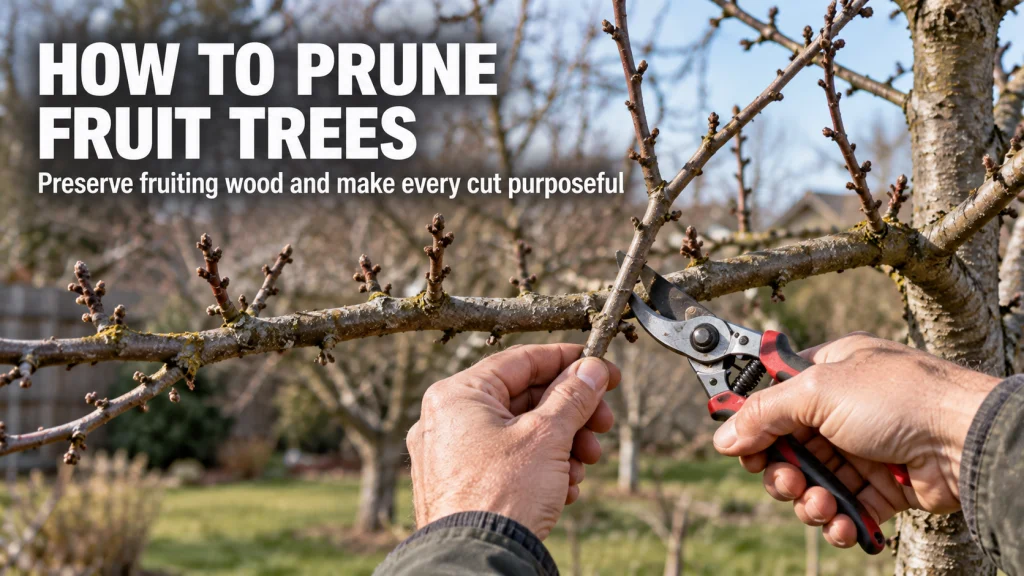
Fruiting wood makes pruning more than size control
A crowded tree can look like a simple light problem until the first cut removes the branch that was carrying next season’s crop. Learning how to prune fruit trees starts with separating wood that is clearly expendable from wood that may be part of the fruiting system. That means the first pass should be observational, not a race to open the center or shorten every tall shoot. I would rather leave one uncertain branch for another round than make a clean but poorly informed cut that cannot be reversed.
The same visual problem can also mean different things on different fruit trees. A vigorous upright shoot, a short spur, and a young lateral branch do not have the same role, and the productive age of wood varies by crop and cultivar. Pruning also changes future growth, because a cut is not just removal, it is a signal that affects where new shoots develop. Once the tree and its fruiting habit are clear, the rest of the pruning sequence becomes much easier to justify.

This set includes 100 T-type PVC plant labels measuring 6 x 10 cm each. The labels are water resistant and have blank surfaces that can be marked with a permanent marker or pencil. Their T-shaped design is made to push into soil for garden labeling.
Check On AmazonIf you click this link and buy, we earn a commission at no additional cost to you.
Identify the fruit tree and its fruiting habit before cutting
Start by confirming the species, and the cultivar when that information is available, before deciding which young or older wood can be shortened. Apples and pears commonly carry fruit on spur systems that can remain productive for more than one season, while peaches depend much more heavily on younger wood. Other stone fruits have their own patterns, so the label “fruit tree” is too broad to tell you what every branch is doing. If the identity is uncertain, postpone nonessential cuts until you can match the tree to crop-specific university or Extension guidance.
Then look for the visual transition between newer shoots, older branches, short spur-like growth, buds, and the permanent scaffold framework. You do not need to identify every bud with perfect confidence to make progress, but you should know which wood is obviously structural and which wood may be reproductive. This is especially important on a tree that has been pruned inconsistently, because a dense canopy can hide productive laterals behind vigorous vertical growth. The practical goal is not to memorize one diagram, but to stop treating branch length or branch age as a universal reason to cut.

This set includes 100 T-type plastic plant labels and a marker pen. Each label measures 3.9 by 2.4 inches and provides a broad writing area. The Amazon listing describes the labels as waterproof garden signs for outdoor plants.
Check On AmazonIf you click this link and buy, we earn a commission at no additional cost to you.
Start with dead, damaged and clearly conflicting wood
The safest first cuts are usually the ones that solve a visible structural problem without requiring a guess about fruiting potential. Dead wood, broken branches, and branches that rub hard against each other can be evaluated before you begin reshaping the canopy. Crossing growth is not automatically a reason to strip out every inward branch, but a pair of branches that continually abrades bark or occupies the same space deserves attention. Removing obvious conflicts first also makes it easier to see what healthy structure remains.
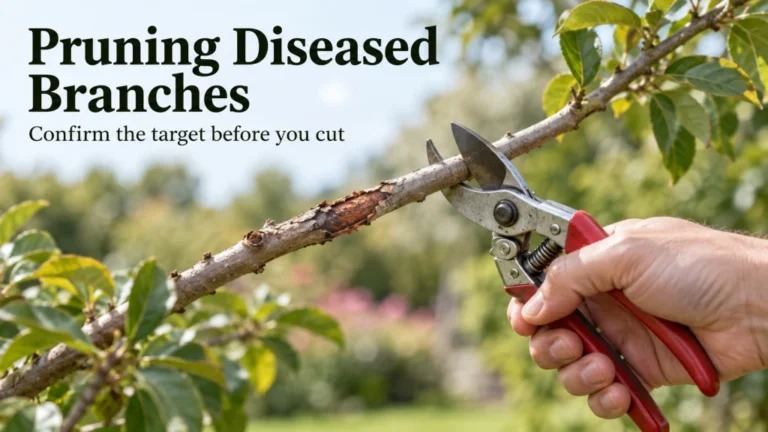
If wood is discolored, sunken, oozing, repeatedly dying back, or associated with abnormal leaves or fruit, do not turn appearance alone into a disease diagnosis. Use the symptoms to narrow the question, then compare them with reliable guidance on common plant diseases before deciding whether pruning is part of the response. The same rule applies when chewing, boring, webbing, scale-like growth, or other activity suggests an insect or animal problem, because garden pest identification should come before treatment. Pruning can remove compromised wood in some situations, but it should not become a substitute for identifying the underlying problem.
- Mark dead or broken small wood that is safely reachable from the ground.
- Choose between crossing branches only after comparing their health, position, and structural role.
- Pause on healthy short shoots or spurs until you know whether they are part of the fruiting system.
- Stop and identify unusual symptoms before treating pruning as the cure.
This order keeps the first pass conservative and makes the permanent framework easier to read. Check the remaining branches from more than one viewing angle because overlap can look different from the opposite side of the tree. That second look helps separate a true structural conflict from a branch that only appears crowded from one position. Move into structural pruning only after those obvious problems have been resolved.

This snip uses long, straight, pointed steel blades for detailed garden cutting. The blades are fully heat treated for strength, and the blades, spring, and handle are coated to resist rust. A leather strap lock keeps the tool closed for storage.
Check On AmazonIf you click this link and buy, we earn a commission at no additional cost to you.
Keep the intended permanent structure visible through gradual thinning
After the obvious cleanup, step back far enough to see the trunk, major scaffold branches, and the spaces between them. A useful structure carries fruiting wood without forcing branches to compete for exactly the same corridor of light and space. Thinning cuts can remove an entire unwanted branch back to its point of origin, which often changes density without creating the same concentrated regrowth that an indiscriminate heading cut can trigger. I would use that kind of whole-branch decision only when the remaining framework becomes clearer, not simply because the canopy looks busy.
Work gradually around the tree instead of finishing one side before looking at the whole canopy again. A branch that seems excessive from arm’s length may be doing useful structural work when viewed from another angle, especially on a tree trained to a deliberate form. The target is a readable framework with room for productive laterals, not a bare interior or a perfectly symmetrical silhouette. Once the permanent structure is visible, you can make better choices about fruiting wood instead of confusing openness with improvement.

These bypass loppers measure 28 inches long and cut branches up to 1.5 inches in diameter. The steel blades use a low-friction coating, and the handles include SoftGrip surfaces. Shock-absorbing bumpers help cushion the handles during branch cutting.
Check On AmazonIf you click this link and buy, we earn a commission at no additional cost to you.
Preserve the fruiting wood the species relies on
Productive wood should be treated as a resource with a crop-specific life cycle, not as clutter that happens to carry buds. On apples and pears, repeated removal of spur-bearing wood can reduce flowering potential even if the tree looks neat afterward. On peaches, the pruning logic is different because fruit production depends heavily on younger shoots, so keeping only old permanent branches would create a different problem. These examples are enough to show why a generic instruction such as “remove the old wood” or “cut back all new growth” is unreliable.
Before shortening a healthy branch, ask what job the branch currently performs and what growth would replace it. A branch can contribute fruiting sites, occupy a useful angle, shade vulnerable bark, or fill a gap in the framework, and those functions may matter more than its visual neatness. If you cannot tell whether a short shoot, spur, or lateral is productive, leave it until the crop’s fruiting habit is confirmed. This slower approach is particularly useful for inherited or neglected trees where past pruning has already created a mixture of old spurs, vigorous shoots, stubs, and crowded replacement growth.

These 6-inch pruning scissors use stainless steel micro-tip blades for detailed cuts on small plants. The blades cut all the way to the tip and are listed for flower stems, herbs, and buds. An Easy Action spring and SoftGrip handle are designed to reduce hand fatigue during repeated snipping.
Check On AmazonIf you click this link and buy, we earn a commission at no additional cost to you.
Use heading and thinning cuts for different responses
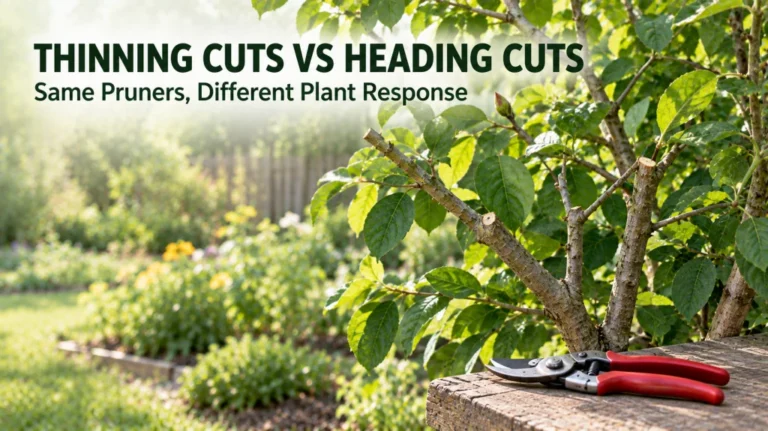
A thinning cut removes a shoot or branch back to its point of origin, while a heading cut shortens a branch and leaves buds below the cut to respond. University guidance consistently warns that heading can stimulate denser vegetative growth below the cut, which is useful in some training situations but counterproductive when used everywhere. Thinning is often the better tool when the goal is to reduce crowding while preserving a more natural branch line. Neither cut is automatically correct, because the right choice depends on what you want the remaining branch to do next.
A simple decision check helps keep the cut purposeful. If the problem is one whole branch competing with another, a thinning cut may solve the conflict cleanly; if the goal is to stimulate branching at a specific point on young growth, a heading cut may be deliberate. Avoid repeatedly shortening every shoot to the same length, because that can trade one crowded canopy for many vigorous shoots near the cut ends. The useful question is not “which cut is better,” but “which plant response does this tree need here?”
- Use a thinning decision when an entire branch is unnecessary, crowded, rubbing, or poorly placed.
- Use a heading decision only when shortening the branch and stimulating growth below the cut serves a defined training or renewal goal.
- Leave a healthy branch alone when neither cut solves a real structural or fruiting problem.
That last option matters because pruning is not a quota. A tree that already has useful spacing and productive wood does not benefit from extra cuts just because the tools are in hand. Compare each proposed cut with the goal that started the work and with the growth response that cut is likely to trigger. If neither connection is clear, the branch has not earned a cut.

This forged-steel bypass pruner has a 1-inch cutting capacity for live branches, stems, and green wood. Its design includes a sap groove, spring-loaded action, and contoured non-slip handles. A built-in safety lock keeps the blades closed when the pruner is stored.
Check On AmazonIf you click this link and buy, we earn a commission at no additional cost to you.
Avoid removing a large share of the canopy in one catch-up session
Neglected fruit trees often tempt homeowners into a single dramatic correction, especially when height, crossing limbs, and interior shade have accumulated together. Heavy pruning can trigger strong vegetative regrowth, and a large loss of canopy can also remove substantial fruiting wood before replacement growth is ready to carry the same role. There is no useful universal canopy percentage that fits every species, tree age, condition, training system, or climate. I would instead rank the most important corrections and stop when the next cut starts solving a lower priority problem.
Spread renovation across multiple pruning cycles when the tree needs major structural change but does not present an immediate hazard. One session might remove dead wood and the clearest conflicts, while later work addresses height, crowding, or replacement structure after you can see how the tree responded. This also gives you a chance to observe which shoots become useful and which become excessively vigorous after earlier cuts. Gradual correction is slower, but it protects your ability to change course instead of committing the entire canopy to one guess.
| What you see | Homeowner priority | Why it comes first |
|---|---|---|
| Dead or broken small wood within safe reach | Evaluate first | It can usually be separated from healthy fruiting decisions. |
| Two healthy branches rubbing or occupying the same space | Choose the better positioned branch | The decision improves structure without shortening everything nearby. |
| Dense but healthy fruiting canopy | Thin selectively | Removing too much at once can sacrifice productive wood and stimulate regrowth. |
| Large, split, hanging or inaccessible limbs | Stop homeowner pruning | The work has moved beyond ordinary ground-level garden maintenance. |
Use the matrix as an order of operations, not as permission to keep cutting until every row has been addressed. If the important work is complete, ending the session is a valid pruning decision. Observing the tree from the same position before the next pruning cycle can help you judge how the canopy responded without relying on memory. The next round should respond to that growth rather than automatically repeat the previous cuts.
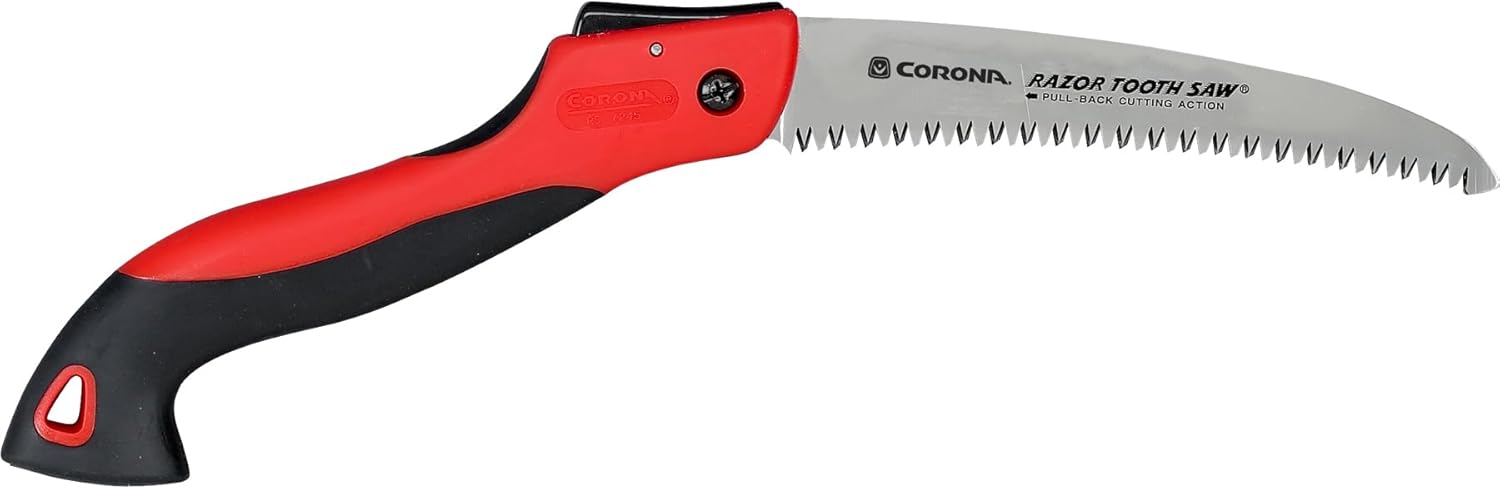
This folding pruning saw uses a 7-inch curved high-carbon steel blade. The selected Amazon variant is the RS 7245 style with the 7-inch blade. The blade is designed for cutting small and medium branches during pruning work.
Check On AmazonIf you click this link and buy, we earn a commission at no additional cost to you.
Route espalier, cane fruit and crop-specific systems to their own guidance
Some pruning questions look general until the plant is part of a system with its own renewal rules. Espalier depends on a planned framework and repeated training decisions, so a generic open-canopy approach can undo the form rather than improve it. Cane fruits are not miniature fruit trees, and their old and new canes are managed according to the crop’s fruiting cycle. Likewise, a high-density apple system or a deliberately trained peach tree may need crop-specific instructions that go beyond this homeowner framework.
Use this article to decide what kind of decision you are facing, then switch to species or system guidance when the answer depends on exact fruiting habit, training form, or regional timing. That keeps general pruning principles from overruling the biology of the plant. It also prevents a common beginner mistake, which is copying the visible shape of another fruit plant without understanding why that shape was chosen. The broader garden care guidance can help place pruning within routine maintenance, while crop-specific growing instructions should own the details of each fruiting system.

This roll provides 50 feet of 1/2-inch ONE-WRAP garden tie material. The reusable ties can be cut to length and repositioned for staking, training, and supporting plants. The listing states that the material is made from 65 percent recycled plastic and has a soft side intended to be gentle on plants.
Check On AmazonIf you click this link and buy, we earn a commission at no additional cost to you.
Stop at large limbs, climbing, split wood or difficult access
Ordinary homeowner pruning ends when the work requires unstable access, climbing, control of a heavy limb, or judgment about a structurally compromised trunk or major branch. A branch can be biologically appropriate to remove and still be unsafe for a homeowner to remove. Split trunks, hanging limbs, storm-damaged wood under tension, and branches near utility lines are not extensions of the same small-cut task. Those conditions call for a qualified arborist or the appropriate utility service rather than a more aggressive tool.
Keep the work within comfortable ground-level reach and within the capacity of ordinary hand pruning. If a desired cut requires you to lean from a ladder, support a large falling section, or work beneath unstable wood, the pruning plan has exceeded the safe scope of this article. The same limit applies when a mature tree has widespread structural defects that cannot be corrected with small selective cuts. For smaller routine work, the pruning plants framework provides the next level of general pruning logic without turning the task into professional tree work.

These clear safety glasses use wraparound polycarbonate lenses with anti-fog and scratch-resistant features. The temples and nose pads are adjustable for fit. The listing states ANSI Z87 certification and 100 percent UV shielding.
Check On AmazonIf you click this link and buy, we earn a commission at no additional cost to you.
Final Thoughts: Prune for a reason, then stop
Fruit-tree pruning becomes more manageable when every cut has a job. Identify the tree, preserve the fruiting wood it relies on, clear obvious problems, and use thinning or heading only when the expected response matches the goal. If a branch is healthy, useful, and not creating a clear conflict, leaving it in place can be the better decision. That restraint matters most on a tree whose fruiting habit or past training is still uncertain.
Use local and crop-specific guidance for timing and species details, especially when regional disease pressure or a specialized training system changes the answer. Spread major renovation over more than one cycle instead of treating a neglected canopy as a one-session reset. Stop when access, limb size, structural damage, or electrical hazards move the work outside ordinary homeowner maintenance. A good pruning session should leave you able to explain why each important cut was made and why the remaining productive wood was kept.

This handheld sharpener uses a tungsten carbide sharpening edge for garden cutting tools. The listing names pruning shears, loppers, hedge clippers, folding saws, and other blades among its supported uses. Its compact design includes a slip-resistant handle for controlled sharpening.
Check On AmazonIf you click this link and buy, we earn a commission at no additional cost to you.
FAQs
🍎 Should I prune every fruit tree the same way?
No. Fruiting habit, training system, tree age, and local conditions change what should be kept or removed. Confirm the species first, then use crop-specific guidance for the details that affect fruiting wood and timing.
✂️ Is a thinning cut better than a heading cut?
Not universally. Thinning removes a branch back to its origin and is often useful for crowding, while heading shortens a branch and stimulates growth below the cut. Choose the cut by the response you need rather than using one cut everywhere.
🌿 How do I know whether a short branch is fruiting wood?
That depends on the crop and sometimes the cultivar. Compare the shoot or spur with reliable guidance for your exact fruit tree before removing it. If you are uncertain and the branch is healthy, postponing that cut is usually the more reversible choice.
🌳 Can I fix a neglected fruit tree in one pruning session?
Major renovation is usually better approached gradually when no immediate hazard is present. Prioritize dead or broken wood, major conflicts, and the most important structural correction, then reassess the tree’s response before making lower-priority cuts.
🪵 Should I remove every vertical shoot?
No. Vigorous vertical shoots often crowd the canopy, but the correct decision still depends on the tree’s structure and whether a shoot could serve as useful replacement growth. Remove or retain it for a defined reason rather than by angle alone.
🧤 When should I stop pruning and call an arborist?
Stop when the job involves large or hanging limbs, climbing, unstable access, split structural wood, or branches near utility lines. Those conditions exceed ordinary ground-level homeowner pruning and require qualified help or the appropriate utility service.
References and Sources
- Illinois Extension fruit tree pruning: Supports the distinction between heading and thinning cuts and the growth response associated with each.
- University of Minnesota Extension apple pruning: Supports removing dead, broken, competing wood and making branch-removal cuts at the branch collar.
- Penn State Extension fruiting and pruning: Supports the need to match pruning to fruiting habit and the different effects of repeated heading on apples, pears, and peaches.
- University of Maine Cooperative Extension pruning: Supports gradual renovation of neglected fruit trees and the need to avoid severe correction in one session.