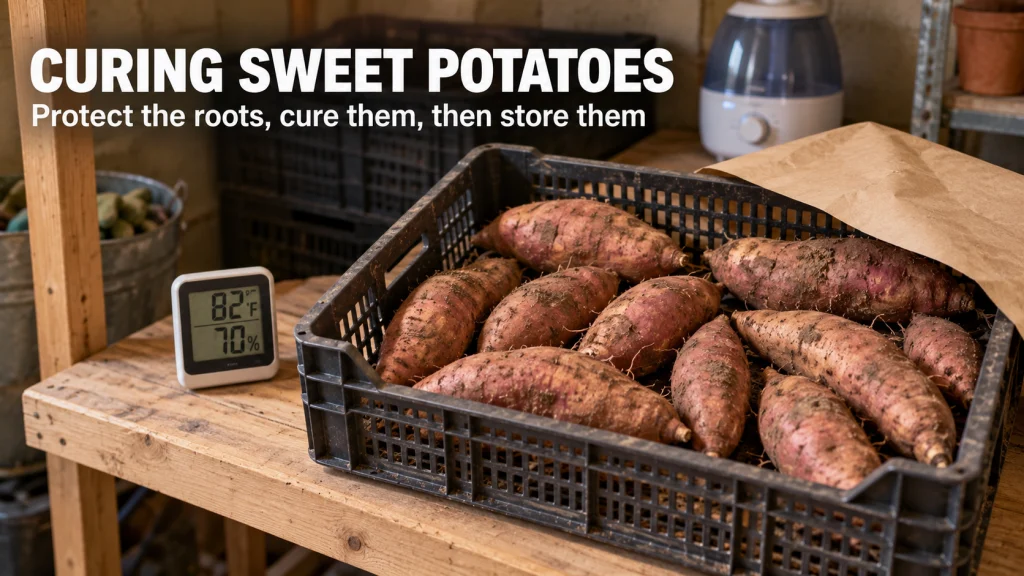
Curing sweet potatoes is the post-harvest step that helps sound roots heal minor harvest wounds and develop better storage quality before they are moved to cooler conditions. The key is to handle freshly dug roots gently, keep them warm and humid with ventilation for the curing period, and avoid treating curing and storage as the same environment. Unwashed roots are generally easier to protect while their skins are still tender. Once curing is complete, the job changes from encouraging wound healing to keeping the roots cool enough for storage without exposing them to chilling temperatures.
Harvest carefully because curing cannot undo major wounds
Freshly dug sweet potatoes look finished, but curing sweet potatoes is really the hidden second half of harvest. The roots are still living tissue, and their skins can be rubbed, cut, or bruised while they are lifted and moved. Curing can support the healing of minor harvest injuries, but it cannot turn a badly cut, crushed, or actively decaying root into a good storage candidate. That makes careful digging and handling part of the curing decision, not a separate chore that no longer matters once the roots leave the soil.
Lift around the root zone rather than driving a fork or shovel directly under the crown, then handle the roots as little as practical while the skin is tender. Do not toss them into a container, scrape soil off aggressively, or stack a heavy load on top of freshly harvested roots. Set aside roots with severe cuts, soft breakdown, or obvious decay instead of expecting the curing environment to rescue them. For the growing and harvest context that comes before this post-harvest step, the site’s vegetable gardening guidance keeps those decisions separate from curing.

The Fiskars Garden Harvest Basket has a durable plastic body with separate colander and enclosed sides. Ergonomic side handles and interlocking folding handles give you controlled carrying options for moving a fresh harvest. For this section, use it as a transport basket so tender roots can be moved without tossing them into a deep or overloaded container.
Check On AmazonIf you click this link and buy, we earn a commission at no additional cost to you.
Cure promptly under warm, humid, ventilated conditions
Once sound roots are selected, move them into curing conditions promptly rather than leaving them wherever the harvest happened to land. Mississippi State University Extension recommends 80 to 85°F with 85 to 90 percent relative humidity for 7 to 10 days, while Alabama Cooperative Extension gives 85°F with 90 to 95 percent relative humidity for 4 to 7 days. Those ranges are close, but they are not proof that any warm room will work equally well. The practical goal is a controlled combination of warmth, high humidity, and air movement that supports wound healing without creating a stagnant, wet enclosure.
At home, the hardest part is often keeping temperature, humidity, and airflow in the useful range at the same time. If you buy a monitor for the curing space, prioritize one that shows both temperature and relative humidity clearly, and place the sensor where the roots actually sit rather than across the room. A minimum and maximum reading is useful when the space changes overnight, and a display that can be checked without repeatedly opening a small enclosure helps you see whether the setup is stable. The goal is not to buy a more elaborate device than the job requires, but to replace guesswork with measurements that can change what you do next.
The container should solve a different problem. Look for enough capacity to hold the batch without tightly compressing the roots, plus openings or spacing that let air move through the load instead of only around the outside. An open crate, ventilated box, or similar container can work if it protects the roots from bruising without trapping wet air. If the roots are packed so tightly that airflow is blocked, a larger or more open container is more useful than adding more heat or humidity.
- Start with sound, gently handled roots.
- Verify temperature and relative humidity where the roots are curing.
- If the temperature is somewhat below the ideal range but remains stable, use guidance that allows a longer cure rather than forcing extra heat without control.
- If humidity is too low, raise humidity without wetting the root surfaces.
- If condensation collects or root surfaces stay wet, increase ventilation instead of adding more moisture.
- Inspect for softening, mold, decay, overheating near a heat source, or widespread sprouting.
That gives you a practical decision rule when ideal conditions are not possible. A slightly cooler but stable setup can still be workable when the source allows more curing time, while a cold, dry, unmeasured space gives you much less confidence that wound healing is progressing as intended. Wet surfaces, spreading mold, soft rot, or widespread sprouting are not signs to keep curing longer. They are signs that the environment or the batch needs correction before more time is added.

The TempPro TP50 displays temperature and relative humidity and records high and low readings. Its listed accuracy is about plus or minus 1°F for temperature and plus or minus 2 to 3 percent RH for humidity, with readings refreshed every 10 seconds. A tabletop stand and magnetic back make it easy to position near the curing batch.
Check On AmazonIf you click this link and buy, we earn a commission at no additional cost to you.
Do not wash roots before curing when the guidance calls for dry handling
For a straightforward home curing routine, leave the roots unwashed and remove only loose soil that comes away without scrubbing. Alabama Cooperative Extension specifically advises against washing sweet potatoes before curing, and Mississippi State emphasizes how easily the skin can be damaged during harvest. Washing adds rubbing, water, and extra handling at the moment when the skin is most vulnerable. If the roots are only dusty or lightly soiled, there is little reason to trade that harmless soil for a higher chance of abrasion.
This does not mean every trace of soil has to remain attached or that a muddy root should be scrubbed clean before it can be cured. Brush away loose material gently, keep the surface from staying wet, and focus on protecting the skin. Some university guidance notes that washed roots can still be cured under controlled conditions, but that is a different handling path and can reduce the margin for error. For most home harvests, leaving sound roots unwashed until they are ready for use keeps the curing step simpler and closer to the conservative Extension recommendations.

This vegetable brush uses 100 percent natural plant-fiber soft bristles. The soft-bristle design is a better match for gently flicking away loose dry soil than a stiff scrubber. Use it dry and lightly before curing rather than turning the step into washing or aggressive scrubbing.
Check On AmazonIf you click this link and buy, we earn a commission at no additional cost to you.
Move from curing conditions to cooler storage conditions
Curing ends with a deliberate change in environment. Do not decide that the batch is finished only because the calendar says enough time has passed, and do not wait for a dramatic visual change that may never appear. A more defensible home rule is to combine the source-recommended curing period with verified conditions and the absence of failure signs such as wet surfaces, soft rot, mold, overheating, or widespread sprouting. When those pieces line up, move the roots out of the warm curing environment instead of extending the treatment just to feel safer.
Keeping roots in the same warm, humid conditions after the treatment is complete can encourage sprouting and unnecessary weight loss, so the curing setup should not become the storage setup by default. Mississippi State recommends moving cured roots to a dark place at 55 to 60°F, while Alabama Extension also separates its warmer curing conditions from cooler storage. If a garage, basement, pantry, or utility room regularly falls outside the recommended range, measure the space before treating it as suitable storage. After the move, the main task becomes checking stored roots periodically and removing any that develop soft rot or other obvious deterioration.
| Stage | Main job | Environment to verify |
|---|---|---|
| Harvest | Protect tender skin and avoid major wounds | Gentle handling, no unnecessary washing or abrasion |
| Curing | Support wound healing and post-harvest changes | Warm, humid, ventilated conditions within Extension guidance |
| Storage | Maintain cured roots without encouraging sprouting or chilling injury | Cooler, dark, ventilated conditions around 55 to 60°F |
The useful distinction is the change in purpose from one stage to the next. Harvest handling protects what you grew, curing prepares sound roots for storage, and storage tries to hold that condition rather than continue the curing treatment. If those stages blur together, it becomes easy to leave roots too warm for too long or to cool them before the cure has done its job. Treat each transition as a separate decision.

The TempPro TP359 measures temperature and humidity and shows the readings on a 3.5-inch backlit LCD. Bluetooth monitoring reaches up to 260 feet, while the app can store and export up to two years of data and send preset alerts. That makes it useful for checking whether a storage area stays stable after the warm curing stage ends.
Check On AmazonIf you click this link and buy, we earn a commission at no additional cost to you.
Keep sweet potatoes out of refrigerator temperatures that cause chilling injury
Raw sweet potatoes do not belong in ordinary refrigerator storage. Mississippi State University Extension warns that extended exposure below 55°F can cause chilling injury, including hard cores and changes in taste after cooking. University of Massachusetts guidance likewise describes chilling injury below 55°F and notes that the damage becomes more serious with colder temperatures or longer exposure. A refrigerator may look like the safest place for produce, but for cured sweet potatoes it is colder than the storage range these roots need.
This is also why a cold garage is not automatically a good winter storage space. What matters is the temperature the roots actually experience, not the name of the room or how convenient it is. If a storage area can drop into refrigerator-like conditions, move the roots somewhere that stays within a suitable range rather than relying on a blanket or cardboard box to correct the temperature. Home food gardening decisions often change once the crop leaves the soil, and the broader edible gardening guide provides context for handling those crop-specific differences without turning every harvest into the same storage routine.

The AcuRite 00613 displays current indoor temperature and humidity and records daily high and low values. Its indoor temperature range is 32°F to 122°F, and it can stand on a flat surface, mount to a wall, or attach magnetically. In a sweet potato storage area, those readings help reveal whether the space is drifting toward refrigerator-like temperatures.
Check On AmazonIf you click this link and buy, we earn a commission at no additional cost to you.
Separate curing from later storage once the treatment is complete
The simplest way to avoid confusion is to stop using curing as a label for everything after harvest. Curing is a short, warm, humid treatment with a specific purpose, while storage is the longer period that follows under cooler conditions. The distinction matters because the same environment that helps during curing can become counterproductive if it is maintained indefinitely. Warm storage can promote sprouting, while storage that is too cold can cause chilling injury, so the transition should be intentional.
It also helps to keep expectations realistic about what curing can accomplish. Curing supports the healing of minor wounds and improves post-harvest quality, but it does not guarantee a fixed storage life, erase serious damage, or make poor storage conditions harmless. Variety, harvest condition, handling damage, temperature, humidity, ventilation, and the stability of the storage space can all affect how well the roots keep. If you cannot hold ideal conditions, the best upgrade is usually better information and airflow first: measure the curing space, avoid crowding the roots, correct obvious wetness or overheating, and only then decide whether extra heat, added humidity, or a different container is actually needed.
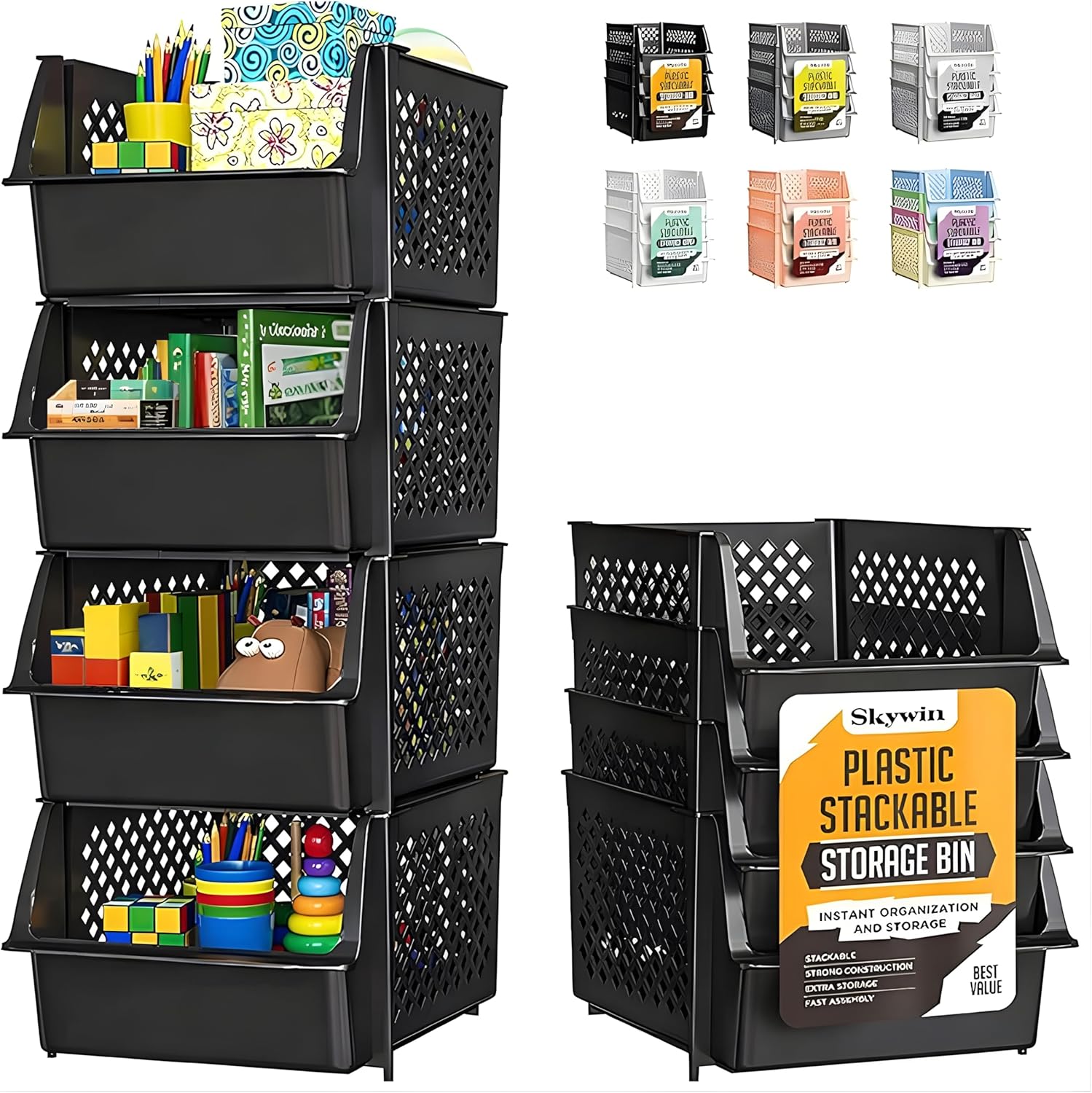
Skywin Stackable Storage Bins are a four-pack of sturdy plastic open-front containers with ventilated mesh sides. Each bin measures 14 by 11 by 7 inches and the bins stack for vertical storage. The ventilated sides make this a better fit when a post-harvest batch needs a separate container without sealing the roots into stagnant air.
Check On AmazonIf you click this link and buy, we earn a commission at no additional cost to you.
Final Thoughts: curing is a post-harvest treatment, not storage itself
The harvest is not finished when sweet potatoes come out of the ground. Protect the tender roots first, because curing works with sound roots rather than repairing severe harvest damage. Then cure them promptly in warm, humid, ventilated conditions that match a reliable Extension recommendation. Keep washing and rough handling to a minimum while the skin is still vulnerable.
Once curing is complete, change the environment instead of leaving the roots in the same warm setup. Move them into cooler, dark, ventilated storage and keep them out of refrigerator temperatures that can cause chilling injury. If your home setup cannot hold the recommended conditions, measure the space and narrow your expectations rather than assuming one room can serve every post-harvest stage. The practical goal is a clean sequence: protect the roots, cure them, then store them under conditions suited to a different job.

The TempPro TP49 is a compact digital hygrometer that displays temperature and relative humidity. It refreshes readings every 10 seconds and is listed at plus or minus 1°F for temperature and plus or minus 2 to 3 percent RH for humidity. Its tabletop, magnetic, and hanging placement options make it easy to keep a basic monitor with the post-harvest setup.
Check On AmazonIf you click this link and buy, we earn a commission at no additional cost to you.
FAQs
🍠 Do sweet potatoes have to be cured before eating?
They can be eaten without a full storage cure, but curing is used to support wound healing and improve post-harvest eating and storage quality. If the roots are being held rather than used promptly, curing becomes much more important.
🌡️ What temperature should I use to cure sweet potatoes?
University Extension recommendations commonly place curing in the low to mid 80s°F with high relative humidity. Follow one source-supported range consistently rather than mixing the temperature from one recommendation with the duration or humidity from another.
💧 Should I wash sweet potatoes before curing them?
For the conservative home method, no. Brush away loose soil gently and avoid scrubbing tender skin before curing, then wash the roots when you are ready to prepare them for use.
📦 Can I cure sweet potatoes in a cardboard box?
A box can organize and protect the roots, but it does not guarantee the temperature, humidity, or ventilation needed for curing. Verify the environment around the roots and avoid trapping condensation or stagnant moisture.
❄️ Can cured sweet potatoes go in the refrigerator?
Raw sweet potatoes should not be kept at refrigerator temperatures for long-term storage because prolonged exposure below the recommended storage range can cause chilling injury. Use a cool, dark, ventilated space that stays around the Extension-recommended storage range instead.
References and Sources
- Alabama Cooperative Extension System: Supports the guidance on gentle post-harvest handling, curing conditions, avoiding washing before curing, cooler storage conditions, and chilling injury.
- Mississippi State University Extension: Supports the home-garden curing range, wound-healing purpose, storage transition, and warning against refrigerator storage.
- Washington State University Vegetable Research and Extension: Supports monitoring the curing environment, using longer curing periods when temperatures are lower, and avoiding moisture buildup or overheating.
- NC State Extension: Supports the importance of ventilation, the risks of improper curing conditions, and widespread sprouting as a sign of overcuring.