Dense carrot seedlings need enough room for the roots you actually want to harvest, but thinning too aggressively can disturb the plants you mean to keep. A useful approach is to wait until the seedlings are established enough to identify and handle, then set the final spacing from expected root size rather than from how thickly the seed was sown. Very crowded rows may be easier to thin in two passes, while a more even stand can often be taken to final spacing in one careful session. The goal is not a perfectly tidy row above ground, but a stand that gives each remaining carrot room to develop with as little root disturbance as practical.
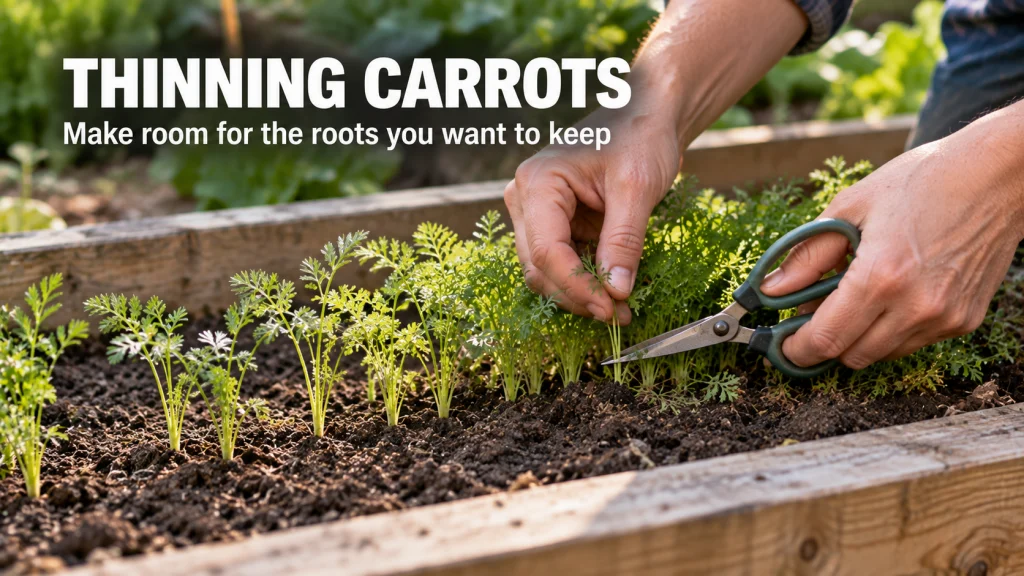
Thin only after seedlings are established enough to handle
Thinning carrots starts with a row that often looks much denser than expected because the seed is small and emergence can be uneven. The first useful moment is not tied to one universal height, since Extension guidance uses different markers such as seedling height or the number of true leaves. What matters in the garden is that the seedlings are clearly established, you can tell carrot foliage from weeds, and you can remove an extra plant without dragging several neighbors with it. If the row is still a fragile green haze, waiting until the plants are easier to distinguish can make the job more controlled.
Do not let that caution turn into a reason to ignore a packed row until the roots are already pressing tightly together. Carrots begin forming their taproots early, so a dense stand is not just an aboveground appearance problem. I would thin as soon as the plants are established enough for deliberate selection, while the unwanted seedlings are still small and the keepers can remain in place. If you need broader context for crop care around this stage, the site’s vegetable gardening guidance can help place thinning within the rest of the growing sequence.

This five-pair glove pack uses a polyester knit shell with nitrile-coated palms for grip and abrasion resistance. The pull-on design and stretch knit construction help keep the gloves secure while working close to the soil. They are intended for gardening and other general work, making them useful when handling seedlings and loose soil along a row.
Check On AmazonIf you click this link and buy, we earn a commission at no additional cost to you.
Use the final root size rather than seed density to set the target
A thick line of seedlings can make it tempting to preserve as many plants as possible, but the original sowing density does not tell you how many mature carrots the row can support. Final spacing should follow the kind of root you expect to harvest, because small finger carrots and larger mature roots do not need the same amount of room. Illinois Extension, for example, gives closer spacing for finger carrots and wider spacing for larger types, while other Extension guidance commonly places standard mature carrots several inches apart. That variation is a reason to check the cultivar information you planted instead of treating one spacing number as correct for every carrot.
Think of the seed packet or cultivar description as the starting point, then compare it with the actual root size you intend to let the crop reach. If you plan to harvest young carrots, a closer final stand can make sense, but keeping full-size types at that same density works against the harvest goal. Wider spacing also should not become an automatic upgrade, because removing more plants than necessary simply reduces the number of roots in the row. The practical target is enough room for the intended root diameter without turning the bed into empty soil between widely scattered plants.
| Harvest goal | Spacing approach | What to verify |
|---|---|---|
| Small or young carrots | Keep a closer final stand when the cultivar and harvest stage allow it | Expected root size and the seed packet guidance |
| Standard mature carrots | Give each plant enough separation for normal root expansion | Cultivar size and Extension guidance for mature roots |
| Large mature types | Use the wider end of appropriate spacing guidance | Mature root diameter rather than seedling top size |
The table is a decision aid, not a substitute for the cultivar information in front of you. A short, broad carrot and a long, slender carrot can put different demands on the same row even when their tops look similar while young. When the expected size is unclear, avoid pretending that precision is possible and use the most reliable cultivar or Extension guidance you have. That keeps spacing connected to the crop you are actually growing rather than to a generic number copied from another variety.

This 12-inch clear acrylic ruler gives a simple reference for checking spacing along a carrot row. Easy-to-read markings support quick comparisons between neighboring seedlings and the target distance. Its scratch-resistant design and raised beveled edges are part of the verified Westcott listing.
Check On AmazonIf you click this link and buy, we earn a commission at no additional cost to you.
Remove seedlings with minimal disturbance to the plants that remain
The seedling you remove matters less than what happens to the roots beside it. In a lightly crowded patch, a small unwanted seedling may come away cleanly, but tightly packed roots or crusted soil can make pulling transmit movement through the whole group. Snipping an unwanted seedling at soil level is a useful low-disturbance option when the plants are intertwined or when a keeper visibly shifts as you touch its neighbor. If gentle pulling works without moving nearby plants, it can also be practical, but the remaining carrots should stay anchored and upright.
Work along the row slowly enough to choose the keepers first instead of grabbing plants at random. Favor a well-positioned, healthy seedling, then clear only the competitors that prevent the spacing you need around it. Avoid digging around the roots or trying to rescue every removed seedling for transplanting, because the priority is protecting the taproots that will finish in place. Carrots are normally direct seeded, and University of Minnesota Extension specifically warns that moving their developing taproots can damage or redirect root growth.
- Choose the seedlings that will remain before removing their nearest competitors.
- Use a clean snip at soil level when pulling would tug on neighboring plants.
- If you pull, stop if the keeper moves or the surrounding soil lifts with the seedling.
- After thinning, check that the remaining plants are still upright and that their roots have not been exposed.
Once the row is thinned, resist the urge to keep handling it just because a few tops are not perfectly centered. The underground root is the crop, and unnecessary correction can create more disturbance than the crooked leaf position is worth. Keep the soil surface settled around the plants and return to normal care rather than repeatedly adjusting individual seedlings. For a wider view of how root crops fit into a home food garden, see the site’s edible gardening basics.

These 6-inch pruning snips use stainless steel blades and a compact micro-tip design for controlled cuts around small plants. The tool has a comfortable handle and an ambidextrous layout for close work. It suits the low-disturbance method of cutting an unwanted carrot seedling at soil level when pulling would move nearby plants.
Check On AmazonIf you click this link and buy, we earn a commission at no additional cost to you.
Decide whether one or two thinning passes fit the sowing density
Two thinning passes are useful when a row is so dense that taking it directly to final spacing would require a lot of manipulation around tiny keepers. The first pass can simply break up the worst clumps and create enough separation for the remaining seedlings to become easier to judge. A later pass can then set the final spacing once the stand is clearer and the harvest goal is easier to apply. This is a workflow choice, not a rule that every carrot row must follow.
A single pass is reasonable when emergence is already fairly even and you can establish final spacing without repeatedly disturbing the same patch. It also makes sense when the seedlings are established enough to handle and the intended mature spacing is already clear from the cultivar guidance. I would choose the fewest passes that let me create the needed spacing while keeping the remaining roots quiet. The more the row resembles a tangled tuft rather than distinct plants, the stronger the case for separating the decision into an early cleanup and a later final pass.
| What the row looks like | Likely approach | Reason |
|---|---|---|
| Even emergence with visible gaps | One careful pass | Final spacing can be set without repeated handling |
| Dense clumps with seedlings touching | Consider two passes | An early pass can reduce crowding before final selection |
| Mixed row with a few crowded pockets | Use one pass where clear and stage only the dense pockets | The whole row does not need the same treatment |
After the first pass, the row should have a clear reason for being revisited rather than a vague plan to thin again later. A second pass is useful when plants are still closer than the final root size calls for, not merely because two passes sound more careful. If the first session already produced appropriate final spacing, leave the row alone. That stop condition prevents thinning from becoming repeated handling without a crop benefit.

This foam kneeling pad measures 17.5 by 11 inches and is designed for gardening and other kneeling tasks. Its lightweight, portable build is water resistant and stain resistant for repeated outdoor use. The padded surface gives the gardener a steadier working position while moving slowly through a one-pass or two-pass thinning session.
Check On AmazonIf you click this link and buy, we earn a commission at no additional cost to you.
Treat pest precautions around disturbed foliage as region-specific guidance
Advice about carrot thinning sometimes comes with warnings that disturbed carrot foliage will automatically create a pest problem, but that should not be turned into a universal rule for every U.S. garden. Carrot rust fly is a real pest in places where it occurs, and UC IPM notes that its larvae tunnel into roots while management can include excluding adults with row cover and adjusting planting around local activity periods. Oregon State University also describes adults as being attracted to host plant odor, which explains why gardeners in affected areas may take extra care when the crop is disturbed. Those facts support a local pest precaution, not a claim that every freshly thinned row is suddenly at high risk.
If carrot rust fly is a known problem in your area, keep the thinning session tidy, remove the pulled foliage from the bed, and restore any protective row cover promptly after access. If the pest is not documented locally, there is little value in building the whole thinning method around a warning borrowed from another region. Use local Extension or integrated pest management guidance to decide whether exclusion or timing precautions belong in your routine. The core thinning decision remains the same either way: create appropriate root spacing while causing as little unnecessary disturbance as practical.

This 4 by 10 foot fine HDPE mesh is designed as a pest barrier for vegetable beds and other garden plantings. The UV-stabilized netting allows air, water, and light to pass through while it remains over the crop. It fits the region-specific row-cover precaution when local carrot pest guidance calls for exclusion.
Check On AmazonIf you click this link and buy, we earn a commission at no additional cost to you.
Final Thoughts: thin for the root size you actually want
A crowded carrot row is easier to manage when the decision starts with the plants that will remain. Once the seedlings are established enough for controlled handling, use the expected mature root size to set the spacing and protect each keeper from unnecessary movement. In the densest pockets, snipping can be the cleaner choice when pulling shifts neighboring plants. If one careful pass already creates the spacing you need, stop there rather than thinning again by habit.
The final check is whether the row now matches the harvest you intend. Larger roots need the room supported by their cultivar guidance, while carrots being harvested small do not need extra space simply because a wider recommendation exists for another type or harvest stage. Mixed rows can be judged pocket by pocket instead of forcing the same response everywhere. Once the spacing decision is finished, leave the stand alone and let the remaining roots develop.
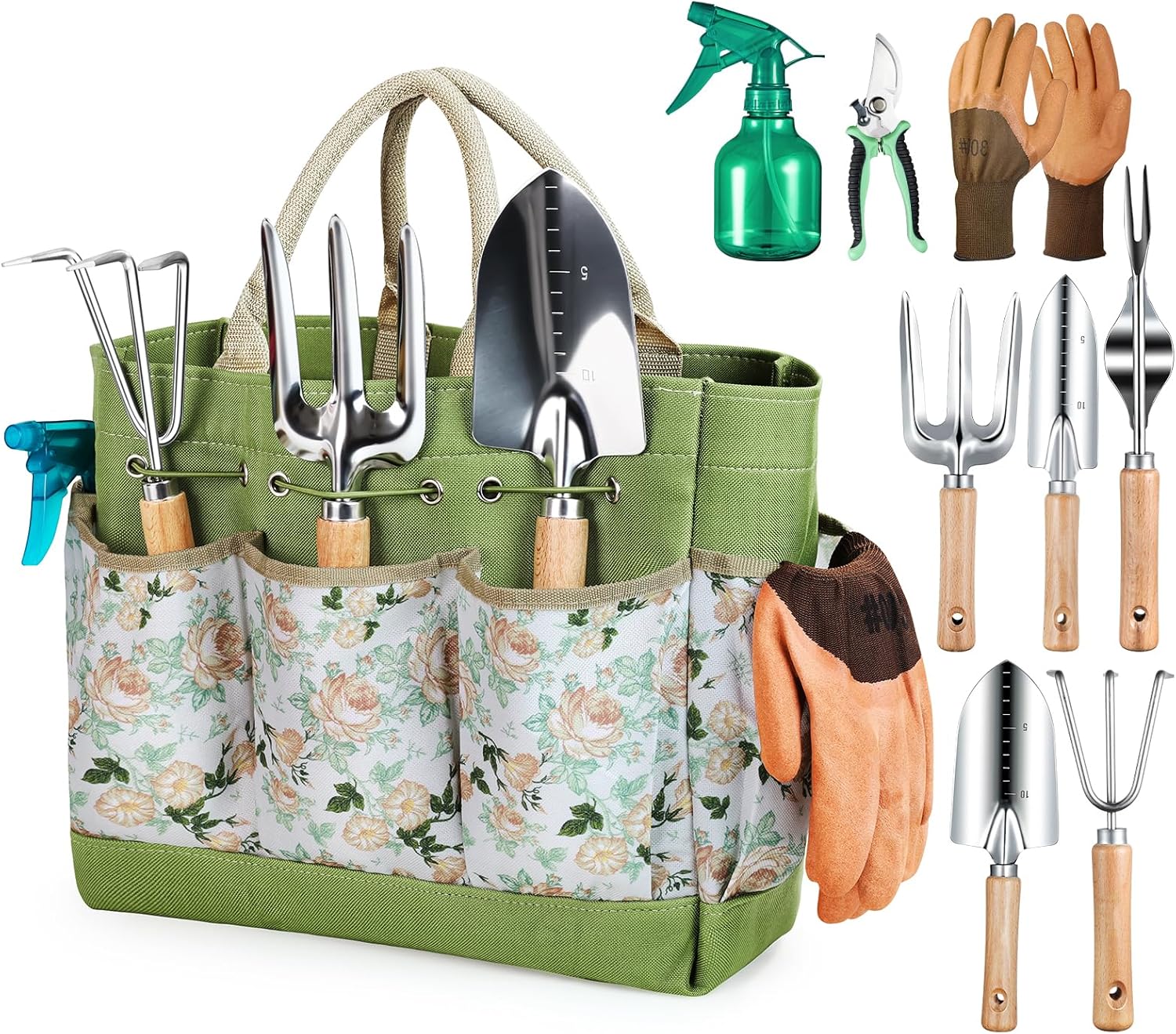
This nine-piece set combines eight garden hand tools with a storage tote. The verified set includes pruning shears, a weeder, a transplanter, and a cultivator among its everyday maintenance tools. Stainless steel tools, wooden handles, and the carry bag make it a practical general kit for follow-up work after the carrot row has been thinned.
Check On AmazonIf you click this link and buy, we earn a commission at no additional cost to you.
FAQs
🥕 When should I thin carrot seedlings?
Thin when the seedlings are established enough to identify and handle without repeatedly moving the plants you want to keep. Extension recommendations use different height and leaf stage markers, so treat plant stability and local guidance as more useful than one universal number.
📏 How far apart should carrot seedlings be after thinning?
Final spacing depends on the expected root size and harvest stage. Smaller carrots can be kept closer, while larger mature varieties need more room, so check the cultivar information and suitable Extension guidance rather than forcing every row to the same spacing.
✂️ Is it better to pull or cut carrot seedlings when thinning?
Use the method that disturbs the keepers least. Snipping at soil level is a good choice when roots are crowded or pulling makes nearby seedlings move, while gentle removal can work when an unwanted plant comes free without shifting its neighbors.
🌱 Do carrots always need to be thinned twice?
No. A second pass is useful when the first pass only reduces severe crowding, but an evenly emerged row can often be taken to appropriate final spacing in one careful session.
🪴 Can I transplant carrot seedlings that I remove?
Do not depend on transplanting thinnings as part of the plan. Carrot taproots begin developing early and can be damaged or redirected when moved, so protecting the plants already growing in place is the safer priority.
🐛 Does thinning carrots attract carrot rust fly?
Carrot rust fly is a real regional pest, but the risk should not be treated as universal. Where it is locally documented, follow local pest guidance and restore protective row cover promptly after thinning; elsewhere, focus on spacing and minimizing root disturbance.
References and Sources
- Illinois Extension carrots: Supports carrot thinning stages and spacing differences for smaller versus larger mature roots.
- University of Minnesota Extension carrots and parsnips: Supports thinning established seedlings, wider spacing for larger varieties, and the caution against transplanting developing carrot taproots.
- Utah State University carrots in the garden: Supports using true leaf development as a thinning marker and mature in row spacing guidance.
- UC IPM carrot rust fly: Supports the pest boundary, root damage description, and exclusion measures where carrot rust fly is relevant.
- Oregon State University carrot rust fly biology and management: Supports the host odor attraction point and the need to treat rust fly precautions as location-dependent.