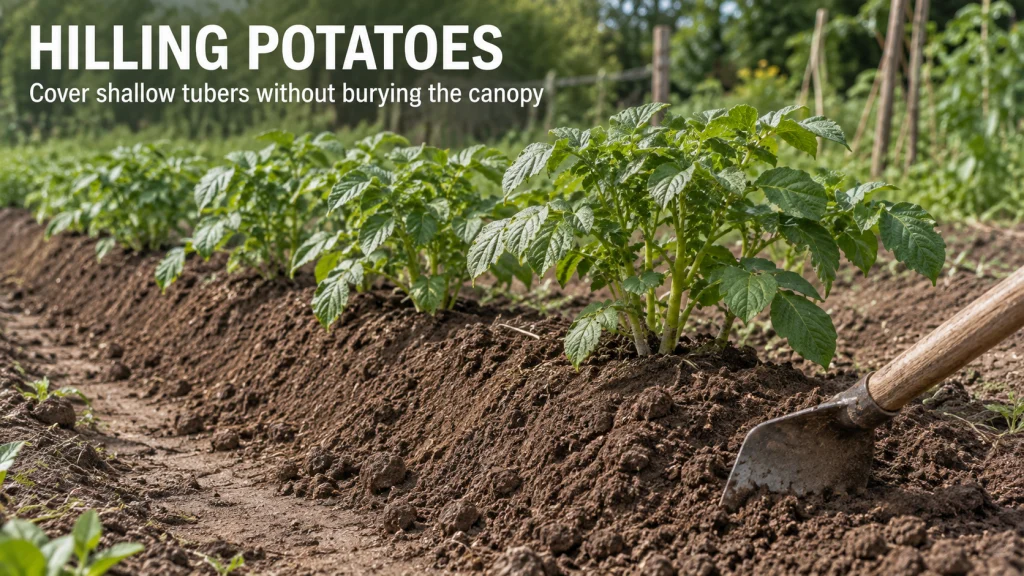
Hilling potatoes is mainly a coverage job: keep shallow developing tubers protected from light while leaving enough active foliage above the soil to keep the plant working. A useful first cue is established stem growth, then later passes should depend on whether the ridge has settled, washed down, or allowed tubers to approach the surface. More soil is not automatically better, and hilling should not be treated as a guaranteed way to increase yield. The practical goal is a stable ridge that protects the tuber zone without repeatedly burying healthy canopy.

This hand trowel uses a cast aluminum head with rust resistance and an ergonomic comfort-grip handle. It is designed for digging and planting in garden beds and pots. The compact hand-tool format suits moving loose soil around the lower stems during hilling.
Check On AmazonIf you click this link and buy, we earn a commission at no additional cost to you.
Understand where tubers form relative to the seed piece
The planted seed piece starts the plant, but the harvest does not simply swell out of that original piece. New tubers develop on stolons produced from underground portions of the plant, so the useful growing zone is tied to the buried stem area and the soil surrounding it. This is why shallow tubers can eventually sit close enough to the surface to be exposed when a ridge settles or erodes. Keeping that zone covered is the central reason for hilling in a home garden.
The seed piece also gives you a useful mental reference for what not to do. You do not need to keep raising the soil line indefinitely just because the stems keep getting taller. Once the tuber zone is protected by a stable mound, additional soil has to solve a real problem such as settling, washout, or visible tubers near the surface. Thinking in terms of protected underground space prevents hilling from turning into a competition to build the tallest ridge.
A simple vertical cross-section helps keep those parts in the right order without turning the mound into a height target. The seed piece begins below the original soil line, underground stems produce stolons, and tubers develop on those stolons within the covered soil zone. Above that zone, the leafy canopy needs to remain exposed so it can keep supporting the plant. Read the table from bottom to top as a practical map of what hilling is protecting and what it should leave uncovered.
| Position in the plant | What is there | What it means for hilling |
|---|---|---|
| Below the original soil line | Seed piece and buried stem base | Keep this area stable and avoid rough disturbance while moving soil |
| Underground around the lower stems | Stolons extending from buried stem tissue | Maintain loose, continuous cover around the developing underground zone |
| Within the shallow covered zone | Developing tubers on stolons | Restore soil when settling or erosion brings tubers close to light |
| Above the mound | Active leafy canopy | Leave enough foliage exposed for normal plant function |
This cross-section also explains why the right mound height cannot be separated from the plant in front of you. A ridge is useful when it preserves cover over the stolon and tuber zone while keeping the canopy above the soil. If the ridge already does that, more height is not automatically an improvement. If soil loss exposes the shallow zone, rebuilding cover has a clear protective purpose.

This five-pack includes 5-gallon fabric grow bags made from 300G thickened nonwoven material. The fabric design supports drainage, and the bags include reinforced handles for moving them. The container format provides a defined soil zone for small-space growing and soil-cover management.
Check On AmazonIf you click this link and buy, we earn a commission at no additional cost to you.
Start hilling after stems have established enough growth
A practical first cue is when the stems are around a foot tall and the plants have enough foliage to remain clearly above the new soil level. At that stage, pull loose soil toward the plant base from both sides rather than dumping a heavy load onto the center. The goal is to cover the lower stem area while leaving a healthy portion of the canopy exposed. If the plants are still small enough that a normal mound would swallow most of the leaves, the crop has not given you much working room yet.
Before making that first pass, check the ridge instead of relying on stem height alone. The soil should be workable rather than waterlogged or packed into hard clods, because rough handling can disturb roots and stolons while compacted soil can leave an uneven mound. A ridge that crumbles and shapes cleanly is easier to place where protection is needed. Use the following checklist as a condition check, not a calendar.
- The stems have enough height that lower growth can be covered without burying the whole canopy.
- The soil can be moved into a broad, stable mound without smearing or forming hard chunks.
- The ridge needs more cover around the lower stem and shallow tuber zone.
- You can move soil without scraping, breaking, or sharply bending the stems.
If those conditions are present, the first hill has a clear job to do. Work gently enough that the mound supports the lower plant instead of pushing stems sideways. Step back afterward and make sure a useful amount of foliage remains above the new soil line. If the conditions are not present, waiting for more usable stem growth or better soil condition is usually more sensible than forcing the task.

This hand cultivator uses three thick claws for loosening, cultivating, digging, and weeding soil. Its aluminum-alloy working head is paired with an ergonomic TPR handle. The claw layout is useful for pulling loose soil toward a plant base without dumping a large load at once.
Check On AmazonIf you click this link and buy, we earn a commission at no additional cost to you.
Cover shallow developing tubers without burying the whole canopy
Build the mound broadly around the base rather than making a narrow peak that sheds soil away from the plant. Bring loose soil up around the lower stems and shape it so the protected zone stays covered after normal watering or rain. The upper leaves should remain exposed and functional, because the point is not to turn green foliage into buried stem all at once. A mound that protects the lower plant while leaving the top open is doing the job more cleanly than one that simply looks tall.
If a tuber is already visible at the surface, cover it promptly with loose soil and then inspect the surrounding ridge for the reason it became exposed. The problem may be local settling, runoff, cracking soil, or a tuber expanding close to the surface. Fixing only the visible spot can leave another shallow tuber exposed nearby, so restore the ridge around the plant rather than placing a small cap directly on one potato. The practical target is continuous cover over the tuber zone, not a decorative mound around the stem.

This heavy-duty steel hand tool is designed for transplanting, cultivating soil, digging holes, and removing weeds. Its narrow transplanter shape and ergonomic grip support controlled soil work around individual plants. That makes it suitable for restoring cover around a shallow tuber without reshaping an entire row.
Check On AmazonIf you click this link and buy, we earn a commission at no additional cost to you.
Repeat only as the ridge settles or tubers approach the surface
A second pass is justified when the existing hill no longer protects the tuber zone as well as it did after the first pass. Soil can settle after watering, wash away from one side, or crack enough to expose shallow tubers. In those cases, rebuild the weak part of the ridge and restore even coverage around the plant. If the mound remains broad, intact, and protective, adding more soil simply because the plant is taller may create work without solving a new problem.
The repeat decision should stay tied to what you can actually see in the garden. A weak ridge calls for repair, while an intact ridge can usually be left alone. This keeps the work connected to tuber protection instead of a preset number of passes. The table below separates a protective correction from routine piling that has no clear target.
| What you see | What it means | What to do |
|---|---|---|
| Ridge still broad and intact | The tuber zone is still protected | Leave it alone and keep monitoring |
| Soil has settled around the stems | Cover may be getting shallow | Add enough loose soil to rebuild the ridge |
| One side has washed down | Coverage is uneven | Repair that side and reshape the mound |
| A tuber is visible near the surface | Light protection has failed at that spot | Cover it and inspect the surrounding ridge |
After each correction, return to the same question: is the tuber zone covered without unnecessarily burying active foliage? Check both sides of the row because runoff and settling are rarely perfectly even. A ridge that stays protective does not need extra soil simply to match an imagined schedule. That condition-based check is more useful than counting how many times the row has been hilled.

This lightweight hand trowel uses a rustproof FiberComp composite body and is designed for digging and turning soil. Its small hand-tool format is suited to localized ridge repairs after settling or washout. It can move a modest amount of loose soil without requiring a full-row rework.
Check On AmazonIf you click this link and buy, we earn a commission at no additional cost to you.
Separate light protection from exaggerated yield claims
Hilling has a clear protective purpose because shallow tubers exposed to light can green, and a stable soil cover reduces that exposure. It can also shape the row and improve the physical space around developing tubers when the original ridge is shallow. Those are practical reasons to do the job carefully. They are different from promising that every extra layer of soil will automatically produce more potatoes.
Yield depends on the crop, growing conditions, water, fertility, plant health, and the way the tuber-bearing system develops, so one maintenance step should not be sold as a universal yield switch. Research on one transplanted hybrid potato system found that additional hilling did not increase total tuber yield under the tested conditions, even though tuber number and size distribution could change. That study does not define every home garden, but it is a useful reminder to keep the claim narrow. Hill because the crop needs protected soil around shallow tubers, then judge the harvest by the whole growing system rather than the height of the mound.

This soil test kit checks pH, nitrogen, phosphorus, and potash. The 20-test version provides five tests for each of those four soil factors. It helps separate broader soil-fertility questions from the narrower job of protecting tubers with a stable hill.
Check On AmazonIf you click this link and buy, we earn a commission at no additional cost to you.
Move to broader potato culture when the question is no longer soil cover
Hilling cannot answer every problem that appears in a potato row. If the real question is planting depth, spacing, crop rotation, watering, fertility, or general care, the decision has moved beyond soil cover around developing tubers. Those issues belong in broader vegetable gardening guidance, where the crop can be considered from planting through harvest. Keeping that boundary clear prevents a simple ridge-building task from becoming a catchall explanation for weak growth or a disappointing crop.
The same boundary matters when you are planning several food crops rather than troubleshooting one potato row. Broader edible gardening basics can help connect crop choice, site conditions, planting, care, and harvest without pretending that hilling solves those larger decisions. If foliage looks abnormal, growth is poor, or tubers show symptoms that suggest a crop health problem, identify that problem on its own evidence instead of adding more soil as a reflex. Hilling is useful when coverage is the problem, and it should stay that specific.

This 15-inch watering wand uses zinc-alloy construction and offers 10 spray patterns. A thumb flow control adjusts water output while the wand connects to a standard 3/4-inch garden hose. It is relevant when potato care expands from hilling into routine watering around the crop.
Check On AmazonIf you click this link and buy, we earn a commission at no additional cost to you.
Final thoughts: hill to keep tubers covered, not to chase a yield myth
A good potato hill is not the tallest one in the garden. It is the one that keeps the shallow tuber zone covered, stays broad enough to resist normal settling, and leaves the active canopy working above the soil. Start only after the stems give you enough room to mound soil without swallowing the plant. Then make another pass only when the ridge condition shows that more cover is actually needed.
That approach keeps the job tied to what you can verify in front of you. Watch for soil loss, exposed tubers, and weak spots in the ridge, then correct those conditions rather than adding soil on autopilot. Treat yield as the result of the whole crop system, not as a reward for repeated mounding. The simplest successful hill is the one that protects the tubers and then gets out of the plant’s way.

This Craft911 set groups multiple heavy-duty gardening hand tools for routine garden work. The listing describes the set as durable and ergonomic. Keeping several soil-working tools together can support digging, loosening, and small maintenance corrections around vegetable beds.
Check On AmazonIf you click this link and buy, we earn a commission at no additional cost to you.
FAQs
🥔 When should I hill potatoes for the first time?
Use established stem growth as the cue rather than a calendar. Around a foot of stem height is a practical starting point if you can mound soil around the lower stems while leaving plenty of active foliage exposed.
🌿 How much of the potato plant should I cover?
Cover the lower stem area and keep the upper canopy exposed. The mound should protect the shallow tuber zone without burying most of the plant’s working leaves.
🪴 Do I need to hill potatoes again after the first mound?
Only if the ridge settles, washes down, or allows tubers to approach the surface. If the mound is still broad and protective, another pass may not solve anything new.
☀️ What should I do if I can see a potato at the soil surface?
Cover the exposed tuber promptly with loose soil, then inspect the ridge around the whole plant. Restore even coverage so another shallow tuber is not left exposed nearby.
📈 Does hilling potatoes always increase yield?
No guaranteed yield increase can be assumed from hilling alone. Its clearest home-garden role is protecting shallow tubers from light and maintaining a useful ridge around the plant.
References and Sources
- University of Minnesota Extension potato guide: Supports tuber formation on stolons, light protection, and a practical growth-stage cue for hilling.
- Utah State University Extension potato production guidance: Supports careful cultivation, broad ridge formation, and minimizing damage while hilling.
- Wageningen University potato hilling study: Provides a condition-specific example in which additional hilling did not increase total tuber yield.