A cucumber trellis is useful when it solves a real space or harvest-access problem for a vining cultivar, not simply because cucumbers are commonly shown climbing. Compact bush types may fit the available bed without vertical support, while vigorous vines can occupy much more ground if they are allowed to run. The practical decision is to confirm plant habit, compare the space each growth pattern will use, and keep the fruit reachable before choosing any structure. Support should be in place early enough that vines can be guided without untangling a mature plant.
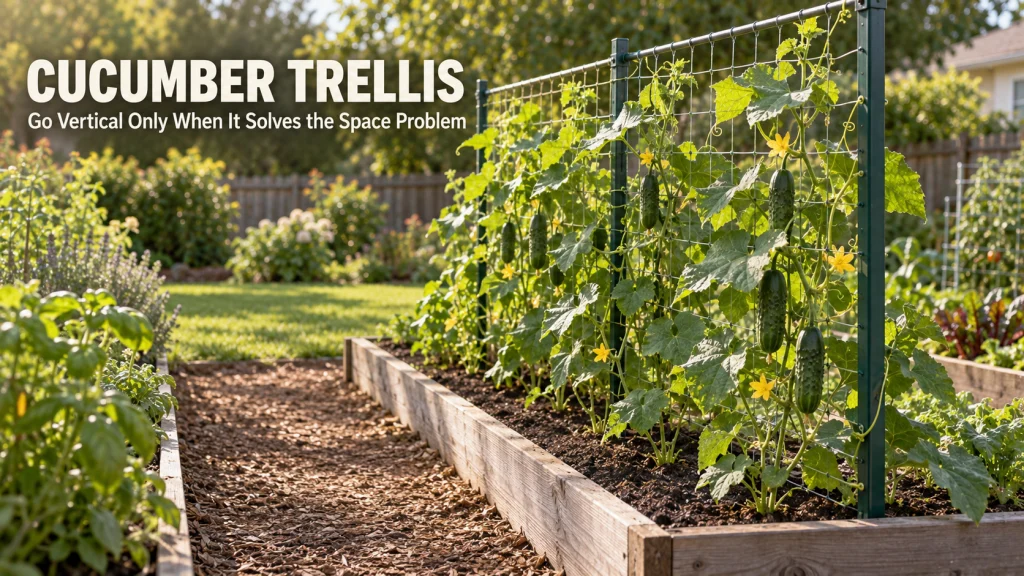
Decide whether vertical growth solves a real garden constraint
The same cucumber can spread across a wide patch of soil or occupy a much narrower vertical plane. That difference matters only when one growth pattern fits the garden better than the other, so the decision should begin with the site rather than with the structure. A trellis is useful when redirecting the vine upward solves a real conflict in the layout, not because vertical cucumbers are automatically the better way to grow. If both ground-running and vertical growth fit comfortably, either approach can be reasonable. Starting with that question keeps the support from becoming the decision before the plant and the space have been considered.
Treat trellising as a sequence of fit checks rather than a construction project. First confirm whether the cultivar is truly vining, then compare how each growth pattern would use the available area, and finally make sure the finished layout remains easy to harvest. Those steps keep the decision focused on the cucumber’s habit and the gardener’s working space without drifting into hardware or detailed structure design. The same site-first logic applies to other vegetable gardening decisions, where plant behavior and available room should guide the setup. With that frame established, the next step is verifying whether the selected cucumber actually has the growth habit that makes vertical support useful.

This retractable STANLEY tape measure has a 25-foot blade, a 7-foot standout, and a secure blade lock. Its Tru-Zero end hook is designed for accurate measurements. It gives a gardener a simple way to measure the bed, walking route, and proposed support footprint before deciding whether vertical growth actually solves a space constraint.
Check On AmazonIf you click this link and buy, we earn a commission at no additional cost to you.
Confirm that the cucumber is vining rather than a compact bush type
Start with the cultivar description on the seed packet, plant tag, or breeder information because cucumbers are not all built around the same amount of vine growth. Many familiar cultivars make long vines, while compact or bush types are bred to occupy less space and can fit smaller gardens more easily. A compact plant may still lean or benefit from light support in some settings, but it should not be treated as though it needs the same vertical plan as a vigorous vining cultivar. The habit label matters more than whether the fruit is described as slicing, pickling, snacking, or another use type. Fruit use and vine habit answer different questions.
If the cultivar information is unclear, avoid designing the entire bed around an assumed vine length or a universal trellis height. Instead, verify the plant habit first and plan enough room to keep the vine from colliding with paths or neighboring plants. That is especially important in a small raised bed, where a mistaken assumption about growth habit can consume the space reserved for another crop. The broader edible gardening guide covers crop planning beyond this one support decision, while the focus here stays on whether vertical growth improves the cucumber’s fit. Once you know you are dealing with a true vining type, comparing ground and vertical footprints becomes much more useful.

This set includes 300 white 4-inch plastic plant labels and a marker pen. The labels are described as waterproof and intended for outdoor seedlings and vegetable gardens. Keeping the cultivar name at the plant makes it easier to return to the seed packet or breeder information when checking whether a cucumber is a compact bush type or a vining type.
Check On AmazonIf you click this link and buy, we earn a commission at no additional cost to you.
Compare the ground footprint with the vertical footprint
A sprawling cucumber does not use only the soil directly beneath its base. The runners extend outward, leaves occupy working space, and fruit can end up under foliage where you have to reach across stems to find it. That can be acceptable in an open row or at the edge of a garden where the vines can travel into an intentionally empty area. In a narrow bed, however, the same habit may turn every harvest into careful stepping and reaching. Vertical growth earns its place when moving that foliage upward preserves ground area that you actually need.
The opposite mistake is assuming that a trellis makes the plant almost dimensionless. A vertical planting still needs root space, light, airflow, and a clear approach for checking leaves and picking fruit. The support also casts some shade and can become awkward if it is placed tight against a wall, fence, or bed edge that you cannot reach from the other side. The better comparison is not ground space versus no ground space, but broad horizontal occupation versus a narrower growing plane with its own access requirements. Use the table below as a fit check rather than a prescription for one structure.
| Garden situation | Ground-running fit | Vertical-support fit | What to verify first |
|---|---|---|---|
| Compact or bush cucumber in a small bed | Often manageable if the plant stays within its planned area | May be optional rather than necessary | Confirm the cultivar is truly compact |
| Vining cucumber beside open unused soil | Can work if vines will not block access | Useful only if it improves handling or space use | Mark the walking and picking route |
| Vining cucumber in a narrow raised bed | Can consume planting and access space quickly | Often a strong fit when upward growth preserves bed area | Make sure the support remains reachable |
| Vining cucumber along a boundary | Works if the vine has a safe direction to spread | Works when fruit and foliage can still be reached | Check access from the usable side or sides |
The table is meant to expose the real constraint before you think about materials. If both approaches fit the site, you do not need to invent a problem that only a trellis can solve. If sprawling growth would erase a path or take over the neighboring planting zone, vertical support has a clear job. That keeps the decision tied to the garden you have rather than to a universal claim that all cucumbers should be grown the same way.

This Tcamp trellis netting is made from heavy-duty polyester and measures 5 feet by 15 feet. The selected variant uses 3.5-inch openings and is listed for climbing vines, vegetables, fruits, and flowers. Its broad rectangular net creates a defined vertical support plane for comparing a cucumber vine's horizontal ground use with an upward growing layout.
Check On AmazonIf you click this link and buy, we earn a commission at no additional cost to you.
Leave practical harvest access on both sides where the site allows it
Saving ground space is only useful if the finished layout remains easy to work around. Cucumbers develop behind leaves, along side growth, and at different heights, so a support that looks tidy from the front can still be frustrating if the back is pressed against an inaccessible surface. Where the bed layout allows it, leaving a reachable side on both faces of the growing plane makes inspection and picking simpler. If only one side will be accessible, treat that as a design constraint before the vines fill in. You should be able to reach developing fruit without pushing through a dense wall of stems every time you harvest.
Access also protects the rest of the bed from routine foot traffic. A ground-running vine can work well when its direction is intentional, but problems begin when the only way to reach fruit is to step across stems or stand in planted soil. A vertical support can reduce that conflict, yet it can also create a barrier if it cuts the bed in half or blocks the path to plants behind it. Before planting, stand where you expect to harvest and imagine the support covered with foliage rather than seeing it as an empty frame. That simple check often reveals whether the proposed location actually improves the job.
- Keep the normal walking route clear of the vine or support.
- Make sure mature foliage will not block the only approach to neighboring crops.
- Leave enough hand access to find fruit without pulling vines apart.
- Check whether the far side of the support can be reached if fruit develops there.
- Avoid placing the support where opening a gate, door, or garden access panel will hit it.
These checks matter more than choosing a fashionable support shape. A trellis that preserves bed space but makes harvest harder has solved only half of the problem. If a ground-running vine can be directed into open space while keeping the same access, there may be little reason to add another structure. The best fit is the layout that keeps the plant and the gardener from competing for the same narrow strip of ground.

This VIVOSUN netting is a 5-by-30-foot sheet of braided heavy-duty polyester that can be cut to fit a stable support. Its 6-by-6-inch mesh leaves room to prune and pick through the trellis. The listing specifically includes cucumbers among the supported vining crops, making the open mesh useful where harvest access matters as much as saving ground space.
Check On AmazonIf you click this link and buy, we earn a commission at no additional cost to you.
Install support before the vines become tangled
If you decide to grow a vining cucumber vertically, put the support in place while the plant is still small and the surrounding bed is easy to work in. Young runners are simple to direct toward a support, while an established vine can weave through neighboring stems, mulch, and other plants surprisingly quickly. Trying to add a structure after that point can turn a straightforward layout job into an untangling job. It also increases the chance that you will bend or break stems while moving them out of the way. Early placement is less about a strict calendar and more about avoiding unnecessary handling once the plant has spread.
The support does not need to be selected from one universal height, width, or material rule for this decision to be sound. Its useful size depends on the cultivar’s vigor, the available bed, the structure’s stability, and how you plan to reach the crop. This article stops before detailed construction and hardware selection because those choices belong to the specific site and support design. What matters here is sequencing: decide on vertical growth first, reserve the space, make sure the growing plane is reachable, and then have the support ready before runners need repeated redirection. That order keeps the cucumber support decision connected to plant habit instead of turning it into a construction project.

This AGTEK metal garden arch measures 87 inches high by 65 inches wide and includes green nylon netting. The listing states a 60-pound load capacity with reinforced metal buckle connections and an adjustable base width. Because it is a full support structure, it fits the point in the process where the gardener installs the chosen support before cucumber runners become tangled.
Check On AmazonIf you click this link and buy, we earn a commission at no additional cost to you.
Train vines gently without treating every tendril as a tie point
Cucumber vines use tendrils to catch nearby support, so the goal is usually to help the growing tip meet the structure rather than to fasten every section of stem. When a runner heads away from the growing plane, guide it back while it is still flexible and easy to move. University of Minnesota Extension recommends gently weaving growing tips through trellis openings as vines lengthen, which fits the low-intervention approach well. Once the plant has found the support, let its natural climbing habit do much of the work. Repeatedly handling every tendril adds work without improving the basic space decision.
Watch where new growth is going instead of trying to make the vine look perfectly arranged. A stem that is already firmly wrapped around neighboring growth should not be pulled free just to match a neat pattern, because the practical goal is support and access, not visual symmetry. Check developing fruit as the canopy fills so it does not become trapped awkwardly in a narrow opening or hidden where you cannot reach it. If the cultivar continually outruns the support or spills into the path, that is useful information about the fit between plant vigor and the chosen growing plane. The next adjustment should solve that mismatch rather than adding more ties to a layout that was too restrictive from the start.

These VELCRO Brand ONE-WRAP Garden Ties come as a 50-foot by 1/2-inch cut-to-length roll. The fastener wraps onto itself and is reusable and adjustable, allowing plant support to be repositioned as growth changes. That makes it suitable for occasional guidance when a cucumber runner needs help reaching the trellis without treating every tendril as a permanent tie point.
Check On AmazonIf you click this link and buy, we earn a commission at no additional cost to you.
Final thoughts: trellis only when vertical growth solves the real space problem
A trellis is not a requirement that makes every cucumber planting more correct. It is a way to redirect the footprint of a vining cultivar when horizontal spread would interfere with usable garden space, harvest access, or nearby plants. Bush and compact types deserve a separate decision because their growth habit may already fit the site. Start with the cultivar, then judge the bed rather than starting with a structure.
If vertical growth clearly improves the layout, reserve access around the support and put it in place before the vines become difficult to redirect. If sprawling growth fits comfortably and still leaves a clean route for picking, there is no need to add complexity just for appearance. The useful outcome is a cucumber plant that has room to grow without taking away the space you need to tend and harvest it. That is the point where a support earns its footprint.

This VIVOSUN elastic trellis netting measures 4 by 4 feet and includes four rustproof S hooks. Its 3.9-by-3.9-inch square mesh leaves space to prune and pick through the netting. The listing names cucumbers among the supported vining crops, making it a compact support option when the final layout check shows that vertical growth solves a real space or access problem.
Check On AmazonIf you click this link and buy, we earn a commission at no additional cost to you.
Frequently asked questions
🥒 Do cucumbers have to grow on a trellis?
No. Vining cucumbers can sprawl on the ground when there is enough room and harvest access remains practical. A trellis is most useful when vertical growth solves a space or access problem.
🌿 Do bush cucumbers need support?
Compact bush cultivars generally need less space than long-vining types and may not need a trellis at all. Check the cultivar description rather than assuming every cucumber needs the same support.
📏 Is it better to grow cucumbers on the ground or vertically?
Neither method is automatically better for every garden. Compare the plant’s habit, available ground area, and your ability to reach the fruit, then choose the method that creates the cleaner working layout.
🪴 When should I put the support in place?
Set it up while the plant is still small and before runners become tangled with neighboring growth. That makes it easier to guide the vine without pulling apart established stems.
🧵 Do cucumber vines need to be tied to a trellis?
Often they mainly need help reaching the support because their tendrils can hold on once they find it. Guide flexible growing tips gently and avoid turning routine training into constant fastening.
🚶 Why does access matter if the trellis saves space?
A narrow vertical footprint can still be inconvenient if you cannot reach fruit or inspect the far side. Leave a workable picking route and make sure the support does not block access to the rest of the bed.
References and sources
- Iowa State University Extension: Supports the distinction between sprawling vining cucumbers and compact bush varieties, and notes that trellising can save space and make harvest easier.
- University of Minnesota Extension: Supports using trellises for long-vined cucumbers in small spaces and gently guiding growing tips through the support as vines lengthen.