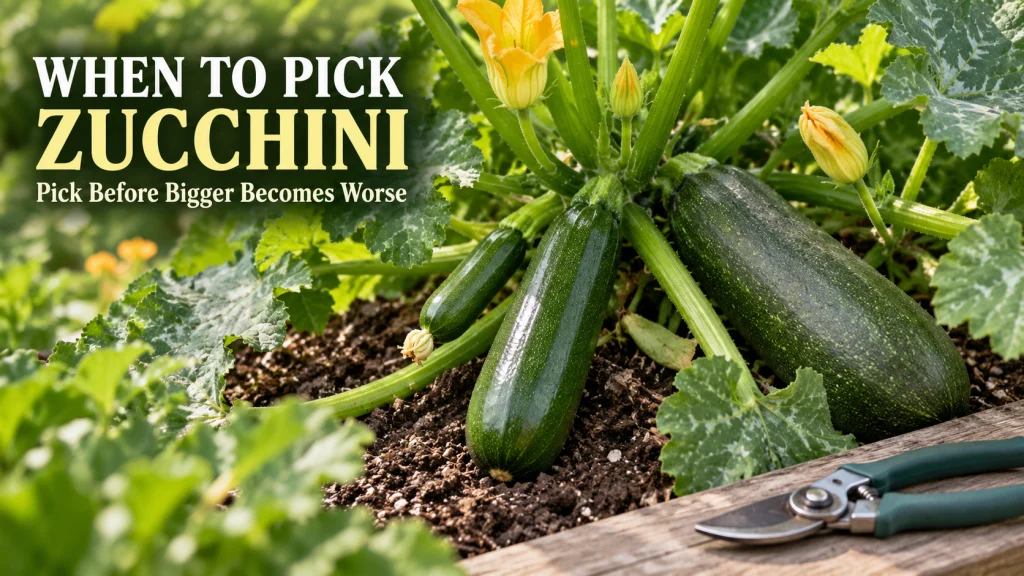
Zucchini is usually best harvested for eating quality before the fruit reaches its maximum possible size. For many common elongated types, a medium fruit is a useful starting target, but skin texture, seed development, cultivar, and the way you plan to use it matter more than one universal length. Once a plant starts producing heavily, frequent checks keep fruit from slipping into the stage with hard skin and large seeds. The goal is to choose the size you actually want in the kitchen, recognize signs that a fruit is moving past it, and cut it from the vine without rough handling.
Choose the eating size before measuring fruit
A zucchini can move from a useful dinner size to an oversized fruit between picking rounds, which is why the answer to when to pick zucchini should start with eating quality rather than maximum growth. For many common elongated zucchini, Extension guidance often places a high-quality harvest around 6 to 8 inches long and about 2 inches or less in diameter, but that range is a starting point rather than a universal rule for every cultivar. Smaller fruit can be very tender, while slightly larger fruit may still be perfectly useful if the skin and seeds have not become coarse. Bigger is not automatically better just because the plant is capable of making a much larger squash.
Start by deciding what size works for the meals you actually make, then use that preference as your household harvest target. A gardener slicing zucchini into quick meals may prefer smaller, tender fruit, while someone planning to hollow or grate fruit may accept a somewhat larger size before quality drops too far. If you are managing several crops at once, the broader vegetable gardening guide can help keep harvest decisions tied to the needs of each crop instead of one generic calendar. The same approach fits the wider edible gardening process, where harvest quality depends on what you are growing and how you intend to use it.
| Harvest target | What to look for | Practical use |
|---|---|---|
| Smaller tender fruit | Young fruit with tender skin and little seed development | Good when a delicate texture matters more than maximum volume |
| Common kitchen size | For many elongated types, about 6 to 8 inches is a useful reference range | A practical starting target for slicing, sauteing, grilling, or general cooking |
| Moving past eating quality | Skin becoming hard or dull, larger developed seeds, fibrous or watery flesh | Remove from the plant even if it is no longer your preferred table size |
The table is a decision guide, not a grading standard that every zucchini must match. A useful zucchini harvest size is therefore a range you confirm against cultivar shape, personal preference, and the quality you see after cutting the fruit. When size and quality cues disagree, favor the texture and seed development that match your intended use rather than forcing the fruit to reach a number. That keeps the ruler in its proper role as a reference instead of turning it into the whole harvest decision.

This 12-inch stainless steel ruler has etched standard and metric markings, including 1/16-inch graduations, plus a non-slip cork backing. Its length makes it convenient for checking zucchini against a 6-to-8-inch harvest reference while keeping measurement secondary to texture and seed maturity. The flexible, bend-resistant construction also handles routine measuring on flat or gently curved surfaces.
Check On AmazonIf you click this link and buy, we earn a commission at no additional cost to you.
Use skin and seed development to recognize overmaturity
Size is easy to see, but overmaturity is really a change in the fruit itself. University guidance describes lower quality summer squash as fruit that has moved away from the tender, glossy stage toward harder skin, more developed seeds, and flesh that can become fibrous or watery. Those changes matter because zucchini is normally eaten as an immature summer squash, so waiting for maximum botanical maturity works against the texture most people are trying to harvest. A fruit can therefore be larger than your preferred size without being useless, yet still be clearly past the stage you would choose for tender everyday cooking.
Watch the trend across several harvests instead of trying to make one outside cue do all the work. If fruit from a certain size range is beginning to show tougher skin or noticeably larger seeds when cut, move your next harvest slightly earlier on that plant or cultivar. If smaller fruit is still very tender and useful, there is no need to leave it on the vine simply to hit a target length. The practical distinction is between personal size preference and biological overmaturity, and learning that distinction is more useful than memorizing one number.
Key point: Treat skin and seed development as the quality check that confirms whether your chosen size is still working. A bright, tender fruit with immature seeds is still in the eating stage you are trying to capture, while hard skin and heavily developed seeds show that the fruit has moved farther along. Because you cannot judge every internal seed change from the outside with certainty, use what you learn when you cut harvested fruit to fine-tune the next picking round. That feedback makes your own harvest target more accurate without pretending every cultivar matures at the same exact size.

This 3.25-inch paring knife uses a straight-edge spear-point blade and an ergonomic non-slip black handle. Its compact blade is suited to controlled fruit and vegetable prep, making it useful for cutting harvested zucchini open to inspect seeds and flesh texture. The knife is NSF approved and dishwasher safe for straightforward kitchen cleanup.
Check On AmazonIf you click this link and buy, we earn a commission at no additional cost to you.
Check plants frequently once production starts
Once zucchini begins setting fruit steadily, inspection frequency becomes part of harvest quality. Summer squash develops rapidly, and Extension guidance commonly recommends going over producing plants every day or two, with especially frequent checks when growing conditions are pushing fast fruit growth. That does not mean every plant must be harvested on a rigid schedule, because weather, plant vigor, cultivar, and the size you prefer can all change the interval. It means the plant should be checked often enough that you are making a choice rather than discovering a missed fruit only after it has become hard and oversized.
Make the check deliberate because zucchini can hide under broad leaves and near the crown. Look beneath foliage, scan both sides of the plant, and compare small developing fruit with the size you want for the next meal or two. A quick visual pass from above is more likely to miss fruit that is tucked under petioles, which is how one zucchini can seem to appear enormous without warning. Frequent inspection is therefore less about chasing a perfect day count and more about shortening the time between noticing a fruit and deciding whether it has reached your preferred stage.
- When fruit is still clearly below your preferred eating size, leave it and check again soon.
- When fruit has reached your preferred size and still has tender quality cues, harvest it.
- When several fruit are sizing quickly, shorten the interval between plant checks.
- When a fruit is already oversized, remove it rather than waiting for it to become even more mature.
The useful routine is a four-part check rather than a calendar rule: start with your preferred eating size, confirm the skin still feels tender, use seed development from recently cut fruit as feedback, then set the next inspection interval from how fast the plant is moving through those stages. During active production, that may mean checking very frequently, while slower growth lets you stretch the interval without abandoning the routine. If fruit repeatedly grows larger than you wanted before you notice it, shorten the inspection interval instead of redefining oversized fruit as the new ideal. This keeps size, skin, seeds, and inspection timing working as one decision system rather than four disconnected tips.

This green Hutzler garden colander combines a harvest basket with a perforated strainer. The open design lets loose soil fall away while you gather vegetables, and it can be used to rinse the harvest with a hose or in the kitchen sink. A flat bottom helps prevent tipping, while comfortable handles and dishwasher-safe construction simplify repeated picking rounds.
Check On AmazonIf you click this link and buy, we earn a commission at no additional cost to you.
Remove oversized fruit even when you will not eat it
Finding an oversized zucchini does not mean the plant has failed, and it does not mean you should leave the fruit in place. Extension guidance specifically recommends removing fruit that has become very large because allowing it to continue maturing can reduce continued production of young fruit. That makes removal a plant management decision as well as a kitchen decision. Even if the skin is too hard or the seed development is beyond what you want to eat, taking the fruit off keeps the plant from investing further in a harvest you have already decided not to use.
What you do with that fruit afterward depends on its actual condition and your household use, but that does not change the harvest decision: once it is beyond the eating quality you want, remove it from the plant. A somewhat larger fruit may still be usable after trimming or seeding, while a very hard, coarse fruit may simply be better discarded or composted where appropriate. The important point is not to treat oversized specimens as the standard you should aim for on the next picking round. Use them as a signal that your inspection interval or preferred size target needs a small adjustment.

This 1.75-gallon compost bin has a smooth interior, a stay-open lid, and a handle for moving food scraps. Its lid is designed to contain odors while allowing airflow, and the bag-concealing design keeps liners tucked inside. It gives home gardeners a tidy place to collect suitable zucchini trimmings before transferring compostable scraps to an outdoor compost system.
Check On AmazonIf you click this link and buy, we earn a commission at no additional cost to you.
Harvest without wrenching the vine
Once a fruit is ready, remove it with a clean cut instead of pulling hard or wrenching it away from the plant. Summer squash stems can be firm, and rough twisting can disturb the vine or damage nearby growth, so a clean knife or hand pruners gives you better control. Leave a short piece of stem attached to the fruit rather than cutting into the fruit body. Support the zucchini with one hand while cutting with the other so its weight does not tear the stem as it comes free.
Handle the fruit gently after cutting because zucchini skin can scratch and puncture more easily than its size suggests. If foliage is dense, move leaves only as much as needed to see the stem clearly instead of yanking the fruit through the canopy. Avoid treating harvest as a strength test, especially around new roots or branching points that can be disturbed by rough handling. A clean cut, a supported fruit, and a quick look for the next developing zucchini are enough to finish the job without making the plant pay for the harvest.

These 6-inch pruning snips come as a two-pack with non-stick steel blades, Easy Action springs, and SoftGrip handles. Their compact size and spring-assisted action provide control for clean cuts on small green stems instead of twisting produce from the plant. The non-stick blade treatment is designed to reduce gumming during repeated garden use.
Check On AmazonIf you click this link and buy, we earn a commission at no additional cost to you.
Final Thoughts: pick for eating quality before size takes over
The best zucchini harvest target is the size and maturity stage that gives your household the texture you actually want, not the largest fruit the plant can produce. Use the familiar 6 to 8 inch range for many elongated types as a practical reference, then confirm it against tenderness, seed development, cultivar shape, and your intended use. Once production is active, check often enough that fruit does not repeatedly pass your preferred stage unnoticed. If a zucchini does get away from you, remove it and use that miss to tighten the next inspection round.
That approach keeps the decision grounded in the plant instead of a rigid number. Smaller fruit can be harvested early, medium fruit often gives a useful balance of size and tenderness, and oversized fruit should not become the standard simply because it contains more volume. Cut ready fruit cleanly from the vine, handle it gently, and keep watching the plant for what is developing next. The routine is simple: choose your eating target, verify quality cues, check frequently, and harvest before bigger becomes worse.

This six-pair set uses breathable polyester liners with textured latex-coated palms for grip in yard and garden work. The medium red-and-green gloves are flexible for routine picking and tool handling, and their bright colors make them easier to spot outdoors. They are machine washable, which simplifies cleanup after regular harvest rounds.
Check On AmazonIf you click this link and buy, we earn a commission at no additional cost to you.
FAQs
🥒 When is zucchini ready to pick?
For many common elongated varieties, about 6 to 8 inches is a useful harvest reference, but it is not a universal requirement. Pick earlier if you prefer smaller tender fruit, and use skin and seed development to confirm that larger fruit has not moved past your preferred quality.
🌱 Can I pick zucchini when it is still small?
Yes. Young zucchini can be harvested at a smaller size when you want a tender texture, and there is no need to leave a usable fruit on the plant just to reach one fixed length.
🔎 How can I tell if zucchini is overmature?
Harder skin, larger developed seeds, and flesh that becomes fibrous or watery are stronger warning signs than length alone. If fruit at your usual size is showing those changes, shift your future harvest a little earlier.
🧺 How often should I check zucchini plants for harvest?
During active production, checking every day or two is a useful starting routine because summer squash can enlarge quickly. Adjust the interval to your growing conditions and shorten it if fruit repeatedly grows past the size you want between checks.
✂️ Should I cut or twist zucchini off the plant?
Cutting is the more controlled approach. Use a clean sharp knife or hand pruners, support the fruit, and leave a short stem attached instead of pulling hard on the vine.
🌿 Should I remove a zucchini that has grown too large?
Yes. Remove oversized fruit even if you no longer want to eat it, because leaving very large fruit on the plant can reduce continued production of younger squash.
References and Sources
- University of Minnesota Extension summer squash guidance: Supports harvesting by preferred size before hard skin, large seeds, and poor flesh quality develop, plus removing very large fruit from the vine.
- Utah State University Extension harvest and handling guidance: Supports tender glossy harvest cues, frequent picking, common zucchini size guidance, leaving a short stem, and cutting rather than twisting fruit from the vine.
- Illinois Extension summer squash guidance: Supports the common 6 to 8 inch reference for elongated summer squash, frequent plant checks, and removal of large hard seedy fruit.