Raised bed gardening works best when the bed is chosen from the site upward, not from a catalog size downward. The ground below the frame, the distance you can comfortably reach, the crops you plan to grow, and the amount of soil you need all change what a sensible bed looks like. An open-bottom bed over usable soil can provide more rootable depth than its walls suggest, while the same frame on concrete behaves much more like a contained growing system. The practical goal is to settle the site connection, dimensions, fill burden, and frame requirements before deciding whether to build or buy.
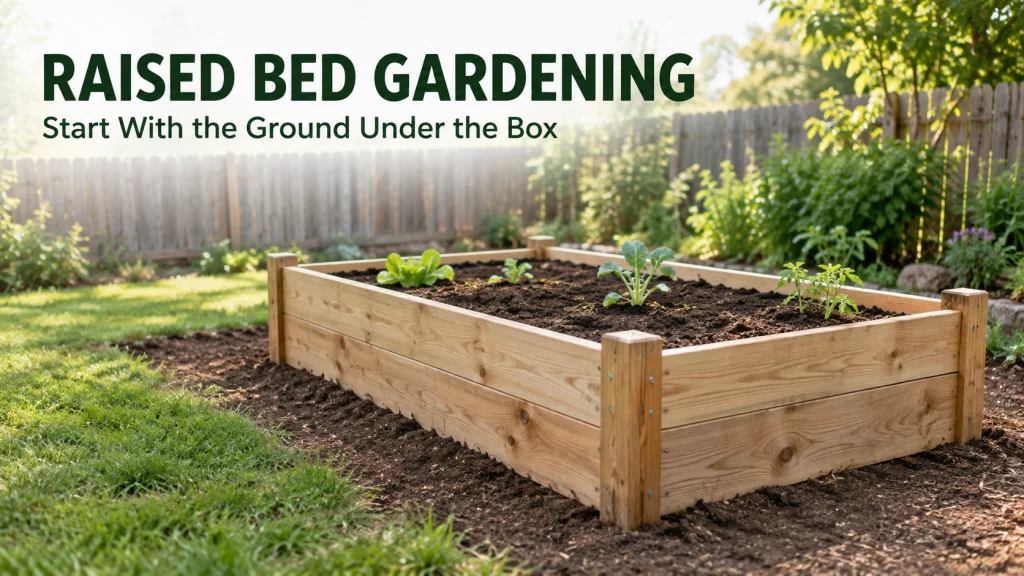
A raised bed is defined by more than wall height
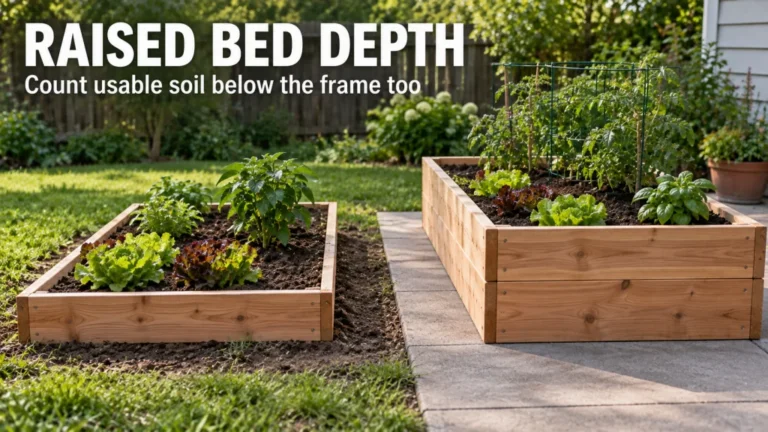
A raised bed with twelve-inch walls can behave very differently depending on what sits under it. Put that frame over healthy, loosened soil and roots may continue below the visible bed; put it over concrete and every usable inch of root zone has to come from the material inside the frame. That difference changes depth, water storage, fill volume, and sometimes the crop choices that make sense. In other words, raised bed gardening starts with the ground connection before it starts with lumber, metal panels, or a kit.
The same logic applies to width and height. A bed that looks generous on a product page may be awkward if you cannot reach the center without stepping into the soil, while a very tall bed may solve bending concerns but create a much larger soil bill. Before choosing a particular shape, treat the bed as one part of the broader raised beds and container gardening setup, then narrow the decision to the conditions in your yard. For practical gardening in raised beds, the useful question is not how big a bed should be in general, but what dimensions and construction actually solve the problem that made you consider one.

This 5-foot oval raised bed uses galvanized metal and an open-bottom frame. It is made with GRS-certified recycled material and is intended for vegetables, flowers, and herbs. The open base makes it a useful physical example when comparing visible wall height with the soil that remains available underneath.
Check On AmazonIf you click this link and buy, we earn a commission at no additional cost to you.
Confirm why a raised bed is being used instead of in-ground soil
Raised garden beds should solve a real site or access constraint. Common reasons include compacted ground, poor drainage, a need to keep the growing area clearly separated from foot traffic, or a desire to bring the soil surface to a more comfortable working height. It can also make sense when the usable planting footprint is small and you want a defined area that is easier to amend and maintain. If the existing soil is already workable, drains adequately, and fits the way you garden, adding a frame may create cost and maintenance without solving much.
This is where the decision should stay practical rather than aspirational. A frame does not automatically make soil better, and a taller frame does not automatically make the garden more productive. It simply changes the physical system you have to fill, water, access, and eventually maintain or replace. If the main problem is actually sunlight, crop placement, path access, or how much space to devote to food crops, those are broader garden planning decisions that should be settled before a raised bed is sized around them.
- Use a raised bed when it solves a defined soil, drainage, access, or space problem.
- Skip extra height when it only adds fill volume without improving access or root conditions.
- Keep the planting area reachable from the paths so the soil does not become a walkway.
- Treat hard surfaces, usable ground, and questionable ground as different starting conditions.
Once the reason is clear, the rest of the design becomes easier to judge. The next step is to look beneath the future bed and decide whether the soil below is part of the root zone or whether the bed must function on its own.

This large kneeling pad measures 17.5 by 11 by 1.5 inches and uses soft NBR foam. It is intended for gardening and other tasks that put the knees close to a hard surface. It gives readers an access-oriented tool to compare with raising the soil surface simply to reduce kneeling.
Check On AmazonIf you click this link and buy, we earn a commission at no additional cost to you.
Check what sits below the bed before choosing depth
Start by classifying the surface under the future bed. Usable garden soil lets an open-bottom bed function as an extension of the ground, while concrete, pavement, compacted subsoil, or questionable fill can change drainage, rooting, and preparation needs. University of Maryland Extension notes that roots can grow from raised-bed soil into the soil below when the bed sits on the ground. The first decision is therefore not how tall the frame looks, but whether the soil beneath it can participate in the growing system.
That check also tells you what needs to happen before the frame is filled. Ordinary lawn or weeds may need removal or suppression, compacted soil may need loosening when appropriate, and a hard surface has to be treated as a contained root-zone case. If the underlying ground is questionable because of contamination or another site-specific hazard, ordinary bed-preparation advice is not enough. Resolve the ground condition first, then use the next design decisions to set width, usable soil depth, and fill volume.

This battery-free soil moisture meter gives an instant reading through a single 304 stainless steel probe. The display is designed to be clear and easy to read for indoor or outdoor soil checks. It is useful for checking moisture conditions in existing ground before assuming a raised bed alone will solve a drainage or watering problem.
Check On AmazonIf you click this link and buy, we earn a commission at no additional cost to you.
Choose overall size from reach, paths, and the crop plan
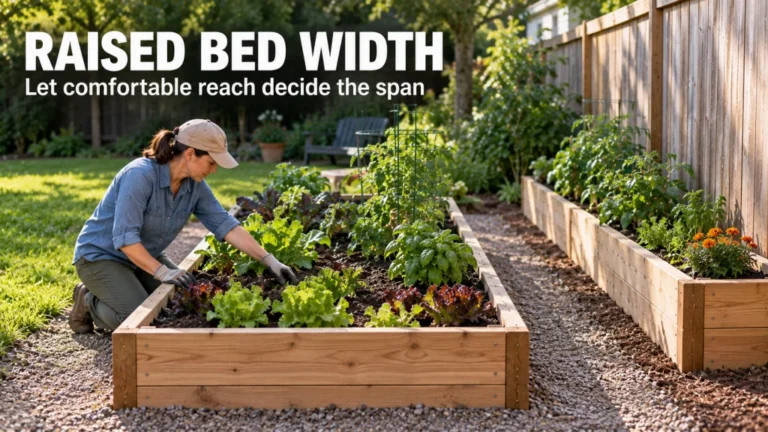
Raised-bed width is first an access decision. Several Extension sources use about four feet as a common upper width when a bed can be reached from both long sides, because the gardener can work toward the center without stepping into the planting area. That does not mean four feet is automatically right for every person or site. A shorter reach, a bed against a wall, limited mobility, or a desire to work comfortably while seated can justify a narrower layout.
Length is usually more flexible, but it still affects movement around the garden. A very long bed can save framing material at shared ends, yet it can also force a long walk around the structure every time you need to cross the space. Leave enough path width for the way you actually carry tools, move soil, kneel, or use a cart, rather than sizing the bed first and accepting whatever path remains. Crop layout matters too, but crop-specific spacing belongs with the crop plan rather than becoming a reason to force one standard raised-bed size.
| Decision | What to check first | What changes the answer |
|---|---|---|
| Width | Comfortable reach from accessible sides | One-sided access, mobility, bed height, working position |
| Length | Path circulation and available footprint | Need to cross the space, frame support, yard shape |
| Wall height | Access goal and ground connection | Usable soil below, bending comfort, fill burden |
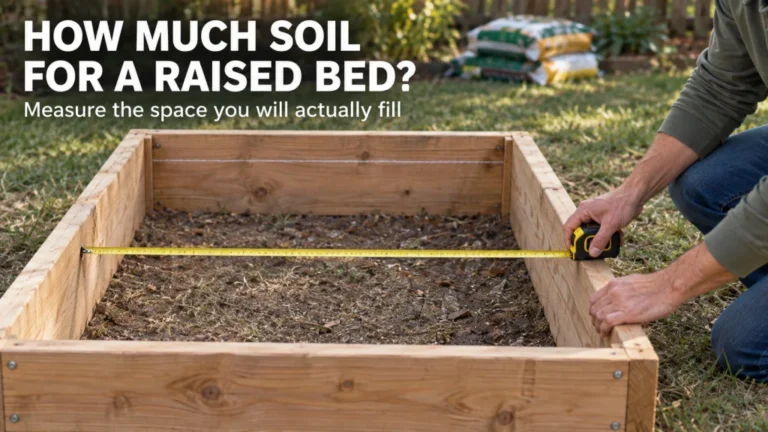
| Fill volume | Inside dimensions, not marketing footprint | Actual soil depth, frame thickness, settling allowance |
Use the table as a sequence rather than four separate shopping questions. Reach and path access set the footprint, the ground below helps set useful depth, and only then does the fill calculation become meaningful.

This 25-foot tape measure has fraction markings and a retractable self-locking blade. Its length is practical for checking a raised-bed footprint together with surrounding path space. The self-locking blade helps hold a dimension while bed width, length, and access clearance are being compared.
Check On AmazonIf you click this link and buy, we earn a commission at no additional cost to you.
Separate wall height from total rootable depth
Once the ground condition is known, set depth from the continuous soil profile the crop can actually use. The frame height matters for access, fill volume, and how much soil is held above grade, but it is not a complete measure of rooting space. On usable ground, the bed fill and the soil below may form one continuous profile. On a hard surface, all usable rooting depth has to be provided inside the bed.
Crop requirements still control how much depth is enough. Shallow-rooted crops and deeper-rooted crops do not place the same demand on a contained bed, and water storage becomes more important when roots cannot explore soil below the frame. This is where a taller bed may be justified, but only because it adds needed soil volume or improves access. Extra wall height that serves neither purpose simply increases fill cost and future maintenance.

This 36-inch stainless steel soil probe is designed for collecting core samples from lawns, gardens, and planting areas. The T-handle and foot pedal provide leverage when pushing the probe into workable soil. It also includes reusable sample bags for holding collected soil before testing.
Check On AmazonIf you click this link and buy, we earn a commission at no additional cost to you.
Calculate fill volume before buying soil
Fill cost is one of the easiest raised-bed expenses to underestimate because outside dimensions look smaller than the volume they create. Calculate from the usable inside length, inside width, and actual fill depth, then convert that volume to the units used by the soil supplier. A bed that becomes only a little taller can require a large amount of additional material across the full footprint. That extra fill may be worthwhile for access or for a hard-surface root zone, but it should be a deliberate cost rather than a surprise after the frame is assembled.
Also decide what portion of the stated wall height will really be filled. Leaving room for mulch, irrigation hardware, or normal settling can reduce the final soil depth compared with the frame height. Avoid counting logs, gravel, or random bulky material as free volume unless there is a defined horticultural reason for using it, because a filler that changes water movement or decomposes unpredictably can create a different problem. The safest budgeting habit is to calculate the growing medium first, then change the design if the volume is more than the site, budget, or workload can support.

This garden cart has a 4-cubic-foot poly bed and a 600-pound rated capacity. It uses pneumatic tires and a quick-release dumping mechanism for moving yard and garden materials. After soil volume is calculated, the cart provides a practical way to move bags or loose growing medium around the site.
Check On AmazonIf you click this link and buy, we earn a commission at no additional cost to you.
Choose frame material from cost, service conditions, and maintenance
The frame’s job is to hold the growing medium in the shape you need for long enough to justify the cost and effort. Wood is easy to cut and customize, metal systems can provide thin walls and modular shapes, and masonry or block systems can be durable but heavy. None of those categories is automatically best because local moisture, sun exposure, soil contact, available tools, and willingness to repair or replace parts change the trade-off. Start with the dimensions and site conditions, then compare materials that can meet them.
Material safety claims deserve more care than broad internet rules. Extension guidance distinguishes among untreated wood, naturally decay-resistant species, modern pressure-treated lumber, masonry, and other frame materials, but the exact treatment or product still matters when a claim depends on chemistry or intended use. Do not rely on color, age, or a seller’s general label to identify what a piece of reclaimed lumber contains. If the material history is uncertain, especially with old treated timbers or industrial salvage, choose a material with documentation you can actually verify.
Decide whether the base needs vegetation removal, a barrier, or nothing extra
There is no universal bottom layer that every raised bed needs. On ordinary ground, the first job is to identify what is already growing in the footprint and whether it is likely to push back through the new bed. Existing sod or annual weeds may be handled differently from persistent perennial weeds, and a bed built over clean garden soil may need very little intervention. The base treatment should solve a specific problem rather than become a ritual of cardboard, landscape fabric, rocks, and gravel.
Iowa State and Maryland both emphasize preparing the existing ground so the new bed connects well with the soil below, including loosening or working the underlying soil when appropriate. That connection matters because distinct layers can interfere with water movement and root growth. A permeable separation layer can have a purpose in some situations, but an impermeable sheet under an open-bottom bed changes the system by blocking drainage and roots. If the concern is contamination or another site-specific hazard, stop treating the question as ordinary bed prep and follow authoritative guidance for that exact condition.

This 62-inch garden hoe combines a stirrup-style hula hoe with a cultivator and rake function. The adjustable long handle is intended for weeding, loosening soil, and pulling weeds. It fits base-preparation work when the actual problem is existing vegetation rather than a blanket need for fabric or gravel.
Check On AmazonIf you click this link and buy, we earn a commission at no additional cost to you.
Treat concrete and other hard surfaces as a different root-zone case
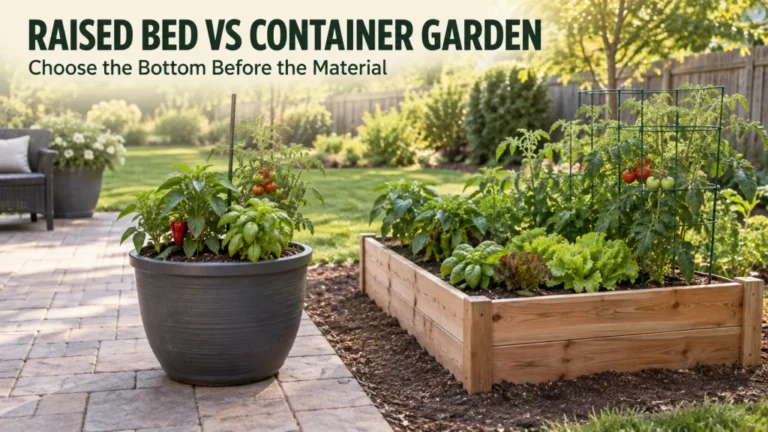
A raised bed garden on concrete is not just an ordinary raised bed with a different floor. The hard surface removes the connection to native soil, so the bed has to supply all rootable depth and most of the water buffer inside the frame. University of Maryland Extension also notes that beds on pavement can dry more quickly and may experience extra heat from surrounding hard surfaces. That makes crop choice, depth, drainage, and watering routine more important than they are in a shallow open-bottom bed over usable ground.
Before placing a large volume of wet soil on any patio, deck, roof, or elevated structure, separate simple ground-level pavement from a structure that has load limits. This article does not cover structural deck loading, retaining walls, or engineered rooftop planters. On ordinary ground-level concrete, make sure excess water has a real route out of the bed and away from nearby structures instead of assuming a bottom layer of gravel will solve drainage. If the site cannot provide adequate depth, drainage, or safe support, a different growing system may be more appropriate than forcing a raised-bed frame into the space.

This 12.7-gallon raised planter is a contained outdoor herb and garden bed rather than an open-bottom frame. It includes a self-watering gauge and a drainage plug. Those features make it relevant to hard-surface sites where the growing medium and drainage must be managed inside the planter.
Check On AmazonIf you click this link and buy, we earn a commission at no additional cost to you.
Compare a kit with DIY only after size and material are known
A kit is easiest to compare with a DIY frame after the bed requirements are already fixed. If you know the usable inside dimensions, desired wall height, material family, access needs, and site conditions, you can compare whether a packaged system actually matches them. Without those requirements, a kit can look convenient simply because it arrives as one purchase, while a DIY plan can look cheaper because hardware, tools, delivery, finishing, and replacement parts have not been counted. The meaningful comparison is the entire build path, not the price printed on the box or lumber list.
DIY makes sense when customization matters and you have the tools and tolerance for measuring, cutting, fastening, leveling, and future repairs. A kit can make sense when standardized parts, predictable assembly, and fewer sourcing decisions reduce the setup burden. Neither route deserves a universal recommendation because site fit comes first. If a kit forces the wrong width, depth, or material for the yard, convenience at assembly time is not enough to make it the better bed.
- Confirm inside dimensions and actual soil depth.
- Check whether all required hardware and supports are included.
- Account for tools, delivery, replacement parts, and future maintenance.
- Reject a kit or DIY plan that creates an access problem just to match a common size.
Use this checklist after the site and dimensions are settled, not before. It keeps the buying decision tied to the garden requirement instead of letting the available product format define the garden.

This 20V MAX drill-driver set uses a brushless 1/2-inch two-speed drill. It includes a 2.0 Ah battery, charger, and LED light. It is relevant to DIY raised-bed assembly when the chosen frame requires drilling or driving fasteners, while a complete kit may reduce the need for separate tools.
Check On AmazonIf you click this link and buy, we earn a commission at no additional cost to you.
Route planting, soil, and watering questions to the decision that owns them
Once the physical bed is chosen, several questions remain, but they should not all be answered by the frame. Crop spacing belongs with the plants you intend to grow, soil recipes and fertility belong with the growing medium and soil condition, and irrigation design depends on climate, crop demand, bed size, and the way the medium dries. Keeping those decisions separate prevents a general raised-bed article from turning one setup into a universal recipe. It also makes later adjustments easier because you can change the soil, planting plan, or watering method without pretending the frame itself was wrong.
The raised bed should therefore be treated as the physical boundary of the growing space, not as the answer to every gardening question inside it. Set the ground connection, reach, rootable depth, fill volume, and frame first. Then use crop-specific and condition-specific guidance for what happens inside the bed. That sequence keeps the expensive and difficult-to-change choices separate from the seasonal choices you may revise from one planting to the next.

This weighted oscillating sprinkler uses 16 precision nozzles and an adjustable watering range. It is rated to cover up to 3,600 square feet and includes a quick-connect bundle with stainless steel filters. It belongs with the watering decision rather than the frame decision, matching the article separation of irrigation from bed construction.
Check On AmazonIf you click this link and buy, we earn a commission at no additional cost to you.
Final Thoughts: let the ground connection control the raised-bed design
Make the site do the first round of filtering before you buy a frame. Confirm what sits below the bed, how far you can comfortably reach, how much usable soil the planned crops need, and how much growing medium the finished dimensions will require. Those checks narrow the design faster than starting with a popular size or a catalog photo. They also keep access, soil volume, and cost tied to a real garden condition.
From there, choose a frame material and build path that fit the site rather than chasing a standard size or a universal recommendation. A raised bed should make the garden easier to use, not create a new burden of soil, watering, access, or replacement work. If a simpler in-ground or container setup solves the same constraint, that is a valid outcome too. The right design is the one whose dimensions, ground condition, and maintenance demands match the way the space will actually be used.

This foldable garden kneeler combines a padded kneeling surface with a seat. It has a thickened, widened soft pad and two tool pouches. The two working positions make it relevant to the final access check because a raised-bed design should match how the gardener actually works around the bed.
Check On AmazonIf you click this link and buy, we earn a commission at no additional cost to you.
Explore the raised-bed decisions that come next
The physical setup becomes much easier to refine when each unresolved question is handled on its own. Use the comparisons below after you know what the site is asking the bed to do, whether that means replacing unusable ground, improving access, working on a hard surface, or simply defining a manageable growing area. Each article takes one decision deeper without turning the rest of the raised-bed system into a one-size-fits-all rule. That keeps material, size, depth, base, and buying questions from getting mixed together.
| Topic | What you’ll find |
|---|---|
| Raised bed vs in-ground garden | Decide whether the site needs a framed bed at all before paying for extra control. |
| Raised bed vs container garden | Compare an open-bottom root zone with a fully contained and potentially movable system. |
| What size raised bed do I need? | Set the footprint from reach, root space, and the amount of soil the bed will require. |
| How deep should a raised garden bed be? | Separate visible wall height from the full depth roots can actually use. |
| How wide should a raised garden bed be? | Use real reach and accessible sides instead of default lumber dimensions. |
| How much soil does a raised bed need? | Calculate fill volume from inside dimensions before buying bags or ordering bulk soil. |
| Raised bed materials | Compare frame families by service conditions, maintenance, documentation, and replacement burden. |
| Wood vs metal raised beds | Compare the two common frame choices after size and site requirements are already known. |
| Pressure-treated wood for raised beds | Judge treated lumber from the documented treatment rather than from a generic warning or assumption. |
| What to put on the bottom of a raised garden bed | Choose a bottom treatment only when it solves a defined vegetation, pest, or separation problem. |
| Should I line my raised garden bed? | Separate side lining, bottom separation, drainage, and material-contact purposes. |
| Raised beds on concrete | Plan a contained root zone where the ground cannot provide extra depth or water buffering. |
| Raised beds on grass | Prepare lawn and persistent vegetation without adding unnecessary bottom layers. |
| Raised bed kit vs DIY | Compare the full build path after dimensions and frame material have already been fixed. |
Do not try to solve every row at once. Start with the decision that can invalidate the others, usually whether the bed is needed, what sits below it, and whether the footprint is reachable. Then move through depth, fill, material, and build path in that order. That sequence reduces rework and keeps the permanent parts of the setup tied to conditions that are unlikely to change midseason.
Frequently asked questions
🌱 How deep should a raised bed be if there is good soil underneath?
Do not judge the bed from wall height alone. In an open-bottom bed over healthy, loosened soil, roots can continue below the added fill, so the usable root zone may be deeper than the frame.
📏 Is four feet always the best raised-bed width?
No. Four feet is a common width when both long sides are accessible, but your comfortable reach, mobility, bed height, and one-sided access can make a narrower bed more practical.
🧱 Can I put a raised bed directly on concrete?
Yes, but treat it as a contained root zone. The bed needs crop-appropriate depth, reliable drainage, and closer attention to moisture because roots cannot use soil below the pavement.
🌿 Do I need landscape fabric under every raised bed?
No. A bottom layer should have a specific job, such as separation for a documented site condition; an open-bottom bed over ordinary usable soil often benefits from maintaining soil and drainage connection rather than adding an unnecessary barrier.
🪵 Is wood or metal better for a raised bed?
Neither is universally better. Compare cost, dimensions, local exposure, maintenance, repairability, and verified material details after you know what the bed must do.
🛠️ Is a raised-bed kit easier than building one yourself?
It can reduce sourcing and assembly decisions, but convenience only matters if the kit fits the required width, depth, material, and site. Compare the whole build, including tools, hardware, delivery, and future replacement parts.
References and Sources
- University of Maryland Extension: supports the distinction between open-bottom beds over soil and raised beds on hard surfaces, including crop-dependent depth and moisture considerations.
- University of Delaware Cooperative Extension: supports access-based width guidance, material considerations, site preparation, and barrier guidance for specific ground conditions.
- Iowa State University Extension and Outreach: supports ground preparation, integration of new fill with existing soil, wall stability, and drainage-focused construction guidance.