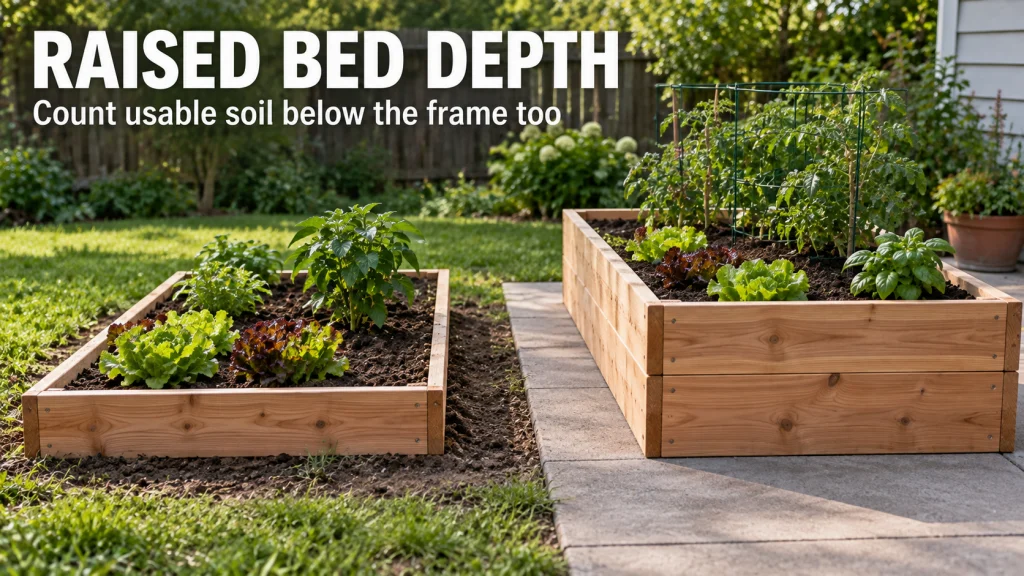
Raised bed depth is not just the height of the frame. An open-bottom bed over healthy, loosened soil may give roots usable space below the boards, while a bed on concrete or another hard surface must provide its full root zone inside the bed. Crop needs, the condition of the soil underneath, room left for mulch, and the amount of fill all change the practical answer. The goal is enough usable rooting depth without paying for wall height and soil volume that the site does not require.
Wall height is not the same as usable root depth
How deep should a raised garden bed be depends less on the boards you can see than on the total depth roots can actually use. A 10-inch open-bottom bed over deep, workable soil can offer roots more room than its wall height suggests. A 20-inch bed on concrete, by contrast, has a firm lower limit because roots cannot continue into garden soil below. That difference is why a single depth number is a poor starting point for every yard.
Think of the frame as one part of the root zone, not automatically the whole root zone. The broader decisions around siting, access, drainage, and layout belong with practical raised bed gardening planning, while this page stays focused on vertical growing space. Wall height can still matter for comfort and access, but a taller wall does not automatically mean a plant has better rooting conditions. First identify the lower boundary roots will meet, then decide how much contained soil the bed actually needs.

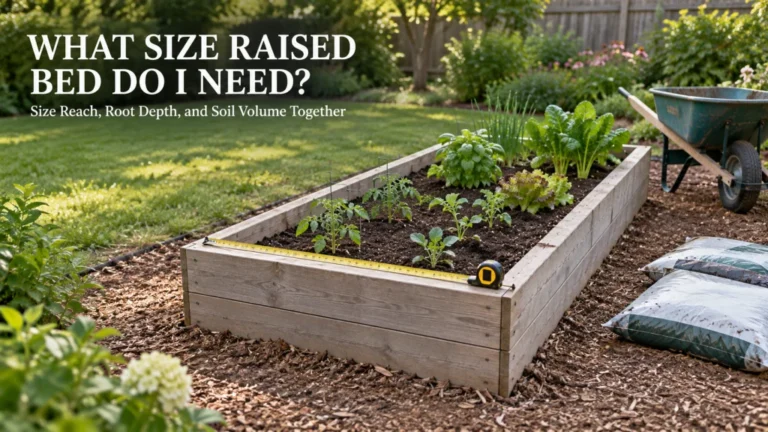
The 25-foot tape uses a self-locking mechanism that holds the blade until the release button is pressed. Its nylon-coated blade and impact-resistant rubberized case are designed for durability. It is useful for separating visible wall height from the dimensions you actually need to measure around a raised bed.
Check On AmazonIf you click this link and buy, we earn a commission at no additional cost to you.
Check whether roots can enter the soil below
An open bottom only helps if the soil underneath is genuinely usable. Healthy garden soil that drains reasonably well and is not severely compacted can become part of the effective rooting profile. Hard, dense, construction-compacted, or poorly drained ground may technically be soil while still acting like a restrictive layer. Before choosing a shallow frame, inspect the site itself instead of assuming that every patch of earth gives roots equal access.
University Extension guidance commonly recommends loosening compacted soil beneath a bed when needed rather than treating the frame as an isolated box. That does not mean digging as deeply as possible or rebuilding the native soil from scratch. It means checking whether roots, air, and water can move into the layer below without immediately meeting a hard barrier. If the answer is yes, the contained soil and the underlying soil can work together as one larger rootable profile.
- Confirm that the bed will have an open bottom if you intend roots to use the soil below.
- Check whether the underlying soil is compacted, waterlogged, rubble-filled, or otherwise restrictive.
- Look at drainage after ordinary watering or rain instead of judging soil only by surface appearance.
- Separate usable soil below the bed from barriers such as pavement, solid liners, or structural surfaces.
| Site condition | Open-bottom bed over usable soil | Bed over a hard surface |
|---|---|---|
| Lower root boundary | Roots may continue below the frame when the native soil is workable and well drained | Roots stop at the base because concrete, pavement, or another hard layer blocks downward growth |
| Meaning of wall height | Wall height is only part of the usable rooting profile | Contained soil depth carries much more of the rooting job |
| Main planning question | How much usable soil exists below the frame? | How much soil must the bed contain for the intended crop? |
The comparison shows why two beds with very different wall heights can still reverse the expected result. An open-bottom frame can use the ground below as part of the root zone, while a bed over a hard surface cannot. That makes the lower boundary the first measurement to settle before choosing contained depth. Once that boundary is clear, record the rest of the profile instead of relying on the frame dimension alone.
| Rootable-profile worksheet | What to record | Why it changes the depth decision |
|---|---|---|
| Contained soil | Measure the actual soil depth inside the frame, excluding empty space above the soil | This is the root zone the bed provides by itself |
| Usable soil below | Note whether roots can enter workable native soil beneath an open bottom | Usable soil below can extend the total rooting profile beyond the boards |
| Lower barrier | Identify concrete, pavement, solid liners, severe compaction, poor drainage, or other restrictions | A real barrier means the bed must provide more of the root zone inside the frame |
| Intended crop | Check crop-specific guidance for the plants you actually plan to grow | Crop needs determine whether the total usable profile is sufficient |
Use the worksheet before choosing frame depth. If the usable soil below or the lower boundary is uncertain, plan conservatively rather than assigning imaginary depth to a layer roots may not use. The worksheet is not a universal sizing chart because crop needs and site conditions still vary. Its job is to make each part of the rootable profile explicit before you compare that profile with the needs of what you intend to grow.

This hand cultivator uses a double-sided design for cultivating, tilling, and breaking up soil. The 91367 model has a steel half-moon blade and an ergonomic T-handle grip. It suits checking and loosening soil below an open-bottom raised bed before treating that layer as usable root space.
Check On AmazonIf you click this link and buy, we earn a commission at no additional cost to you.
Use crop-specific root needs as a check, not a universal chart
Different vegetables do not use soil in exactly the same way, so crop choice still matters after you evaluate the site. Extension guidance gives shallower contained depths for some leafy crops and greater contained depth for larger fruiting plants when beds sit on hard surfaces. Those ranges are useful examples, but they should not be turned into a universal chart that ignores soil below the frame. A crop that can root into healthy ground is in a different situation from the same crop confined above pavement.
Use crop information to answer one practical question: does the total usable profile give this plant enough room for normal rooting and moisture access? For long root crops, also consider the physical quality of the soil where the edible root must develop, because depth without a workable texture is not the same as useful growing space. For larger crops, the important issue is not simply whether the frame reaches a magic number but whether the whole root zone is adequate and can be kept evenly moist. Exact crop requirements belong with crop-specific guidance, especially when variety, climate, or growing season changes the answer.

This heavy-duty steel transplanter is designed for transplanting bulbs, cultivating soil, digging holes, and removing weeds. Serrated edges help cut through roots, remove weeds, and loosen compacted soil. It fits crop-specific planting work without turning one bed-depth number into a universal rule.
Check On AmazonIf you click this link and buy, we earn a commission at no additional cost to you.
Increase contained depth when the base is hard
A hard surface changes the calculation because the bed can no longer borrow root space or moisture from native soil. University of Maryland Extension notes that raised beds on pavement or concrete need enough contained depth for the crops being grown, with shallower guidance for some leafy crops and substantially more depth for crops such as peppers, tomatoes, and squash. The exact choice still depends on what you are growing, but the direction is clear: once the lower surface is impermeable, the soil inside the bed becomes the complete rooting environment. That makes contained depth more important than it is for an open-bottom frame over usable soil.
Hard-surface beds also need closer attention to drainage and moisture because roots cannot move downward into surrounding ground to reach additional water. A deeper profile can provide more growing medium and a larger moisture buffer, but depth does not fix blocked drainage or a poor growing mix. The bed must still let excess water escape safely without creating problems for the surface beneath it. If the site is a patio, paved area, or another non-soil location, treat the lower boundary as real rather than counting space that plants cannot reach.

This two-piece elevated planter set measures 48 by 18 by 30 inches and uses galvanized metal construction. The selected ASIN is the black two-piece variant on the Amazon listing. Its contained planter format is directly relevant when a patio or other hard base prevents roots from extending into native soil.
Check On AmazonIf you click this link and buy, we earn a commission at no additional cost to you.
Leave room for mulch without counting it as root depth
The inside height of a raised bed is not always the same as the depth of planted soil. You may intentionally leave some space below the top edge so irrigation does not wash soil over the sides and so mulch can sit below the rim. That unfilled space is useful, but roots cannot grow through empty air. When you calculate growing depth, measure from the soil surface down to the usable lower boundary, not from the top of the frame.
Mulch should be treated the same way in the calculation. It can help protect the soil surface and reduce moisture loss, but a mulch layer is not a substitute for the soil profile a crop needs. If a nominally 12-inch frame contains less actual growing mix because space is reserved above the soil, the rootable depth is the smaller number. Keeping frame height, soil depth, and mulch depth separate prevents a simple measurement mistake from turning into an undersized root zone.

This heavy-duty steel trowel is made for digging holes, moving soil, cultivating, and planting flowers or bulbs. Its ergonomic handle is designed for comfort during hand work. It is useful when setting the actual soil surface below the bed rim so reserved freeboard remains separate from usable root depth.
Check On AmazonIf you click this link and buy, we earn a commission at no additional cost to you.
See what extra depth does to fill volume and moisture
Every extra inch of contained depth increases the amount of material needed across the entire footprint. For the same bed length and width, doubling the filled depth doubles the calculated fill volume. That can be worthwhile when the base is restrictive or the crop genuinely needs more contained soil, but it is not free capacity. More fill means more material to source, move, settle, water, and maintain over time.
The arithmetic is straightforward: length times width times filled depth gives volume. A 4-by-8-foot bed filled to 10 inches uses about 26.7 cubic feet, while the same footprint filled to 20 inches uses about 53.3 cubic feet. Those numbers are only a volume example, not a recommendation for either depth. The practical point is to calculate the consequence of a depth choice before buying or moving soil.
| Example setup | Contained fill depth | Approximate fill volume | What the number means |
|---|---|---|---|
| 4-by-8-foot bed | 10 inches | 26.7 cubic feet | Lower fill burden if the site still provides enough total usable rooting depth |
| 4-by-8-foot bed | 20 inches | 53.3 cubic feet | Twice the fill volume, which may be justified when roots are fully confined or access goals require a taller bed |
Depth also changes how much growing medium is available to store water, but deeper is not a guarantee of easier watering. Raised beds can dry faster than surrounding ground, and beds on hard surfaces may need especially close moisture monitoring because roots cannot reach soil below. A larger soil volume can increase the buffer between watering events when the mix, drainage, weather, and crop all cooperate. Use depth as one part of moisture planning rather than as a replacement for checking the soil itself.
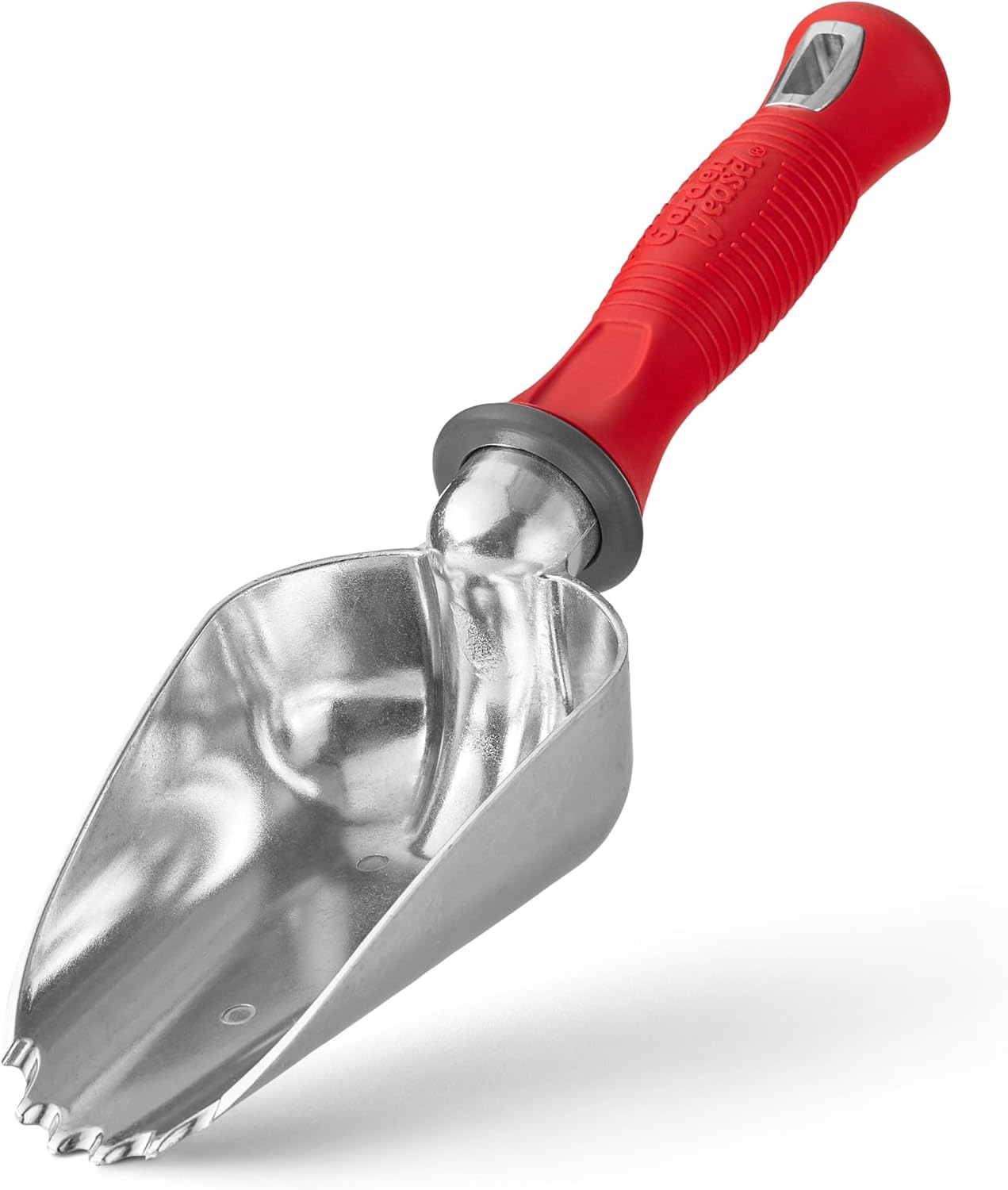
This oversized potting scoop is a heavy-duty steel hand tool for moving soil and potting mix. Its mini-shovel design is intended for garden beds and container planting. It fits the fill-volume section because extra bed depth translates into more soil that must be moved and placed across the footprint.
Check On AmazonIf you click this link and buy, we earn a commission at no additional cost to you.
Avoid the deeper-is-always-better shortcut
A taller bed can be valuable for easier reach, poor native soil, hard surfaces, or a crop that needs more contained rooting space. It can also add fill volume, material cost, weight, and maintenance without improving the root zone enough to matter. The right depth is therefore a fit decision, not a contest to build the tallest frame. Once total usable rooting depth is sufficient, additional wall height should solve another real constraint before it earns its place.
This is also where depth should stay separate from the larger choice of growing space. A raised bed, container, grow bag, or other setup may handle access, drainage, and root confinement differently, so the broader comparison belongs with raised beds and container gardening options. Within a raised bed, start with the lower boundary, then crop needs, then fill and access. That order prevents a convenient-looking frame dimension from becoming the answer before the garden conditions are known.
- Go deeper when the lower surface restricts roots and the crop needs more contained soil.
- Consider extra wall height when easier access is a real priority, but do not confuse that with plant root depth.
- Skip unnecessary depth when open soil below already provides a healthy extension of the root zone.
- Recheck the plan if added depth creates a large fill burden without solving a crop, site, moisture, or access constraint.
A useful final check is to explain what every extra inch is doing. If it adds necessary root space, moisture buffer, or accessible working height, the added depth has a purpose. If the only reason is that a generic chart said deeper is better, revisit the site and crop before committing. Good raised bed depth is enough depth for the conditions, not the largest number available.

These 10-gallon grow bags use 300G thickened nonwoven fabric and reinforced handles. The fabric is designed to drain excess water, while the handles help move bags filled with soil and plants. They give readers a concrete container-style alternative when extra raised-bed depth would add fill without solving the actual site or access constraint.
Check On AmazonIf you click this link and buy, we earn a commission at no additional cost to you.
Final Thoughts: count all usable rooting depth, not only the wall
Choose raised bed depth by starting below the frame. If roots can move into healthy, workable soil, count that usable layer as part of the growing profile instead of assuming the boards must contain everything. If concrete, pavement, severe compaction, or another hard boundary stops roots, provide enough contained soil for the crop inside the bed. Then subtract any space intentionally left above the soil for mulch and clean watering.
After that, run the fill calculation and ask whether extra height solves a real need. The best depth is the one that provides sufficient root space, workable moisture management, and practical access without unnecessary fill. Recheck crop-specific guidance when a plant has unusual rooting needs or when the site creates a clear restriction. That keeps the decision tied to the garden in front of you rather than to a universal number.

This battery-free soil moisture meter uses a single 304 stainless-steel probe and provides an instant dial reading. It is designed for indoor and outdoor soil checks with a clear, easy-to-read display. It supports the article's final moisture check after usable rooting depth, fill, and access have already been considered.
Check On AmazonIf you click this link and buy, we earn a commission at no additional cost to you.
FAQs
🌱 Is 10 inches deep enough for a raised garden bed?
It can be enough when the bed is open-bottomed over healthy soil that roots can enter. On a hard surface, 10 inches may be too little for crops that need a larger contained root zone. Judge the total usable profile, not the frame measurement alone.
🥕 Do root vegetables always need a taller raised bed?
No. They need enough workable soil for the edible root to develop without a restrictive layer. A lower frame over deep, loose soil can provide more useful depth than a taller frame over a hard base.
🧱 How deep should a raised bed be on concrete?
It should contain the full root zone required by the crops because roots cannot continue into soil below. University Extension guidance uses greater contained depths for larger vegetables than for some leafy crops on hard surfaces. Drainage and moisture monitoring also become more important in that setup.
🍂 Does mulch count toward raised bed soil depth?
No. Mulch covers the soil surface but does not replace the growing medium roots need. Measure usable soil depth from the soil surface to the lower rootable boundary.
📏 Is a taller raised bed automatically better?
No. Extra height can improve access or provide necessary contained soil, but it also increases fill volume and weight. Add depth when it solves a crop, site, moisture, or access constraint rather than because taller sounds better.
References and Sources
- University of Maryland Extension: Supports the distinction between raised beds over soil and beds on hard surfaces, including crop-depth examples and moisture considerations.
- Utah State University Extension: Supports open-bottom construction, preparation of soil below shallow beds, and the role of underlying soil in potential rooting depth.
- University of Delaware Cooperative Extension: Supports considering bed depth together with accessibility and site soil conditions.