How wide should a raised garden bed be? Start with the number of sides you can actually work from, then choose a width that keeps the center within comfortable reach without stepping into the growing area. A bed that works from two sides can usually be wider than the same bed placed against a wall or fence, so there is no single ideal raised bed width for every yard. Plant size, bed height, and path access can narrow the practical choice further.
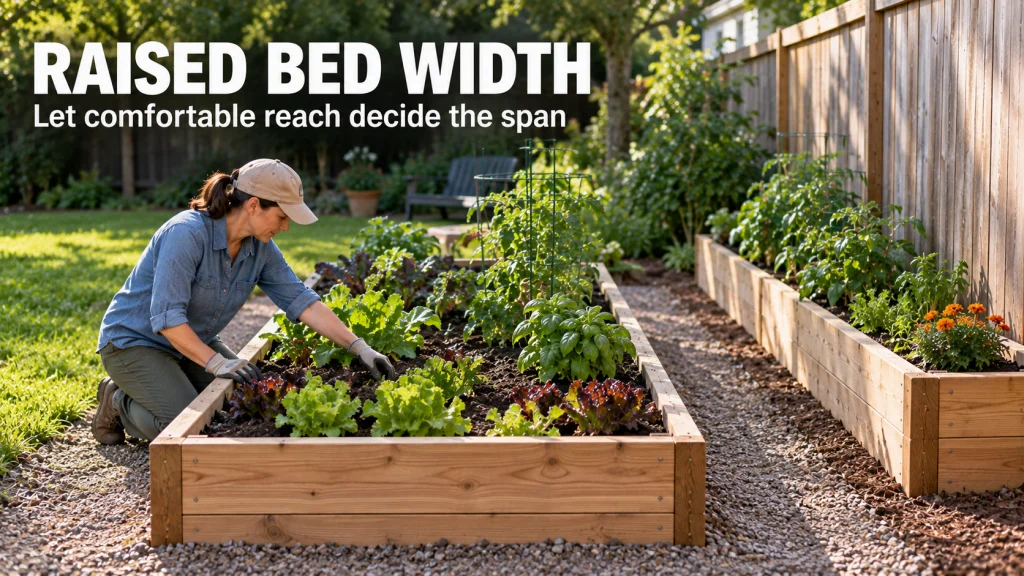
Count accessible sides before choosing width
Put the same four-foot bed in the middle of an open yard and then place it against a fence, and the reach problem changes immediately. In the open location, you can approach the center from both long sides, so each side only has to serve part of the bed. Against the fence, every planting, weeding, watering, and harvesting task must happen from the front edge. That is why raised bed width should start with access rather than with a familiar lumber dimension.
I would treat common measurements as starting points, not as automatic answers. Iowa State University Extension notes that beds accessible from both sides can be about three to four feet wide, while a bed accessible from only one side should be much narrower so everything remains within reach. Before settling on a number, stand where the future path will be and check which sides will remain usable after the frame, fence, plants, and nearby structures are in place. For broader setup decisions beyond width, the site’s raised bed gardening guidance can help keep the bed design tied to how the space will actually be used.

This 25-foot tape measure has fraction markings and a retractable self-locking blade. It gives enough length to lay out a raised bed footprint and compare access from both long sides. Use it to mark the proposed edges before choosing a width or cutting materials.
Check On AmazonIf you click this link and buy, we earn a commission at no additional cost to you.
Use center reach rather than lumber convenience
A four-foot board is convenient to buy and cut, but convenience at the saw does not guarantee convenience in the garden. The useful test is whether the person tending the bed can reach the center repeatedly with a stable stance and without pressing a knee, hand, or forearm into the growing area. Reaching once with fingertips is not the same as being able to transplant, pull a stubborn weed, tie a plant, or harvest for several minutes. A good raised garden bed width should support ordinary repeated work, not a maximum stretch.
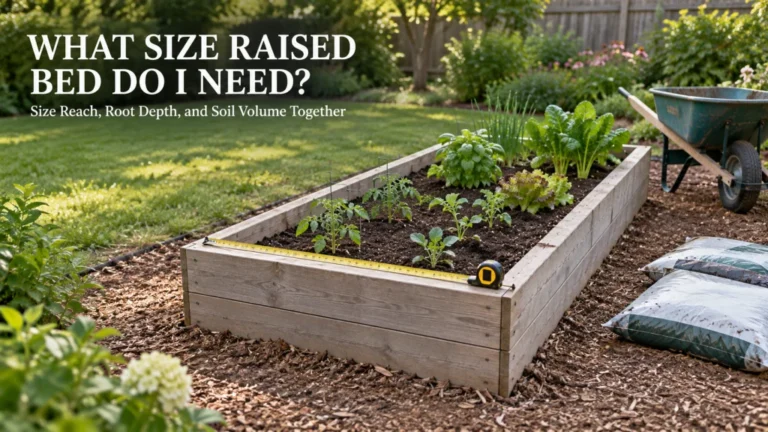
Try the reach test at roughly the height the finished bed will have, because reach can feel different when the planting surface is elevated. Mark the proposed front and back edges with boards, string, or boxes, then mimic a few real tasks at the center line instead of simply touching it. If the motion requires twisting, leaning heavily, or bracing against the frame, reduce the width before buying material or filling the bed. The extra strip of planting area is not useful if routine care turns the middle into the least manageable part of the bed.

This 16-foot retractable tape measure provides both metric and SAE measurements. It can be used to set a trial bed width and check how far the center sits from the working edge. Repeating that measurement at the planned bed height helps keep the reach test tied to the actual layout.
Check On AmazonIf you click this link and buy, we earn a commission at no additional cost to you.
Keep feet out of the growing soil
One practical reason to limit width is to keep routine traffic on the path rather than inside the bed. When the center cannot be reached, the tempting workaround is to step onto the soil for planting, weeding, staking, or harvest. That concentrates weight in the root zone and works against the loose, workable soil structure that raised beds are meant to protect. A narrower bed that can be tended completely from outside is usually more functional than a wider bed that requires occasional shortcuts.
The same rule applies even when the soil looks firm enough to support a footstep. Repeated access matters more than one isolated step, especially in a bed that is watered, amended, and planted throughout the growing season. If a design assumes someone will enter the bed to reach the center, width has already exceeded the access plan. The better correction is to shrink the span, add a legitimate path outside the growing area, or redesign the bed arrangement before the frame becomes difficult to move.
- Can you plant at the center without putting a hand or knee into the soil?
- Can you weed and harvest the center from the path with a stable stance?
- Can you reach the far edge after plants have filled in?
- Can every regular gardener use the same access pattern comfortably?
If any answer is no, treat that as a width problem before treating it as a technique problem. A few inches removed from the frame can prevent years of awkward reaching and unnecessary traffic through the growing area. Recheck the reach after narrowing the outline so the adjustment is based on the actual site rather than guesswork. Once the center is easy to work from the path, the width is doing its job.

This 17.5 by 11-inch kneeling pad uses thick supportive foam and is described as dirt and water resistant. It gives the gardener a dedicated place to kneel beside the bed while planting, weeding, or harvesting. Keeping the pad on the path also reinforces the section's goal of working from outside the growing soil.
Check On AmazonIf you click this link and buy, we earn a commission at no additional cost to you.
Reduce width for wall or fence placement
A bed against a wall, fence, shed, or other fixed boundary loses the second working edge that makes a wider bed practical. Iowa State guidance places one-sided access at roughly one and a half to two feet as a maximum range for ordinary arm reach, while beds worked from both sides can be wider. The exact comfortable distance still varies by gardener and bed height, so the measured reach test should decide the final number. What matters is that the back edge remains a real working area rather than unused square footage.
Do not assume access from the short ends will fully solve a bed that is too wide. The middle portion along a long fence can still be difficult to reach, and tall crops can make that problem worse as the season progresses. If maintenance access behind the bed is needed for the fence or wall itself, that is a separate site constraint and may justify leaving clearance rather than pushing the frame tight to the boundary. The width decision should preserve both garden access and ordinary property maintenance.
| Bed position | Width starting point | What to verify before building |
|---|---|---|
| Both long sides accessible | About 3 to 4 feet | Center can be worked comfortably from either side |
| Only one long side accessible | About 1.5 to 2 feet | Back edge is reachable without bracing or stepping in |
| Mixed or uncertain access | Narrower than the maximum that fits | Fences, gates, plant growth, and maintenance do not remove access later |
Use the table as a first filter, then test the actual space. The goal is not to match a standard number but to keep every part of the bed serviceable from a path. If the proposed width sits at the upper end of a range, test it with the shorter regular gardener rather than the person with the longest reach. A comfortable smaller span is a better fit than a nominal maximum that only one person can manage.

This open-reel fiberglass tape measures up to 100 feet and shows inch and metric scales. Its long range is useful for checking a bed against a fence while also measuring the surrounding clearance and route. The impact-resistant shell and shock-absorbing handle are designed for repeated layout measurements around the yard.
Check On AmazonIf you click this link and buy, we earn a commission at no additional cost to you.
Check that future plant mass does not hide the center
An empty frame can make a reach test feel easier than the planted bed will feel later. Leaves, stems, stakes, cages, and trellises can occupy the space your upper body would otherwise lean across, so the center may become harder to work even when the bare bed seemed manageable. This is especially relevant when larger plants are placed along the edge you depend on for access. Width should leave enough working room for the garden at its fullest, not only for the frame on installation day.
Think through the tasks that will still need center access after plants size up. You may need to check irrigation, remove weeds, harvest lower fruit, add mulch, or reach a support without crushing foliage in front of you. If the planting plan uses dense or tall crops along both sides, a slightly narrower bed can preserve a workable center better than a maximum width. The point is not to predict every stem, but to avoid designing a bed whose access works only while it is empty.

This set includes 70 plastic-coated metal stake sections, 40 connectors, and 30 rotatable clips. The sections can be joined into taller plant supports, letting a gardener plan how future stems and foliage may occupy the bed. Testing support positions before planting helps reveal whether mature plant mass could interfere with center access.
Check On AmazonIf you click this link and buy, we earn a commission at no additional cost to you.
Integrate width with paths only after the bed itself works
Path width matters, but it should not be used to justify a bed that is already too wide to reach. First choose a bed span that works from the sides that will remain accessible, then check whether the surrounding route supports the way you will carry soil, compost, tools, watering equipment, and harvested produce. A narrow path can make even a well-sized bed unpleasant to use if there is no room to stand securely or move a cart. The bed and path need to function together, but reach is the first constraint inside the growing area.
When space is tight, reducing bed width can sometimes improve the whole layout more than squeezing the paths. A small loss of planting area may create a stable place to kneel, turn, or pass with a bucket, which makes every maintenance task easier. Keep larger layout decisions separate from the width question so the article’s rule stays clear: first make the bed reachable, then make the route around it usable. That sequence prevents the common mistake of maximizing planted square footage while minimizing the space needed to care for it.

This black 120-liter utility wagon folds for storage and rolls on wheels for moving garden loads. It suits the section's path test because soil, compost, tools, watering gear, or harvest containers all need usable clearance around a raised bed. Walking the planned route with a cart can expose paths that are too tight before the layout is fixed.
Check On AmazonIf you click this link and buy, we earn a commission at no additional cost to you.
Return to whole bed sizing for length and height
Width is only one dimension, and it should not silently decide the others. Once the reachable span is set, length can respond to the available site, convenient movement around the ends, and how much growing area is actually needed. Height changes soil volume, material demand, and the gardener’s working position, so it deserves its own check rather than being copied from a standard kit. A bed can have the right width and still be a poor fit if its length blocks circulation or its height creates more filling and maintenance burden than the garden needs.
This is where the width decision reconnects to the larger growing space without losing its purpose. The site’s overview of raised beds and container gardening can help place width alongside other growing space choices while keeping each decision distinct. When comparing a prefabricated frame or kit, check the usable interior width, finished height, outside footprint, and which long sides will remain accessible after installation. I would settle width first because it is hard to compensate for an unreachable center after the bed is filled. Then use length, height, and placement to fit the available yard rather than stretching width to capture more area.

This two-pack uses the selected 4 by 2 by 1-foot raised-bed size and galvanized metal construction. Each bed has an open base, so its fixed footprint gives a concrete example for checking width, length, height, and surrounding access together. Compare the listed dimensions with the actual yard before treating any kit size as a fit.
Check On AmazonIf you click this link and buy, we earn a commission at no additional cost to you.
Final Thoughts: let reachable sides determine width
A useful raised bed is one you can tend from the path without turning the center into a difficult zone. Count the sides that will remain accessible, test the reach at the planned bed height, and narrow the frame when a wall or fence removes an approach side. Common dimensions are helpful references, but they should not override the actual gardener or site. The best final width is the one that keeps every planting position usable through routine care.
Before buying lumber or filling the frame, mark the proposed edges and rehearse a few ordinary tasks at the center and far edge. Check the same reach again while imagining mature plants, supports, and the equipment that will use the surrounding paths. If a slightly narrower bed makes those tasks easier, the lost strip of soil is usually a good trade. Reachable growing space is more valuable than extra square footage that is hard to maintain.

This roll provides 656 feet of 2 mm green natural jute twine for plant tying and garden support. It can also be stretched between simple markers to outline proposed bed edges while the gardener rehearses reach from the surrounding path. A temporary string outline can be repositioned and retested before lumber or soil is committed.
Check On AmazonIf you click this link and buy, we earn a commission at no additional cost to you.
FAQs
Raised bed width questions usually sound like requests for one number, but the useful answer depends on access. Two-sided access, one-sided access, bed height, and the gardener’s comfortable reach can all change the practical choice. The questions below focus on the decisions that most often change the final span. Use them as checks before materials are purchased or soil is added.
None of these answers requires maximizing width. A narrower bed can be the better choice when it preserves stable footing, keeps the far edge usable, or prevents mature plants from blocking routine care. If several people will tend the bed, plan around the person with the shorter comfortable reach rather than the longest reach in the group. That keeps the design workable without needing anyone to stretch into the planting area.
🌱 Is four feet too wide for a raised garden bed?
Not necessarily. Four feet can work when both long sides are accessible and the intended gardener can comfortably work the center from either side. If the reach feels strained, choose a narrower bed rather than treating four feet as a target.
🧱 How wide should a raised bed be against a fence?
A fence usually turns the bed into a one-sided working space, so it should be much narrower than a bed reached from both sides. Extension guidance commonly places that one-sided range around one and a half to two feet, but test the actual gardener’s reach before building.
🪴 Does raised bed height change the best width?
It can change how the reach feels because your working angle changes as the soil surface moves higher. Test the proposed width at roughly the planned height instead of assuming a measurement that works for a low bed will feel the same in a taller one.
🥕 Should I make a raised bed wider to grow more vegetables?
Only if the added width remains fully reachable. More planted area is not a practical gain when the center becomes difficult to weed, water, support, or harvest without stepping into the bed.
🌿 Can plants make a raised bed feel too wide later?
Yes. Dense foliage, cages, stakes, and trellises can occupy the space you use to lean and reach, so check width with mature plant mass in mind rather than judging only an empty frame.
References and Sources
The numerical starting points in this article are anchored to university Extension guidance rather than treated as universal dimensions. Iowa State directly distinguishes beds reached from one side from beds reached from both sides, which supports the access-first rule used throughout the article. University of Delaware also identifies four feet as a convenient width when the center is reachable from either side and emphasizes accessibility when sizing beds. These sources support the dimensional guidance while the final choice still depends on the actual gardener and site.
Only sources used for the width and access claims are listed here. Product listings and commercial buying pages were not needed because the article does not recommend a specific kit, material, or brand. The sources do not establish one perfect width for every person, and the article does not use them that way. Their value is in showing why reachable sides and center access should control the decision before a standard measurement does.
- Iowa State University Extension raised bed guidance: supports one-sided and two-sided width ranges and the rule that the bed should be reachable without stepping into it.
- University of Delaware Cooperative Extension raised bed guidance: supports accessible center reach as a primary width consideration.