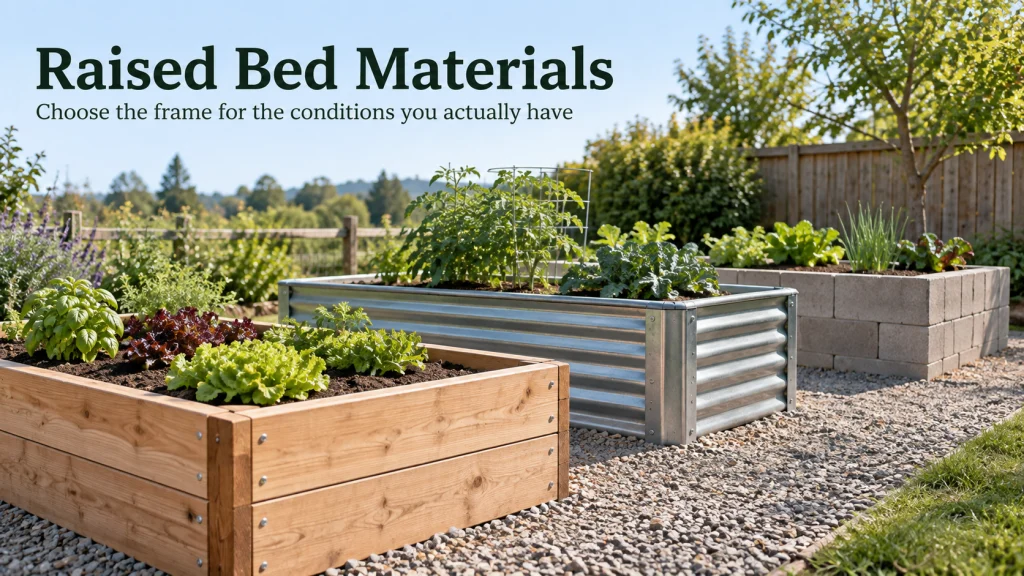
Raised garden bed materials are best chosen by site conditions, budget, maintenance tolerance, and how easily the frame can be repaired or replaced. Wood, metal, masonry, plastic, and composite systems can all work, but a material name alone does not prove lifespan, safety, or performance. The useful comparison starts with what touches wet soil, how the frame is built, what coatings or treatments are present, and whether the manufacturer documents the exact material. A good choice is the one that fits the bed you already planned without creating more cost or maintenance than the garden needs.
Start with what the frame actually has to do
The frame does not grow the plants, but it can determine a large share of the upfront cost and future replacement work. When comparing raised bed materials, first ask whether the frame must hold a shallow soil lift on good ground, contain a deeper fill over a hard surface, handle frequent irrigation, or stay presentable beside a patio. Those situations place different demands on stiffness, moisture resistance, fastening, weight, and access for repair. A material that makes sense for a low backyard bed may be a poor fit for a tall bed that holds much more soil against the walls.
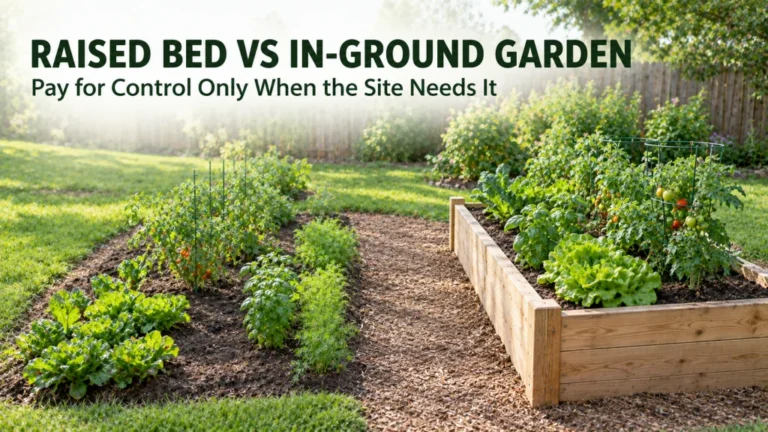
I would also separate material choice from the broader decision about whether a framed bed is the right growing space in the first place. If you are still deciding on bed placement, access, or basic construction, start with the broader raised bed gardening decisions that shape the whole setup. Once the dimensions and site are fixed, material comparisons become much more useful because you can evaluate the actual wall length, soil contact, corner load, and replacement access. That keeps a cheap-looking option from becoming expensive later simply because it was chosen before the bed itself was settled.
| Material family | Cost, maintenance, weight, and heat considerations | What to verify before choosing |
|---|---|---|
| Untreated or decay-resistant wood | Cost: varies widely by species and local supply. Maintenance: inspect for decay and fastener problems; individual boards are often straightforward to replace. Weight: moderate and usually manageable piece by piece. Heat: wood does not remove the faster warming and drying that can occur in raised soil, so hot-site exposure still matters. | Actual species, grade, dimensions, fastening plan, replacement access |
| Pressure-treated lumber | Cost: compare against untreated lumber in the same dimensions. Maintenance: check fasteners, damaged areas, and any treatment instructions for cut ends. Weight: similar handling questions to other dimensional lumber. Heat: treatment does not make hot-site exposure irrelevant, so judge heat separately from preservative choice. | End tag, intended use, preservative information, handling instructions |
| Metal | Cost: compare complete kits or equivalent panel systems at the same bed size. Maintenance: inspect coatings, fasteners, braces, and damaged edges. Weight: many metal systems are easier to move than masonry, although finished-bed weight still comes mostly from the fill. Heat: sun-exposed wall surfaces can become hot, but wall temperature alone does not prove the whole root zone is overheating; site exposure, color, soil volume, moisture, and surrounding pavement all affect the practical result. | Exact metal, coating, fasteners, panel construction, manufacturer documentation |
| Masonry | Cost: include units, base preparation, delivery, and labor rather than unit price alone. Maintenance: routine care can be limited when the wall remains sound, but changes are laborious. Weight: high, with relocation becoming difficult. Heat: masonry adds thermal mass that can absorb heat and release it later, so exposure and nearby hard surfaces belong in the site decision. | Unit type, base requirements, whether the design stays within simple homeowner construction |
| Plastic or composite | Cost: varies with formulation and system design. Maintenance: rot may be less relevant, but connectors, reinforcement, and weathering still need inspection. Weight: often light to moderate before filling. Heat: color, panel construction, and exposure can affect surface heating, so avoid assuming every plastic or composite panel behaves the same. | Exact material composition, structural limits, soil-contact guidance, replacement parts |
The table is a screening tool, not a ranking, and the cost notes are relative rather than price estimates. Use it to compare the same planned bed across four practical burdens: what it costs to put in place, what it asks from you later, how difficult the material is to handle or move, and whether the site creates a meaningful heat concern. Exact construction still matters because two kits or panels in the same family can differ in thickness, coating, reinforcement, color, or replacement system. Shortlist the family only after those differences are clear enough to compare on equal terms.

This 7-inch aluminum layout square combines try-square, miter-square, saw-guide, line-scriber, and protractor functions. Its black gradations and quarter-inch scribing notches support clear layout marks on dimensional lumber. It is useful for checking square corners and marking cuts before a raised-bed frame is assembled.
Check On AmazonIf you click this link and buy, we earn a commission at no additional cost to you.
Compare untreated wood by species, moisture exposure, and replaceability
Untreated wood is easy to understand mechanically because boards can be cut, screwed together, reinforced, and replaced with ordinary tools. The weakness is equally straightforward: wood remains biodegradable, and frequent contact with damp soil can accelerate decay. Decay-resistant species can improve the fit for wet contact, but the label “wood” is too broad to support one lifespan number for every bed. Climate, drainage around the outside wall, board thickness, species, and how long the inside face stays wet all matter.
That makes cost comparisons more useful when they include future replacement rather than only the first receipt. Less expensive softwood may still be sensible for a short-term bed, a rental property, or a layout you expect to change, while a more decay-resistant species may better suit a bed you do not want to rebuild soon. I would prioritize boards that are easy to source again in the same dimensions if a side eventually needs replacement. The practical question is not whether cedar, pine, redwood, or another species is universally best, but whether its documented properties and local price fit the service conditions you actually have.

This four-pack uses 6-inch mini bar clamps with reinforced resin bodies and hardened steel bars. One-handed quick-release triggers make it easier to reposition a board during fitting or replacement. Non-marring pads help hold wood without unnecessarily marking the surface while frame pieces are aligned.
Check On AmazonIf you click this link and buy, we earn a commission at no additional cost to you.
Treat pressure-treated lumber as a separate evidence question
Pressure-treated lumber should not be judged by the vague idea that all treated wood is either safe or unsafe. Current residential products may use copper-based preservatives, while older reclaimed lumber can involve preservative systems that are not appropriate to assume equivalent to current residential material. The end tag and intended use matter because treatment differs by application, including whether the lumber is rated for ground contact. If the treatment cannot be identified, especially with older salvaged lumber, uncertainty itself is a reason to choose a material with clearer documentation.
Extension research also shows why claims need conditions attached. In an Oregon State University raised-bed study using copper azole-treated lumber, copper increases were small and concentrated near the wood, while the tested vegetables and herbs did not show increased copper under the study conditions. That finding is useful evidence for the specific preservative and setup studied, but it is not permission to treat every unknown piece of reclaimed wood as equivalent. If you choose treated lumber, verify the label, follow handling instructions, manage fresh cut ends as directed, and avoid old industrial material such as railroad ties for food-growing beds.
- Strong evidence: current Extension research, government guidance, an end tag, or manufacturer documentation that identifies the preservative, use category, or tested condition.
- Moderate evidence: guidance that clearly applies to the same material family but does not document the exact product or site condition.
- Weak evidence: seller lifespan slogans, unlabeled reclaimed material, or claims that use one treatment name to represent all treated lumber.
Use that evidence grade before accepting any lifespan or safety statement. A claim becomes more useful when it identifies the wood, preservative, contact condition, and source rather than promising a fixed number of years. If those details are missing, treat the claim as marketing or an estimate instead of a design fact. That approach keeps the decision practical without pretending uncertainty has disappeared.

These #10 x 3-inch wood screws use epoxy-coated steel for outdoor decking and fencing. The listing specifically identifies them for treated lumber and includes a T25 star-drive bit. A self-drilling point supports straightforward fastening when a treated raised-bed frame needs assembly or board replacement.
Check On AmazonIf you click this link and buy, we earn a commission at no additional cost to you.
Compare metal by coating and construction, not by the word metal
Metal beds can reduce the decay concerns associated with wood, but the material family still needs to be broken down before you compare it. Galvanized steel, painted steel, stainless steel, aluminum, and other systems do not have identical coatings, stiffness, fasteners, or corrosion behavior. Panel shape and bracing also matter because a thin flat sheet and a formed panel can carry soil pressure differently even if both are sold as metal beds. Look for documentation that identifies the base metal, coating, panel construction, connectors, and edge treatment rather than relying on a broad rust-resistant claim.
Site conditions matter as well. University guidance notes that galvanized coatings can behave differently in highly acidic soil, and raised beds in general can warm earlier and dry faster than surrounding ground, especially in hot exposed locations. For a metal frame, treat heat as a site check rather than an automatic disqualifier: a sun-facing wall can become hot, but wall temperature by itself does not establish the temperature of the whole root zone. Bed height, soil volume, moisture, wall color, airflow, and nearby pavement can all change what the plants experience. I would favor a system with clear material specifications and replaceable hardware, then watch soil moisture and edge-zone conditions in a hot site instead of relying on a generic claim that metal is either too hot or completely heat-neutral.

This silver two-pack contains two raised beds measuring 72 by 36 by 12 inches each. The beds use galvanized steel and three horizontal connecting rods to support the frame. An open-bottom design allows natural drainage while giving readers a concrete metal-bed construction to inspect for panel, connector, and coating details.
Check On AmazonIf you click this link and buy, we earn a commission at no additional cost to you.
Keep masonry choices within simple homeowner construction
Brick, concrete block, and stone can make a bed feel permanent, and their mass may fit landscapes where a lightweight frame would look temporary or move too easily. That same weight changes the project, because relocation, base preparation, and correction of an out-of-level site become harder after the material is in place. Simple low walls made from ordinary units can stay within normal homeowner scope, but taller or structurally demanding walls are a different project. Once the design depends on engineered footings, retaining-wall behavior, or complex structural work, material selection is no longer the only question.
Masonry also deserves material-specific caution rather than a blanket statement that every block is identical. Extension guidance notes that concrete products can vary in composition and that exact aggregate information may not be obvious from a basic label. If material composition is a concern for a food-growing bed, choose a product with better documentation or use another material instead of inventing certainty. The practical advantage of masonry is permanence, but permanence is only useful when you are confident about the final location, access, and bed dimensions.

This 16-ounce mallet uses a rubber head designed for soft-blow tasks without surface damage. The listing includes woodworking and flooring among its intended uses and pairs the head with an ergonomic grip. That makes it a practical hand tool for gently positioning simple masonry units or frame pieces where a steel hammer would be unnecessarily harsh.
Check On AmazonIf you click this link and buy, we earn a commission at no additional cost to you.
Judge plastic and composite beds from exact material documentation
Plastic and composite products vary too much to evaluate from appearance alone. A solid recycled-plastic board, a hollow molded panel, and a wood-plastic composite may all be marketed as low-maintenance alternatives, yet they can differ in stiffness, reinforcement, UV resistance, fastener design, and suitability for continuous soil contact. University guidance on composite lumber also notes that formulation varies by manufacturer and that performance in direct soil contact cannot simply be inferred from a generic category name. That makes exact documentation more important here than with a familiar piece of dimensional lumber.
Before buying, check what the panel is made from, whether the maker allows the intended soil-contact use, how long unsupported spans can be, and whether corner or brace parts can be replaced. Lightweight panels can be convenient when access is difficult, but low weight does not automatically mean the assembled bed will resist outward soil pressure without adequate structure. I would also check whether proprietary connectors lock you into one replacement source if a small part fails later. A material that avoids rot is not automatically maintenance-free if the frame depends on unique clips, caps, braces, or molded sections that are hard to replace.

This elevated raised bed has a 12.7-gallon soil capacity and a resin body. Its built-in self-watering system and drainage tap provide documented water-management features. The listing also includes a seed-starting tray, giving readers a clearly specified plastic-system example rather than relying on a generic material label.
Check On AmazonIf you click this link and buy, we earn a commission at no additional cost to you.
Include repairability, modularity, and replacement burden in the cost
The cheapest frame at checkout is not always the least expensive frame to live with. A board that can be swapped individually may be easier to maintain than a system that requires removing an entire side, while a modular kit may be convenient if replacement panels and hardware remain available. Heavy masonry may need little routine attention but can be costly to move when the layout changes. The relevant cost is the combination of purchase, assembly, maintenance, repair access, and what happens when one part finally fails.
Disposal and reuse also belong in that decision. Clean untreated boards may have different reuse options from treated lumber, coated metal, mixed-material composites, or proprietary molded panels, and local disposal rules can differ. You do not need to predict the exact end of the bed, but you should know whether common failure points can be repaired without replacing everything around them. A slightly higher upfront cost can be sensible when it buys replaceable parts or simpler maintenance, while a low-cost frame can still be the better choice when you expect the layout to be temporary.
- Can one damaged side, corner, brace, or fastener be replaced by itself?
- Are replacement dimensions and hardware ordinary or proprietary?
- Will repair require emptying most of the soil or moving the whole frame?
- Does the material need recoating, sealing, retightening, or other recurring care?
- Can the material be reused, recycled, or disposed of locally without unusual handling?
Run through that checklist before comparing headline prices. It turns maintenance from an afterthought into part of the original material decision. The best fit is often the frame whose likely repairs match the tools, access, and effort you are willing to give it. That is a more useful ownership test than choosing whichever option is marketed as the longest lasting.

These 3-inch exterior wood screws use a PrimeGuard coating and coarse threads for outdoor fastening. The listing identifies them for both treated and untreated lumber and uses a Phillips bugle-head design. A one-pound box provides ordinary replacement fasteners for repairing or swapping individual boards without depending on proprietary hardware.
Check On AmazonIf you click this link and buy, we earn a commission at no additional cost to you.
Choose the material after the bed size is fixed
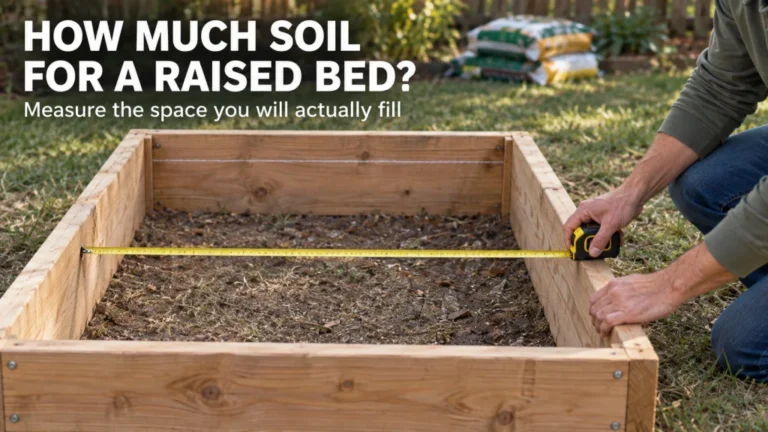
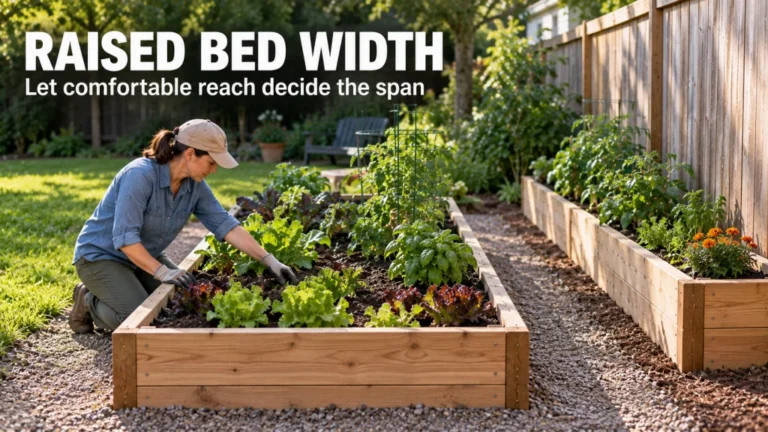
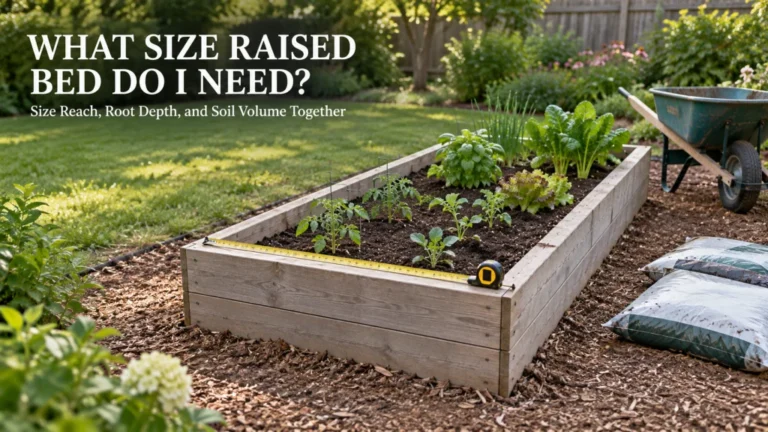
Materials for raised garden beds become much easier to compare after you know the bed length, width, height, location, and whether the bottom is open to usable soil or sits over a hard surface. A taller wall holds more soil against the frame, a longer side creates more opportunity for bowing, and a hard-surface bed can increase the importance of total fill volume and overall weight. Those are design conditions, not reasons to declare one material universally superior. They tell you what the selected frame must resist and what you need to verify in the exact construction.
If you are still deciding whether a raised bed, container, or another growing space makes more sense, the broader raised beds and container gardening guide is the better place to settle that choice first. Once the size is fixed, compare material families against the same job instead of letting a material change the job after the fact. I would shortlist two or three workable families, verify the exact material or treatment, then compare price and maintenance on equal dimensions. That keeps the frame serving the garden plan instead of forcing the garden plan to serve the frame.

The TC25 provides a 25-foot measuring range with a rotating disc that controls blade retraction. Its blade includes backside printing and a high-visibility design for reading measurements from more than one angle. Those features are useful for fixing bed length, width, and height before material quantities and unsupported spans are compared.
Check On AmazonIf you click this link and buy, we earn a commission at no additional cost to you.
Final Thoughts: choose for service conditions, not a lifespan slogan
There is no single best material for raised beds because the frame is being asked to do different jobs in different sites. Untreated wood can be simple and repairable, treated lumber requires clear treatment documentation, metal depends on coating and construction, masonry trades mobility for permanence, and plastic or composite systems depend heavily on exact formulation and structure. The useful comparison is between materials that can all handle the same planned bed. From there, cost, maintenance, repair access, and documentation can make the shortlist smaller.
Before buying, compare the finalists at the same bed dimensions and site. Check what supports long spans, what happens at corners and fasteners, whether a hot exposed location changes moisture management, and whether a damaged part can be replaced without rebuilding the frame. If one option depends on vague promises while another gives you usable construction and material details, the second is easier to plan around. A raised bed frame is successful when its cost, care, and replacement demands stay predictable enough that the plants, soil, and routine care remain the main gardening work.

This open-reel tape provides a 100-foot measuring range with inch and metric scales. It uses a fiberglass tape with an impact-resistant shell and a shock-absorbing handle. The longer range is useful for checking full bed runs and site distances when final material choices are compared at the same dimensions.
Check On AmazonIf you click this link and buy, we earn a commission at no additional cost to you.
FAQs
Most material questions sound simple because the options are familiar, but the useful answer usually depends on one or two site conditions. Soil contact, bed height, treatment or coating, and how permanent the layout needs to be can change the decision. The questions below focus on those practical forks rather than naming one winner for every garden. Use them to narrow the material family before comparing exact products or local prices.
When safety or durability depends on a treatment, coating, or composite formulation, the label and documentation matter more than the material name printed in a listing title. Older reclaimed materials also deserve more caution because their treatment history may be unknown. If a claim cannot be connected to the exact material you are considering, treat it as uncertain. That keeps the final choice within evidence you can actually verify.
🌲 Is cedar always the best wood for a raised bed?
No. Cedar is valued for decay resistance, but local price, board dimensions, moisture exposure, and how long you expect to keep the bed can make other woods reasonable. Compare the actual species and cost rather than assuming the word cedar settles the decision.
🪵 Can I use pressure-treated lumber for a vegetable bed?
Current residential treated lumber can be appropriate when the preservative and intended use are documented. Check the end tag, use lumber rated for the contact condition, and avoid unknown older reclaimed treated wood or industrial material such as railroad ties.
🔩 Are galvanized metal beds maintenance-free?
No material should be assumed maintenance-free from the category name alone. Check the coating, fasteners, bracing, exposed edges, and whether individual panels or connectors can be replaced if they are damaged.
🧱 Are concrete blocks a good raised bed material?
They can work for a simple, permanent bed when the site is level and the design stays within ordinary homeowner construction. If the wall becomes tall, structurally demanding, or dependent on complex footing design, the project has moved beyond a simple material comparison.
♻️ Are composite raised beds better than wood?
Not automatically. Composite formulations, reinforcement, soil-contact guidance, and replacement systems vary, so compare the exact product documentation with the maintenance and repair burden of the wood option you are considering.
📏 Should I choose the frame material before deciding bed height?
Usually no. Fix the bed dimensions and site first because height, wall length, fill volume, and soil pressure affect what the frame needs to do. Then compare materials against the same finished design.
References and Sources
These sources support the material-specific claims that need more than general gardening judgment. They are used for treated-lumber distinctions, material safety boundaries, metal and composite considerations, and the broader list of frame materials used in raised beds. Product-level claims are intentionally limited because this article compares material families rather than named kits. Exact products still need their own current manufacturer documentation before purchase.
The sources do not establish one universal lifespan for wood, metal, masonry, plastic, or composite beds. Instead, they show why treatment, species, coating, formulation, soil contact, and site conditions can change the answer. That is the evidence boundary used throughout the article. Where exact product information is missing, the article stops at the material-family level rather than converting a category into a guarantee.
- University of Maryland Extension raised beds: supports the material categories and distinctions between untreated wood, pressure-treated wood, and other common raised-bed materials.
- University of Maryland Extension material safety guidance: supports the treatment and material-safety boundaries for wood and masonry choices.
- Oregon State University pressure-treated wood research: supports the discussion of copper-based treated lumber, end-tag verification, soil copper findings, and tested plant results.
- Virginia Cooperative Extension material and cost comparison: supports the relative handling differences among material families and the thermal-mass consideration for masonry.
- University of Minnesota raised bed guidance: supports the faster warming and drying of raised beds, hot-site considerations, and material-specific checks for metal and other frame types.