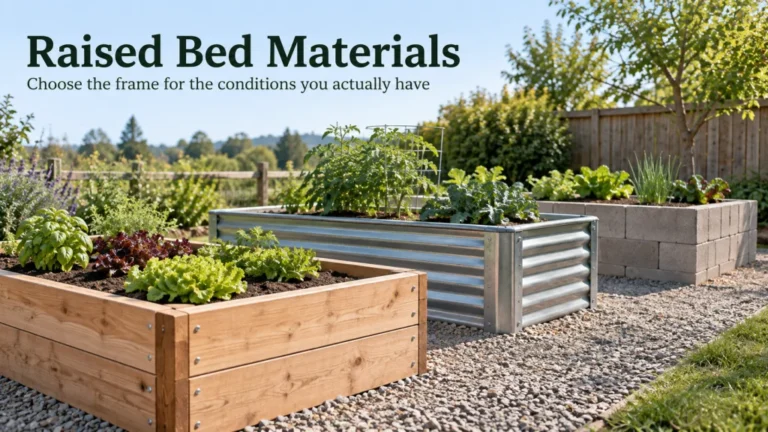
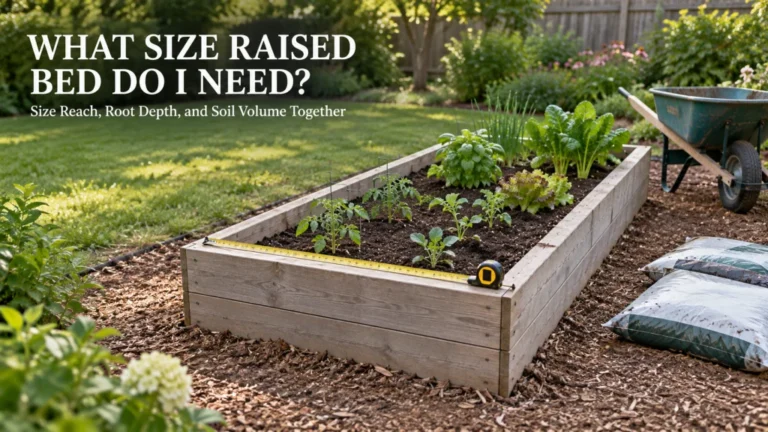
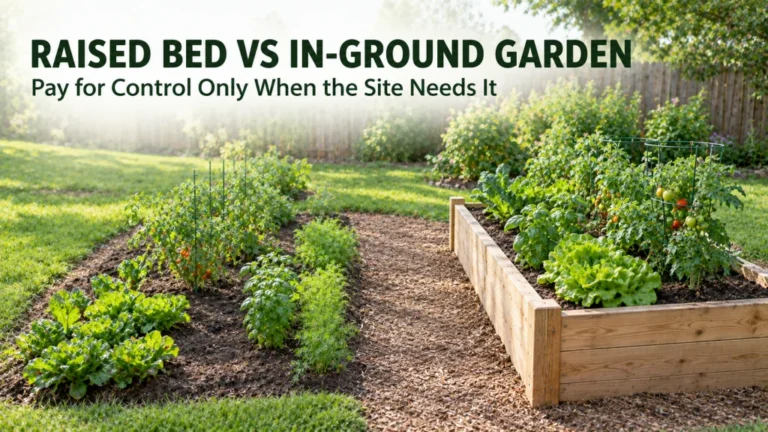
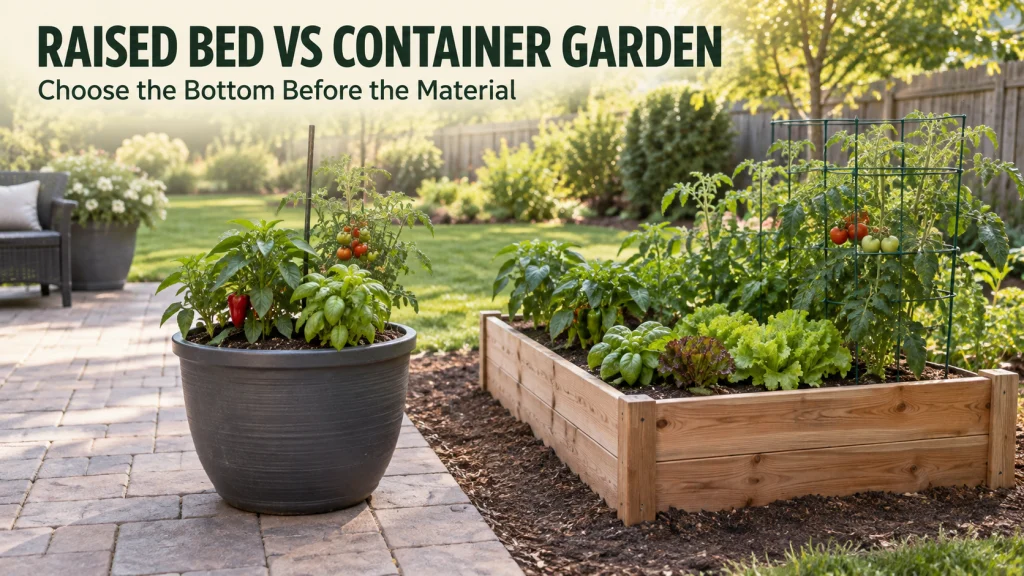
A raised bed and a container can sit at the same height and still create very different root zones. The most useful distinction is whether roots can continue into the ground below or remain inside a closed volume of growing media. That difference affects rootable depth, portability, watering margin, fill volume, stability, and how permanent the setup becomes. Choose the physical system first, then worry about the frame or container material.
Start with what is under the root zone
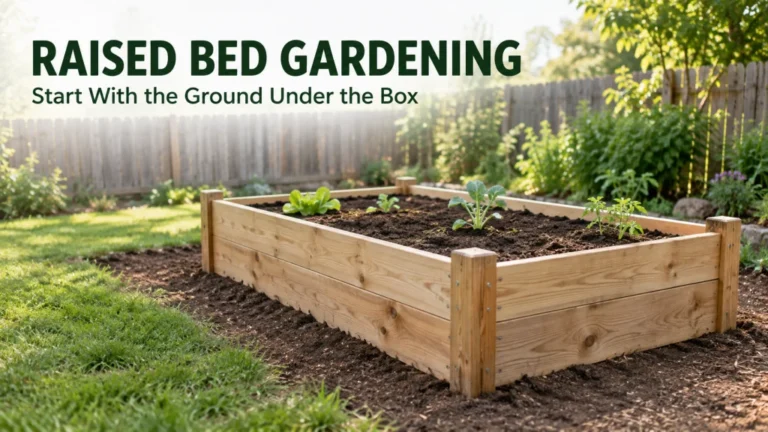
The choice between a raised bed and a container gets much clearer when you stop comparing only the visible walls. A typical open-bottom raised bed sits over soil, so roots may continue through the added growing mix and into suitable soil below. A container keeps the root system inside a defined volume of growing media, even when the container is large. That single physical difference changes several other decisions that are easy to confuse when both systems are described simply as growing above ground.
Think of the bottom as the first branch in the decision, not the finishing detail. If you want a fixed growing area that remains connected to usable ground, the broader raised bed gardening approach is the more relevant path. If the site is a patio, balcony, driveway, rental space, or another place where the growing zone needs to stay self-contained, a container system may make more sense. Neither format is automatically better because the site underneath the roots can change the answer before plant choice or appearance enters the discussion.
| Decision factor | Open-bottom raised bed | Closed container |
|---|---|---|
| Root connection | Can connect with suitable soil below | Roots stay inside the container media |
| Relocation | Usually treated as a fixed growing area | Can be repositioned if size and filled weight allow |
| Water buffer | May benefit from a larger connected soil volume | Depends on the moisture held inside a limited media volume |
| Fill commitment | Requires filling the framed volume but may not need to supply the entire rootable profile | Every usable part of the root zone must be provided inside the container |
| Support | Permanent placement can make fixed supports easier to plan | Support must work with the container without making it unstable or impossible to move |
| Best fit | Dedicated ground-level growing space | Flexible or hard-surface growing space |
The table is a starting point rather than a promise that every raised bed or container behaves the same way. A raised bed placed over pavement loses the root connection that defines an open-bottom bed over soil, while a very large container can offer a much larger moisture reserve than a small pot. The physical form matters, but so do media volume, weather, plant size, sun exposure, and drainage. Use those conditions to refine the choice after you identify whether the root zone is open or contained.

This 17-inch-tall metal raised bed can be assembled in six configurations. Vego states that the bed is bottomless, allowing roots to reach soil below when it is installed over usable ground. That makes it a direct fit for comparing an open-bottom bed with a closed container root zone.
Check On AmazonIf you click this link and buy, we earn a commission at no additional cost to you.
Compare rootable depth beyond the visible wall
The sidewall height does not always tell you how much rootable space a plant can use. In an open-bottom bed over workable soil, the added bed mix can function as the upper part of a deeper soil profile rather than the entire profile. Roots that reach the bottom are not automatically stopped by the frame because there is no solid floor beneath them. That can make a relatively modest wall height function very differently from a container that has the same visible height.
A closed container is simpler to interpret because its internal dimensions define the available root zone. The plant cannot keep exploring downward once it reaches the base, so total media volume and usable depth matter directly. This does not make containers unsuitable for larger plants, but it does mean the container has to be sized for the plant rather than treated as a decorative shell around a small amount of mix. For more detail on choosing and managing that contained growing space, see the container gardening guide.

This set includes four 6-inch terracotta pots with saucers. Each pot has a drainage hole, while the vessel still defines the available container root zone. The fixed pot size makes depth and media volume concrete factors to match to the plant.
Check On AmazonIf you click this link and buy, we earn a commission at no additional cost to you.
Compare portability and relocation before you fill anything
Containers are usually the more flexible system when sunlight, rental rules, seasonal protection, or layout changes make relocation useful. That flexibility is real, but it is easy to overestimate because an empty container and a planted container are two different objects. Moist growing media, roots, supports, and mature top growth can turn a supposedly movable setup into something you will not want to shift casually. Portability should therefore mean movable at the size you actually plan to grow, not merely movable while empty.
An open-bottom raised bed is normally a commitment to one location, which can be an advantage when the site is already right. You can organize paths, irrigation, trellises, and repeated planting around a stable footprint without planning for relocation. The trade-off is that a poor first location is harder to correct later, especially if shade patterns, drainage, access, or household use of the space change. Choose the bed location as though it will stay there, and choose containers when the ability to revise the layout has practical value rather than just theoretical appeal.

This 12-inch plant caddy uses hidden wheels to roll a planted pot across a flat surface. A removable water drawer is built into the saucer-style platform. It supports the section's point that mobility should be planned around the filled container rather than the empty pot alone.
Check On AmazonIf you click this link and buy, we earn a commission at no additional cost to you.
Compare dry-down and water buffer as a daily routine
Container growing media is surrounded by container walls and exposed above ground, so the entire root system depends on the water held inside that limited volume. Smaller containers, sunny exposures, wind, mature plants, and porous container materials can all shorten the interval before the media needs attention. A larger container can create more buffer than a small one, but it is still a contained reservoir that cannot draw on deeper garden soil. That is why a container garden often asks for more frequent moisture checks during demanding weather rather than a fixed watering schedule.
An open-bottom raised bed over suitable soil can behave differently because roots may eventually use moisture beyond the filled portion of the bed. That advantage is conditional, not automatic, because shallow-rooted plants, newly planted crops, compacted soil below, drought, or an impermeable surface can remove much of that buffer. A raised bed installed over concrete should be treated more like a fully contained growing zone when you think about root access and dry-down. In either system, check the actual root zone before watering instead of assuming the label on the structure tells you how often it needs water.

This battery-free moisture meter gives an instant soil-moisture reading through a single 304 stainless-steel probe. Its clear display is designed for indoor and outdoor use. It supports checking the actual root zone before watering instead of relying on a fixed schedule.
Check On AmazonIf you click this link and buy, we earn a commission at no additional cost to you.
Compare fill volume and startup cost by usable root space
Startup cost is often discussed as frame price versus pot price, but the growing media can be just as important to the decision. A broad raised bed requires enough material to fill the framed volume, so even a simple structure can create a substantial first setup task. The advantage is that an open-bottom bed over suitable ground does not necessarily need the frame itself to contain every inch of rootable depth a crop may eventually use. That can make the visible fill volume and the functional root volume two different things.
Containers let you start one vessel at a time, which can keep the first commitment small, but every container must supply its own complete root zone. Adding more pots also repeats the need for media, drainage management, watering access, and physical space around each container. A collection that begins as a low-cost experiment can become a larger maintenance system if each new plant gets its own vessel. Compare the total growing volume you actually need rather than assuming one container is always cheaper than one bed or one bed is always the bigger investment.

This resin soil scoop holds about 1.5 cups and is sized for transferring potting mix into medium planters. Its flat bottom lets it sit upright, while deep sides help keep loose media contained during transfer. It is a practical tool for handling the fill volume that raised beds and containers require.
Check On AmazonIf you click this link and buy, we earn a commission at no additional cost to you.
Compare support and stability options with the mature plant in mind
Support becomes part of the growing-space decision when plants will climb, lean, or carry a heavy canopy. A fixed raised bed gives you a stable footprint where stakes, cages, or trellises can be planned as part of the layout without preserving the ability to move the whole system. That can be useful for repeated crops that need support in roughly the same area. The important check is whether the support can be anchored without damaging the bed, blocking access, or creating a structure that is awkward to maintain.
Containers need a different balance because the plant and support may raise the center of gravity while the root zone remains confined to one vessel. A tall plant in a relatively light or narrow container can become unstable in wind, and a support that works horticulturally may make the container much harder to relocate. If portability matters, plan the support and the movement method together instead of adding a heavy trellis after planting. Flexible systems such as grow bag gardening can solve some space problems, but they still need the same honest check for filled weight, support, moisture, and safe handling.

This set includes four 11.5-inch square tomato cages for gardens and pots. The heavy-gauge supports are described as rust-resistant and designed for climbing vegetables and other plants. They provide a container-compatible support option when mature top growth and stability need to be planned together.
Check On AmazonIf you click this link and buy, we earn a commission at no additional cost to you.
Treat elevated planters with bottoms as a separate physical form
An elevated planter can look like a small raised bed because it has straight walls and a rectangular growing area, but appearance is not the controlling feature. If the growing box has a solid or contained bottom and sits above the ground, the roots are limited to the media inside that box. Functionally, that makes its root-zone behavior much closer to a container than to an open-bottom bed connected to soil. The raised working height may improve access, but it does not create extra rootable depth below the planter floor.
The same distinction matters when a bed frame is placed on pavement or another hard surface. Even if the frame itself is open at the bottom, roots cannot use soil that does not exist beneath it, so the system needs enough internal growing depth, drainage, and moisture capacity for the plants being grown. That is why labels such as planter, bed, box, or garden bed can be misleading when you are comparing systems. Look under the media first, then decide which care routine and plant choices fit the actual root zone.

This elevated Vego planter uses a 2-by-4-foot growing box on legs with a lower storage rack. The Amazon listing specifies a 700-pound weight capacity. Its above-ground growing box makes it a useful example of an elevated root zone that must be sized independently of the soil below.
Check On AmazonIf you click this link and buy, we earn a commission at no additional cost to you.
Choose from site permanence and the routine you can maintain
The best choice comes from matching the physical system to the site and the work you are willing to repeat. A fixed yard with suitable soil below, dependable access, and a long-term planting area favors the strengths of an open-bottom bed. A rental, patio, balcony, driveway, or changing layout gives containers an advantage because the growing zone can stay separate from the ground and can be reorganized more easily. If you are still comparing the broader options, the guide to raised beds and container gardening puts both systems in the larger context of residential growing spaces.
Before buying or building anything, walk through the routine the setup will create once it is full and planted. Think about where water comes from, how you reach every plant, where supports go, what happens when the sun angle changes, and whether you may need to relocate the growing area. Those questions are more predictive than choosing by appearance alone. A simple system that fits the property and your maintenance habits will usually be easier to keep productive than a more elaborate setup that solves problems you do not actually have.
- Choose an open-bottom bed when permanent placement and connection to suitable ground are useful.
- Choose containers when separation from the ground and layout flexibility matter more.
- Treat any hard-surface bed as a contained root zone unless roots truly have access to usable soil below.
- Plan filled weight and plant support before assuming a container will remain easy to move.
- Compare watering access and maintenance frequency before comparing decorative materials.
That checklist also prevents a common beginner mistake: solving for soil control without solving for the routine that follows. Both systems can give you control over the growing medium, but they distribute the work differently. The open-bottom route trades mobility for a more permanent connected growing area, while containers trade root-zone connection for flexibility and isolation. Pick the trade-off you can live with after the novelty of setup is gone.

This hose timer has two programmable watering channels and a brass inlet. The listing includes rain-delay, manual-watering, and automatic-irrigation functions. It can help organize a repeatable watering routine after the garden system and site are chosen.
Check On AmazonIf you click this link and buy, we earn a commission at no additional cost to you.
Final thoughts: choose the bottom before the material
The useful question is not whether raised beds or containers are better in general. It is whether your plants should have access to suitable ground below or live inside a fully contained root zone. Once that is clear, decisions about portability, watering margin, fill volume, support, and permanence become much easier to sort out. The visible wall matters, but the unseen bottom often controls how the system actually behaves.
If the site is permanent and the soil below is usable, an open-bottom bed can make that ground part of the growing system. If the site needs flexibility, separation, or hard-surface placement, a properly sized container is often the cleaner physical match. Do not choose by height, shape, or marketing label alone because those details can hide two very different root environments. Start with the bottom, then build the rest of the garden around that decision.

This 27.8-inch-high planter combines two tiers with wheels for relocation. Its self-watering design includes a visible water-level indicator, and the planter is made for indoor or outdoor growing. It is a clear example of a flexible contained system where water storage and portability are built into the vessel.
Check On AmazonIf you click this link and buy, we earn a commission at no additional cost to you.
Frequently asked questions
🌱 Do raised beds need a bottom?
Many ground-level raised beds are intentionally open at the bottom so roots can grow into suitable soil below. A bottom becomes relevant when the bed must contain the growing media above a hard surface or when the structure is actually an elevated planter.
🪴 Is a raised bed on concrete basically a container?
For root-zone planning, it behaves much more like a contained system because roots cannot continue into soil beneath the bed. Give the plants enough internal growing depth, reliable drainage, and a watering routine that matches the limited media volume.
💧 Do containers need more frequent watering than raised beds?
They often need closer moisture monitoring because the roots depend on a limited volume of growing media that can dry quickly in sun, heat, and wind. Container size, material, plant size, weather, and exposure all affect how fast that happens, so check the media instead of watering only by schedule.
🚚 Can I move a container after it is planted?
Sometimes, but filled weight matters much more than empty weight. Large containers with moist media, mature plants, and supports can become difficult to move, so plan relocation before planting if mobility is part of the reason you chose containers.
🌿 Which system gives plants more root space?
An open-bottom bed over usable soil can provide rootable space beyond the visible wall because roots may continue downward. A container can also provide ample root space, but that space is limited to the usable internal volume of the vessel.
🏡 Should renters choose containers instead of raised beds?
Containers are often easier to adapt to rental spaces because they do not require permanent connection to the ground and can be rearranged. The final choice still depends on lease rules, available sunlight, safe filled weight, water access, and where drainage can go.
References and Sources
- University of Maryland Extension raised beds guidance: Supports the distinction between raised beds placed over soil, where roots can grow into the ground below, and beds placed on hard surfaces, where the internal root zone must carry more of the growing load.
- University of Maryland Extension container gardening guidance: Supports container root-volume, portability, stability, growing-media, and moisture-monitoring considerations.